A cable raceway is a channel that mounts to a wall, a desk leg, or the back of a monitor and carries the cable bundle inside it. It is the part of cable management that stops a run from sagging, and it is the part most people buy wrong. The failure is rarely the brand. It is the size. A channel sized for two thin cords will not close over three display cables plus a power lead. A 15.7 inch cover will not cross a wall that needs 60 inches. A rigid channel screwed to a sit-stand leg will pull loose the first week the desk goes up, because the run changes length every time the frame moves. Get the width, the run length, and the stiffness right, and the install is boring in the best way.
Related: Standing Desk Cable Management That Survives Every Height Change →
Quick answer
A cable raceway only works when three numbers match your setup: interior channel width against the diameter of your bundle, total run length against the distance you have to cross, and channel stiffness against whether the surface moves. For a fixed wall, a slim paintable channel with self-adhesive backing is the right class of product. For a sit-stand desk, you want a flexible chain raceway instead. Measure the bundle with the cables laid flat and taped together, then add a little slack. If the bundle is thicker than the channel opening, no amount of adhesive fixes it, because the cover simply will not seat.
Four useful options
| Model | Best fit | What stands out |
|---|---|---|
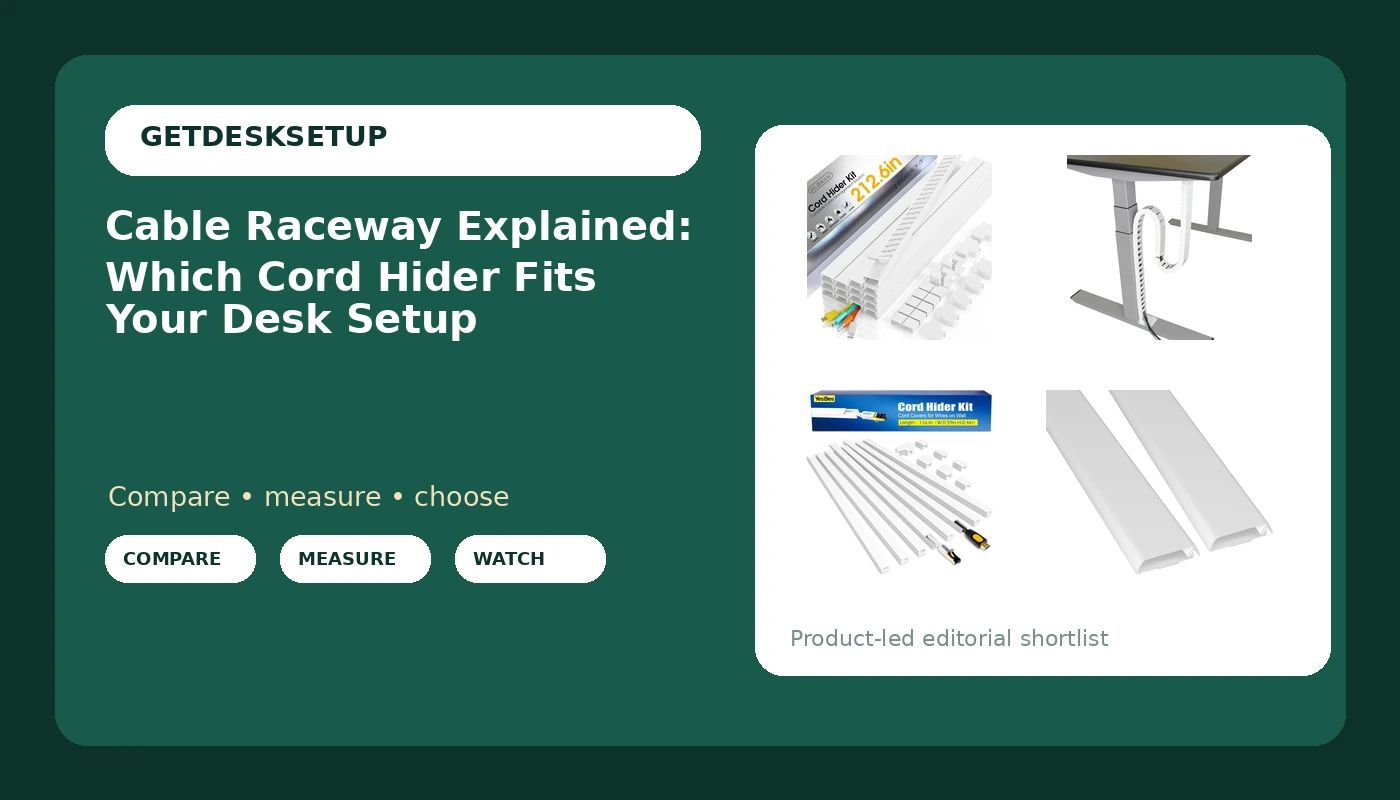
| Wire Covers for Cords on Wall, 212.6in Cord Hider Wall | A long wall run carrying two or three wires | 212.6 in of channel, and the widest opening here at 0.95 in wide by 0.55 in tall |
| Quality Clever PivyCord-Vez Flex Chain Raceway | A sit-stand desk that changes height daily | Flexible chain links instead of a rigid channel, built for variable-height desks |
| YesBes 116in Cord Hider Kit | A wall-mounted TV drop where the channel should disappear | 116 in of channel at a slim 0.59 in wide by 0.4 in tall, paintable |
| D-Line TV Wall Mount Cord Hider | A short, seamless patch between a TV and an outlet | Two 15.7 in lengths at 2.36 in wide by 0.59 in tall, low profile and paintable |
The long multi-cable run: Wire Covers for Cords on Wall
Where this one earns its place is a wall run that has to travel a real distance: from a desk down to a baseboard, or across a room to the nearest outlet. The trade-off is stiffness. A rigid channel does not articulate, so it belongs on a wall or a fixed surface, never on a moving desk leg. Dry-fit the whole run before the backing comes off, because the adhesive is the one part you cannot reposition indefinitely. Also plan the cut points before you start: corners and outlet plates are where a channel looks careless if the joint lands in the wrong place.
The sit-stand flex chain: Quality Clever PivyCord-Vez
The trade-off is purpose. This is the most specialized piece in the group, and if your desk never changes height you are paying for articulation you will not use. Who should skip it: anyone with a fixed-height desk, and anyone whose cable run is a wall drop behind a TV, where a slim rigid channel is the simpler answer. If you do run one, check the folded depth of the chain against the clearance under the desk with the frame at its lowest height, and leave slack at the control box end so the chain is never the thing taking the strain.
The slim TV kit: YesBes 116in Cord Hider Kit
The trade-off is capacity, and it is not negotiable. A 0.4 in tall opening seats only if the bundle stays thin, so count the cables before you commit: one HDMI, one power lead, and one optical cable is a different problem from a bundle that includes a display cable, a USB run, and a power brick cord. Skip this one if you are carrying more than a couple of cables plus power. Where it wins is a TV-to-outlet drop in a visible room, because the low height is what makes the channel disappear after paint.
The low-profile patch: D-Line TV Wall Mount Cord Hider
The trade-off is total coverage. Two 15.7 in pieces give you about 31 inches of run, so this is a patch product: a short drop from a wall-mounted TV, a monitor arm cable, or a single jump from a desk edge to an outlet. Skip it if the distance is longer than that, because butting three of these together creates joints that show even after paint. Choose it when the wall is the thing people see and the run is short enough that a single clean strip does the job.
Prices and availability may change. Product images, names, and retailer links are matched to verified listings. No current price, rating, stock status, or measured result is stated here without current evidence.
Cable raceway explained: width, height, and run length
Sellers use cord raceway, cable channel, and wire channel to mean the same object: a hollow length of plastic with a lid that snaps or slides on. What changes between products is the opening size and the total length, so those are the numbers to compare.
Width is the number that decides whether the lid closes. Lay your cables side by side, tape them into a flat bundle, and measure across the flat side with a ruler. Do not measure a single cable and multiply by three, because round cables nest and the real bundle is smaller than the sum. If the bundle measures close to the channel width, step up a size. The channels here run from 0.59 in wide up to 0.95 in wide, and height runs from 0.4 in to 0.59 in, so there is a real difference between the slimmest and the widest.
Run length is the number that decides how many kits you buy. Measure the vertical drop from the desk or TV down to the outlet, add the horizontal distance along the baseboard or wall, then add a few inches at each end for slack and for the bend into the outlet. That total is what you compare against the kit length, not the height of the wall. A 116 in kit sounds generous until you add a 30 in drop plus a 90 in horizontal run, and now you are cutting joints.
Height matters for a different reason: appearance. A taller channel hides a thicker bundle but stands off the wall further. A 0.4 in tall channel is nearly invisible once painted, which is why slim kits are the usual pick for a TV wall and why a wider, flatter 2.36 in profile is the pick when you want the run to read as a strip rather than a tube.
Adhesive backing, paint, and where clips still win
Every product here uses self-adhesive backing, and adhesive is only as good as the surface under it. Clean the wall with a degreaser, let it dry fully, and avoid sticking anything to fresh paint until it has cured, because uncured paint fails before the adhesive does. Room temperature helps. A cold garage wall in January is a bad place to trust a pressure-sensitive strip.
Paintability is the second half of the job. All four of these channels are listed as paintable, and painting to match the wall is what turns a visible plastic run into a shadow line. Two light coats beat one heavy coat, and a light sanding between coats hides the seam where the lid meets the base. When you check the result, look at it under the same light you work in: a desk lamp running at high lumens will show a seam that a dim room hides, and a visible seam is a sanding problem, not a channel problem.
There are cases where a channel is the wrong tool. A single cable that moves, like a charging lead you unplug daily, is better served by an adhesive clip, because a channel implies a fixed run. A bundle that has to stay flexible along its whole length is better served by a cable sleeve, which wraps without a hard shell. A cord raceway is for runs that are permanent and visible, and it is worth being honest about which of those you actually have.
- Count the cables and measure the bundle flat, taped together.
- Measure the full run: vertical drop, horizontal distance, plus slack at both ends.
- Decide whether the surface moves. A moving desk rules out rigid channels.
- Compare the bundle to the channel opening, and step up if it is close.
- Dry-fit the run and mark cut points before removing any backing.
Practical guidance before the adhesive goes on
- Match the channel to the bundle first, then to the wall. A perfectly painted channel that will not close is still the wrong channel.
- Check clearance under the desk with the frame at its lowest height, since that is where a cable drop has the least room to hang.
- Look at the rest of the desk while you are under it. A footrest angle that changes through the day can pinch a cable that runs low, and a chair mat whose mat thickness and mat density lift the chair will change where the cable needs to fall.
- Leave a service loop at the control box, the monitor arm joint, and the outlet. Cable management that has zero slack turns one failed cable into a full re-route.
- If the wall is textured, plan for the adhesive to bridge less well. Clean, dry, and press the full length rather than just the ends.
Which option should you choose?
Choose the Wire Covers for Cords on Wall when the run is long, the wall is fixed, and you are carrying two or three wires that fit inside a 0.95 in wide opening. Choose the Quality Clever PivyCord-Vez Flex Chain Raceway when the desk changes height and a rigid channel would fight the frame every day. Choose the YesBes 116in Cord Hider Kit when a wall-mounted TV needs a slim, paintable drop and the bundle is thin. Choose the D-Line TV Wall Mount Cord Hider when the run is short, the wall is visible, and you want a flat strip rather than a raised tube.
Two things this page cannot tell you: how your specific bundle measures and how your specific wall surface behaves. Both take about five minutes to check with a ruler and a strip of tape, and both matter more than any spec line. The dimensions quoted above come from the product listings, and none of them is a capacity claim beyond what each listing states.
The bottom line
A cable raceway is a measurement problem wearing a plastic shell. Get the opening wider than your flat bundle, get the total length longer than your actual run, and pick a flexible chain if the surface moves. Do that, and any of the four options here will do its job quietly for years. Skip the measuring step and you will be re-sticking a channel that never should have fit in the first place.