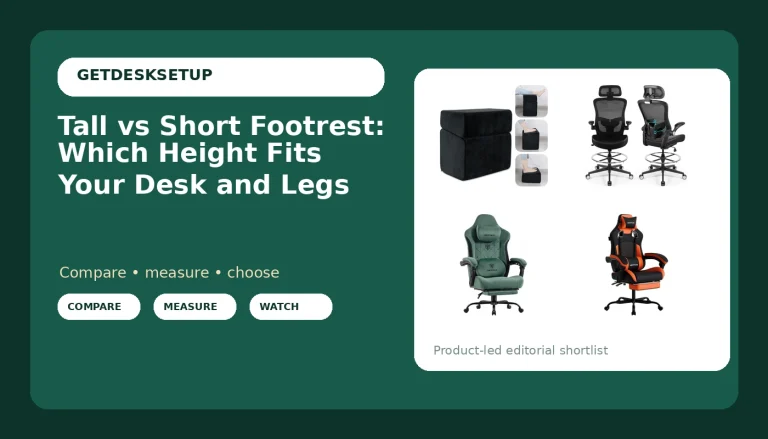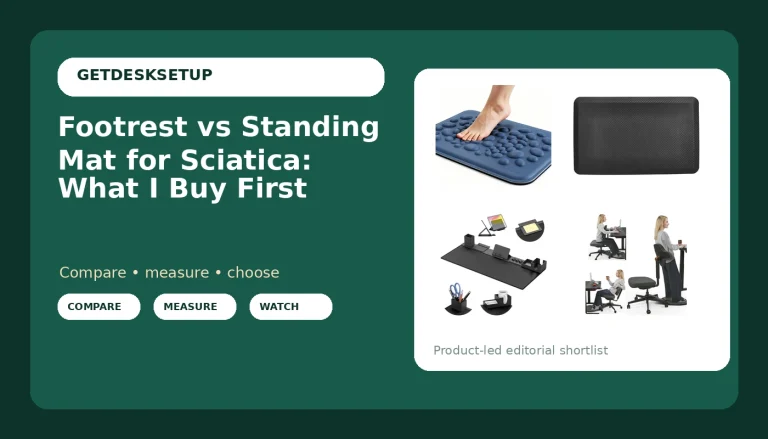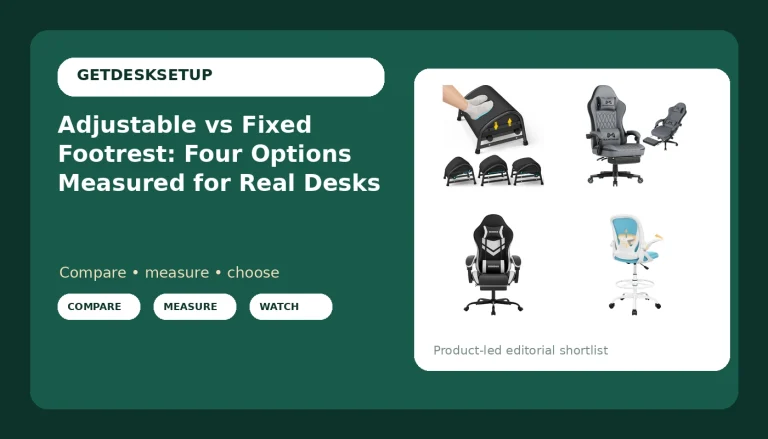
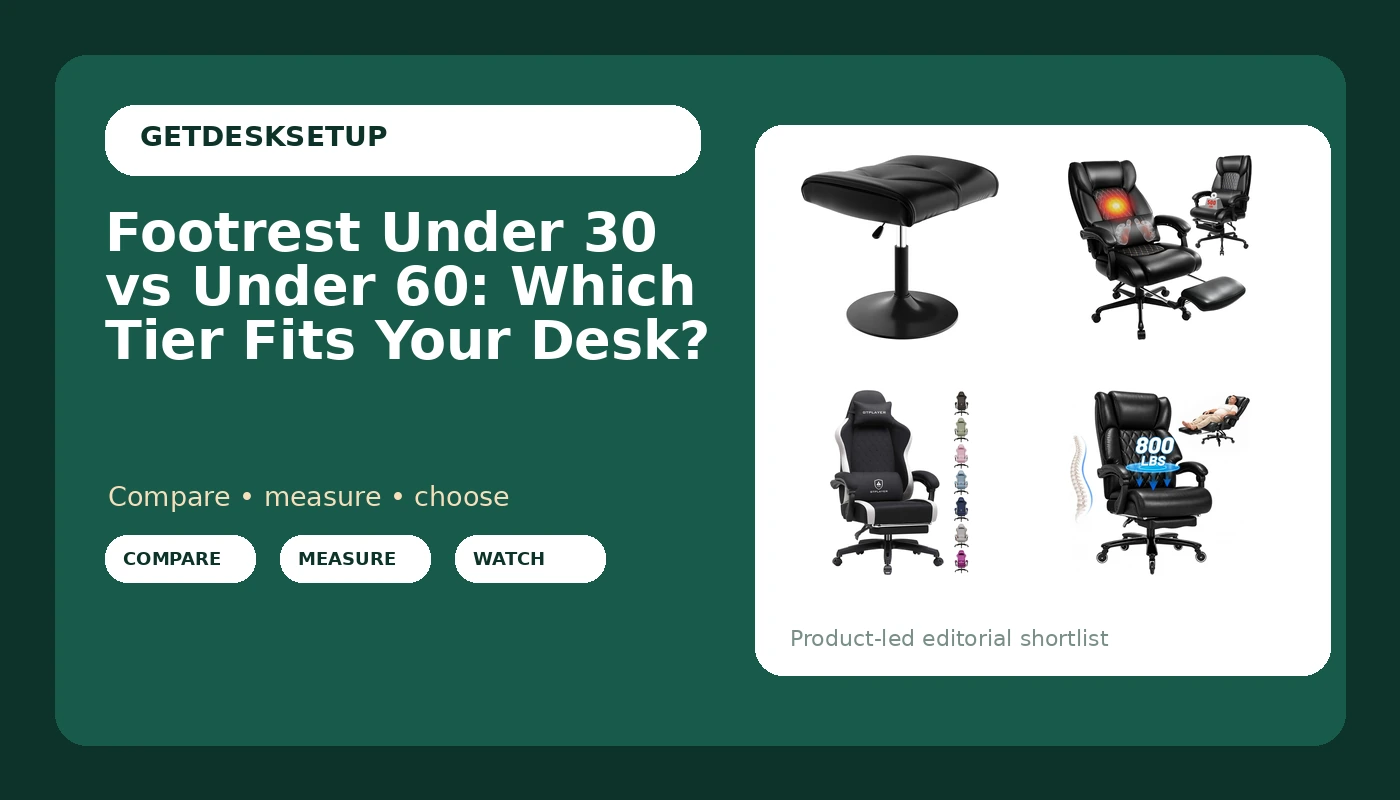
I have bought footrests for 400-person floors and for 310 home offices, and the footrest under 30 vs under 60 question comes up more than any other accessory question I get. The honest answer is that price is not the deciding variable. Geometry is. A footrest is a shim, and a shim either puts your thighs at the angle your hip flexors want or it does not.
Related: Office Chair Seat Depth and Height Sizing Guide
For most desks at the standard 29 to 30 inch height, the VECELO Office Foot Rest Under Desk Ottoman is where I would start, because height adjustment is the only feature that survives a change of chair, shoe, or desk. The other three products here take the opposite approach. They build the footrest into the chair itself, which is a different purchase decision entirely, and one that fits a narrower group of people.
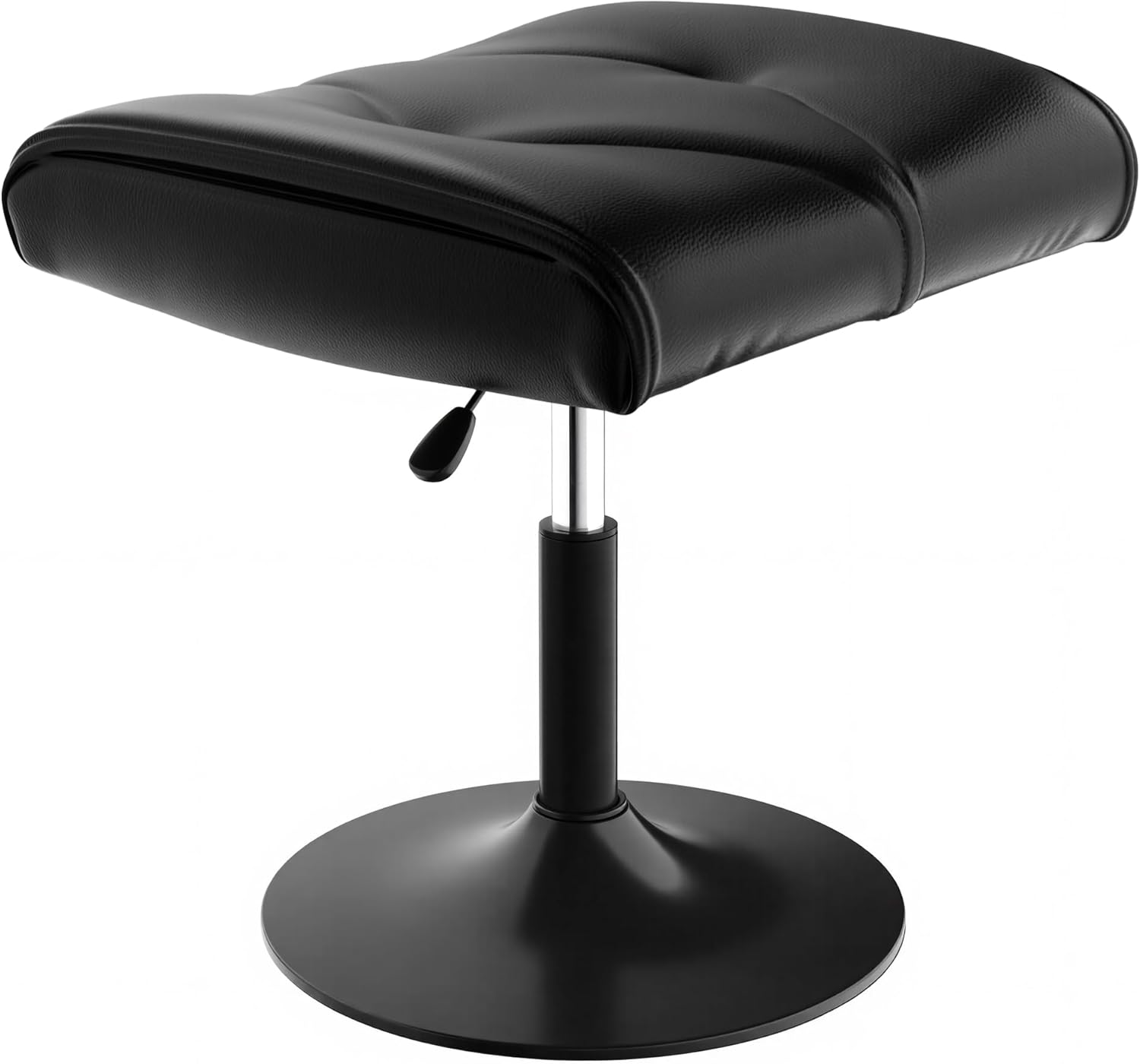
VECELO Office Foot Rest Under Desk Ottoman, Height Adjustable, Black
Height adjustable, slides under any desk, no chair replacement required
Only helps if the gap is between your feet and the floor, not between your hips and the seat
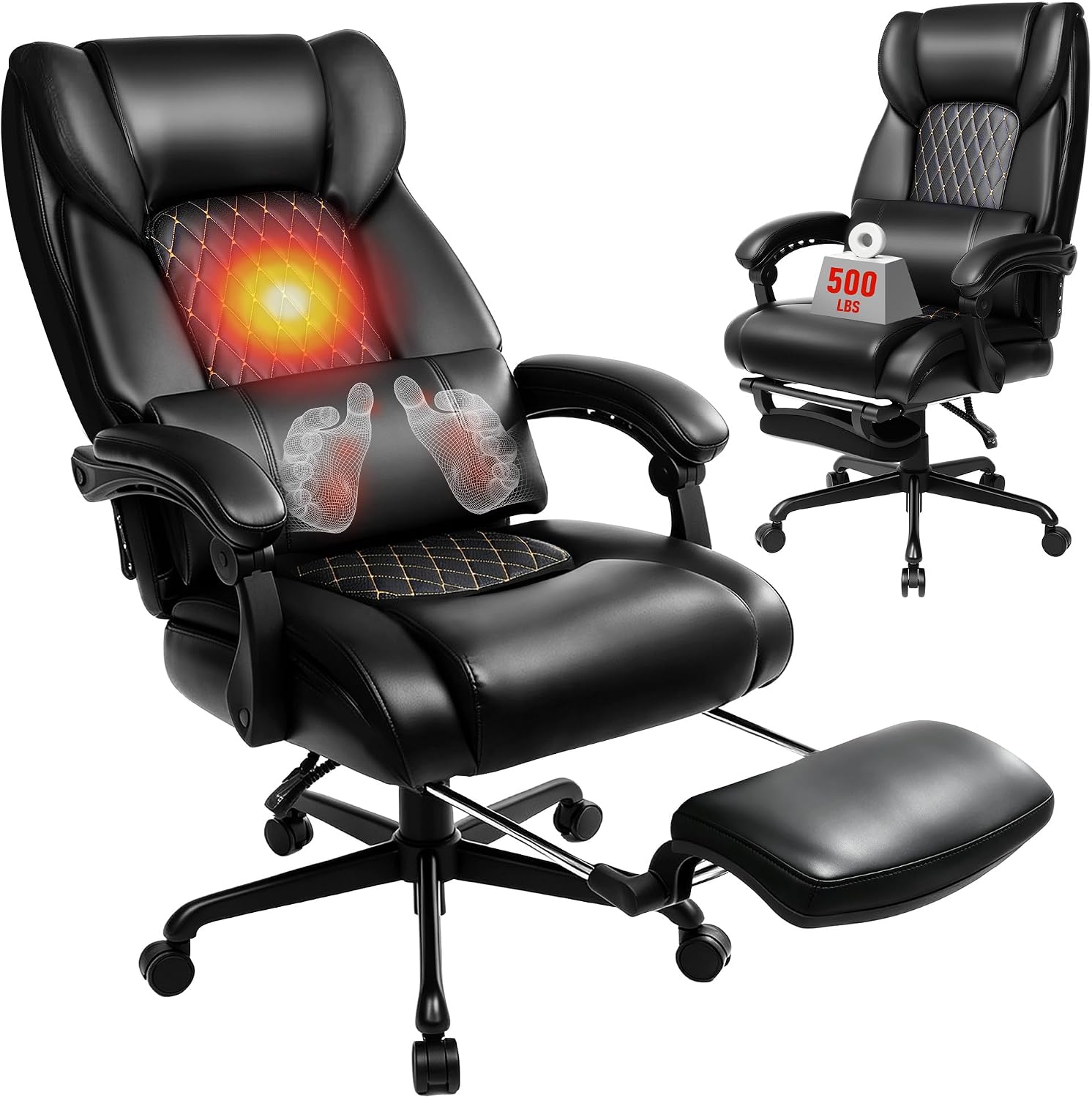
3D Kneading Massage Office Chair with Heat, 500 lbs Big and Tall Executive Computer Desk Recliner, Leather Electric Heated Chair with Footrest, Black
500 lb rating, heated 3D kneading massage, folding footrest built in
Massage motors are not a substitute for a footrest you can set independently
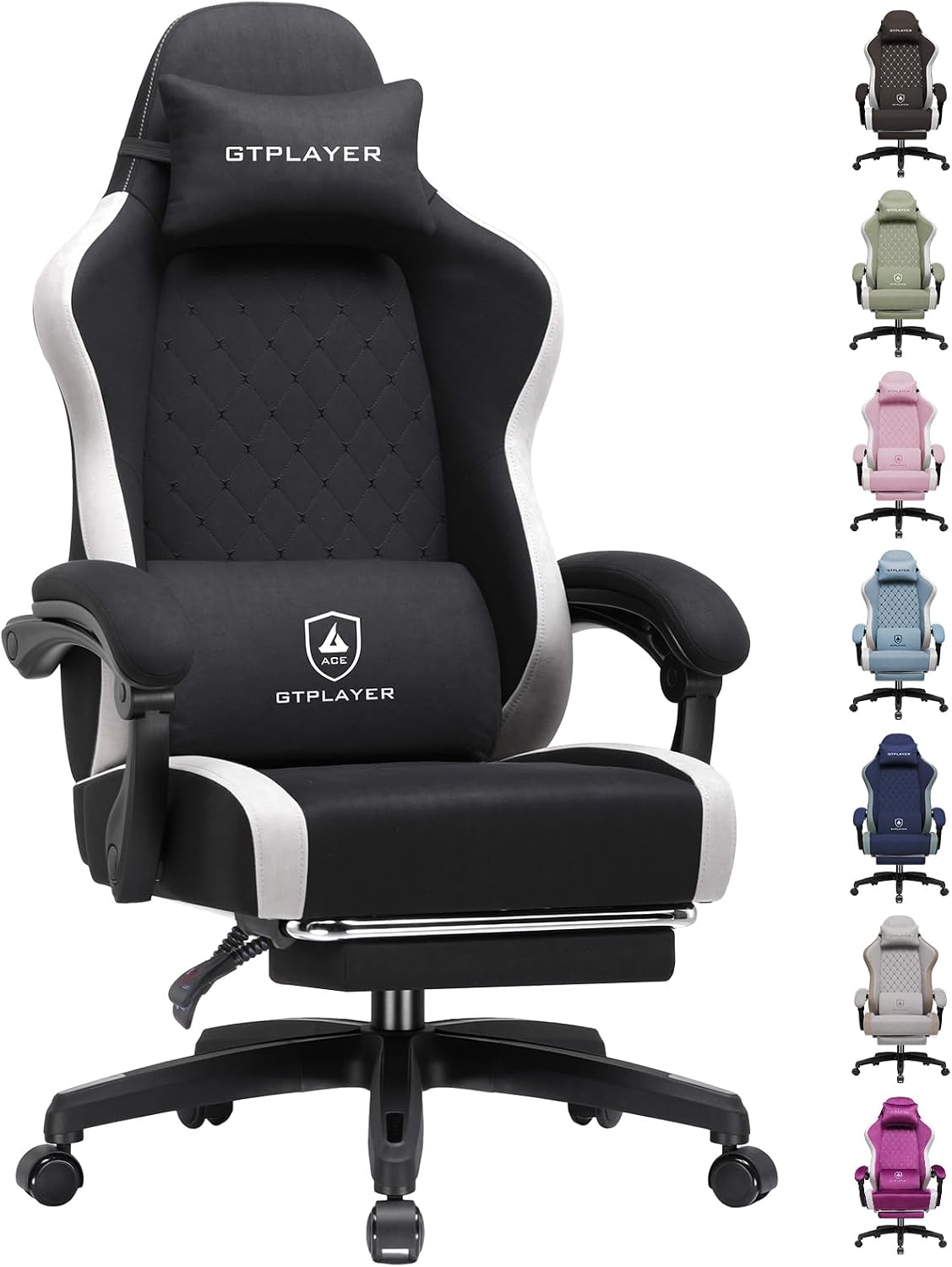
GTPLAYER Gaming Chair, Ergonomic Computer Chair with Footrest and Lumbar Support, High Back Recliner Chair 350lbs, Height Adjustable for Home Office, Black
350 lb rating, lumbar support, retractable footrest on a high back recliner
The footrest is designed around reclining, not around typing posture
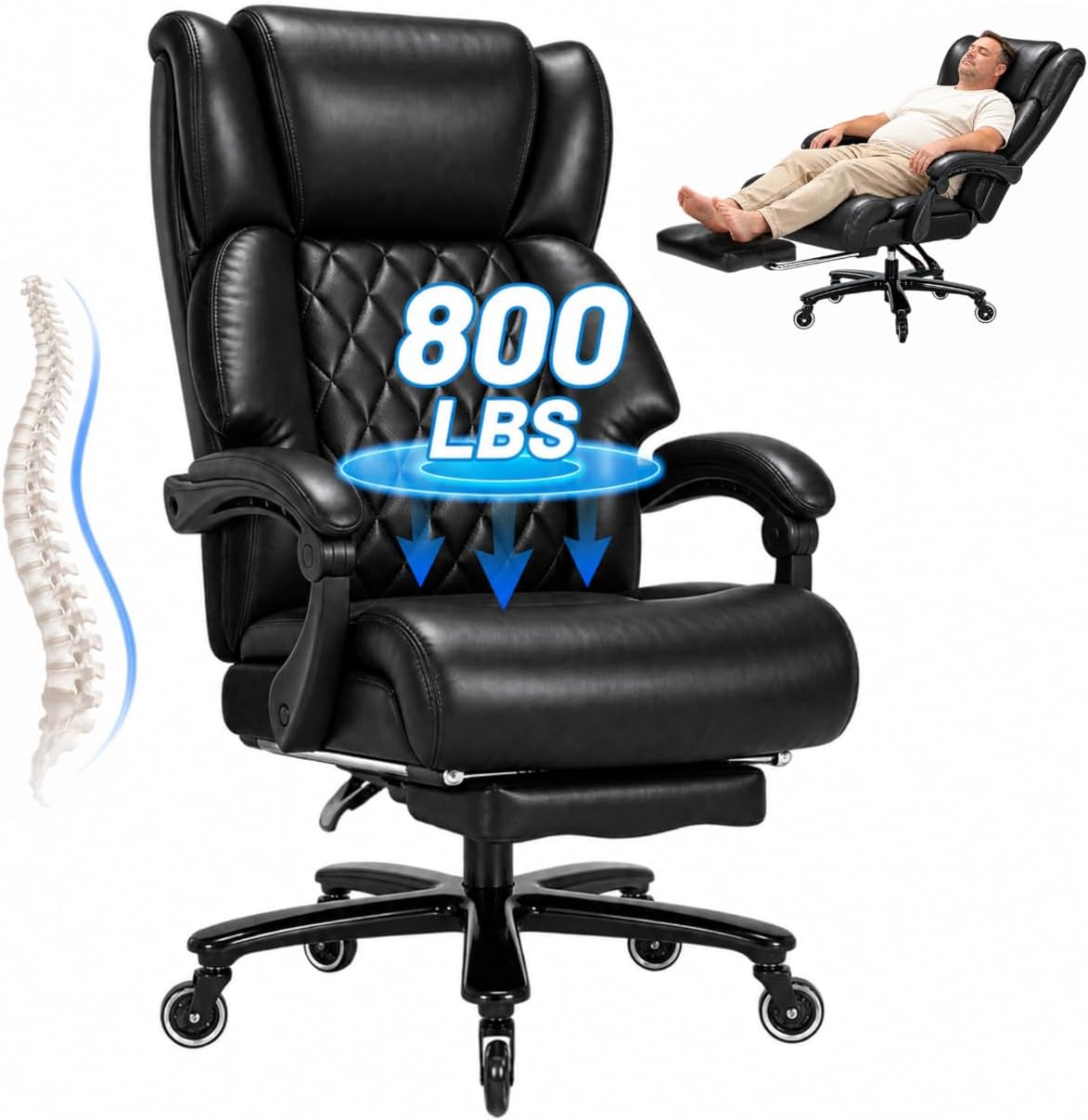
800 LBS Big and Tall Heavy Duty Reclining Executive Office Chair with Footrest for Heavy People High Back Home Office Desk Chair with Large Seat Cushion
800 lb rating and a large seat cushion, the widest fit range in this group
Big footprint, and the footrest only makes sense once you recline
Prices and availability may change.
What actually separates the two tiers
The difference between footrest under 30 and under 60 shows up in three places, and only one of them is about how soft the top feels.
Adjustability. The lower tier is usually a fixed platform, a rocker, or a two-position wedge. You buy it, you put it under the desk, and whatever angle it arrives at is the angle you live with. The higher tier almost always adds a real height range, and often a tilt. That matters because your effective leg length changes with your shoes. A running shoe with a 12 mm drop puts your knee about half an inch higher than a bare foot. If your footrest cannot move, your posture has to.
The surface. This is where mat density and mat thickness do the work. A thick, soft pad feels wonderful for ten minutes and then compresses to a hard bottom under a heel. A thinner but denser pad holds its shape. My rule from buying for office floors: one to two inches of firm material beats three inches of pillow. If you can press your thumb into a footrest and feel the frame underneath, it will bottom out under your feet too.
The frame and hinge. Cheap hinges develop slop. Once a hinge has a quarter inch of play, the platform rocks every time you shift weight, and a rocking footrest is worse than no footrest because it keeps your leg moving. Screws that thread into plastic collars back out. If you can see the mechanism in the photos and it is a metal pin through a metal bracket, that is the version that lasts a year in a client office.
One caution about tiers: they are not guarantees. A badly designed platform with a height range is worse than a well-built fixed wedge. I have thrown out footrests that cost more than the chair they sat under.
Footrest under 30 vs under 60: the measurements that matter
Get a tape measure and take three numbers before you shop. This is the part most people skip, and it is the reason footrests end up in closets.
One, seat height at the front edge. Sit in the chair you actually use, shoes on, feet flat on the floor. Measure from the floor to the top of the front edge of the seat cushion. Not the middle of the cushion, the front edge, because that is where your thighs sit.
Two, popliteal height. Stay seated, stay in the same shoes, and measure from the floor to the crease behind your knee. This is the number that tells you whether your chair is too tall for your legs.
Three, the gap. Subtract popliteal height from seat height. If the gap is more than about an inch, your feet are dangling or your thighs are sloping down toward the floor, and a footrest earns its place. If the gap is under an inch, you may not need one at all, and no tier is going to fix a chair that is simply the wrong size for you.
Once you have the gap, pick the footrest height so that your thighs end up roughly parallel to the floor and your feet are flat, not pointed. Then think about footrest angle. A flat platform is the right default for typing, because it lets your ankle stay near neutral. A slight forward tilt suits reclining, where your hips open and your knees drop. A fixed platform locks you into one of those two positions, which is fine if you only ever work one way and a problem if you alternate between typing and leaning back with a controller or a phone.
Mat thickness and mat density come last. Thin and dense beats thick and soft for the same reason a firm mattress beats a hammock: you want support, not sink. If you have hardwood or tile under the desk, add a small rug or a mat under the footrest so it does not slide when you push back from the desk.
The dedicated pick: VECELO under-desk ottoman
The VECELO Office Foot Rest Under Desk Ottoman is the only true footrest in this comparison. It is height adjustable, it is black, and it sits under the desk as a separate piece of furniture rather than as an attachment to a chair. That last point is the whole argument for it. When you change chairs, you keep the footrest. When you change desks, you keep the footrest. When you switch from shoes to slippers in the afternoon, you adjust the footrest instead of rebuilding your setup.
Who it fits: anyone whose chair is at the top of its height range, anyone with a fixed-height desk who is shorter than the desk was designed for, and anyone who wants their feet supported while sitting in an ordinary task chair that has no recline hardware at all.
Who should skip it: if your thighs are already parallel to the floor with your feet flat on the ground, you do not need this and it will just be an obstacle. If you want your feet up while you are fully reclined in a chair, a chair-integrated footrest handles that better, because it moves with the seat instead of staying on the floor.
Visit on Amazon to check the current listing and the height range.
The chair-with-footrest route
The other three products here are chairs that include a footrest as part of the seat assembly. That is a different product category with a different set of trade-offs, and it is worth being blunt about it: an integrated footrest is designed for reclining. It extends when you lean back. It is not a typing-posture tool, because when you sit upright, the footrest is either retracted or in the way of your shins.
3D kneading massage chair with heat, 500 lb rating
This is the executive leather recliner with the most hardware in it. The listing names a 500 lb weight rating, a big and tall build, heated 3D kneading massage, and a footrest. If you are replacing a chair anyway and you want heat and massage built in, this is the option that folds the most functions into one purchase.
The trade-off is serviceability. Motors, wiring, and heat elements are wear items. A plain office chair has one failure point, the gas cylinder. This chair has several, and none of them are user-replaceable in the way a cylinder is. If you sit eight hours a day and you want a footrest you can adjust without reclining, buy the dedicated footrest instead and put it under a chair you can service.
GTPLAYER gaming chair with footrest, 350 lb rating
The GTPLAYER is the mixed-use option: ergonomic high back recliner, lumbar support, height adjustment, a 350 lb rating, and a retractable footrest. It covers the range from upright desk work to leaned-back video calls, and the lumbar support is an actual adjustable feature rather than a molded bump, which matters if you have a lower back that complains by Thursday.
Check one thing before you buy. Look at the seat pan in the photos and see whether it has deep side bolsters. Bolsters are fine when you recline. When you sit upright for six hours, they can push your shoulders forward and take width away from your hips. If you are broad through the hips or you like to sit cross-legged, that is a skip.
800 lb big and tall heavy duty recliner
This one exists for a specific buyer, and it says so in the name: an 800 lb rating, heavy duty construction, a large seat cushion, a high back, and a footrest. That is the widest weight range in this comparison by a wide margin. If the 350 lb and 500 lb chairs are outside your range, this is the one that is not.
The trade-off is footprint and mass. Big and tall executive chairs are wide, and the ones with a recline mechanism are heavy. Before you buy, measure your desk width and compare it against the chair's listed overall width, because armrests that collide with a desk edge will keep you from ever getting close enough to type. And check your doorway, because a chair this size that will not fit through the office door is a return you have to carry.
Who should skip each one
- Skip the VECELO footrest if your chair already puts your thighs parallel to the floor with your feet flat. You have solved the problem the footrest solves.
- Skip the 500 lb massage chair if you do not want to maintain motors and heating elements, or if you need your feet supported while sitting upright rather than reclined.
- Skip the GTPLAYER if you want a flat, wide seat pan for long typing sessions, or if you are near the top of its 350 lb rating and want headroom.
- Skip the 800 lb heavy duty recliner if you work in a tight space or you move your chair between rooms. It is built to stay put.
None of these four is a bad product. Three of them are chairs, one of them is a shim, and buying a chair when you needed a shim is the most expensive mistake in this whole category.
Setup notes: cable management and desk geometry
A footrest lives in the same volume of space as your cables, and that causes more problems than people expect.
Route your power and display cables in a raceway along the back rail of the desk, not down the middle where your feet go. Bundle the loose run from the monitor arm to the wall in a cable sleeve so it moves as one piece instead of catching on a knee. Then anchor the slack with an adhesive clip on the underside, positioned so that a footrest sliding in and out cannot hook it. I have watched a footrest drag a laptop charger off a desk twice in one week, and both times the fix was one adhesive clip.
Keep the footrest off-center if your setup is asymmetrical. Most people land their feet slightly to one side, usually the side of the mouse hand. Put the footrest where your feet actually land, not where the desk is centered. Check that it clears the clamp of your monitor arm at full extension, because that clamp is a shin-height hazard.
One more geometry note. If your desk lamp lumens are cranked up and you recline to read, the lamp head moves relative to your eyes, and you will end up fighting glare instead of relaxing. Set the lamp arm back far enough that the recline arc does not put the bulb in your eyeline. It has nothing to do with footrests and everything to do with whether the reclined position is actually usable.
Common questions
Is footrest under 30 or under 60 the better buy? Answer the gap question first. If your seat-to-knee gap is over an inch, the tier with a real height range is the one that will actually fix your posture, because you can dial it in. If your gap is small, the simpler fixed platform is enough and the extra adjustment is money spent on a feature you will not use.
What if I found this page by typing under 60 vs footrest under 30? Then you are comparing a platform with a hinge and a height range against a slab with a pad. Buy the hinge if your chair or your shoes are likely to change. Buy the slab if nothing about your setup is going to move for the next three years.
Can I use a footrest with a chair that already has one built in? Yes, but not at the same time. The integrated footrest is for reclining, and the floor footrest is for upright work. People who do both usually keep a floor footrest for typing hours and extend the chair's footrest when they lean back, which is a legitimate two-tool setup.
Do I need a footrest if I have a standing desk? Not while standing. But most standing desk owners sit more than they stand, and at sitting height the same gap math applies. If you raise the desk and lower the chair, the gap gets bigger, not smaller.
The verdict
For most home offices, the footrest under 30 vs under 60 decision resolves the same way: buy the adjustable one, because adjustability is the only feature that keeps working after your chair, your shoes, or your desk changes. In this group, that is the VECELO Office Foot Rest Under Desk Ottoman, and it is the only product here that does not require you to replace anything you already own. Check it on Amazon and compare its height range against the gap you measured.
If you are shopping for a chair rather than an accessory, the choice comes down to weight rating and recline behavior. The GTPLAYER gaming chair is the mixed-use pick at a 350 lb rating. The 3D kneading massage chair is for someone who wants heat and massage in the seat at a 500 lb rating. The 800 lb big and tall recliner is for the heaviest user in the room, with the widest fit range of the three. Check current Amazon price on each before you commit, and measure your desk width first. A chair that does not fit your desk is a chair that does not fit you, no matter what the weight rating says.