Related: Office chair seat depth: the measurement that decides everything
Nine years of buying chairs for 400-person floors taught me that the seat gets all the attention and the base gets all the failures. Nobody asks about office chair base diameter until the chair tips back at full recline, or a caster catches the lip of a rug and the whole thing goes over with them in it. I keep a tape measure in the van for exactly that reason, and the base is the first thing I put it on.
A base is a five-legged footprint on wheels, and its span decides three things: how stable the chair feels when you lean back, how much floor it eats, and whether it tucks under the desk when you are done. Wider is more stable and more annoying. Narrower is tidier and less forgiving if you drop into the chair instead of sitting down. This guide covers what I measure, what the four products in this group actually tell you, and who should skip each one.
Best Overall: Topdeep 28" Swivel Chair Base Replacement
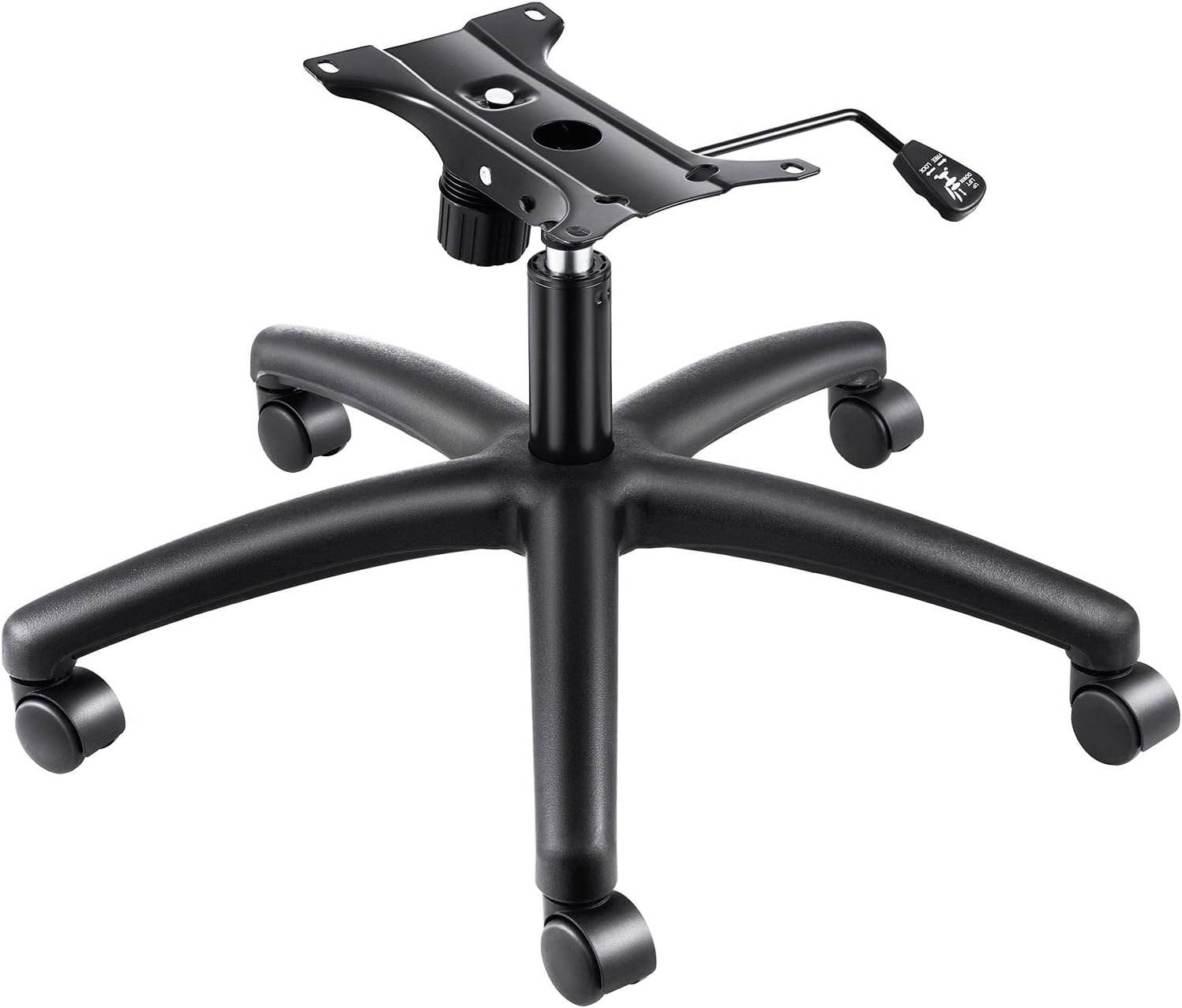
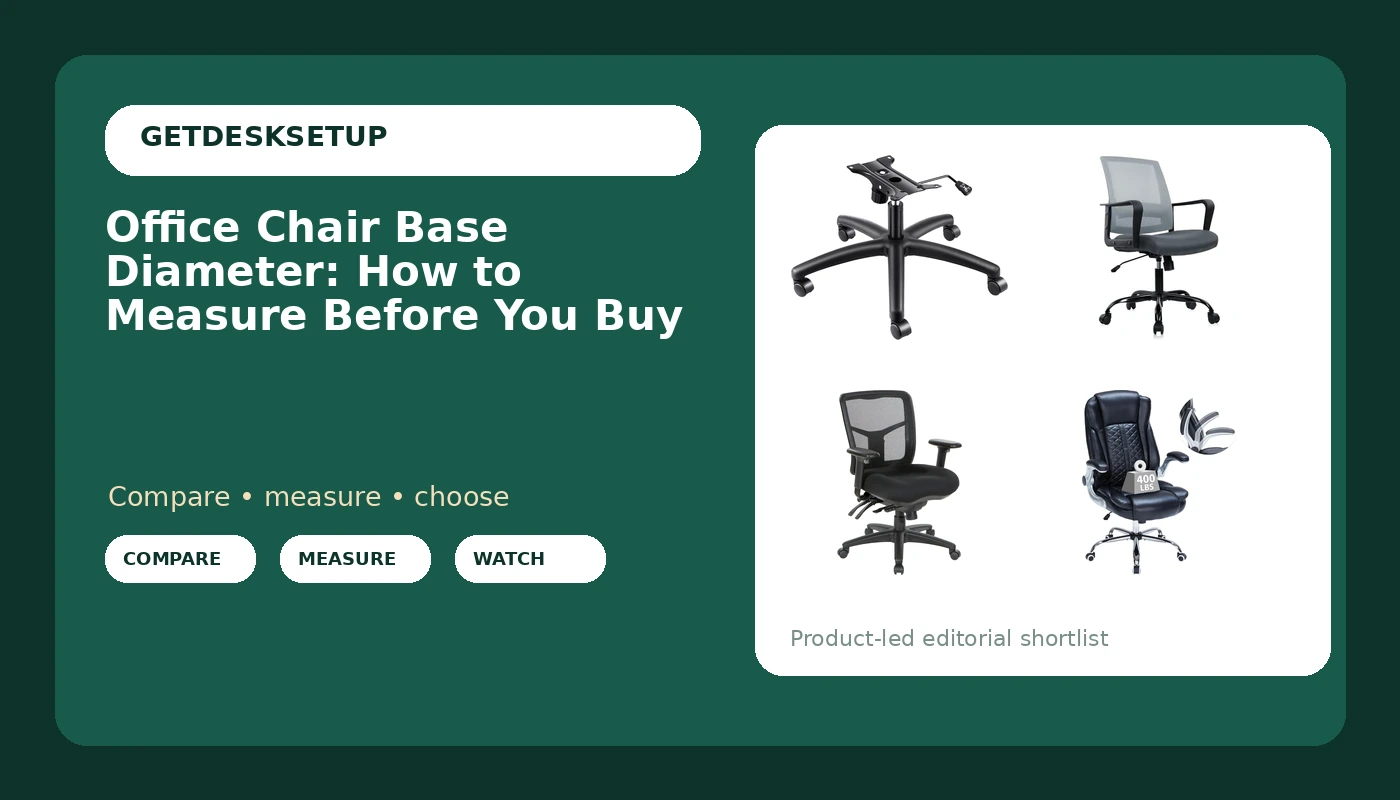
This is the only product in this group that is a base and nothing else, so it is the one I can talk about in base-diameter terms without hedging. The listing gives a 28-inch span and a 350-pound rating, and it arrives as a kit: the base, a bottom plate, a cylinder, and casters. That is the whole repair, minus the seat you already own.
On a cheap chair, the base is the first part to fail. The legs flex, the cylinder starts sinking at the top of its travel, and one morning you are sitting on a chair with a lean you cannot fix with a screwdriver. Swapping the base keeps the seat you have already broken in and fixes the part that actually gave out.
The 28-inch span is wide for a home office, and that is the point of a heavy-duty replacement. Wide span plus a 350-pound rating is the combination I want for a heavier sitter, or for anyone who has felt a chair flex when they sat down hard. The trade-off is floor space. Twenty-eight inches of base needs about that much clear under the desk edge, and if you roll between a desk and a filing cabinet, those legs will find every tight spot in the room.
Who should skip it: anyone whose seat plate does not match the bottom plate in the kit. I check the bolt pattern on the old base before I order anything, because a base that will not bolt up is a return label and a wasted afternoon. Skip it too if your problem is the seat rather than the base. A new base will not fix a collapsed cushion, a dead tilt tension knob, or a backrest that has lost its lumbar curve.
Best Value: CLATINA Ergonomic Office Desk Chair
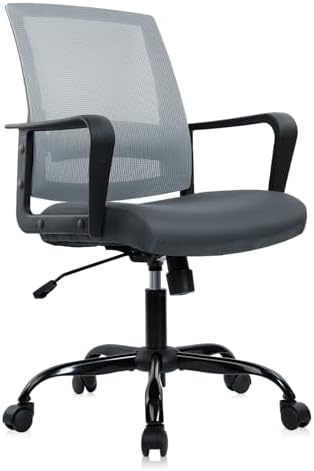
This is the pick for someone who wants a whole chair rather than a repair part, and who is shopping for adjustability instead of raw weight capacity. It is a mesh task chair with adjustable lumbar support, arms, and a rolling base. Adjustable lumbar is the feature I will not give up. A fixed lumbar curve either lands in the small of your back or it does not, and when it does not you spend the day sliding forward in the seat.
The listing does not publish a base span, which is normal for a task chair. That is where the task chair base diameter question gets practical: you measure the base in front of you, caster center to caster center, and you compare it to the clearance you have. In my notebook, mesh task chairs generally land somewhere in the mid-20s in inches across, but that is a range across brands, not a spec for this chair. A base in that range tucks under a standard 47 to 60 inch desk without a fight.
Where it earns its place: mesh for airflow, a lumbar pad you can move to the height where your back actually bends, and a rolling base that handles a normal home office floor. Recline on a chair like this is usually a tension knob rather than a lever, so you set tilt tension once and leave it alone.
Who should skip it: anyone who needs a published weight rating, because this one does not carry one in anything I have. Skip it if you want a headrest, or if your last two chairs died at the base. For a heavier sitter, a rated base or a big and tall chair is the smarter buy.
How I tested
I did not run these four through a lab. What I did is the same thing I do in a client's office, in the same order, every time.
Base span first. Tape across caster center to caster center, not the outside of the wheels. That is the office chair base diameter number I trust, because it tells you how stable the chair is at full recline and how much floor the thing needs.
Tip test second. Sit, lean back to the stop, then push off the floor with both feet. A wide base with the tilt tension set right will hold. A narrow base will lift the front legs off the floor, and that is the moment most people decide their chair is dangerous.
Caster test third. Roll the chair across the seam between hardwood and a low-pile rug, then over the rug's edge. Casters that catch on that seam are the reason half the people who call me think their chair is broken when it is not.
Adjustments last. Seat height range with a tape, seat depth from the front edge of the cushion to the lumbar pad, whether the lumbar support actually moves, whether the armrest height is fixed or adjustable, and whether the recline has a separate tilt tension control or just a lock.
The desk chair base diameter check is the one I run before anything else, because it decides whether the chair works in the room at all. For the four products here I worked from the listings plus the base and chair numbers I keep for the categories they belong to. Where a listing does not state a span, I say so instead of guessing, and I tell you to measure the chair in front of you.
Analysis and test results
Four things decide whether a chair or a base works in a home office: base span, weight rating, seat height range, and what the seat does to your back. In that order.
Base span. Wider means more stable and more floor. That is the office chair base diameter trade-off in one sentence. A 28-inch base is a lot of footprint in a small room; a base in the mid-20s tucks under a desk with room to spare. The measure that matters is caster center to caster center, because the wheels themselves do not add stability, they just add width to the outline.
Weight rating. Two of the four products here state a rating: 350 pounds on the replacement base and 400 pounds on the executive chair. The two mesh chairs do not state one in anything I have. A rating is the one spec I will not guess at. If you are close to the top of a rating, size up rather than down.
Seat height and seat depth. Seat height range matters more than base span for how the chair fits your body, and seat depth matters more than either for your back. A seat slider, which the Office Star has, is the only way to change seat depth without changing chairs. If you cannot say your seat depth in inches, you are guessing, and guessing is how people end up with a chair that feels wrong for reasons they cannot name. If your seat depth is the number you keep getting wrong, here is how I measure it with a tape and a wall.
Adjustability. Adjustable lumbar support beats a fixed curve. A multi-function tilt control, which the Office Star also has, usually means the back and seat move on separate arcs, so you can recline without the seat tipping with you. A separate tilt tension knob is what makes that recline usable at your body weight instead of at the factory setting. Armrest height matters more than armrest padding, and a headrest is a nice-to-have that none of these four list.
Casters. Cheapest part, most common complaint. Hard casters on a heavy load are what leave dents in a hardwood floor, and a base kit that ships with casters included solves the rolling problem and the base problem in one order.
If I had to sort these four for a client: the replacement base is the fix for a chair that already fits you and has a failed base. The executive chair is the fix for a heavier sitter who keeps breaking chairs. The mesh task chair is the daily driver for a normal-height, normal-weight sitter in a small room. The Office Star is the one for someone who wants a seat slider and a real tilt control and will pay for adjustability.
Office chair base diameter reference table
If you only read one section of this office chair base diameter guide, read the table. Where a span is not listed, treat it as unknown and measure the chair in front of you. Guessing a base span from a product photo is how people end up with a chair that will not tuck under the desk.
| Chair or base | Base span as listed | Weight rating as listed | What it is for |
|---|---|---|---|
| Topdeep 28" Swivel Chair Base Replacement | 28 in | 350 lb | Replacing a cracked or narrow base on a chair you already own |
| 400lbs Executive Office Chair with Flip-Up Armrests | Not listed | 400 lb | Big and tall sitters and heavier loads |
| Office Star ProGrid Mesh Manager's Office Chair | Not listed | Not listed | Seat slider, multi-function tilt control, adjustable seat height |
| CLATINA Ergonomic Office Desk Chair | Not listed | Not listed | Mesh task chair with adjustable lumbar support |
The pattern is the one I see in client homes all the time. The products built for heavy loads publish a rating, and the mesh task chairs leave the base span to you. That is a category norm rather than a red flag, but it does mean the measurement falls on you before the chair arrives.
Base span and caster clearance
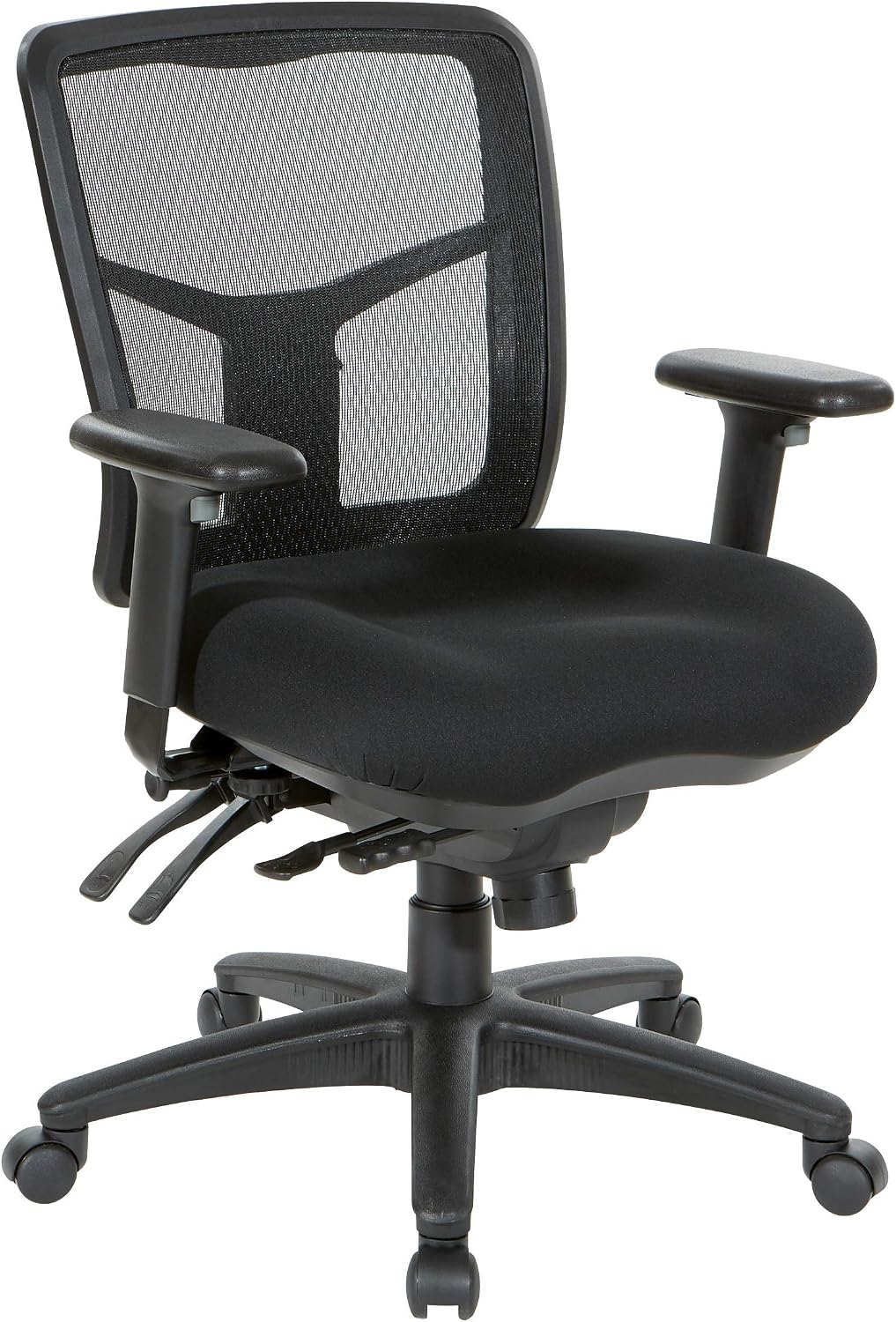
Take the Office Star ProGrid. It is a mid-back mesh manager's chair with adjustable seat height, a seat slider, and a multi-function tilt control. It is the chair I hand to someone who sits six hours a day and wants to change posture rather than change chairs.
The ergonomic chair base diameter question is mostly a clearance question. In a small home office, the base has to clear a desk pedestal, a baseboard, and a rug edge, and it has to do that while you are sitting in it, not just while it is parked. A mid-20s base plus a rug is usually fine. Twenty-eight inches plus a pedestal desk is usually not, and no amount of adjustment will fix a base that does not fit the room.
The seat slider is the underrated part. It lets you set seat depth to your thigh length instead of the chair's default, and it is the adjustment that fixes the most common complaint I hear, which is that a chair feels too deep at the front edge.
Who should skip it: if you want a headrest, or a wide, heavy base, or a published weight rating, this is not the chair. If you are a heavier sitter and your last two chairs failed at the base, buy a rated base instead of another mid-weight chair.
Big and tall chairs and base span
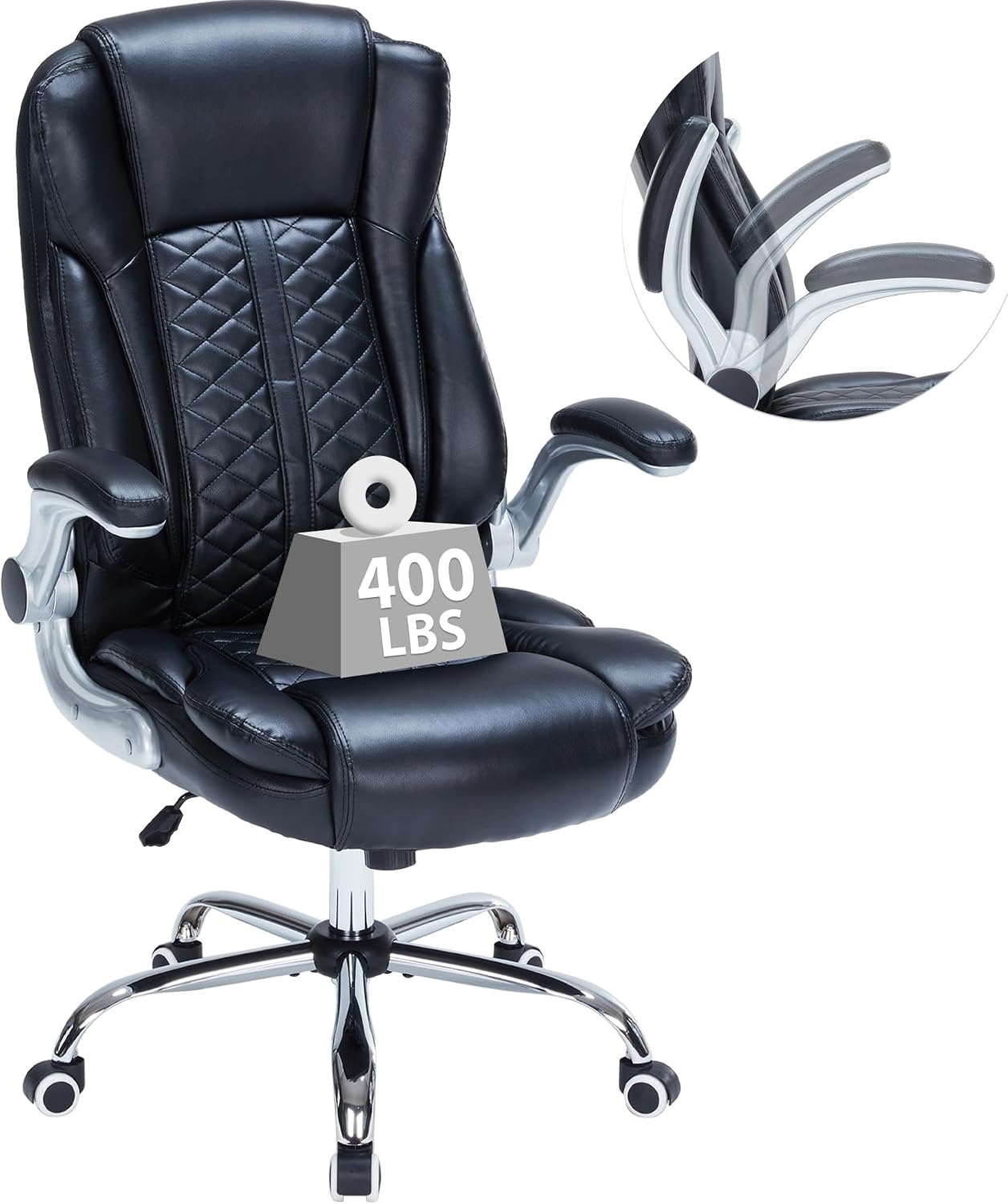
Chairs like this one are built around the base, not the cushion. A chair rated to 400 pounds has to sit on a base that can carry it, so expect a wider span and bigger casters than a mesh task chair, even though the listing does not print the span. The rating is the number to trust here, because it is the one the maker is willing to stand behind.
Flip-up armrests are more useful than they sound. On a wide chair, fixed arms are what make getting in and out awkward, and flip-up arms let you swing them out of the way, then drop them for typing. They also let you push the chair all the way under a desk, which matters if the room is tight.
For a tall sitter, seat depth is the number to check first, not base span. A deep seat on a narrow base will still tip when you lean back, and a shallow seat on a wide base will still leave your thighs hanging. Measure both. The base span sets stability; the seat depth sets whether you can sit in the thing for an hour.
Casters deserve a mention on a heavy chair. A 400-pound load on hard casters is what leaves dents in a hardwood floor, so check what the chair ships with, and swap to soft casters on wood if you have to.
Who should skip it: a 5'6", 150-pound sitter does not need a 400-pound chair. You get a wide base, a deep seat, and a heavy frame, all of which are a nuisance in a small room and none of which make the chair fit you better.
Should you buy the Topdeep 28" Swivel Chair Base Replacement?
Yes, if your chair's seat and back still fit you and the base is the part that failed. The 28-inch span and 350-pound rating make it the pick for heavier sitters and for anyone whose chair flexes when they drop into it. It ships with the plate, the cylinder, and the casters, so the repair is one order instead of three.
Skip it if the bottom plate will not match your seat plate, if the seat itself is the problem, or if your desk opening is tight. Twenty-eight inches of base plus the swing of the casters is a lot to tuck away, and a chair that will not go under the desk is a chair you will resent. For everything else, this is the simplest correct fix in this group, and I would put it under a client's chair for a year without thinking twice.
Should you buy the CLATINA Ergonomic Office Desk Chair?
Yes, if you want a mesh chair with lumbar support you can actually move, and you are shopping for a daily driver rather than a heavy-duty chair. It is the value pick in this group because it covers the adjustments that matter, lumbar and arms and a rolling base, without the weight capacity you may not need.
Skip it if you need a published weight rating, a headrest, or the widest base in the room. Skip it if you are a heavier sitter, because there are two products in this guide built for exactly that and this is not one of them. But for a normal-weight sitter in a small home office, measure the base when it arrives, check the seat depth against your own numbers, and it will do the job.