I have measured more chairs than I have owned. Nine years as an office facilities manager, buying and assembling chairs and desks for floors of 400 people. Then six years running a two person desk setup service, 310 home offices and counting. The question I get most often is how to find an office chair on a budget.
The honest answer is that the budget is the last variable, not the first. A chair that matches your seat depth and your seat height range is a bargain at any tier. A chair that misses your seat depth by two inches is expensive at any price, because you will buy it twice.
Most people open a browser, sort by price, and read reviews written by strangers with different bodies. That is one way to find an office chair on a budget, and it is also how you end up shopping again by March. The sequence that works is tape measure, then numbers, then budget, then checkout.
Why you should trust me
I spent nine years as an office facilities manager in Seattle, buying and assembling chairs and desks for floors of 400 people. Then six years running a two person desk setup service that has built out 310 home offices. Every one of those builds started with a tape measure, not a catalog.
I keep a notebook of every chair seat depth and desk height range I have measured with a tape rather than read off a spec sheet. When a client tells me a chair is comfortable, I ask for two numbers: the seat depth in inches, and the seat height when the cylinder is all the way down. If they cannot give me those, they are guessing, and guessing is what makes a budget chair expensive.
A chair either fits your body or it does not. Brand and price are noise until the seat depth and the height range match your measurements. I will not call a chair comfortable without telling you who should skip it, and I will not quote a fit range for a chair unless the listing publishes one.
How I picked and how I tested
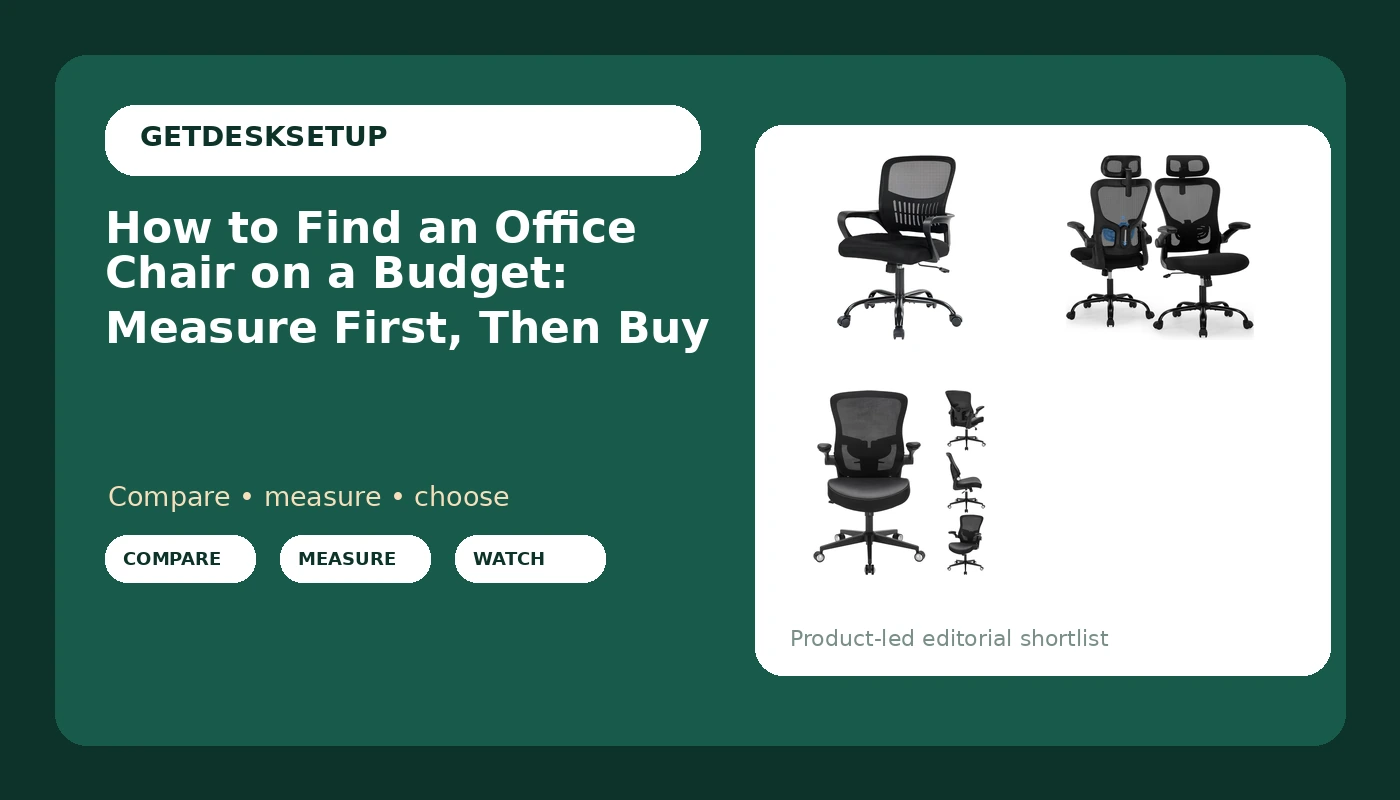
The three chairs below are what I point at when someone wants to find an office chair on a budget without gambling. I picked them on four things: whether the listing states a weight capacity, whether the lumbar support adjusts or is just a molded bump, whether the armrests move out of the way, and whether the back and headrest suit a desk rather than a recliner.
I am not going to pretend I put all three on a load frame for this piece. What I can tell you is what each listing publishes, what it leaves out, and the measurements you have to confirm before you pay. Two of the three state a weight capacity in the product name, which is the first thing I look for and the thing most budget listings hide.
The numbers I trust when I size any chair: seat height is measured from the floor to the top of the compressed cushion, and it has to land so your feet are flat and your knees sit level with your hips. Seat depth is measured from the front edge of the seat to the backrest, and you want two to three fingers of gap behind your knee. Tighter than that and you will sit forward all day, which puts your weight on your thighs instead of your sit bones. That is the whole trick if you want to find a desk chair on a budget that you keep past the first year.
If you are still assembling the rest of the room, start with how to set up a home office desk before you spend a dollar on a chair.
Three tiers, so you can find an office chair on a budget that fits
These tiers are not ranked by price. They are ranked by the body and the hours they suit. Find your tier, then check the two numbers. If your room is tight, my piece on office chairs for small home offices covers footprint before you order anything wide.
The entry tier: DUMOS Home Office Chair, Lumbar Support Computer Desk Chair
The entry tier
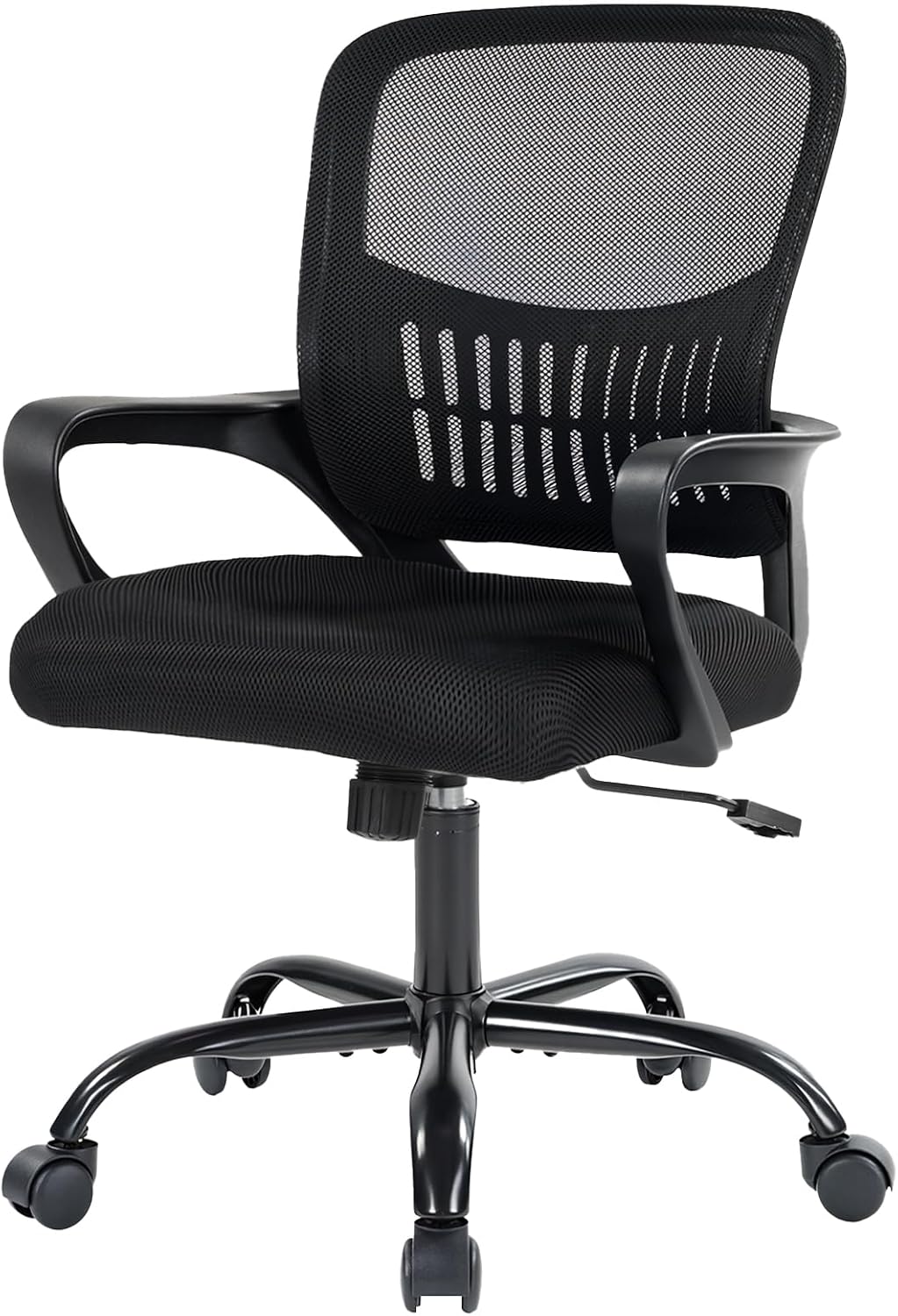
DUMOS Home Office Chair, Lumbar Support Computer Desk Chair
Check current Amazon price
This is the tier I send people to when the chair has to arrive this week and the money is genuinely tight. It is a lumbar support desk chair, and at this tier you are buying a chair for shorter sitting sessions, not an eight hour command post.
Here is the part most buyers skip. The name does not advertise a weight capacity, so before you pay, confirm the capacity and the seat depth in the listing itself or with the seller. If you want to find an office chair budget friendly, this is the tier where the search starts, and it is also the tier where an unverified measurement costs you the most.
My rule for this tier: under roughly 5'9", under roughly 190 pounds, under four hours a day at the desk. If you sit eight hours, or you are heavier than that, skip it and put the same money toward the middle tier. You will spend less across two years than you would replacing this one.
The middle tier: Office Chair Ergonomic Desk Chair High Back Mesh Computer Chair with Adjustable Lumbar Support & Headrest, Flip-Up Armrests, 300lbs Capacity 360 Swivel Chair for Home Office, Black
The middle tier
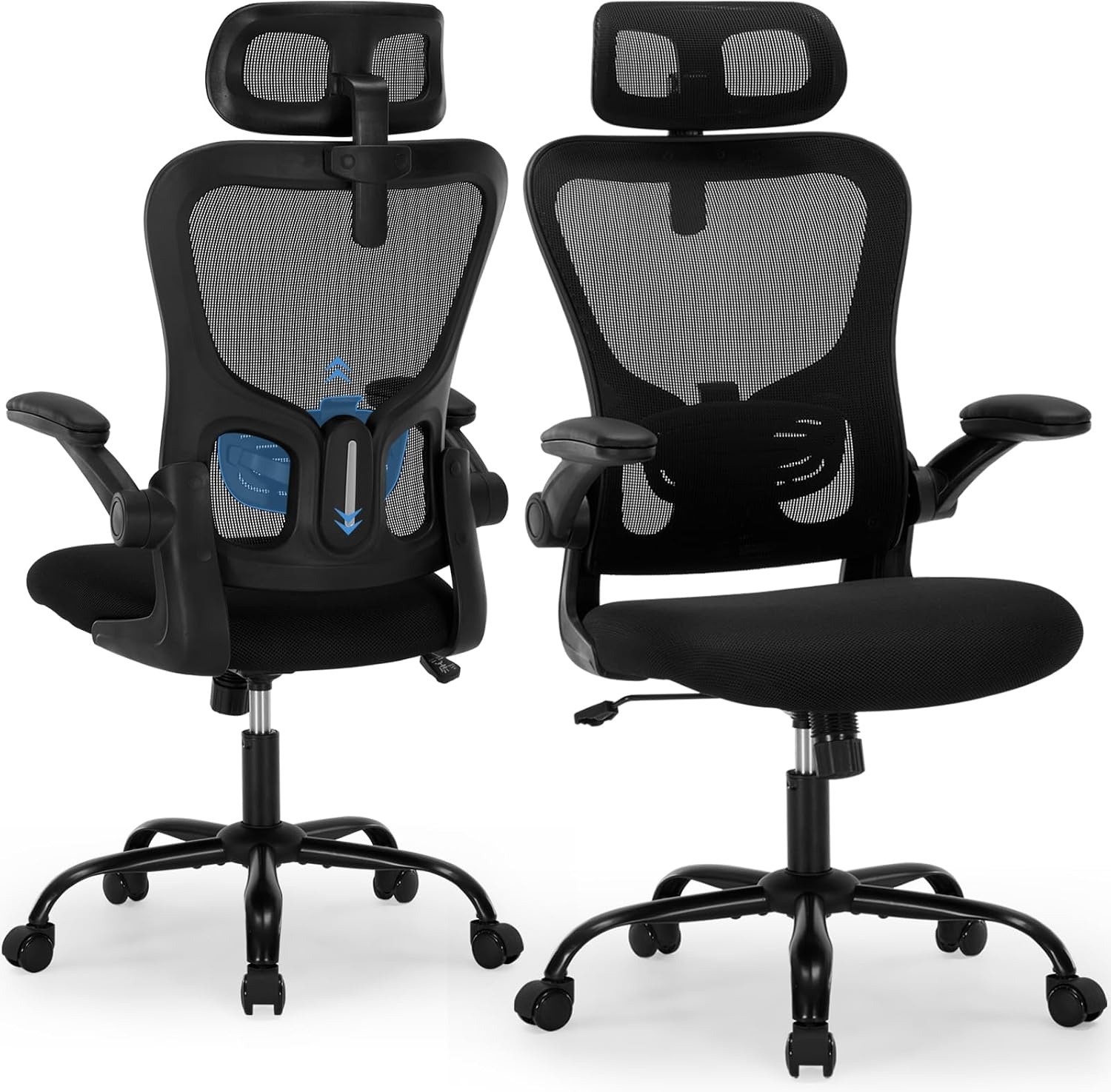
Office Chair Ergonomic Desk Chair High Back Mesh Computer Chair with Adjustable Lumbar Support & Headrest, Flip-Up Armrests, 300lbs Capacity 360 Swivel Chair for Home Office, Black
Check current Amazon price
This is the one I would put in a client's office for a year. It states a 300 pound capacity in the name, it has adjustable lumbar support rather than a molded bump, and it has a headrest. That headrest is the whole reason this tier exists: it is what lets you recline at the end of the day without your neck folding backward.
The flip-up armrests matter more than people think. If your room is tight, arms that fold up let the chair tuck under the desk, which is how you keep a small office walkable. The mesh back is a summer advantage in a room without good airflow.
Who should skip it: if you are over 300 pounds, this is not your chair, go up a tier. If you have never liked mesh, because the frame edge digs into your thighs, skip it too. And if you roll on hardwood, budget for soft casters or a mat, because the casters that ship with most mesh chairs are built for carpet.
The heavy duty tier: Heavy Duty Office Chair, 400lbs Ergonomic Desk Office Chair for Heavy People, Home Office Desk Chairs with Flip-Up Arms Computer Executive Task Chair with Adjustable Lumbar Support
The heavy duty tier
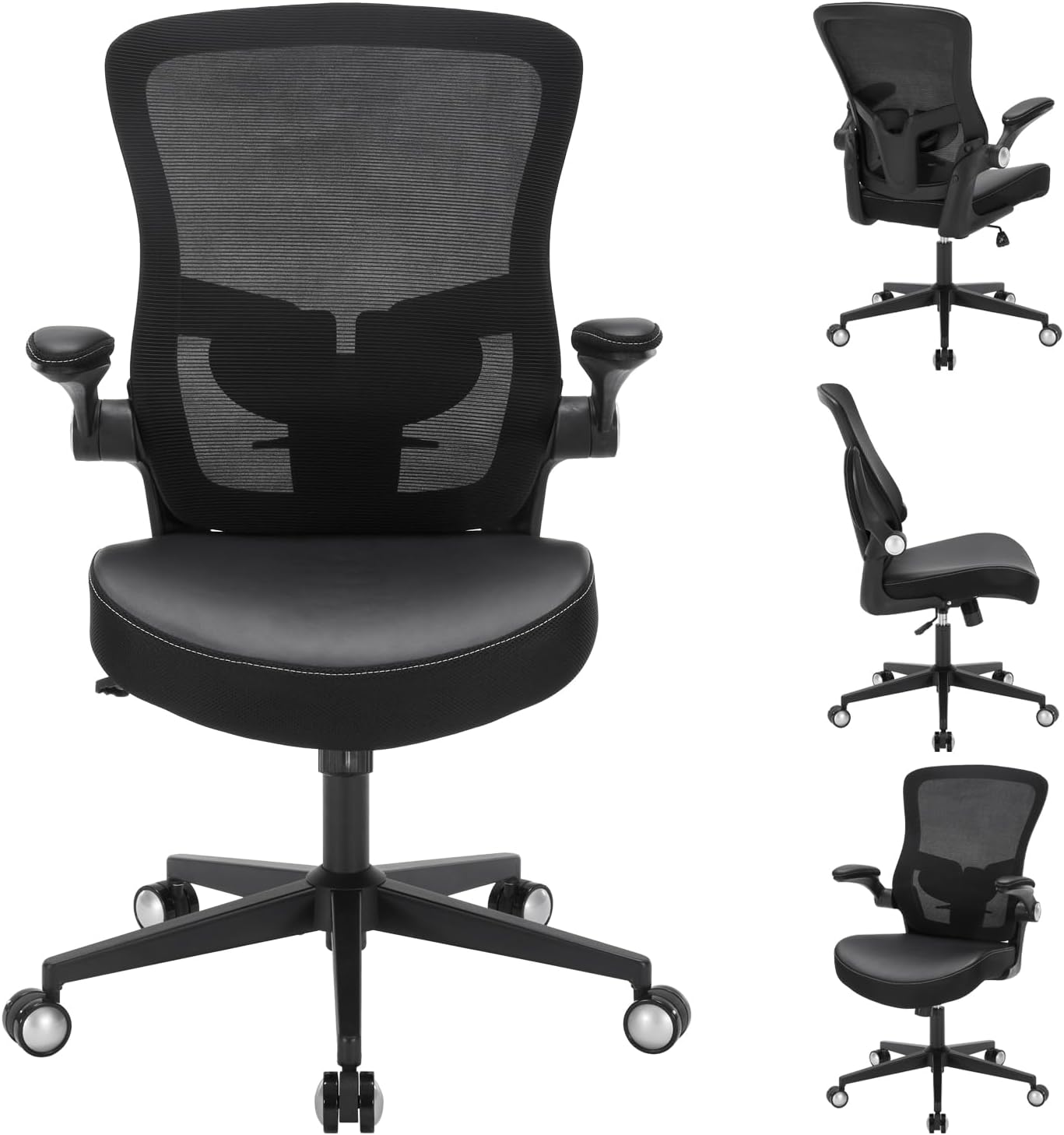
Heavy Duty Office Chair, 400lbs Ergonomic Desk Office Chair for Heavy People, Home Office Desk Chairs with Flip-Up Arms Computer Executive Task Chair with Adjustable Lumbar Support
Check current Amazon price
This is the tier where most budget shopping collapses. Cheap chairs usually top out well under what a heavier sitter needs, and the failure point is never the cushion, it is the cylinder and the base. This one states a 400 pound capacity in the name, has flip-up arms, and has adjustable lumbar support.
When you weigh more, the money belongs in the structure, not the finish. That is why this is the one place I will tell you to spend up rather than down: the wrong chair here does not just feel bad, it fails, and it fails at the cylinder first.
Who should skip it: if you are under about 200 pounds and under about 6 feet, you are paying for capacity you do not need. The middle tier is a better use of the same money. Also measure your room before you order, because a chair built for 400 pounds has a wider base than the two above it, and a wider base needs more floor.
The workflow: eight steps from tape measure to checkout
This works whether you buy from the tiers above or somewhere else. Do it in order. Skipping step one is how people end up asking how to find an office chair on a budget after they have already spent the money.
Step one: Measure your body before you look at a single listing. Sit on a hard chair with your feet flat on the floor. Measure from the floor to the crease behind your knee. That is your target seat height. Then measure from the back of your knee to the back of your hip. That is your target seat depth. Write both numbers on a sticky note and put it on the monitor. Every chair gets checked against those two numbers, and nothing else gets a vote until they match.
Step two: Measure the room and the desk. Desk height, the minimum desk width you can live with, and the floor you are rolling on. A 29 inch desk plus a chair whose lowest seat height is 20 inches means your feet dangle and your thighs carry the load instead of your sit bones. Carpet eats caster height, so measure with the chair on the actual floor, not on a tile sample in a showroom.
Step three: Set the ceiling and hold it. Pick a number before you browse and treat it as a hard stop. The way to find an office chair without overspending is not to hunt for the biggest discount, it is to spend where the load goes: the cylinder and the base. Those two parts decide whether the chair is still level in year three. The finish, the stitching, and the color decide nothing.
Step four: Filter on adjustable lumbar support, not on the word ergonomic. Ergonomic is a marketing word, and it appears on everything from a stool to a sofa. Adjustable lumbar support is a feature you can verify. If the back is one molded curve with no adjustment, it fits exactly one spine, and there is no reason to assume it is yours. That is the most common miss I see in budget chairs.
Step five: Check the seat height range against your number. The listing will publish a range. Your measured seat height has to sit inside that range with room on both sides, not pinned at the very top. If your number is the ceiling of the range, the chair is already too short for you and the cylinder has nowhere left to go. Walk away and keep the number.
Step six: Check seat depth and the knee gap. Sit down, then slide two or three fingers behind your knee. If they fit comfortably, the seat depth is right. If the front edge presses into the back of your knee, the seat is too deep and you will perch on the front edge all day. If there is a whole hand of space, the seat is too shallow and your thighs will take your weight.
Step seven: Decide on armrest, headrest, recline, tilt tension, and caster before you buy. Flip-up armrests earn their place in a small room because they let the chair tuck under the desk. A headrest only matters if you actually recline. Recline and tilt tension are what keep you moving through an eight hour day, and a chair with no tension adjustment will either dump you backward or fight you forward. Casters are the cheapest part to get wrong: soft tread for hardwood, hard tread for carpet.
Step eight: Buy it, assemble it, then re-measure. Set the seat height to your number first, then the lumbar support, then the armrest height, then the tilt tension. Sit in it for a week before you decide anything. If the knee gap is wrong, or your feet will not sit flat with the cylinder all the way down, return it inside the window. Living with a chair that misses by an inch is how the second purchase happens.
The competition and why it lost
Four other options show up in every budget chair search, and each one loses for a specific reason.
The racing style gaming chair loses on seat depth. The bolsters that look aggressive in photos push your shoulders forward, and the deep bucket seat puts pressure behind your knees. It is built for a reclined position in front of a console, not for typing at a desk with your elbows at 90 degrees.
The fixed executive chair with the pillow lumbar loses on adjustability. That pillow sits in one place. If your lower back curves differently, you are buying a chair and a cushion and hoping they meet in the middle.
The big box store ergonomic chair at the very bottom of the price list loses on the cylinder. The parts that carry your weight are the first thing cut, and a chair that sags at month eight is not a bargain, it is a rental.
The used premium task chair from an office liquidator is the one I take seriously. It can be the best chair in this article if you find one with a working cylinder and a seat depth that matches your number. But it loses on two counts: you cannot always test it before you buy, and the return window is usually the parking lot.
What this all costs
Here is the math I actually run with clients. The entry tier chair is the least money up front and the most likely to be replaced inside two years if you sit full time. The middle tier is where most people should land, because it carries a stated 300 pound capacity and a headrest, which is the difference between a chair you tolerate and a chair you keep. The heavy duty tier costs the most of the three, and if you need the capacity, it is the cheapest chair in this article, because the alternative is replacing a failed cylinder twice.
Check current Amazon price before you decide, because these move, and a tier that was out of reach last month may not be this month.
- Entry tier: DUMOS Home Office Chair, Lumbar Support Computer Desk Chair
- Middle tier: Office Chair Ergonomic Desk Chair High Back Mesh Computer Chair
- Heavy duty tier: Heavy Duty Office Chair, 400lbs Ergonomic Desk Office Chair for Heavy People
The cost of getting this wrong is not the price of the chair. It is the price of the chair plus the price of the one you buy to replace it, plus the weeks your back spends complaining in between. The tape measure costs nothing, and the two numbers it gives you are the whole method. That is how to find an office chair on a budget without buying the same chair twice.