If you want to know how to choose an office chair for a nurse, start with a tape measure instead of a product page. Nursing is a standing job with a charting problem bolted onto the end of it: twelve hours on a unit, then two or three more at a home desk finishing documentation, renewing a license, or studying for a certification. The chair at the end of that day is not a luxury. It is the thing that decides whether your lower back clocks out when you do.
Walk into an office superstore and you will find a wall of black mesh chairs with the word ergonomic printed on the box. Almost none of them publish a seat depth. Almost none of them tell you what height range the gas cylinder actually covers. So the chair gets bought on the strength of a marketing photo, and six weeks later the front edge of the seat pan is digging into the back of your knees.
I have measured 310 home offices for a living. The nurses I set up for are the pickiest clients I have, and I mean that as a compliment. They know their bodies. What they do not have is a spec sheet that matches.
The fix is not a the quoted price chair. It is twenty minutes with a tape and three numbers.
Why you should trust me
I spent nine years as a facilities manager buying and assembling chairs and desks for 400-person floors, then six years running a two-person desk setup service. We have built out 310 home offices. I keep a notebook with every chair's measured seat depth and every desk's measured height range in it, taken with a tape rather than copied off a listing.
That distinction matters more for nurses than for anyone else I work with. A 5 foot 4 nurse and a 6 foot 2 nurse are both "average" on a product page, and they need seat heights four inches apart. I have watched a client's lower back pain fade because we swapped a 21 inch seat depth for an 18, and I have watched a different client return a chair that cost more than a month's rent because the armrests would not drop low enough for her desk.
I do not sell chairs. I get paid to measure rooms and people. My only stake in this article is that you buy the one that fits.
How I picked and how I tested
I am not going to pretend I ran these three chairs through a lab. What I did was the same thing I do before a client install: pull the stated specs, check them against the fit ranges in my notebook, and ask who each chair is for and who should skip it.
A chair earns a place in this article if it answers four questions. What height and weight range does it actually fit? What does it do at the top of that range? Who should skip it? Would I put it in a client's office for a year?
The specs I check, in order. Seat height first, because your feet have to stay flat and your knees have to sit at roughly 90 degrees. Seat depth second, because the pan should leave two or three fingers of gap behind your knee. Lumbar support third, because it has to be adjustable and land at your belt line rather than the middle of your back. Armrest fourth, because a nurse's shoulders are already loaded from patient handling, and a fixed armrest that forces them up is worse than no armrest at all. Recline and tilt tension after that. Headrest last, and only if you actually lean back. Caster type depends on your floor.
The fastest way to choose an ergonomic chair for a nurse is to ignore the word ergonomic and look for the adjustment lever. If the lumbar pad does not move and the armrests do not move, the chair fits one body, and there is no reason to assume it is yours.
If you are pairing the chair with a desk, the best standing desks for a home office guide covers the other half of the equation, because the desk's height range matters as much as the seat's.
How to choose an office chair for a nurse, chair by chair
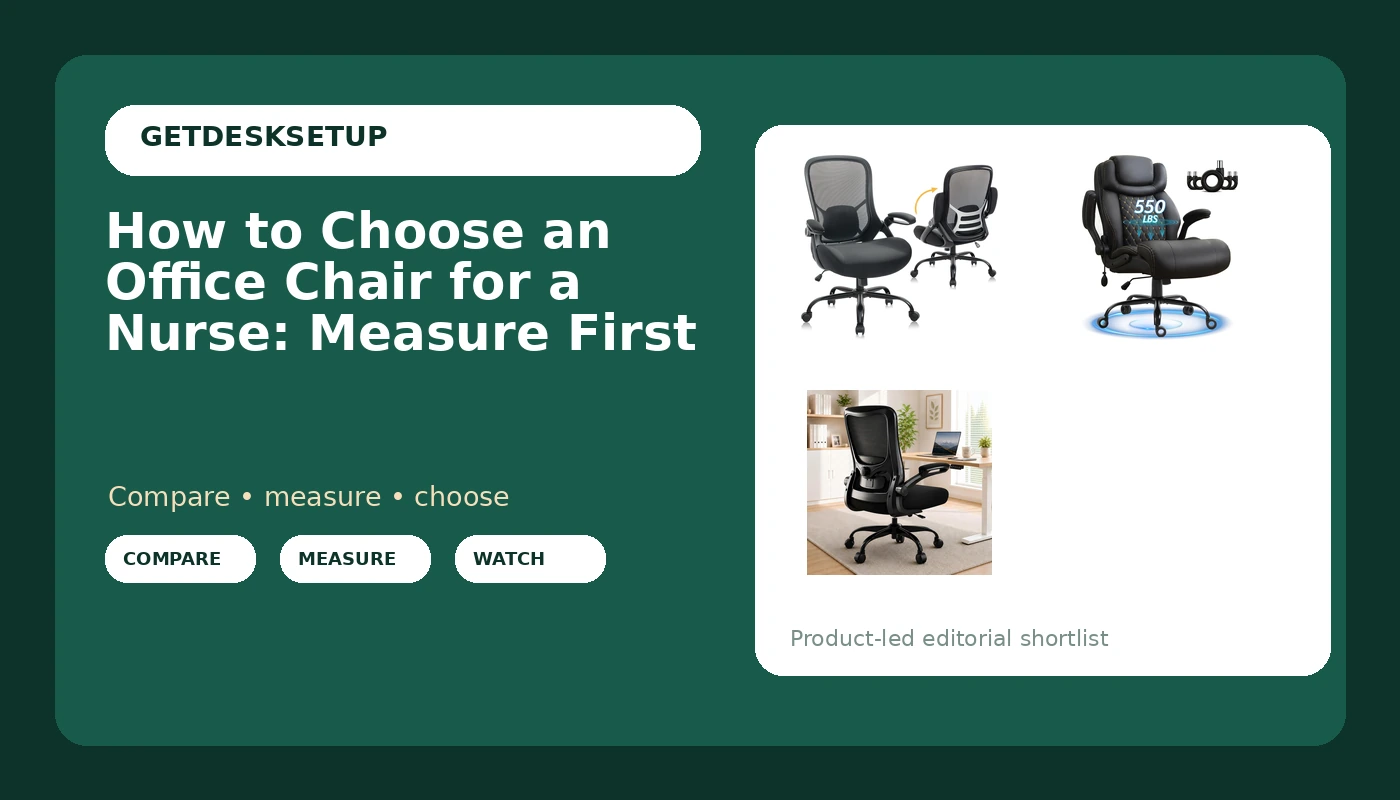
Three chairs, three different answers. When you choose a task chair for a nurse, the same three things break first on every model: the seat foam, the lumbar pad, and the armrest mechanism. Here is how these three handle that.
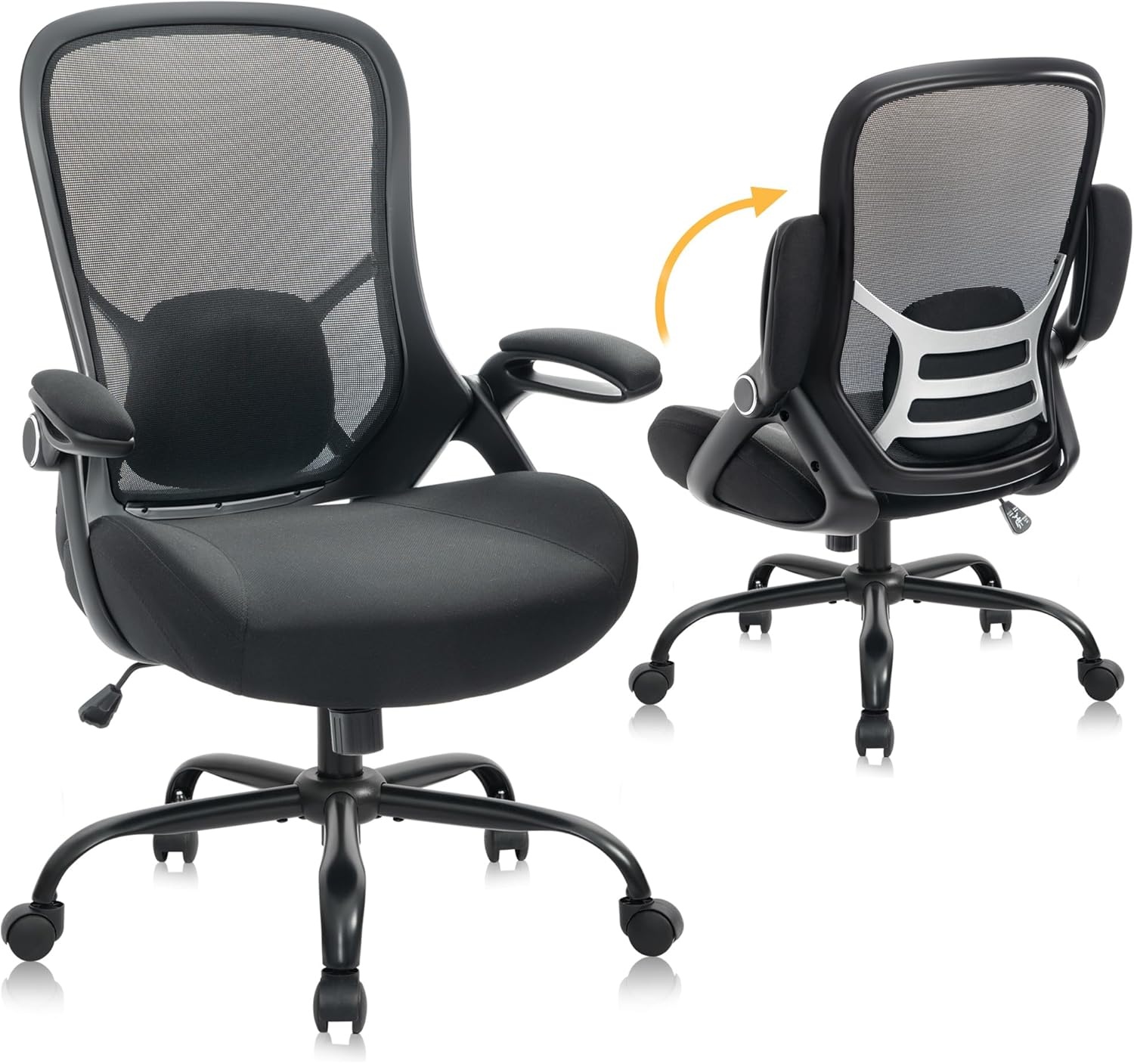
Our pick for long shifts: HYLONE 400lbs Heavy Duty Office Chair
Our pick for long shifts
HYLONE 400lbs Heavy Duty Office Chair
This is the chair I would put in a client's office if the client told me they were heavy, they sit for eight hours, and they never want to think about the chair again. The HYLONE 400lbs Heavy Duty Office Chair is rated to 400 pounds, and the seat is a 5 inch thickened pad rather than the 2 or 3 inches you get on a cheap mesh chair. That thickness is the whole point for a nurse. Foam that starts at 5 inches still has something left at year three. A thin pad is flat by month eight, and a flat pad is a hard seat with a mesh back.
The armrests adjust, so you can drop them low enough to slide under a fixed height desk. If your charting happens at a 29 inch table instead of a real desk, that adjustment is the difference between sitting square and sitting with your shoulders up around your ears. The mesh back moves air, which is worth something when you sit down after a shift still warm from the unit.
Who should skip it: if you are under about 5 foot 6 and under about 150 pounds, this is more chair than you need. A heavy duty frame with a thick pad can put your knees above your hips unless the seat height drops far enough for your feet to stay flat. Measure first, then decide.
Check current Amazon price. If the number works, this is the one that passes question four of my test: yes, I would leave it in a client's office for a year.
Best for big and tall nurses: Office Chair, Big and Tall Executive Chair with Air-Lumbar Support
Best for big and tall nurses
Office Chair, Big and Tall Executive Chair with Air-Lumbar Support
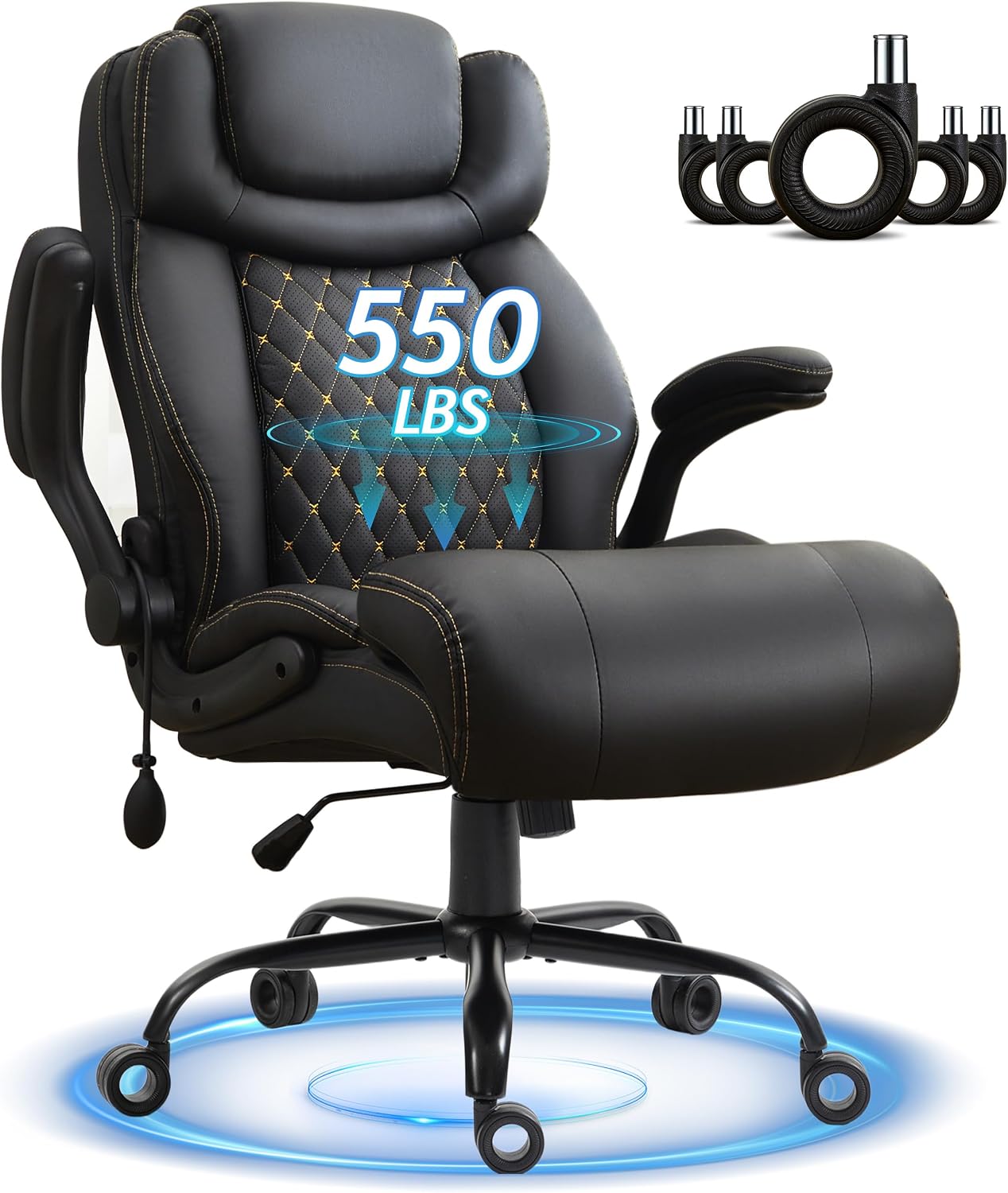
Big and tall is a category that gets abused, so here is what this one actually is: a wide cushion seat, a swivel base, a breathable backrest with air-lumbar support, and armrests that flip up out of the way.
The flip-up armrests are the feature I would pay for if I were a nurse. They let you pull the chair close to a keyboard tray with nothing blocking your elbows, and they let you push the whole chair under a fixed desk at the end of the night. The air-lumbar support adjusts, and that is the line I draw. A chair with a fixed lumbar bump fits one body and fights every other one.
Who should skip it: the listing does not publish a weight rating, so if you are over roughly 250 pounds, buy the 400 pound chair above instead and get the number in writing. If you are shorter than about 5 foot 5, the wide cushion puts the armrests further apart than your shoulders want. Flip them up, or drop to the chair below.
Check current Amazon price.
Best for lower back relief: Ergonomic Office Chair for Long Hours, Adjustable Padded Lumbar Support
Best for lower back relief
Ergonomic Office Chair for Long Hours, Adjustable Padded Lumbar Support
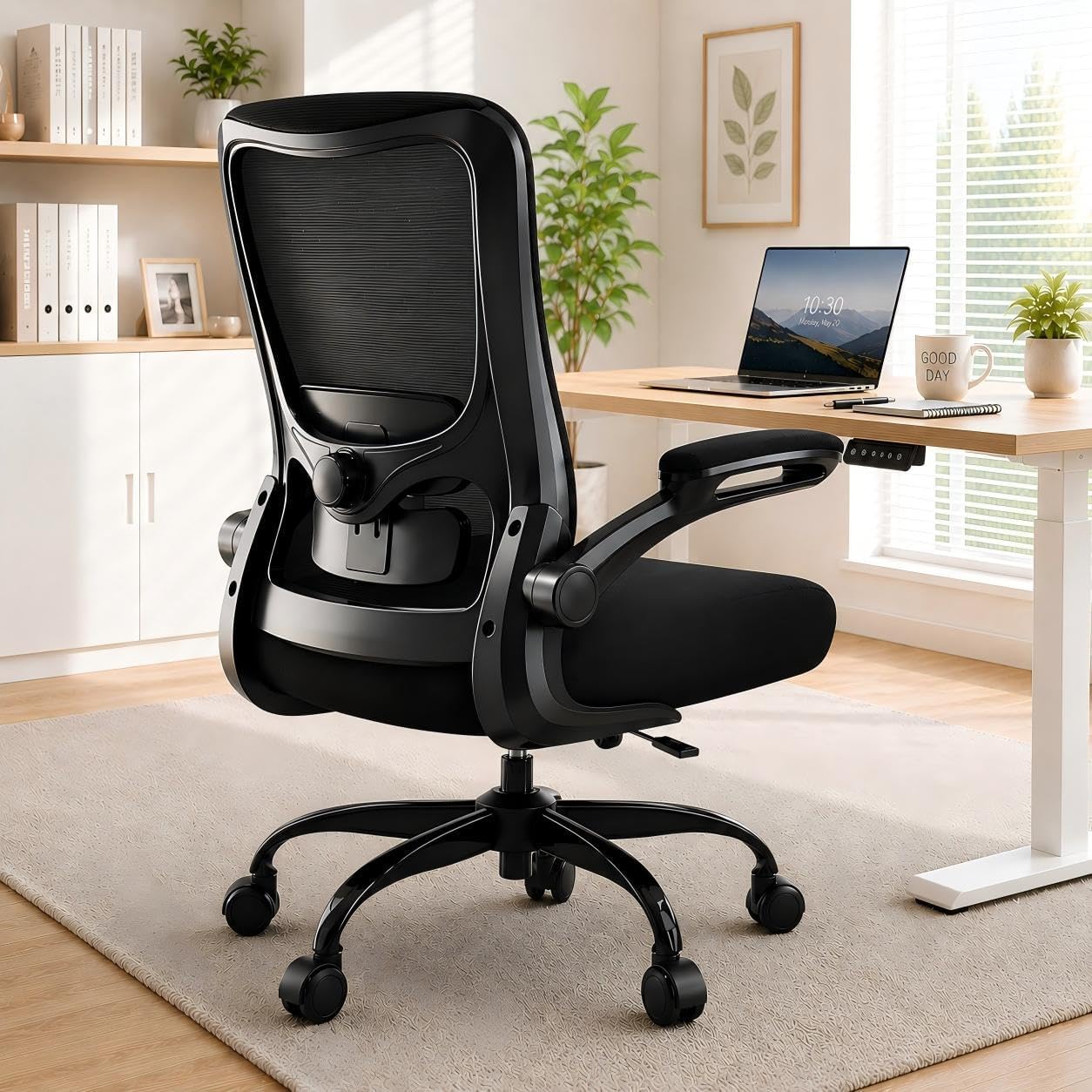
A 330 lb capacity and an adjustable padded lumbar support, which is the combination I look for when a nurse tells me the pain is not in the seat, it is in the lower back at hour nine. The lumbar pad moves, so you can set it at your belt line instead of letting a hard curve press into the middle of your spine. Padded is a different feel than molded plastic, and for a long shift it is the right one.
This is the chair I would point a 5 foot 4 to 5 foot 10 nurse at, in the 130 to 220 pound range, who wants lower back relief to be the point of the chair rather than a side effect. The listing markets it for long hours, home office, work, and study, and that is exactly the pattern: two or three hours of documentation after a shift, plus a full day off spent studying.
Who should skip it: if you are over about 250 pounds, a 330 lb rating leaves you less margin than I like, and the HYLONE's 400 pound frame is the safer call. If you want a headrest, none of these three advertise one, and I would not bolt a clip-on headrest onto a chair it was not designed for.
Check current Amazon price.
The actual fitting workflow
Eight steps, in order. Do them before you open a listing.
Step one: Measure your seat height. Sit on a hard chair with your feet flat and your knees at 90 degrees. Measure from the floor to the crease behind your knee. That is your seat height, plus or minus an inch. Most people between 5 foot 2 and 5 foot 6 land around 16 to 17 inches. Between 5 foot 10 and 6 foot 2, closer to 18 to 19. Then measure your desk from the floor to the underside. If the desk is 29 inches and the armrests will not drop below 27, the chair does not fit that desk, no matter how it feels in the store. If your charting happens at a kitchen table, the numbers you use to choose a desk chair for a nurse are the same, but the clearance under the tabletop is the measurement that will bite you.
Step two: Measure your seat depth. Sit against the back of a chair and measure from the back of your buttock to the back of your knee. Subtract two inches. That is your target seat depth. The gap is the point. If the front edge of the pan presses into the back of your calf, it cuts circulation and pushes your hips forward into a slouch. A 5 foot 4 nurse usually lands at 17 to 18 inches. A 6 foot nurse lands at 19 to 20.
Step three: Check the weight rating against your body plus your habits. A 330 lb rating is not a suggestion, and a 400 lb frame is not marketing. Add for the way you actually sit. If you drop into the chair at the end of a shift, or you sit with one leg tucked, you want margin above your body weight, not a number that matches it exactly.
Step four: Set the lumbar support at your belt line. Not the middle of your back. The pad should fill the inward curve just above your pelvis. Set it higher and it pushes your shoulders forward, then you round your upper back to get away from it. This is the single most common setup mistake I fix in client homes.
Step five: Set the armrests so your shoulders drop. Adjust until your forearms rest with your elbows at roughly 90 degrees and your shoulders are not shrugged. If the armrests are fixed and too high, flip them up or remove them rather than living with raised shoulders. Your shoulders are already loaded from patient handling. Do not add to it.
Step six: Set the recline and the tilt tension together. Most chairs have a recline lock and a tension knob. Set the tension so the backrest moves with you when you lean and does not slam backward when you do not. Then unlock the recline and let the chair move through 5 to 10 degrees while you type. A chair locked bolt upright is a chair you will slouch in by hour two.
Step seven: Decide on a headrest honestly. A headrest only does something if you recline past about 110 degrees. For charting and studying you are not leaning back that far, so a headrest is mostly a place to hang a jacket. If you chart in a reclined position with a laptop on your lap, then hunt for one, and know that none of the three chairs here advertise a headrest.
Step eight: Match the caster to your floor. Hard nylon casters are for carpet. Soft polyurethane casters are for hardwood, tile, and vinyl, because hard wheels scratch and grab. If your home office is a converted bedroom with carpet and your unit's break room is vinyl, that is a real difference. Most chairs ship with one set and sell the other separately, so budget for a second set if your floors are mixed.
Work those eight steps before you open a listing and the question of how to choose an office chair for a nurse turns into arithmetic. You will have a seat height, a seat depth, a weight rating, and an armrest clearance on a sticky note. Then the shopping takes ten minutes instead of ten weekends.
The competition and why it lost
The Herman Miller Aeron is the chair every nurse forum thread eventually lands on, and it is a genuinely good chair. It is not in this guide because it costs more than the three chairs above combined, and its sizing runs by letter rather than by measurement. You can spend that money and still get the wrong seat depth. If you have the budget, take the two measurements from step one and step two, then check them against the size chart before you order.
The Steelcase Leap is the other name that comes up, and adjustable seat depth is the reason. Same story. It solves the problem these three solve, at several times the cost, and it belongs in a different article.
The Branch Ergonomic Chair and the Sihoo M18 sit in the same price band as the chairs here, and both are reasonable picks. They are not in this piece because this piece is built around three chairs with a published weight rating and adjustable lumbar support, and the point of the article is the measurement workflow, not a brand ranking.
Gaming chairs lose on one specific thing: the side bolsters. They push your shoulders forward, which is the opposite of what a nurse with tight upper traps needs.
The other loser is the cheap big-box special with a fixed lumbar bump and no published seat depth. It is not that it is badly made. It is that you cannot tell whether it fits you, and a chair you cannot measure is a chair you are guessing on.
What this all costs
Three chairs, three budgets, and one number that does not change: the measurement workflow. Prices move, so check current Amazon price on each of the three before you decide, but here is how I think about the money.
A chair is one of the few things in a home office you buy once and use for five years. Five years is 1,825 days, so every the quoted price of purchase price is about 5.5 cents a day. That is the math that makes the gap between the cheapest chair and the right chair look small. If the right chair costs the quoted price more than the wrong one and lasts the same five years, you are arguing over 1.6 cents a day. The checklist you use to choose an office chair for a nurse does not change with price. Only the frame and the foam do.
Where the money actually goes:
- Frame and weight rating. The 400 pound frame is the expensive part, and it is the part that keeps a heavy sitter out of a warranty claim at year two.
- Seat foam thickness. Five inches of foam costs more than two, and it is the reason a chair still feels like a chair at year three.
- Adjustability. Adjustable lumbar and adjustable armrests add hardware, and hardware adds cost. It is also the difference between a chair that fits you and a chair that fits the average of everybody.
- Casters. A second set of soft wheels is a small line item that saves a hardwood floor.
What I would not spend money on: a headrest you will not use, a footrest, and a chair with a built-in massage function. None of those fix a seat depth that is wrong.
For most nurses, the answer is the middle of the range, with an adjustable lumbar pad and armrests that drop low enough to clear the desk. Take the four measurements, write them down, and the rest is a ten minute decision.
That is the job. Your back already does enough overtime.