Poor circulation in the legs is one of the quieter reasons a long workday leaves you stiff and heavy. The link between an office chair and poor circulation is mostly mechanical, and it gets easier to see once you name the parts. A seat edge that presses into the back of your thighs, a seat pan deeper than your thigh length, a back angle that never changes, and armrests set too high all reshape how you sit, and how you sit decides where pressure lands. This guide explains what a chair can and cannot influence, then walks through four current models that approach seat height, seat depth, lumbar support, and recline in different ways.
Related: Office Chair Seat Depth: How to Measure Yours →
Quick answer
No chair treats a circulation condition, and numbness, swelling, or pain that outlasts your workday is a question for a clinician, not a product page. What a chair controls is the mechanical side: whether the seat edge lands under your thigh or behind your knee, whether your feet reach the floor, whether your back angle can change through the day, and whether your shoulders stay down. Set seat height so your feet rest flat, set seat depth so two or three fingers fit behind your knee, and use recline and tilt tension to shift position instead of holding one shape for eight hours. The four chairs below solve those problems differently, and each one has a group of buyers who should skip it.
4 useful options
| Model | Best fit | What stands out |
|---|---|---|
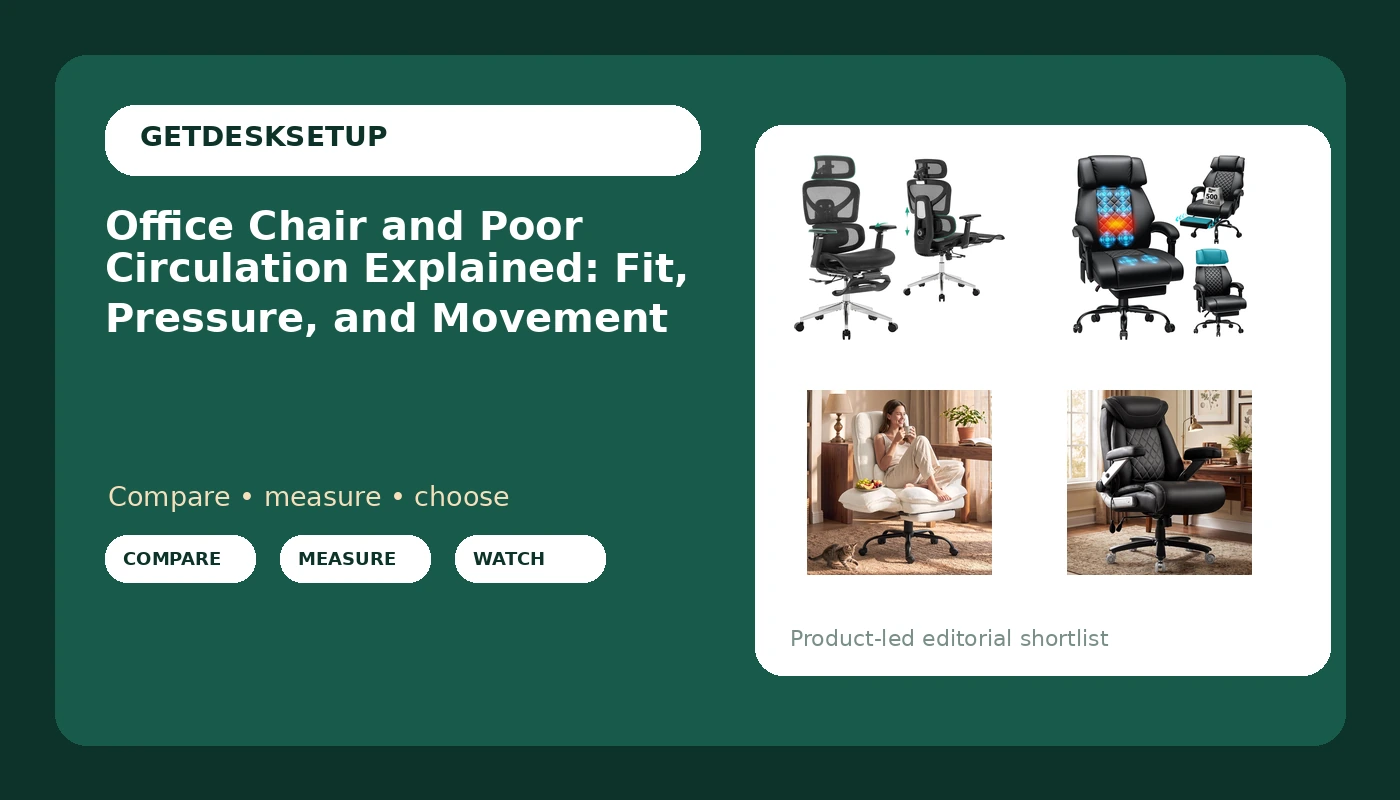
| Cozyman Ergonomic Office Chair with Footrest | Long days with frequent posture changes | 5-level adjustable lumbar support, 90 to 135 degree recline, 3D headrest, 4D armrests |
| HOFFREE 8-Point Vibration Massage Office Chair with Heat | Buyers who want heat and vibration in the chair itself | Eight vibration points plus heat, built for a home office |
| Wider Seat Office Chair with Flip Armrests | Sitting cross-legged, and homes with cats | Extra wide seat, flip armrests, teddy fleece cover, footrest, lumbar pillow |
| 600LBS Large Big and Tall Office Chair | Heavier users who need a wide, reinforced seat | 600 lb rating, 5D flip arms, extra wide padded seat, adjustable lumbar support |
The everyday adjustable chair: Cozyman Ergonomic Office Chair with Footrest – 5-Level Adjustable Lumbar Support & 90-135°Recline, 3D Headrest & 4D Armrests, Mesh Seat Computer Chair for Home Office, Gaming, Black
For circulation, the useful part here is adjustability rather than the mesh. Five lumbar positions mean the curve in the backrest can move to a spot that lets you sit back without slumping, and slumping is what pushes weight onto the front edge of the seat. The 4D armrests let you drop your shoulders, which matters because armrests set too high lift the shoulder girdle and tip you forward. The 90 to 135 degree recline range is the feature I would use most: changing back angle moves load off the same patch of thigh and glute. The footrest is a real feature, not decoration, but it only helps if the seat height still lets your feet reach the floor when the footrest is stowed. If you are under roughly 5'4", check the minimum seat height before ordering, and if you want a lounger rather than a task chair, this is the wrong tool. It reclines; it does not lounge.
The heat and vibration option: HOFFREE 8-Point Vibration Massage Office Chair with Heat for Home Office
Heat and vibration are the two features people associate with circulation, so it is worth being precise about them. They are comfort features built into the chair, not a treatment, and the honest reason to buy this one is that you want them and will actually switch them on. Everything else still has to fit. The seat height has to put your feet flat, the seat depth has to leave clearance behind the knee, and the lumbar support has to be adjustable enough that you can sit back into it rather than perching forward. Buy this chair for the heat and the eight vibration points, then judge the rest on the same measurements you would apply anywhere else. If what you want is a chair that helps you hold a neutral posture, the Cozyman above covers that ground with more adjustment.
The wide seat and cross-legged pick: Wider Seat Office Chair with Flip Armrests for Criss Cross Legged&Cats, Big and Tall Executive Ergonomic Reclining Chair with Footrest&Lumbar Pillow, Teddy Fleece Desk Chair,White Vanity Chair
Sitting cross-legged is one of the most common ways people try to rescue a chair that does not fit, and it is also why a narrow seat pan becomes a problem in the first place. A wider seat lets you bring a leg up without perching on the edge, and flip armrests get the arm out of the way when you do it. The trade-off is real: a wider seat pan means the effective seat depth is longer for a smaller person, so if you are short, the front edge can land behind your knee instead of under it, which is exactly the pressure point you are trying to avoid. The teddy fleece cover is a genuine difference from mesh in winter, and a genuine difference in July. Buy this if you sit cross-legged, share the chair with a cat, or want a softer surface under you. Skip it if you need firm, breathable mesh and a narrow, precise seat.
The heavy-duty wide seat: 600LBS Large Big and Tall Office Chair, Heavy Duty Wide Ergonomic Gaming Office Chair with 5D Flip Arms, Comfy PU Leather Executive Office Desk Chair, Extra Wide Padded Seat, Adjustable Lumbar
Weight capacity is the headline, and it is the reason this chair exists: a 600 lb rating, a wide padded seat, and a reinforced base. For heavier users the pressure question usually comes first, because a seat that is too narrow concentrates load in a small area and a seat that is too shallow puts the front edge under the thigh. An extra wide padded seat spreads that load, and 5D flip arms let you set the armrest where your forearm actually lands. The PU leather is the compromise. It does not breathe the way mesh does, so long sessions in a warm room feel different, and if you run hot, plan around that. Check the seat height range against your own leg length before ordering, because a heavy-duty chair that sits too high is still the wrong chair.
Prices and availability may change. Product images, names, and retailer links are matched to verified listings. No current price, rating, stock status, or measured result is stated here without current evidence.
Office chair and poor circulation explained: what the chair actually changes
The office chair and poor circulation explained in one paragraph: the chair sets your posture, your posture sets where pressure lands, and pressure plus stillness is what most people are actually feeling at the end of a long day.
Sitting is not the problem by itself. Sitting still in one shape for hours is. When your hips hold one angle and your thighs rest on the same part of the seat, the tissue behind the knee and under the thigh takes load that barely changes. The chair does not control blood flow. It controls four mechanical inputs that make the load better or worse:
- Seat edge pressure. If the front edge of the seat sits behind your knee, it presses into the soft tissue at the back of the thigh. This is the most common chair-side explanation for a heavy-leg or numb feeling.
- Seat depth. Too deep and the edge digs in behind the knee. Too shallow and your weight concentrates on a smaller patch instead of spreading across the thigh.
- Back angle. A backrest locked upright keeps the hip at one angle all day. Recline and tilt tension exist so you can change that angle without giving up support.
- Armrest height. Armrests that sit too high lift your shoulders and tip you forward, which moves load onto the front of the seat.
What the chair cannot do is worth saying out loud. It cannot treat a circulation condition, and it cannot replace standing up. The desk chair and poor circulation conversation gets muddled because people expect furniture to solve a medical problem. It will not. It can remove the mechanical causes it owns, and that is the honest scope of the claim.
Seat height, seat depth, and the rest of the measurement list
Every other adjustment sits downstream of seat height. Set it first. With your shoes on, your feet should rest flat and your knees should be level with your hips or slightly below. If the chair will not go low enough, a footrest fixes it. If it will not go high enough, no cushion fixes it.
Seat depth comes second. Sit all the way back against the lumbar support and slide two or three fingers behind your knee. If they fit, the depth is close. If the seat edge already touches the back of your leg, the seat is too deep for you, and no amount of lumbar support will rescue that.
Then the rest, in the order I would set them:
- Lumbar support: it should land in the small of your back, not at your shoulder blades. Adjustable is the point.
- Armrest: set them so your forearms rest with your shoulders down. If they only go up, they are part of the problem.
- Recline and tilt tension: pick an angle you can hold without gripping the desk, then set tilt tension so the chair follows you back instead of fighting you.
- Headrest: useful for reclined work and video calls, useless if it pushes your chin forward.
- Caster: on hardwood, soft rolling casters cut the shuffle that makes you drag the chair instead of rolling it, and dragging pulls you out of a good position.
The task chair and poor circulation link runs through all of it. A task chair set wrong creates the pressure; the same chair set right removes it.
The setup order that fixes the pressure points
- Set seat height with your shoes on: feet flat, knees level with or just below the hips.
- Set seat depth so two or three fingers fit behind your knee with your back against the backrest.
- Set lumbar support to the small of your back, then set armrest height until your shoulders drop.
- Set a slight recline and tune tilt tension so the chair moves with you rather than against you.
- Stand up and reset at least once an hour. No adjustment list replaces that step.
Practical guidance for a full workday
- Change back angle at least twice an hour. Even a small change in recline moves load off the same patch of thigh.
- Keep the floor under the desk clear. A bag or box pushes your feet forward and rotates your hips, which changes where the seat edge lands.
- Add a footrest only if you need one. If your feet already reach the floor, a footrest raises your knees and adds pressure behind the thigh.
- Check the caster and the floor together. A chair that rolls badly on thick pile gets dragged, and dragging resets your position every time.
- Sit back. Perching on the front third of the seat puts the edge under your thigh, which is the exact pressure point this article is about.
- If numbness, tingling, or swelling does not settle after you stand up, treat that as a medical question and talk to a clinician. Nothing here changes that.
Which option should you choose?
Choose the Cozyman Ergonomic Office Chair with Footrest when you want the most adjustability in this group and you plan to change posture through the day, since five lumbar positions, a 90 to 135 degree recline, and 4D armrests give you the most ways to move load off one spot. Choose the HOFFREE 8-Point Vibration Massage Office Chair with Heat when heat and vibration are features you will actually use, and judge its seat height and seat depth on the same terms as any other chair. Choose the Wider Seat Office Chair with Flip Armrests when you sit cross-legged, want a softer teddy fleece surface, or share the chair with a cat, and only if the wider seat still leaves clearance behind your knee. Choose the 600LBS Large Big and Tall Office Chair when you need a 600 lb rating and an extra wide padded seat, and accept the PU leather as the trade for that reinforced build.
One caveat: none of these four is a medical device, and no listing states a measured circulation outcome. The ergonomic chair and poor circulation claim is a fit claim, not a health claim. What the listings do state is what you can verify: seat height range, seat depth, adjustable lumbar support, armrest movement, recline range, and weight rating. Check those against your own measurements before ordering, and check current Amazon price rather than a number quoted in an old review.
The bottom line
An office chair and poor circulation problems connect through pressure and stillness, not through brand or price. Set seat height first, set seat depth second, keep lumbar support in the small of your back, and use recline and tilt tension to change position instead of holding one shape for eight hours. If you want the most adjustment in this group, the Cozyman is the one to compare against. If heat and vibration are why you are shopping, the HOFFREE has them built in. If you sit cross-legged or want a wide, soft seat, look at the Wider Seat chair. If you need a high weight rating and a reinforced wide seat, the heavy-duty 600 lb model is built for that. Any of the four can be the right chair, and any of them can be the wrong chair if the seat height and seat depth do not match your body. Measure first, then buy.