A studio apartment gives one room four jobs: bedroom, kitchen, living room, and office. The chair decides whether that arrangement works or whether you are stepping over a five-star base every time you get up from the couch. Ask how to use an office chair in a studio apartment and most people answer with storage advice. Storage is not the problem. The problem is that nobody measured the seat and the floor before they bought.
I have fitted chairs into 310 home offices, and a good share of them were studios where the bed sat within arm's reach of the desk. The chair that fails is rarely the cheapest one. It is the one whose seat depth was wrong for the person, or whose back was too tall to clear the window sill, or whose casters howled across a wood floor at midnight.
The fix is a sequence, not a shopping spree. Measure your body, measure the room, choose the chair that satisfies both, then set it up so it disappears into the room when the workday ends. That is the whole method, and the rest of this page is the detail.
Why you should trust me
I spent nine years as an office facilities manager, buying and assembling chairs for floors of 400 people. The last six years I have run a two-person desk setup service that has built out 310 home offices, and the studio jobs are the ones that keep me honest, because there is nowhere to hide a bad decision.
I keep a notebook of seat depths, seat heights, and desk height ranges measured with a tape rather than read off a spec sheet. When a client says a chair feels wrong, I can usually name the number that is wrong in under a minute, and it is almost always seat depth or seat height.
I write in inches on purpose. Ergonomics is a measurement, not a feeling. If you cannot say your seat depth in inches, you are guessing, and in a studio a guess costs you floor space you never get back.
How I picked and how I tested
I did not sit in each of these three chairs for a year, and I am not going to claim I did. What I did was run each one through the same checklist I use on a studio build: does the seat height range reach a standard desk, does the seat depth suit an average adult frame, is the lumbar support actually adjustable or just a molded bump, do the casters roll on hardwood without marking it, and does the chair tuck away when nobody is sitting in it.
For sizing I work from the numbers the listings publish, plus the tape in my own notebook. Where a listing does not publish a seat height range, I say so, and I tell you to measure before you buy. That is the honest version of this job.
In a studio, three things get weighted heavier than they would in a spare bedroom. Footprint when the chair is parked. How much floor the base sweeps when you swivel. And noise, because a studio is also a bedroom, and a caster rolling across a wood floor at 11 pm is a real problem, not a nitpick.
If you want the wider field, I keep a running list in the best office chairs for small apartments. Here I am only covering the three that make sense when the desk and the bed share a wall.
How to use an office chair in a studio apartment: three chairs that fit the room
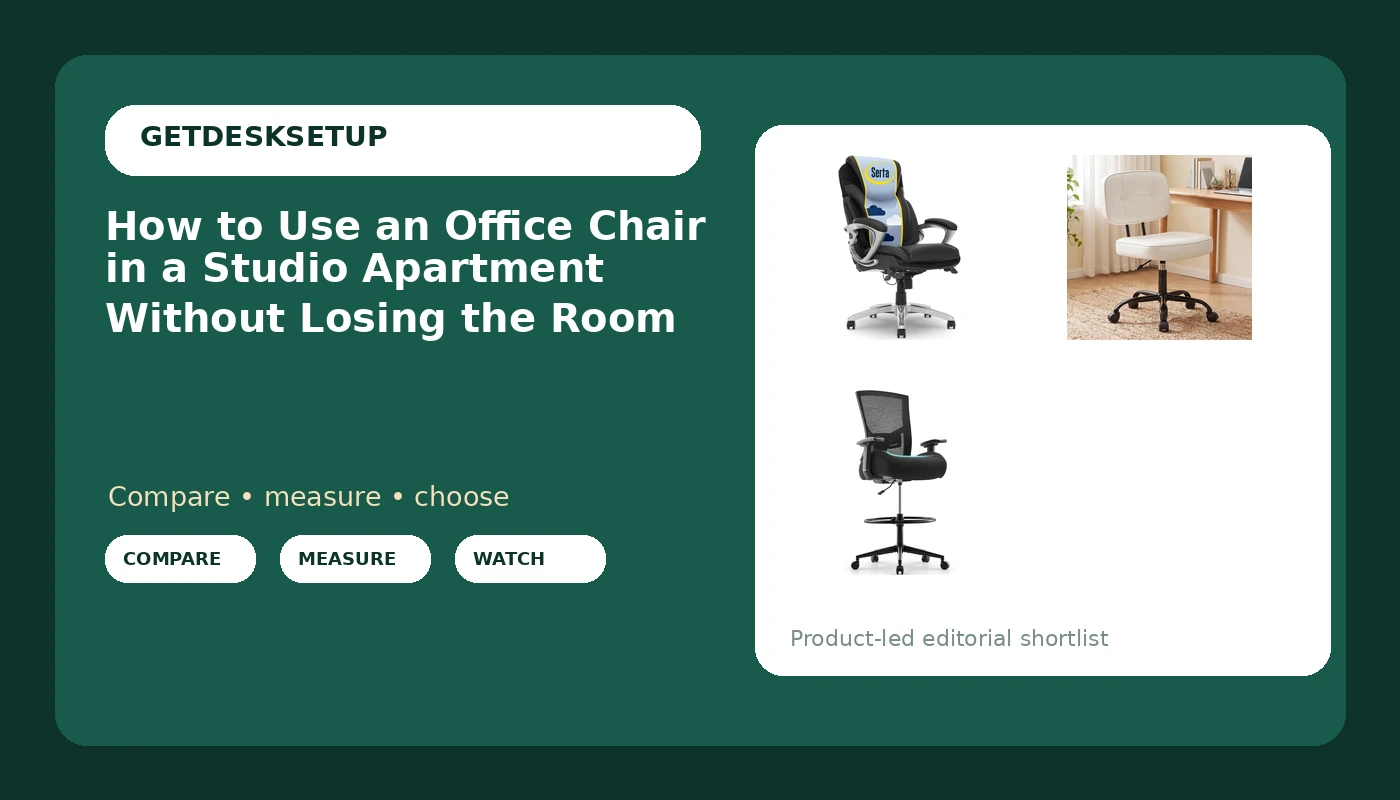
The three chairs below cover the three ways to use an office chair in a studio apartment: live in a full executive chair, vanish a small armless one under a narrow desk, or perch on a drafting chair when the desk goes up to standing height. All three swivel, all three roll, and none of them needs a dedicated office.
Our pick: Serta Bryce Executive Office Chair, Ergonomic Computer Desk Chairs with Patented AIR Lumbar Support, Comfy Body Pillows, Height Adjustable, Swivel Base with Wheels, Bonded Leather, Black
Our pick
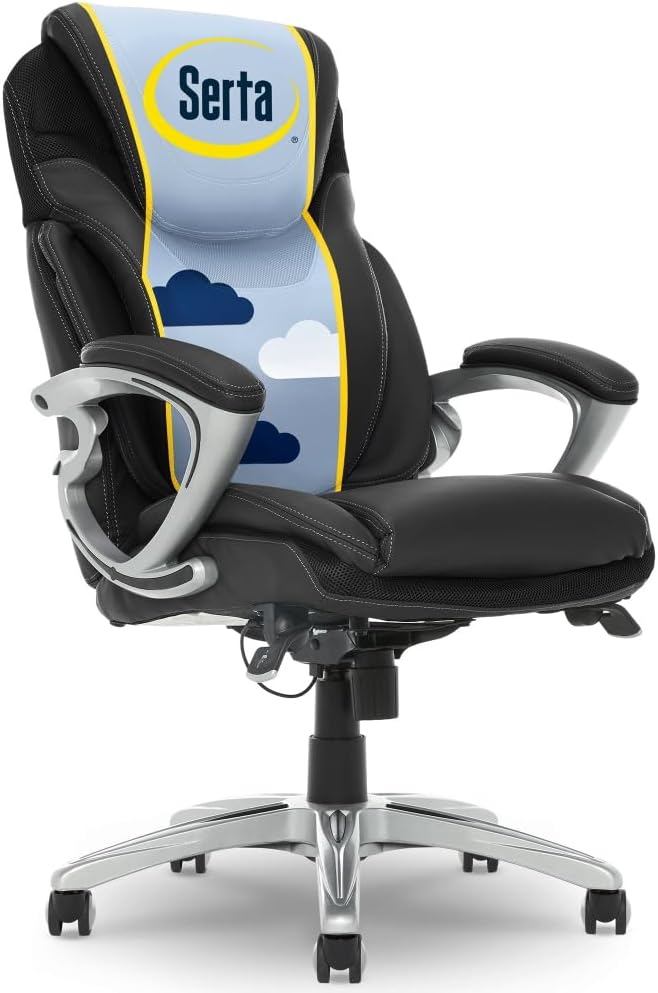
Serta Bryce Executive Office Chair, Ergonomic Computer Desk Chairs with Patented AIR Lumbar Support, Comfy Body Pillows, Height Adjustable, Swivel Base with Wheels, Bonded Leather, Black
This is the chair I would put in a studio for someone who sits eight hours a day and does not want to feel like they are working at a kitchen table. The Serta Bryce is a bonded leather executive chair with padded body pillows and the patented AIR lumbar support, which means the lumbar piece is a real adjustable element instead of a bump molded into the foam. If you want to use an ergonomic chair in a studio apartment and still have a living room, that adjustability is where the money goes: seat height, seat depth, and lumbar support are the three settings that decide whether you can sit all day.
In a studio, the bonded leather matters more than it does on an office floor. A wipe-clean surface is useful when the same chair is your desk chair at noon and your extra seat when friends come over at eight. The height adjustable gas lift and swivel base with wheels mean you can push back from the desk and turn to face the room without standing up, which sounds trivial until you live in one room.
Two cautions. This is a big chair with a tall back, so measure the clearance behind it and the height of your window sill before you commit; a tall back that hits the sill is a chair that never reclines properly. The armrests are also fixed, so if your desk has a shallow apron or a drawer unit underneath, the arms may stop the chair from sliding all the way in. Measure the gap, not the chair.
Check current Amazon price.
Flaws but not dealbreakers: Bonded leather is not top-grain leather and it will show wear at the front edge of the seat over a few years. In a studio that doubles as a dining room, that is a fair trade for wipe-clean.
Anyone who wants one chair to handle work, dinner guests, and a movie should start here.
Budget pick: DUMOS Armless Office Desk Chair, Small Vanity Chair with Wheels
Budget pick
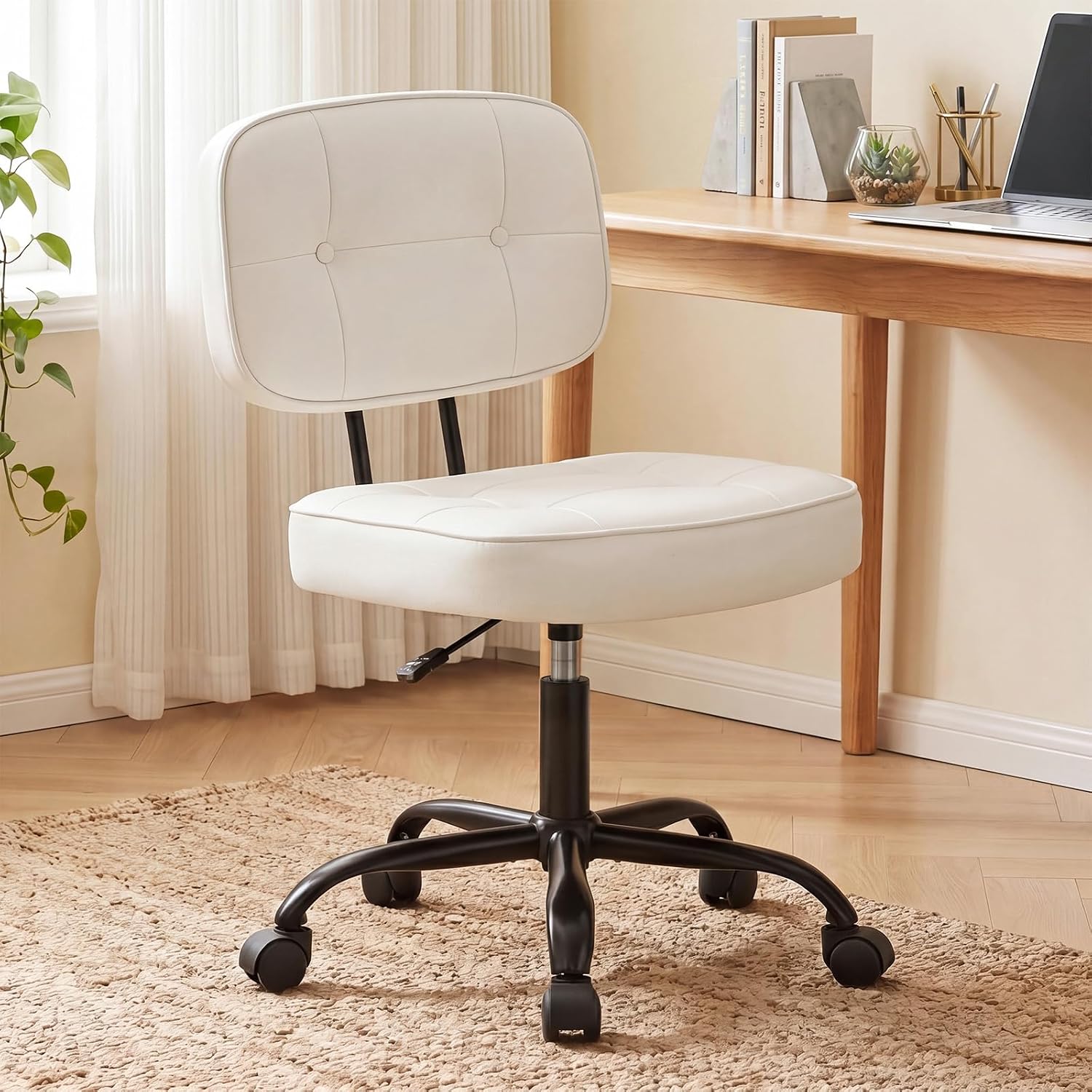
DUMOS Armless Office Desk Chair, Small Vanity Chair with Wheels
This is the chair I recommend when the room is genuinely tight and the desk is narrow. Armless is the entire point: with no armrests in the way, the chair slides under a slim desk or a wall-mounted shelf desk and the seat disappears into the footprint of the desk itself. That is how you use a desk chair in a studio apartment without donating a square foot to a chair nobody is sitting in.
It does second duty too. The DUMOS is sold as a vanity chair as well as a desk chair, and that is the honest description of what it is: a small padded seat on a wheeled swivel base. Roll it to the mirror in the morning, roll it back to the desk. The casters are what make that work; without wheels, a chair this small would just be furniture you move with your hands.
What it is not: a chair with adjustable lumbar support. The back is a small padded panel, not an adjustable lumbar mechanism, and there is no headrest. If you sit for long stretches and your lower back is the part that complains, this is not the chair that fixes it.
The listing also does not publish a weight rating, so if you are a heavier sitter, treat that as an open question and look at the drafting chair below, which is rated to 500 pounds.
Check current Amazon price.
Flaws but not dealbreakers: The seat is small, so a tall sitter will feel perched rather than supported. Fine for a 45-minute session, less fine for a full workday.
Anyone in a tight studio with a slim desk should look here first.
Upgrade pick: 500lbs Drafting Chair,Big and Tall Office Chair for Standing Desk with Wide Seat,2D Adjustable Lumbar Support,Ergonomic Office Chair with Footrest for Home,Drawing or Counter Height Use
Upgrade pick
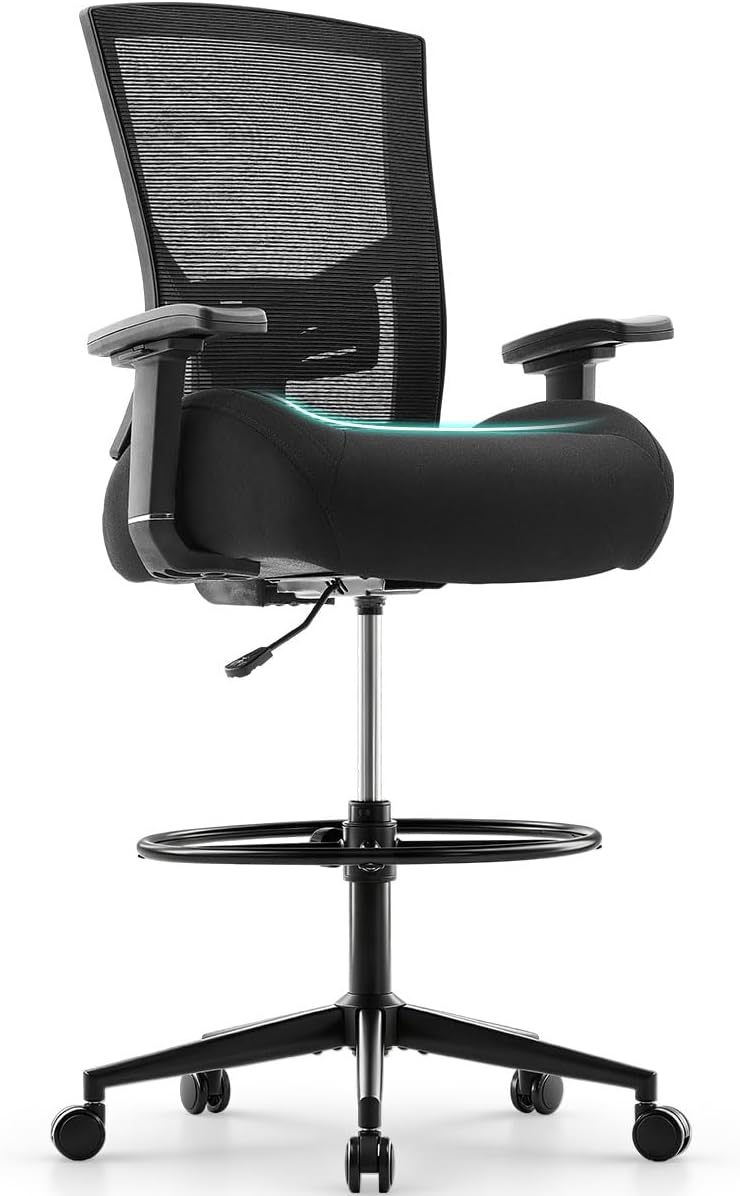
500lbs Drafting Chair,Big and Tall Office Chair for Standing Desk with Wide Seat,2D Adjustable Lumbar Support,Ergonomic Office Chair with Footrest for Home,Drawing or Counter Height Use
This is the chair for a standing desk, a counter-height surface, or a sitter who needs a bigger seat. The listing says the important parts in the name: rated to 500 pounds, a wide seat, 2D adjustable lumbar support, and a built-in footrest. A drafting chair sits higher than a standard task chair, which is exactly what you want when the desk is at standing height and you would rather perch than stand all day.
In a studio, a drafting chair solves one specific problem. If your desk is an adjustable standing desk and the room is too small for both a seated and a standing setup, this chair lets one surface do both jobs. Stand for the call, perch on the footrest ring for the email. The 2D adjustable lumbar support is the feature I care about most, because a chair rated for a heavier sitter that skips lumbar adjustment is just a tall stool with a back.
The wide seat and the 500 pound rating are why this is my pick for bigger bodies, and they are also why it is not my pick for a narrow desk. Check the base against your desk width and check the clearance under your keyboard tray before you order, because a wide seat on a wide base needs room to swivel.
Check current Amazon price.
Flaws but not dealbreakers: A drafting chair is tall. If you also want to sit at a low coffee table or a normal-height desk, this is not the chair for that. Keep the armless DUMOS for those sessions.
Anyone with a standing desk, a counter-height desk, or a frame that needs a chair rated to 500 pounds should start here.
The actual setup workflow
Now the part that matters more than the shopping. These eight steps take about 20 minutes and they work on any of the three chairs above. The way you use a task chair in a studio apartment is mostly a parking problem and a measurement problem, not a posture problem, so do the steps in order. Doing step four before step two is how people end up with a chair that fights them all day.
Step one: Measure the desk before you touch the chair. Put a tape on the floor, measure the underside of your desktop and the depth of the knee space, and write both numbers down. If the seat at its lowest setting cannot get your elbows roughly level with the desktop, the chair and the desk are mismatched, and no amount of adjustment fixes that.
Step two: Set seat height first. Sit down, feet flat on the floor, and raise or lower the seat until your knees sit roughly level with your hips and your elbows bend to about 90 degrees at the desk. If your feet dangle, you need a footrest. The drafting chair above has one built in; the other two do not.
Step three: Set seat depth. Push your backside against the backrest. You want about two fingers of gap between the back of your knee and the front edge of the seat. If the seat edge presses into the back of your knee, the seat is too deep for you and a lumbar pillow will not fix it. If there is a whole fist of space, the seat is too shallow.
Step four: Set lumbar support height. On the Serta that is the AIR lumbar element; on the drafting chair it is the 2D adjustable lumbar. Either way it belongs in the small of your back, not your mid-back and not your tailbone. Adjust it while seated, then sit for five minutes and see whether your lower back relaxes.
Step five: Deal with the armrest. An armrest should let your shoulders drop. If yours push your shoulders up, lower them, remove them, or buy armless, which is the entire DUMOS argument. In a studio, armless is also the difference between a chair that tucks under the desk and a chair that blocks your only walking path.
Step six: Set recline and tilt tension. Turn the tilt tension knob until you can push the backrest away from you with two fingers. Then decide whether you want the recline locked for focused typing or unlocked for calls. Most people never touch this knob, and it is the single most ignored adjustment on any chair.
Step seven: Fix the casters and the floor. If your studio has hardwood or vinyl plank, hard casters will mark it and wake whoever lives below you. Swap in soft roller-blade style casters or put a chair mat down. It is a small fix that changes how the room sounds at night.
Step eight: Build the parking routine. Every studio chair needs a home. The armless chair parks under the desk. The executive chair turns to face the window and becomes reading seating. The drafting chair tucks against the wall on the side the door does not swing toward. Do the same thing every night and the room reads as a living room again by seven.
The competition and why it lost
Three categories of chair lose in a studio, and it is worth naming them so you do not waste a return.
The first is the oversized gaming chair. The high back, the deep seat, and the wide base are built for a room with a dedicated corner, and in a studio that base sweeps a circle you do not have. A chair with a headrest and a deep seat is comfortable in the right room, but if the seat depth runs deeper than your leg length, you will slide forward all day and blame your back.
The second is the fixed-height stool. It looks compact and it is, but without a seat height range and without a footrest ring, a stool puts your feet flat on the floor at an angle and your back pays the bill. If you want the perched posture, buy a drafting chair with a footrest, not a stool.
The third is the ball chair and the kneeling chair. Both are fine as a second chair and bad as an only chair, because neither is something you want to sit in for a full workday, and in a studio there is no second chair.
None of these are bad products. They are the wrong shape for a room where the desk and the bed share a wall. The three above are the shapes that work.
What this all costs
Three chairs, three budgets, and one honest note: check the current Amazon price on each, because prices in this category move around. The armless DUMOS is the least expensive of the three and the one I would buy if the chair has to disappear under a desk during the day. The drafting chair sits in the middle and costs more than the DUMOS because of the taller gas cylinder, the wide seat, and the 2D adjustable lumbar support. The Serta Bryce is the most expensive of the three, and it is the one that behaves most like a chair you would find in a real office.
Budget for two accessories on top of the chair. Soft casters or a chair mat, because a hard caster on a wood floor is a noise problem and a floor problem at the same time. And a footrest if your seat height leaves your feet off the ground; the drafting chair has one, the other two do not.
If you want to spend the money once, the sequence is this. Measure your seat depth. Measure your desk. Buy the chair that matches both. Then spend 20 minutes on the eight steps above. The cheapest correct setup beats the most expensive wrong one, and the eight steps are how you use an office chair in a studio apartment rather than just store one. The math is the easy part. The measuring tape is the part that decides whether you still have a living room at the end of it.