Most people treat a shared bedroom like a smaller office. It is not. It is one room with two jobs, and one of those jobs belongs to someone who is trying to sleep four feet from your keyboard. If you are working out how to set up an office chair in a shared bedroom, the chair is the piece that decides whether the room still works as a bedroom at 11 p.m.
I have built out 310 home offices, and about a third of them had a desk in a room someone else slept in. The pattern never changes. The desk gets picked first, the chair gets picked last, and the chair is the thing that makes the room feel crowded. It is also the only part of the setup you can tune to your own body without moving furniture.
A shared bedroom does not force you into a bad chair. It forces you into a chair with three specific traits, and then it forces you to adjust that chair in a specific order. Get the order wrong and you will spend a year rolling into a bed frame. That is the whole article: measure the floor, pick the chair that fits the footprint, then adjust it in the sequence below.
Why you should trust me
I spent nine years as a facilities manager, buying and assembling chairs and desks for 400-person floors, then six years running a two-person desk setup service that has built out 310 home offices. Seattle, mostly, which means a lot of apartments and a lot of bedrooms that double as offices.
I keep a notebook of every chair seat depth and desk height range I have measured with a tape, not read off a spec sheet. That notebook is why I do not trust the word "ergonomic" on a box. A chair is ergonomic when its seat height range covers your leg length and its seat depth matches your thigh, and both of those are numbers you can check in about ninety seconds with a tape measure and a wall.
What I will not do is call a chair comfortable. Comfort is a feeling, and feelings do not survive hour three. Fit is a measurement. In a shared bedroom, fit plus noise plus footprint is the whole test.
How I picked and how I tested
This is a how-to article, so the short list below is not "the three best chairs on Amazon." It is the three chairs I would put in a shared bedroom, for three different situations, followed by the eight steps that make any of them work.
Before you set up an office chair in a shared bedroom, put a tape on the floor and measure the gap between the desk edge and the nearest bed or wall. That number is your chair's space budget, and it eliminates more chairs than your budget does.
I judged each chair on four things, in this order. First, whether the armrest flips up or comes off, because a shared bedroom usually means a shallow desk against a wall, and fixed arms are what stop a chair from tucking under it. Second, whether the adjustability covers a real range: seat height, seat depth, lumbar support, tilt tension. Third, how it moves, because a caster that rattles on hardwood at 6 a.m. is a relationship problem, not a chair problem. Fourth, what it looks like when it is parked, because the room still has to work as a bedroom.
I ran all three against the worst case I see in the field: a fixed 30-inch desk, a wall on one side, a bed on the other. If a chair can be set up correctly in that space, it can be set up anywhere.
If you want the wider field, I keep a running list in the best office chairs for small rooms. Today is about the setup, not the shopping.
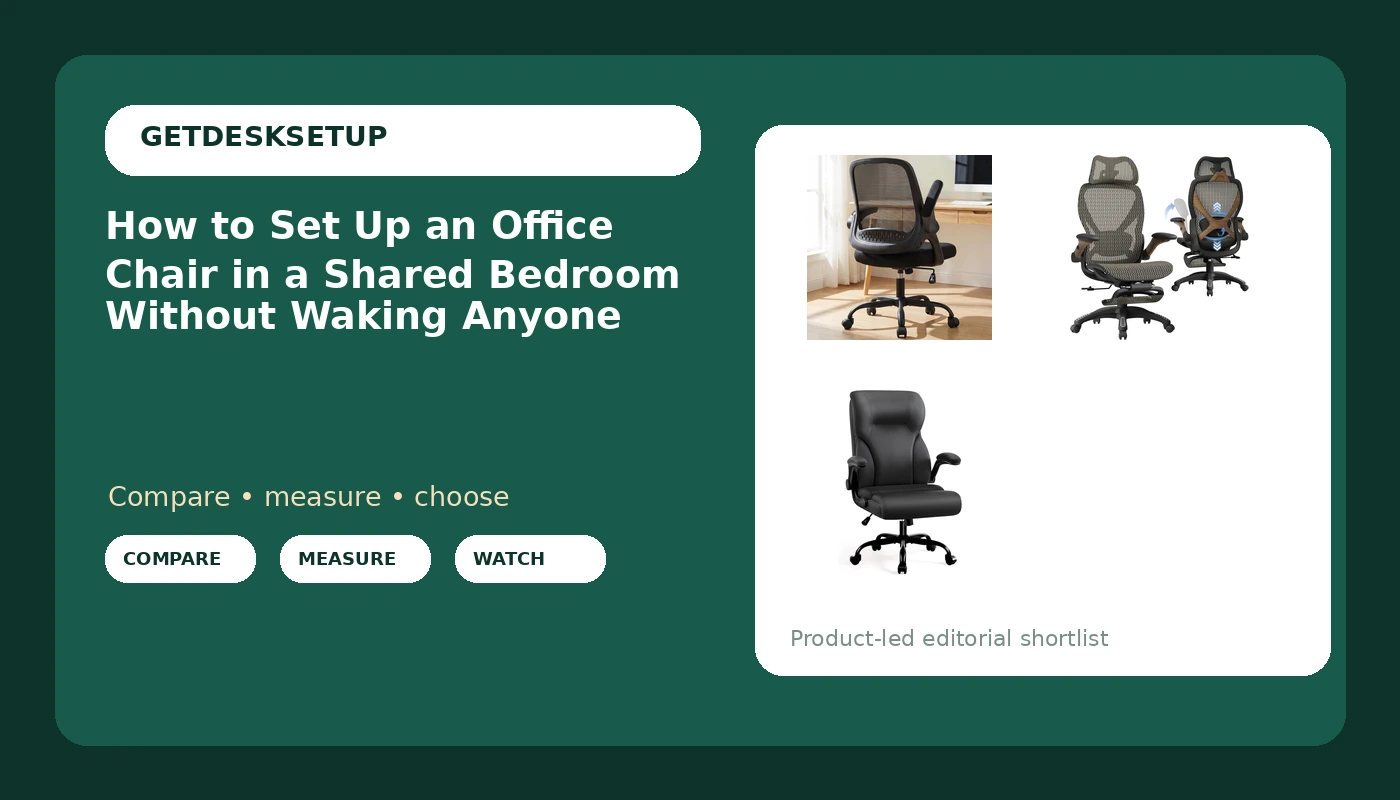
Three chairs that make it easier to set up an office chair in a shared bedroom
None of these is the best chair in the abstract. Each one solves a different version of the same problem: a chair that fits a body, fits a small floor plan, and can disappear when the room goes back to being a bedroom.
Our pick: NEO CHAIR Office Computer Chair Ergonomic Mesh Back Flip-Up Arms Mesh Black
Our pick
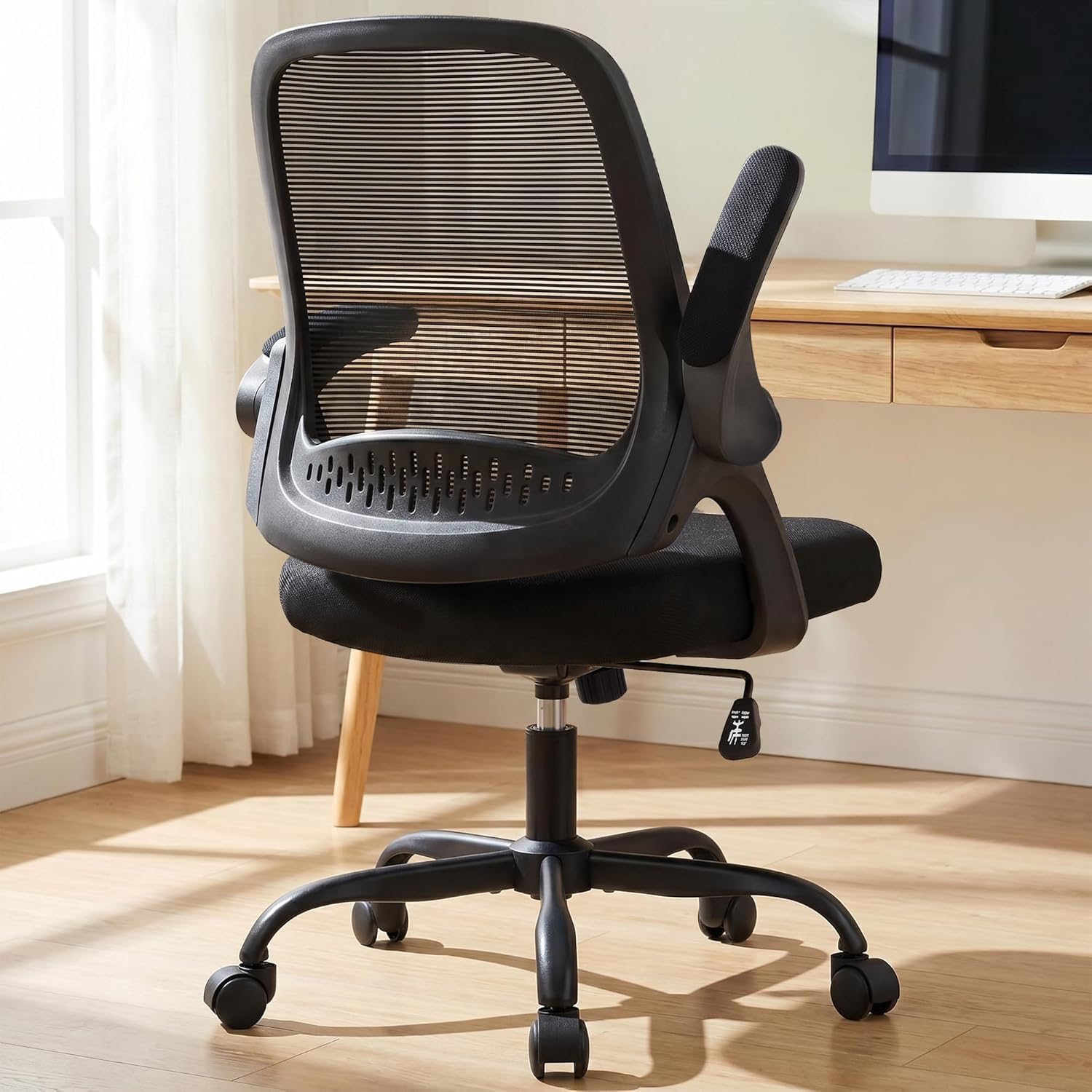
NEO CHAIR Office Computer Chair Ergonomic Mesh Back Flip-Up Arms Mesh Black
Check current Amazon price
This is where I start in most shared bedrooms, because it does the two things the room actually needs. The mesh back means it does not trap heat in a room with the door shut, and the flip-up arms mean it can go under a desk that is barely deep enough for a keyboard. Mesh also reads as a desk chair rather than a gaming throne, which matters when the desk sits six feet from a pillow.
The arms are the reason this chair wins the tuck test. Flip them up, push the chair in, and the floor in front of the desk is a floor again instead of a chair parking spot. That single motion is what most people never get with a fixed-arm chair, and it is the difference between a bedroom that feels crowded and one that does not.
What to verify before you buy: the seat height range against your own leg length, and the caster type against your floor. If your floor is hardwood or laminate, plan on a mat or a set of caster cups no matter which chair you pick, because hard wheels on a hard floor are what wake people up. The arms flip rather than adjust in several directions, so the trade here is clearance, not precision. If your forearms need an exact armrest height, you are giving that up.
Who should skip it: if your knees sit above your hips on a standard-height desk, or if you want a wider seat pan than a standard task chair offers, this is not your chair. Skip it and go to the big and tall option below. Also skip it if you want a headrest, because there is not one.
Upgrade pick: ELABEST X100 Ergonomic Mesh Office Chair with Footrest, Big and Tall Home Desk Chair with 5D Flip-Up Arms, Adjustable 3D Lumbar Support, Gaming & Executive Computer Chair (Coffee Break)
Upgrade pick
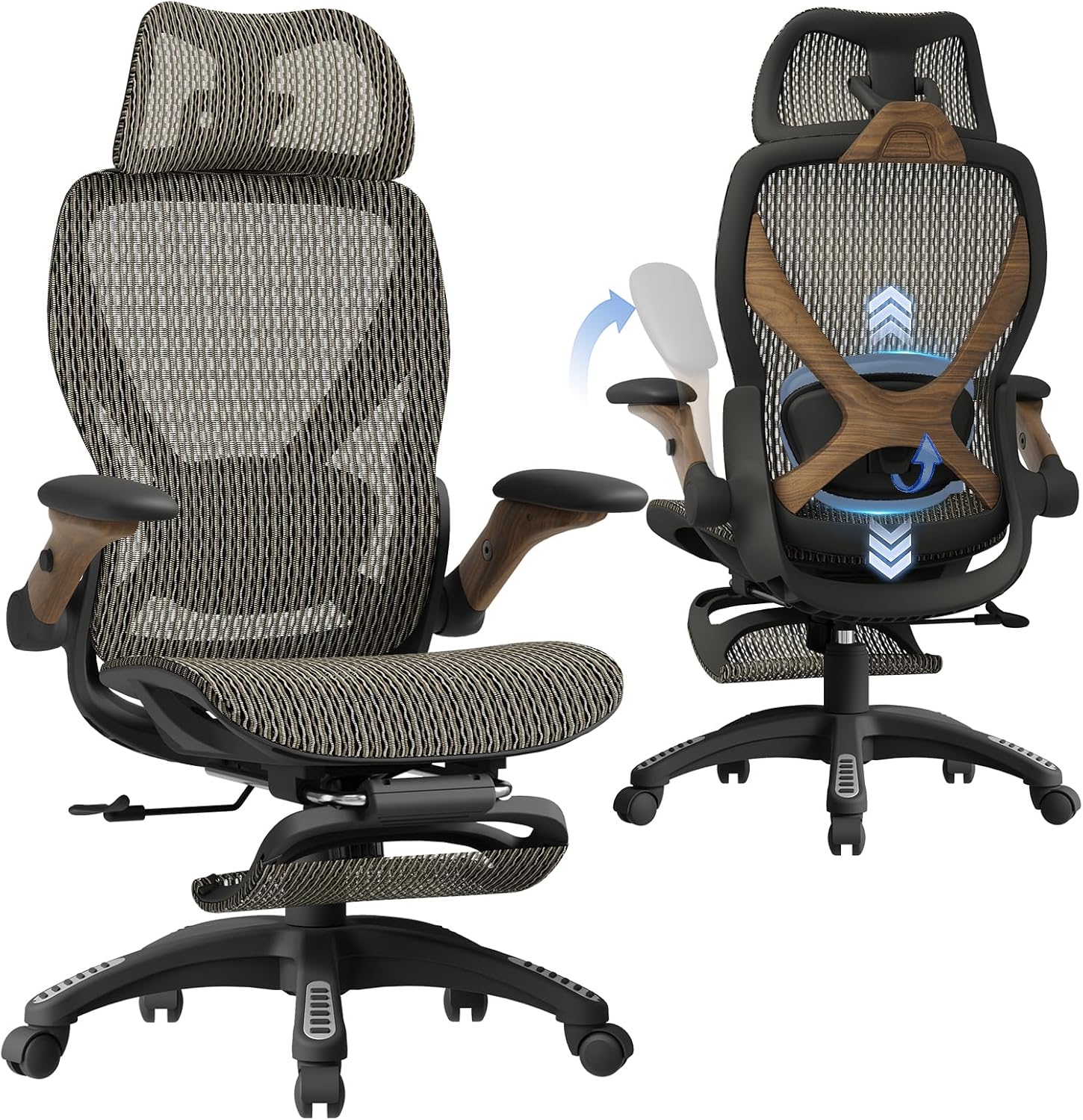
ELABEST X100 Ergonomic Mesh Office Chair with Footrest, Big and Tall Home Desk Chair with 5D Flip-Up Arms, Adjustable 3D Lumbar Support, Gaming & Executive Computer Chair (Coffee Break)
Check current Amazon price
This is the chair for the person the budget pick does not fit. Big and tall in the name is doing real work here, and the adjustable 3D lumbar support means the pad moves instead of sitting as one fixed bump in one fixed spot. That matters more in a shared bedroom than people expect, because you are often working at a desk that was not chosen for you, and the only way to fix a bad desk is a chair that adjusts around it.
The 5D flip-up arms are the other half of that. You get the flip for tucking, plus enough arm adjustment to get the rest under your elbow without shoving the chair away from the desk. And the footrest is the feature people underrate: if your desk is fixed at 30 inches and you are shorter than that desk assumes, a footrest is what keeps your feet planted while your seat height stays correct. It also gives you somewhere to put your feet when you recline.
Coffee Break is the colorway. In a bedroom, a lighter chair disappears against a wall better than black, which is a small thing until you are the one lying in the bed looking at it.
Who should skip it: anyone who does not need the extra seat size. The footprint is bigger, the frame is heavier, and in a small room that weight is what you feel when you try to move the chair out of the way at night. If the budget pick fits your body, buy the budget pick. Skip this one too if the bed is within a foot of the desk, because a bigger chair is the wrong answer no matter how good the lumbar support is.
Runner-up: Executive Office Chair, High Back Ergonomic Comfy Desk Chair with Padded Flip-up Armrests and Wheels, PU Leather Heavy Duty Computer Swivel Rolling Task Chair for Home Office, Adults, Black
Runner-up
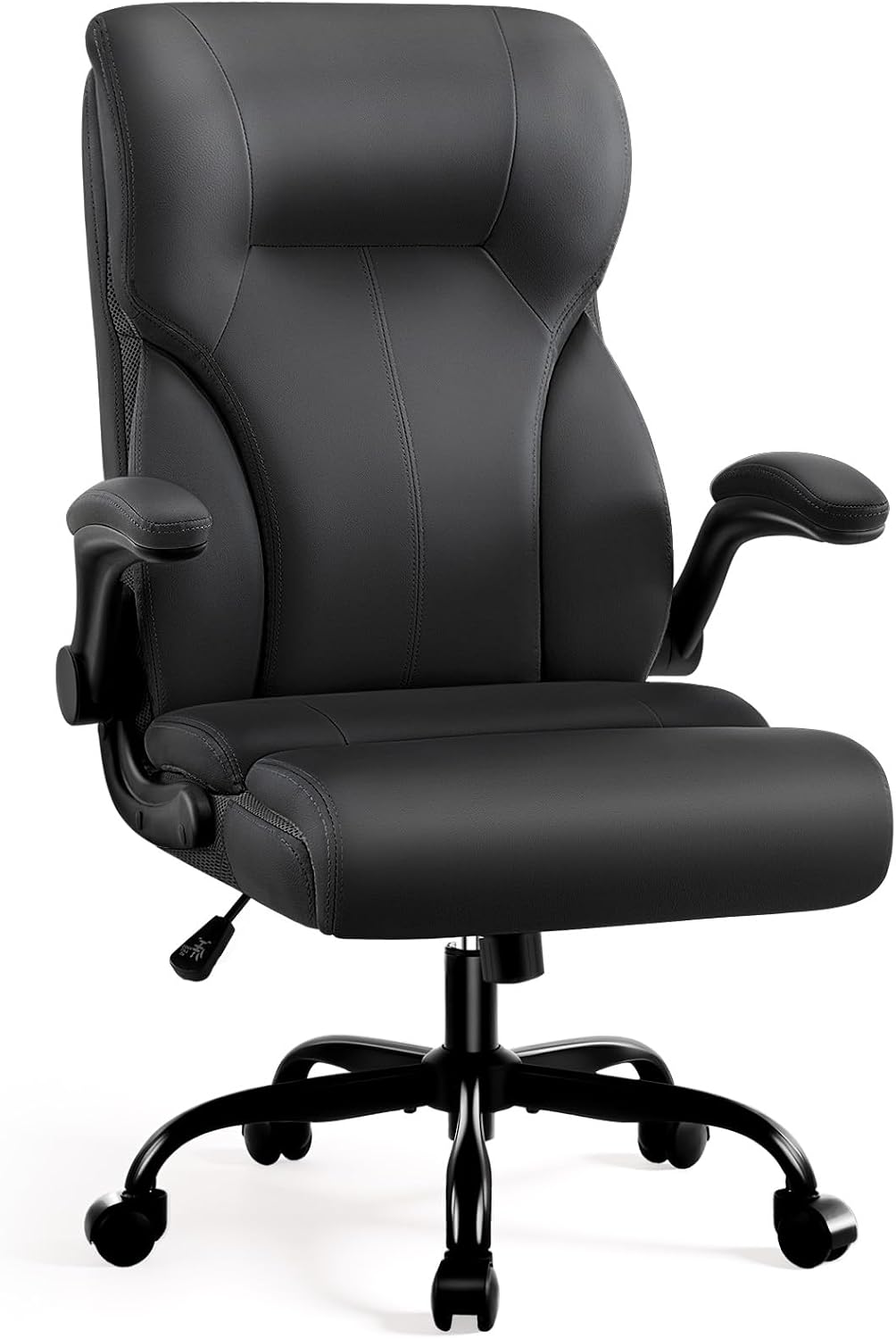
Executive Office Chair, High Back Ergonomic Comfy Desk Chair with Padded Flip-up Armrests and Wheels, PU Leather Heavy Duty Computer Swivel Rolling Task Chair for Home Office, Adults, Black
Check current Amazon price
This is the one for the room where the desk is visible from the door and the chair has to look like furniture. PU leather, high back, padded flip-up armrests, wheels, swivel. It is the least office-looking of the three, which sounds like a style point and is actually a sleep point: the person in the bed next to it has to look at this thing every night.
The padded flip-up armrests give you the same tuck-under clearance as the mesh chairs, with more padding under the forearm, which matters if you rest your elbows on the arms while you type. The high back and the swivel base make it a chair you can lean back in, so set the tilt tension on day one rather than discovering it the first time you lean.
The material is the honest trade. PU leather does not breathe the way mesh does, and a closed bedroom with the door shut is exactly where that shows up. If you run hot, this is the wrong chair for you, no matter how good it looks.
Who should skip it: anyone who needs a seat pan they can tune. The adjustability here is in the back and the arms, so if your thigh length needs a specific seat depth, check the listing for that before you buy. Skip it too if you want a headrest with real height adjustment, or if you need the lumbar support to move rather than sit where it was built.
The actual setup workflow
Here is the order I use when I set up an office chair in a shared bedroom. Every step assumes the chair is assembled. If it is not, build it where it will live, not in the living room, because dragging an assembled chair through a doorway is how you put a scratch in a door frame at 10 p.m.
Step one: Measure the floor and set a space budget. Minimum desk width is 48 inches for a chair plus a monitor, or 40 inches if you work on a laptop and nothing else. Behind the chair you want 30 inches to recline; with 20 you lock the recline and sit upright. Check the door swing and the path to the bed while you are down there. Do this before you assemble anything, because the answer can send a chair back in the box.
Step two: Set seat height against the desk, not the floor. A fixed 30-inch desk is the usual apartment case. Feet flat, knees around 90 degrees, elbows landing at desk height. If the chair's top seat height leaves your elbows below the desk, a keyboard tray is cheaper than a new desk. This is the step most people skip when they set up a desk chair in a shared bedroom, because the desk is already where it is and nobody wants to move it.
Step three: Set seat depth. Two to three inches between the back of your knee and the front edge of the seat. If the seat is deeper than your thigh, you will slide forward and lose the backrest; a lumbar cushion or a footrest pushes you back into the seat. If the seat is shallower than your thigh, no cushion fixes it and you need a different chair. Write the number down.
Step four: Set the lumbar support height. Put the curve into the small of your back, at or just below your belt line. On a chair with adjustable 3D lumbar support you move the pad; on a fixed-lumbar chair you change the seat depth instead and let the pad land where it lands. A lumbar pad set too high pushes your mid-back forward and makes an upright sit feel like work.
Step five: Set the armrests, or get them out of the way. Height so your forearms rest at 90 degrees with your shoulders down, not shrugged. When you set up a task chair in a shared bedroom, the armrest is the first thing to compromise: flip it up when you leave so the chair clears the desk, and keep it slightly below typing height so it never lifts your shoulders. If the arms fight the desk, remove them.
Step six: Set recline and tilt tension. Open the back to about 100 to 110 degrees and set tilt tension so the chair does not slam backward when you lean. If the bed is behind you, lock the recline and use the tension knob only for the small give. Tilt tension is the adjustment people never touch, and it is the one that decides whether you perch on the front edge or actually sit.
Step seven: Set the headrest, then fix the floor. Headrest height so the curve meets the base of your skull, not the top of your head. Then the shared-bedroom step: look at the caster and the floor together. Hardwood plus hard casters equals a chair that drifts and clicks; a low-pile rug or a set of caster cups fixes both. A chair that rolls on its own at 2 a.m. is the number one complaint I get from people sharing a bedroom.
Step eight: Route the cables and define the landing zone. Tape or clip the charge cable so it cannot drag under a caster, leave slack in the run so the chair can move without pulling, and pick one spot where the chair parks every night. When you set up an ergonomic chair in a shared bedroom, this is the step that turns the setup into a routine instead of a one-time event: arms up, chair in, cables off the floor.
The competition and why it lost
A racing-style gaming chair was the first thing I ruled out, and it is usually the first thing people suggest. Fixed side bolsters and fixed arms do not tuck under a shallow desk, and the bolsters push your shoulders forward, which is the opposite of what a long typing session wants.
A big-box task chair with a fixed lumbar bump and no seat depth adjustment lost for a different reason: it is not adjustable, it is shaped. If the shape is not your shape, there is nothing to turn.
A drafting stool or a standing-only setup lost because there is no back, no recline, and no lumbar support, and in a shared bedroom you cannot leave a standing desk up overnight without the other person resenting the room.
A folding chair or a padded dining chair lost on adjustability. Zero. The seat height is whatever the table wanted, and the caster, the armrest, the headrest, and the tilt tension do not exist.
A bed desk or lap desk lost on the workday test. Fine for an hour with a laptop, wrong for eight, and the recline angle puts your neck somewhere it should not be.
Two things did not lose, they just belong to other guides: monitor arms, which decide how far the desk has to sit from the wall, and cable trays, which decide whether your charge cable survives a caster. I cover the arm side of that in how to set up a small desk with a monitor arm.
What this all costs
Strip out the marketing and a shared-bedroom setup costs four things. The chair is the big line item. The floor surface under it is the smallest line item and the one that protects the other person's sleep. A footrest matters if your desk is fixed at 30 inches and your legs are shorter than that desk assumes. A lumbar cushion matters if your chair's lumbar support does not move.
Check current Amazon price on each of the three chairs above and you will see the spread for yourself. The expensive mistake is not picking the top of that spread. It is picking a chair that does not match your seat depth, discovering it in month two, and buying again.
Over the two years people actually keep a chair in a shared bedroom, the difference between the right one and the wrong one is not the price. It is whether the chair tucks under the desk at night, and whether anyone wakes up when you leave the room. Do the eight steps in order, write your seat depth in a notebook, and you will only do this once.