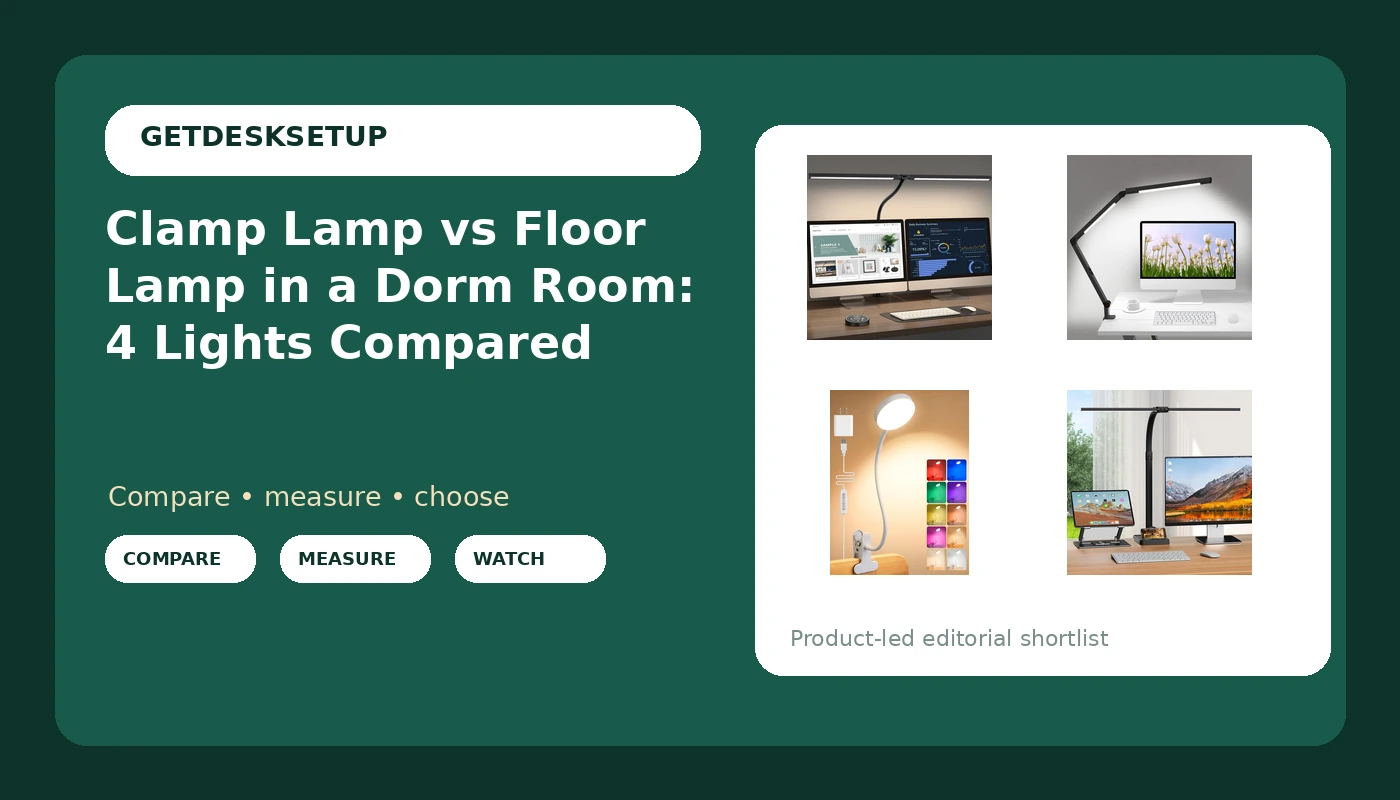
I have built out 310 home offices and roughly 40 of them were dorm rooms, and the question that decides the lighting in every one of those builds is clamp lamp vs floor lamp in a dorm room. Not brand. Not color temperature. Not how the shade looks in a photo. It comes down to whether you have a desk edge you are allowed to clamp to, and whether you can spare the floor. I carry a tape measure to every build, and the tape settles this faster than any spec sheet.
Related: Desk Cable Management for a Small Dorm Desk
The short answer: in a standard dorm room, a clamp lamp wins, and the Pzloz 24W clamp model is the one I would put on a client's desk for a year. A floor lamp is furniture. It needs floor area, an outlet near that floor area, and it needs to survive a roommate who rearranges the room in October.
The long answer involves clamp jaw depth, what happens when the desk edge is too thick, where the cable goes, and what you do when the only clampable surface in the room is a bed frame. Table first, then the reasoning.
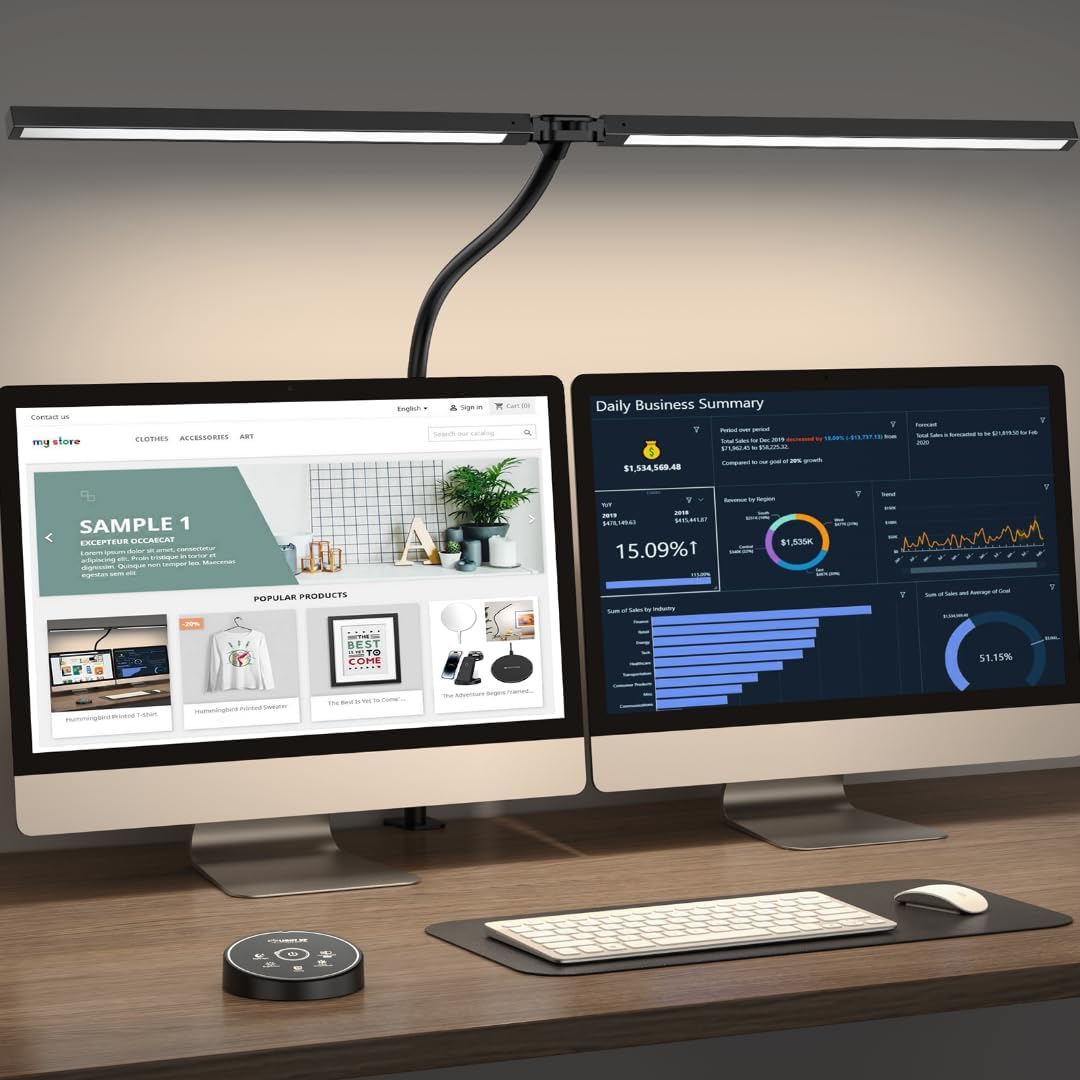
Pzloz Led Desk Lamp for Office Home – Eye Caring Architect lamp with Clamp,Dual Screen Computer Monitor Work Smart Light: 24W 5 Color Flexible Adjustable Lighting Table Lamp for Study Drafting
The best all-round clamp lamp here: 24W, 5 color settings, and a flexible arm that reaches over a monitor without eating desk surface
The arm is only as good as the edge you clamp it to; a thin or hollow-core desk top will flex under it
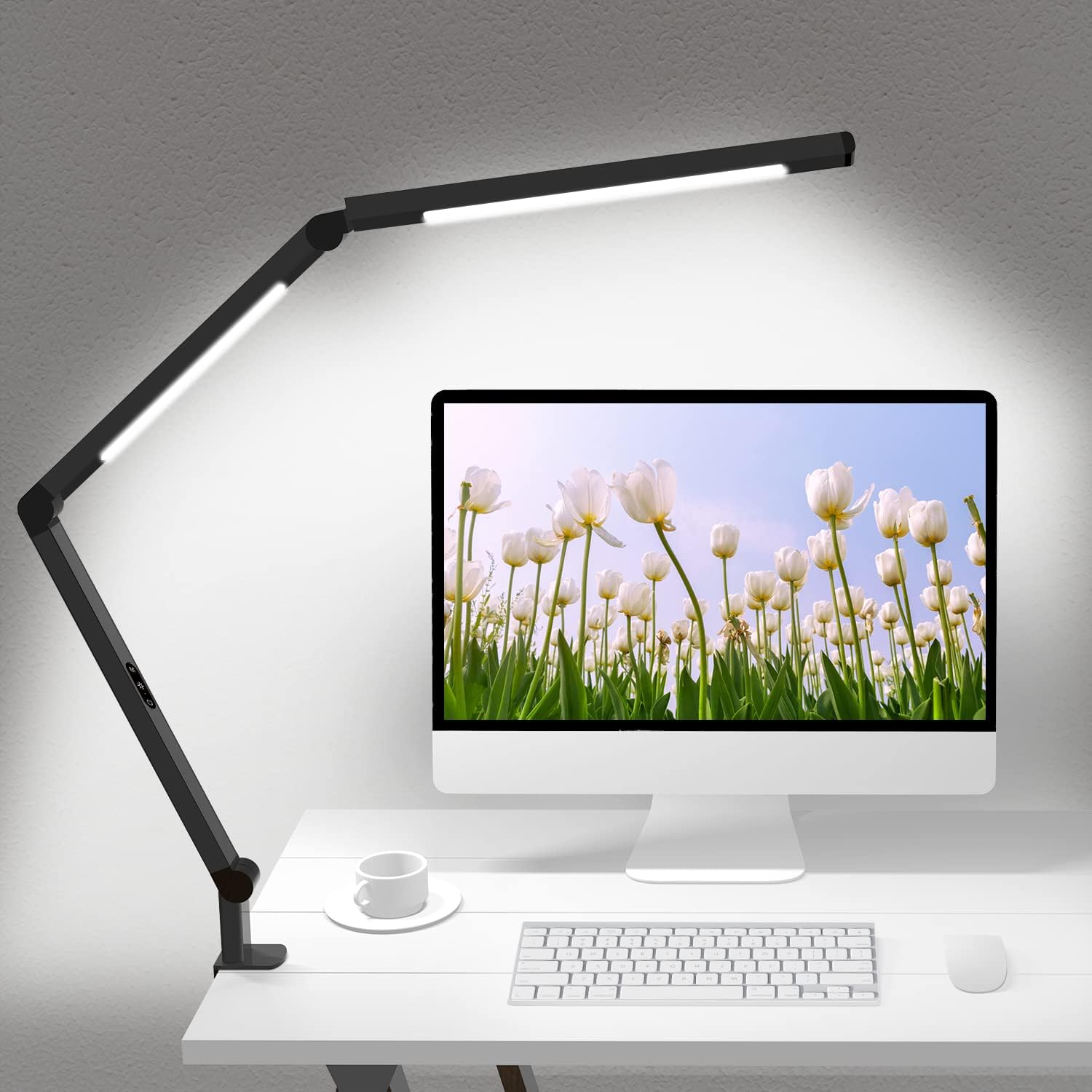
LED Desk Lamp with Clamp, Architect Desk Lamp with Dual Light and Adjustable Swing Arm, Clip-on Eye-Care 4 CCT Modes & 5 Levels Table Light Modern Computer Lighting for Home Office
Dual light heads and a swing arm that holds an angle, with 4 CCT modes and 5 brightness levels to work through
Two heads mean two aiming decisions, and the clamp needs more edge real estate than a single-arm design
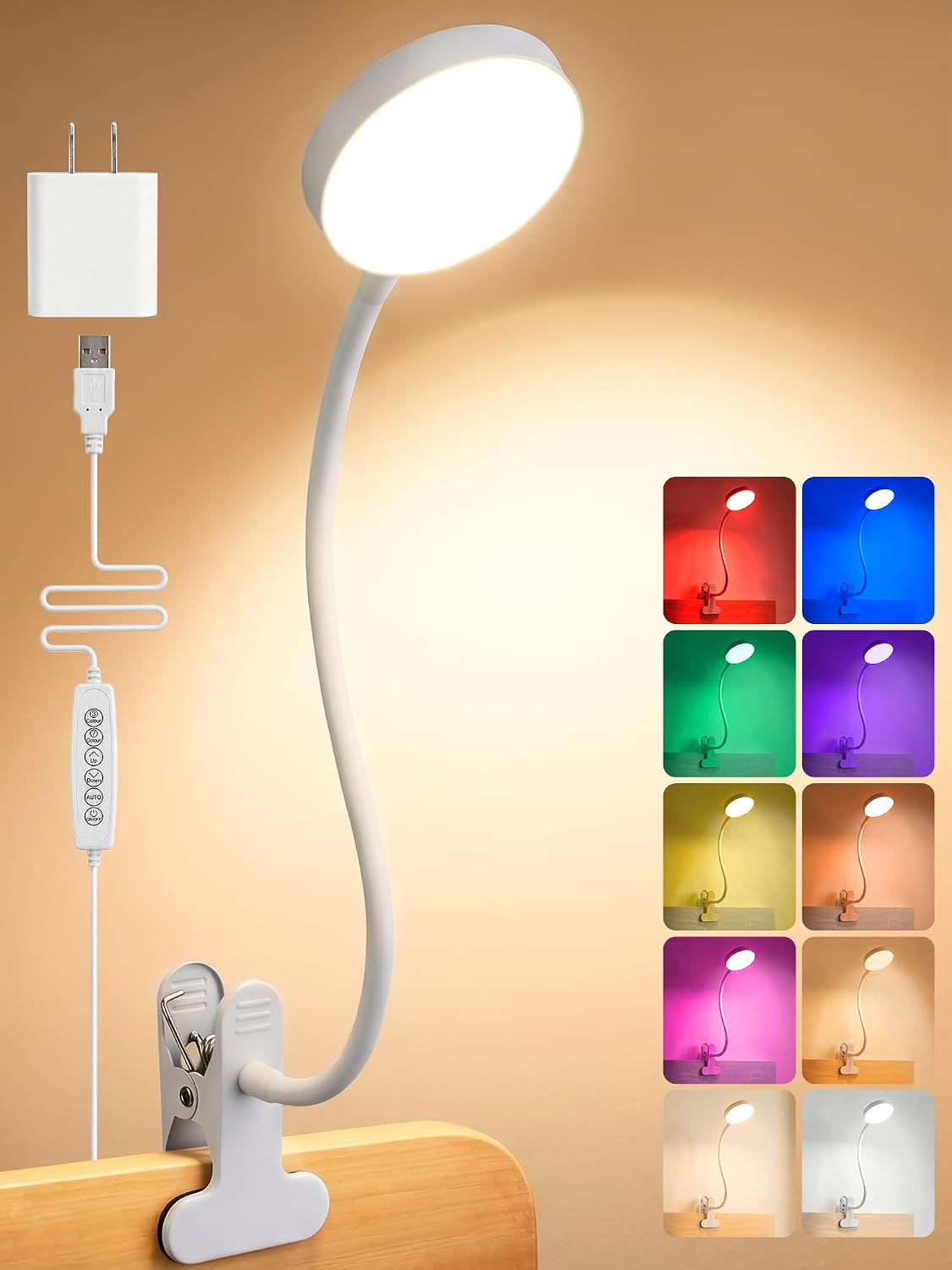
Clip on Light,10 Colors RGB Desk Lamp with Clamp,10 Dimmable Reading Lamp
The cheapest way to get light off the floor, with 10 color options and 10 dimming steps for reading and ambient use
Color modes are not task lighting; treat this as a reading and mood lamp, not a monitor light
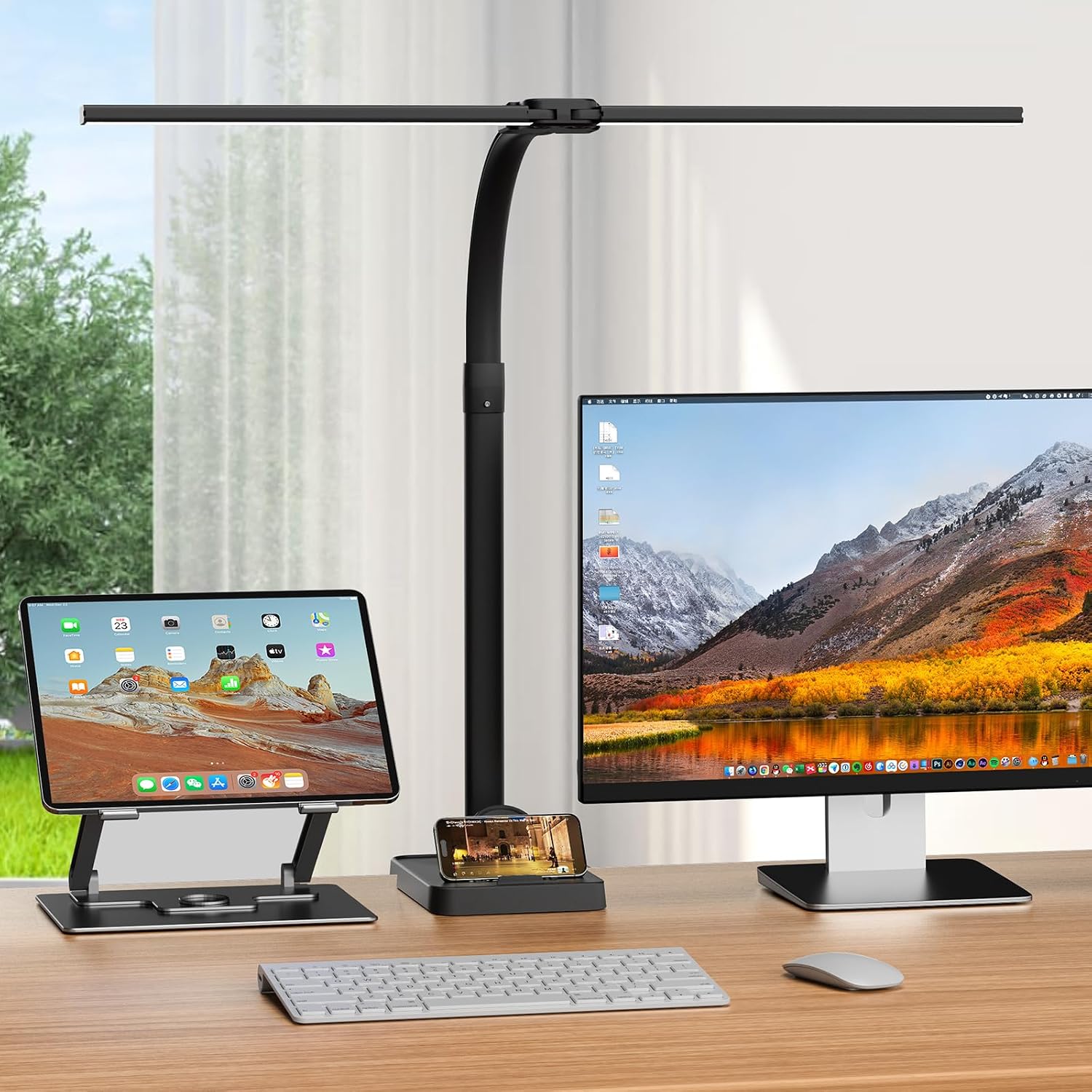
LED Desk Lamp with Base – Bright Dimmable Computer Lamp with Phone Holder, 24W Bendable Desk Light for Monitor Screen, Eye-Caring Tall Desktop Light for Task Home Office Work, Black, Dual Head
The pick when the desk will not take a clamp: 24W, a bendable dual head, and a phone holder built into the base
It is a base lamp, so it eats desk surface, and a base on a narrow dorm desk is the first thing that gets knocked
Prices and availability may change.
Clamp Lamp vs Floor Lamp in a Dorm Room: Start With the Floor Math
Here is the calculation I run in every dorm build. A floor lamp with a shade needs roughly a 12 inch circle of floor, plus clearance so nobody walks into it, plus a reachable outlet. A typical dorm desk is about 42 inches wide, and the bed, the dresser, and the closet take everything else. So the floor lamp is not competing with a bookshelf. It is competing with your chair mat, your footrest, and the only patch of floor your feet have.
That is the whole difference between clamp lamp and floor lamp in a dorm room. A clamp lamp spends vertical space you were not using. A floor lamp spends horizontal space you were.
The floor lamp in a dorm room vs clamp lamp trade is really a trade of three things: floor area, outlet position, and where the light lands. On the first, the clamp wins outright. On the second, the clamp usually wins because a desk outlet or a power strip on the desk is easier to reach than the wall behind the bed. On the third, the floor lamp has a real advantage, because a taller light from behind your shoulder casts fewer shadows across a keyboard than a small head clamped 20 inches from your hand.
If your room is large, the lamp height matters more than the footprint. If your room is a standard double with two beds and two desks, footprint wins and the clamp wins.
What a Clamp Lamp Needs Before You Buy It
This is the part people skip, and it is the part that causes returns. Three measurements decide whether a clamp lamp works on your desk.
Clamp opening versus desk edge thickness. Every clamp has a maximum jaw opening. Measure your desk top at the edge, including any trim or laminate lip. If the opening is close to your edge thickness, the clamp will sit at the end of its threads, which is exactly where it slips.
Edge profile. A flat, square edge clamps well. A rolled edge, a rounded bullnose, or a wire-management cutout at the back of the desk clamps badly. If your desk has a cable tray screwed to the back rail, you may not have a clean edge to grab at all.
Where the arm swings. A clamp at the back corner gives you the most reach. A clamp at the front edge puts the arm in your sight line and in the way of your mouse hand.
Then cable management, which is not aesthetics. Route the lamp cord along the rear edge with a raceway or a cable sleeve, and anchor the slack with an adhesive clip every 8 to 10 inches. A lamp cord that hangs loose from a clamp gets snagged by a chair arm, and a snagged cord changes the head angle within a week. I have re-aimed more lamps than I have replaced.
The installer order matters too: clamp first, then check the swing, then tighten, then run the cord. Tightening before you have positioned the arm means you tighten twice.
The Base Lamp Case: When the Desk Will Not Take a Clamp
Some desks cannot take a clamp. Glass tops, thin hollow-core tops from a big-box store, desks with a full rear modesty panel, and lofted bed frames with a rounded rail all fall into this group. If that is your desk, the clamp lamp is out and the choice is no longer clamp lamp or floor lamp in a dorm room. It becomes a base lamp versus a floor lamp.
A base lamp is the better of those two in almost every dorm. It sits on the desk, so it does not consume floor, and it usually has a wider head than a clip light. The cost is desk surface. On a 42 inch desk with a monitor, a keyboard, and a notebook, a base takes a corner you may want for a mouse pad.
That is where the fourth lamp in the table comes in. It is a base design with a 24W dual head, a bendable arm, and a phone holder in the base. If your desk edge will not take a clamp and you still want task light over a keyboard, this is the shape to look for.
The Four Lights, by Role
The Pzloz 24W clamp lamp
This is the one I would install first. It is a clamp design with a 24W head, five color settings, and a flexible arm, and the listing describes it as built for a monitor plus a second screen. That matches the way dorm desks actually get used: laptop in the middle, a borrowed monitor beside it, notes on the other side.
It fits a desk with a clean edge, a reachable outlet, and a rear corner free of a cable tray. Skip it if your desk top is thin enough to flex when you push the arm sideways, or if your only clamp point is a bed rail that is too thick for the jaw.
The dual light clamp lamp with swing arm
This one splits the light into two heads on an adjustable swing arm, with 4 CCT modes and 5 brightness levels. Two heads are genuinely useful on a wide desk, because you can put one over the keyboard and one over a notebook without moving the whole arm.
The trade-off is aiming time. Two heads mean two angles to set, and if you point them at each other you get a bright stripe down the middle of the desk and dim corners. It also wants more clamp space than a single-arm lamp, so measure the edge twice. Skip it if you want a lamp you set once and forget.
The RGB clip light
Ten colors, ten dimming steps, a clamp, and the lowest entry point in this group. As a reading light clipped to a headboard or a shelf it does its job. As task lighting over a keyboard it is the wrong tool, because colored light is not what you want on a page at 1 a.m. before an exam.
Buy it for ambient light, for a bed frame, or as a second light for a roommate who wants a night light that is not the ceiling fixture. Skip it as your only desk light.
The base lamp with the phone holder
The 24W bendable dual head with a base and a phone holder. It is the answer for a desk that cannot be clamped, and the phone holder is more useful in a dorm than it sounds, because a phone propped at eye level beats a phone flat on the desk where you keep checking it.
The base is the whole compromise. It occupies a footprint roughly the size of a coffee mug, and on a narrow desk that footprint is your mouse corner. Skip it if your desk is under about 40 inches wide and you use a full-size keyboard and a monitor.
Desk Lamp Lumens and the Claims You Can Verify
If a listing will not state a figure for desk lamp lumens, treat the brightness as unknown and buy from a seller with a return window. Wattage is not brightness. A 24W LED head and a 5W LED head can look similar in a photo and very different on a textbook at 11 p.m.
What you can verify without a meter: the number of color temperature settings, the number of dimming steps, and whether the head can be aimed independently of the arm. Color settings matter more than people expect in a dorm, because the overhead fixture is usually a harsh cool white and a lamp that can go warmer at night is the difference between reading comfortably and giving up.
The Things That Share the Floor With a Floor Lamp
This is the part that never makes it into the marketing, and it is why I stopped recommending floor lamps for small rooms. The floor under a dorm desk is already allocated. There is a chair mat, and mat thickness and mat density decide whether that mat curls at the edge or lies flat under a rolling chair. There is often a footrest, and the footrest angle you prefer changes how far your knees travel under the desk. A floor lamp base wants the same square foot as all of it.
Move the lamp to the desk edge and the floor goes back to the chair, the mat, and your feet. That is the practical case for the clamp, and it has nothing to do with how the lamp looks.
The Difference Between Clamp Lamp and Floor Lamp in a Dorm Room, in One Paragraph
The difference between clamp lamp and floor lamp in a dorm room is where the light comes from and what it costs you to put it there. A clamp lamp mounts to furniture you already have, points down at your work, and gives up nothing on the floor. A floor lamp stands on the floor, lights the room from above, and takes space you are already using for a chair mat and a footrest. If you have the floor and you want room light, take the floor lamp. If you have a desk edge and you want task light, take the clamp.
Who Should Skip Each One
Skip the Pzloz clamp lamp if your desk edge is glass, thin, or covered by a cable tray. Skip the dual head swing arm model if you want one aiming decision instead of two, or if your only clamp point is narrower than the base of the clamp. Skip the RGB clip light if you need light on paper for study, because color modes are not task lighting. Skip the base lamp if your desk is narrow and you need the corner for a mouse.
And skip all four if you are buying for a room with a ceiling fixture directly over the desk that you can actually control. Fix the fixture first. A lamp cannot outwork good overhead light.
What I Would Install
For a standard dorm desk with a clean edge and an outlet within reach, I would clamp the Pzloz 24W model to the rear corner, aim the head at the keyboard, and run the cord along a raceway with an adhesive clip every 8 to 10 inches. If the desk will not take a clamp, I would put the base lamp with the dual head and the phone holder on the rear corner instead.
Either way, measure the edge before you order, and buy where you can return it. The clamp lamp vs floor lamp in a dorm room question has one honest answer, and it depends on a number you can take with a tape measure in about ten seconds.