Seat foam is the one number almost no chair listing publishes, and it is the number that quietly moves everything else in a desk setup. Office chair seat cushion thickness decides how high you actually sit, how much of the seat pan your thighs cover, and whether the lumbar support still lands in the small of your back after an hour of work. Two chairs with near-identical spec sheets can put your hips an inch apart once you sit down, because foam compresses under load and a thin, dense pad barely moves. Add a pressure-relief cushion on top of a chair you already own and you have changed the geometry a third time. This article works through what changes, in what order, and which of the four listings below fits which body.
Related: How to Measure Seat Depth for a Home Office Chair →
Quick answer
If you want office chair seat cushion thickness explained in one line, it is the compressed foam layer between the seat pan and your sit bones, and the only version of that number that matters is the one you measure with your full weight in the chair. A firm seat that barely compresses keeps your seat height and seat depth close to the published figures. A soft seat loses height at the back, drops your hips below your knees, and can drive the front edge up into the underside of your thighs. An add-on pad adds thickness back, but it also adds height, and on a chair that is already too tall for your desk, that is the wrong direction.
Four useful options
| Model | Best fit | What stands out |
|---|---|---|
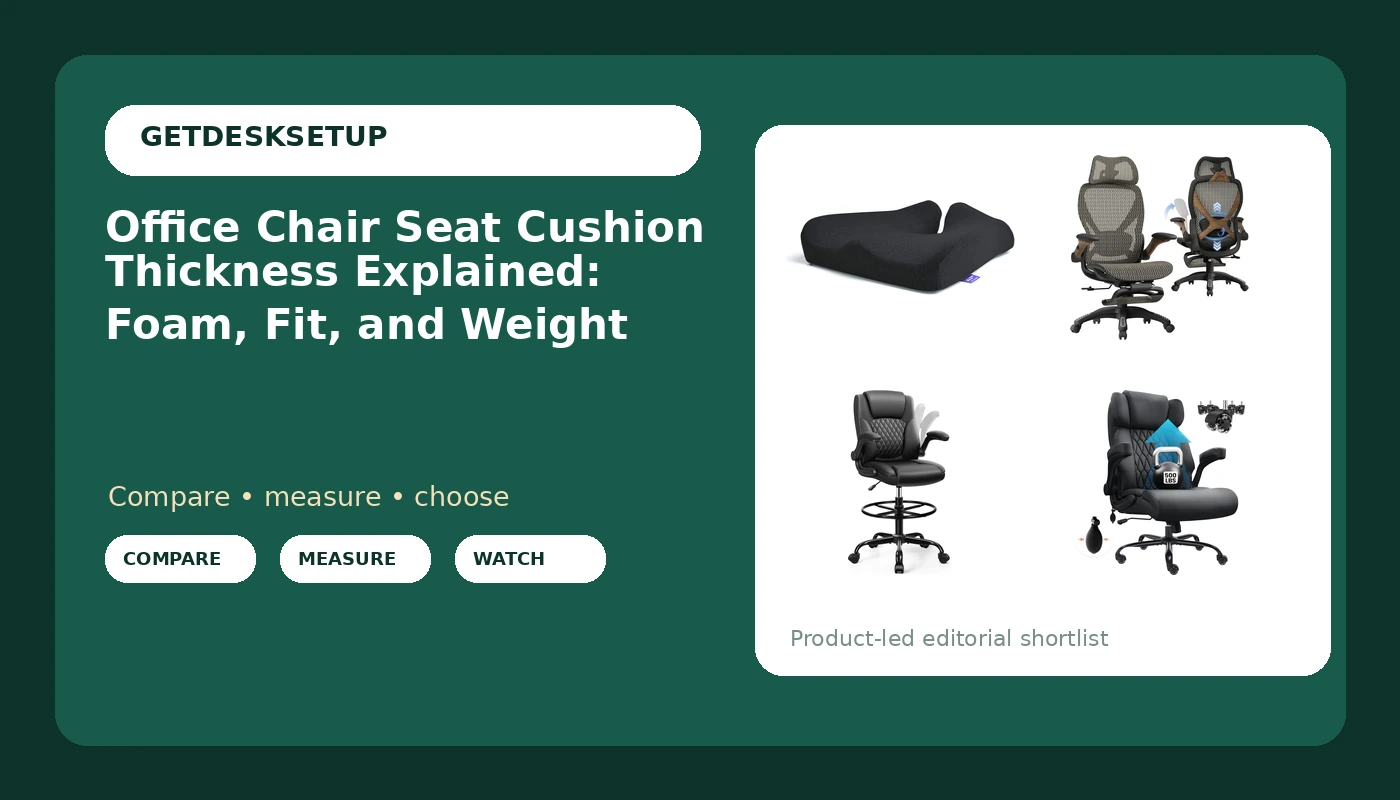
| Cushion Lab Pressure Relief Seat Cushion | Adding foam to a chair you already own | Extra-dense memory foam pad shaped for hip, tailbone, and sciatic pressure |
| ELABEST X100 Ergonomic Mesh Office Chair | Longer sitting sessions with recline and a footrest | Adjustable 3D lumbar support, 5D flip-up arms, mesh back, built-in footrest |
| Drafting Chair for Standing Desk | Counter-height desks and tall work surfaces | Extended height range, flip-up armrests, leather-upholstered executive build |
| 500lbs Big and Tall Office Chair | Wider and heavier sitters who need a firm, wide base | Extra wide seat, adjustable lumbar support, heavy-duty base, upgraded casters |
Seat cushion add-on: Cushion Lab Pressure Relief Seat Cushion
Here is the trade-off a product page rarely spells out: a pad is a fit correction, not a comfort upgrade. This cushion adds thickness to a seat that already exists, which raises your effective seat height and shortens the vertical gap between your thighs and the underside of the desk. If your chair is already near the top of its height range, or your desk is a fixed-height model, you can end up with your forearms angled up at the keyboard. Drop the gas lift by roughly the amount the pad adds and recheck that your feet still rest flat on the floor or on a footrest. If they do not, the pad is solving one problem while creating another.
Ergonomic mesh chair: ELABEST X100 Ergonomic Mesh Office Chair
The mesh back gets the attention, but the seat is where thickness does its work. A chair like this is worth considering when you want the lumbar support to move with you: because the pad adjusts in more than one direction, you can set it after you have sat down and the foam has compressed, instead of guessing from a spec sheet. The footrest matters for the same reason. When you recline, more of your weight moves off the seat cushion and onto your back, so the seat can be firmer without feeling harsh. Flip-up arms are a clearance feature first and an armrest second, and if you rest a lot of weight on your elbows, check how rigid the arm feels before you commit.
Tall drafting chair: Drafting Chair for Standing Desk
Tall chairs expose the cushion problem faster than standard ones. When the seat is high, most sitters either dangle their feet or perch on the front edge, and both habits concentrate load on a small area of foam. That is where a thick, soft seat works against you: the front edge rolls up under the thighs while the rear compresses and tips your pelvis back. A foot ring or a footrest changes the math, because it puts weight back through your feet instead of through the cushion. Pair a tall chair with a matching surface height, and if you are choosing a standing desk to go with it, our notes on standing desk height for tall users cover where the range usually falls short.
Big and tall chair: 500lbs Big and Tall Office Chair
Weight changes how foam behaves, and this is the category where that matters most. Heavier sitters compress a seat cushion further and faster, so the effective seat height drops more than the listing suggests, and a firm, wide seat holds its shape longer than a plush one. The catch is that a wider seat usually grows in depth too. Sit down and check the gap behind your knee before you commit: if the front edge presses into the back of your leg, the width is not helping you. The upgraded casters and heavy-duty base are worth noting for a different reason, since a wider base resists tipping when you recline, and casters roll differently on carpet than on a hard floor.
Prices and availability may change. Product images, names, and retailer links are matched to verified listings. No current price, rating, stock status, or measured result is stated here without current evidence.
How office chair seat cushion thickness changes seat height and seat depth
The seat pan under the foam is fixed metal or plastic. Everything above it is the variable, and that variable moves under your body weight. Listings usually publish seat height measured to the top of an uncompressed cushion, which means the number you read and the number you sit at are not the same. A soft, thick cushion compresses more at the rear, where your sit bones load it, than at the front. The result is a seat that is effectively lower at the back and slightly higher at the front, which rotates your pelvis backward and lifts your knees relative to your hips. That is not the position your lumbar support was shaped for, and it is why a chair that felt fine in a showroom can feel wrong after an hour.
Seat depth shifts for the same reason. Seat depth is the horizontal distance from the front edge of the seat to the backrest, and the usual guidance is to leave roughly two to four inches of clearance between that front edge and the back of your knee. Compress the rear of the cushion and your hips slide back, which shortens the usable depth in front of you and increases pressure under your thighs. Ergonomic chair seat cushion thickness is not a separate specification from any of this. It is the reason two chairs with the same published seat depth can behave like different sizes, and why a pad that feels supportive on a firm chair can feel like a wedge on a soft one.
Then the chain continues upward. Sink an inch into foam and your elbows drop an inch, which moves the keyboard plane relative to your shoulders and changes where the armrest should sit. Set the cushion question first, then seat height, then desk height, then recline angle.
How to judge seat foam before you buy
Almost no listing publishes foam density or thickness in inches, so judge the seat by the numbers that are published and by the adjustments that let you compensate. Desk chair seat cushion thickness is easier to infer from the seat height range than from adjectives like plush or supportive. A chair with a wide height range gives you room to correct for compression. A chair with a narrow range does not, and a pad becomes your only lever.
Look for a front edge that curves down rather than a square lip, since a waterfall edge reduces pressure behind the knee when the cushion compresses. Check whether the chair has a tilt tension adjustment, because a seat that sinks also changes how the backrest loads your spine when you lean. Confirm the seat cushion can be replaced if it flattens, and check the caster type against your floor, since wheels that sink into carpet lower the whole chair by a small amount. If the listing only offers words like "premium comfort" with no height range and no adjustable lumbar support, treat it as a chair you cannot size from a distance.
- Measure the seat height of your current chair at the front edge with your full weight in it, not the figure from the listing.
- Measure seat depth from the front edge to the backrest, then sit and check the gap behind your knee.
- Measure your desk height and the clearance between the underside of the desk and the top of your thighs.
- Decide whether you need a chair with a different height range or a pad on the chair you already own.
- Recheck the same three numbers after a week, because foam breaks in and the effective seat height changes.
Practical guidance for a seat cushion decision
- Treat a pad as a fit correction. If your chair fits and you only want softer foam, the pad raises your seat height for a benefit you may not need.
- If you add a pad, lower the gas lift by roughly the same amount, then confirm your feet still reach the floor.
- Task chair seat cushion thickness matters most on fixed-height chairs, where there is no lift to compensate for compression.
- Check the front edge, not the middle. Perching forward puts your weight exactly where a thick cushion rolls up under the thigh.
- On hard floors, casters and a chair mat change your working height slightly. Set the chair after the mat is down, not before.
- Use the recline and tilt tension to move weight off the cushion during long sessions instead of buying thickness to absorb it.
Which option should you choose?
Choose the Cushion Lab Patented Pressure Relief Seat Cushion when the chair you own already fits your desk and your only complaint is pressure under the hips or tailbone. Choose the ELABEST X100 Ergonomic Mesh Office Chair when you want adjustable lumbar support, flip-up arms, and a footrest in one chair, and you are willing to set the lumbar pad after sitting rather than before. Choose the Drafting Chair when your desk sits at counter height and you need a tall seat with a matching height range and a footrest to take load off the cushion. Choose the 500lbs Big and Tall Office Chair when you need a wide seat and a heavy-duty base, and you have confirmed the seat depth still leaves clearance behind your knee.
One caveat on evidence: none of the compression figures in this article are measured results from these products. Foam behavior depends on your weight, your sitting duration, and room temperature, so verify the seat height range, the seat depth, and the weight capacity on the listing itself before you buy. A chair that fits your measurements beats a chair that fits a marketing category.
The bottom line
Cushion thickness is not a comfort feature you shop for by feel. It is a fit variable that sets your effective seat height and your usable seat depth, and it changes again once your body weight is in the chair. Size the chair first: height range against your desk, seat depth against the back of your knee, adjustable lumbar support against the curve of your spine. Add foam only when the chair underneath is already the right size, and be ready to lower the chair by whatever the pad adds. The cheapest correct setup still beats the most expensive wrong one, and with seat foam, the wrong one is usually the chair that was an inch off before you sat down.