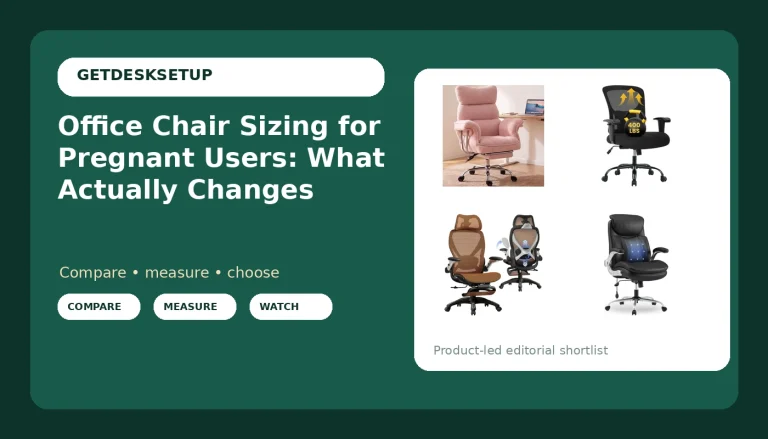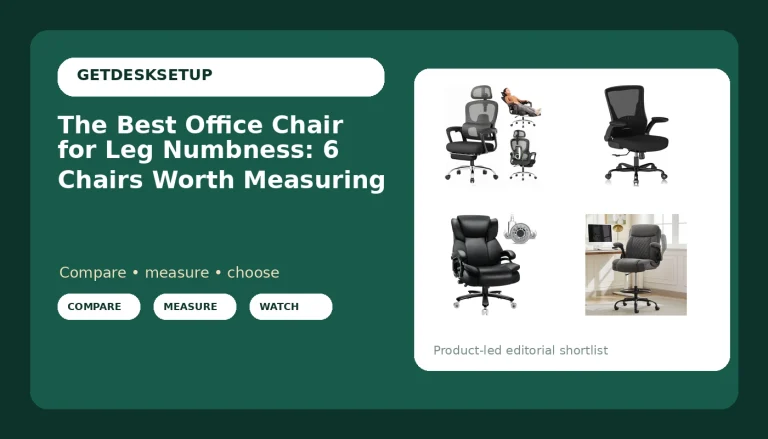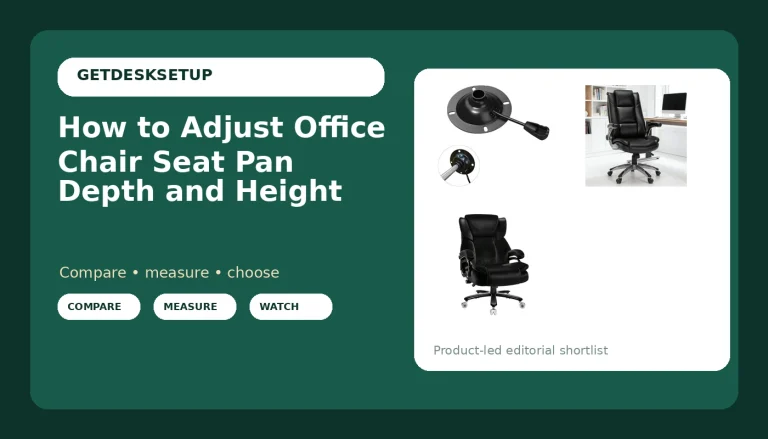
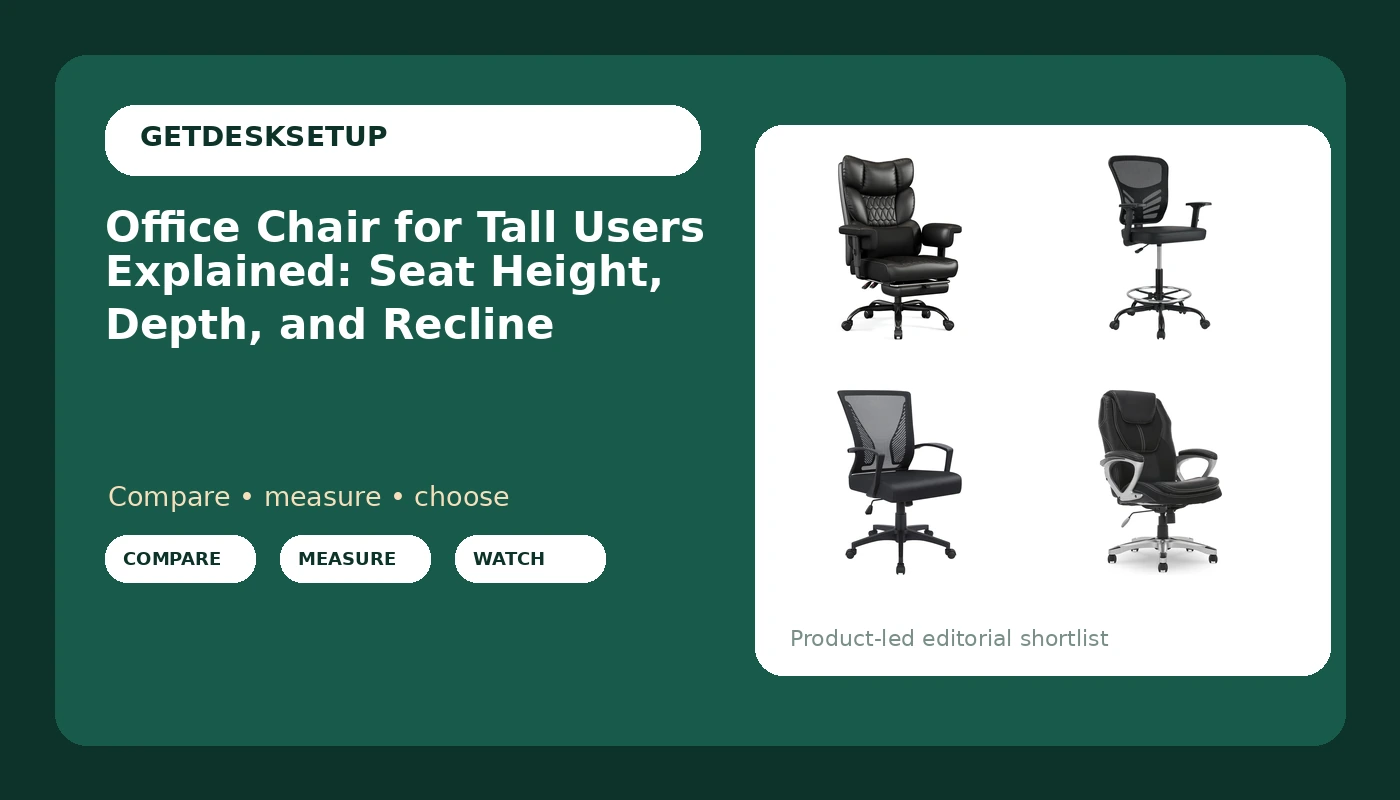
Tall sitters get told to buy a "big and tall" chair and then left to guess the rest. The label is not a measurement. An office chair for tall users has to pass three checks before anything else on the listing matters: the seat height range must reach your measured popliteal height with your feet flat, the seat depth must support your thigh without pressing behind the knee, and the lumbar support must land on your lower back instead of your mid-back. Get those three wrong and no amount of padding or stitching rescues the chair.
That is the whole of the office chair for tall users explained in one sentence: it is a measurement problem before it is a comfort problem. This guide covers four chairs that keep showing up in the tall-sitter conversation, what each one actually does at the top of its range, and who should skip it.
Related: How to measure seat depth before you buy a chair →
Quick answer
An office chair for tall users fits when three things line up: a seat height range that reaches your measured popliteal height, a seat depth that supports the thigh without pressing behind the knee, and a lumbar support that adjusts up and down rather than sitting in one fixed spot. If a listing never publishes a seat height range, treat it as an average-height chair and keep looking.
Four useful options
| Model | Best fit | What stands out |
|---|---|---|
| Misolant Big and Tall Office Chair with Footrest | Taller sitters who want recline and a footrest | Adjustable lift armrest, 155 degree recline, lumbar support pillow |
| COSTWAY Ergonomic Tall Office Chair with Adjustable Armrest | Tall sitters whose armrest height is the sticking point | Sold as a tall chair, with height-adjustable armrests |
| Furmax Office Chair | Average frames on a tight budget | Mesh back with a lumbar support curve at a low entry point |
| Serta Ergonomic Executive Office Chair | Sitters who want padded arms and a leather look | Padded arms over a mesh back with a leather finish |
Big and tall pick: Misolant Big and Tall Office Chair with Footrest
The trade-off is footprint and evidence. A reclining executive chair with a footrest needs more floor space behind the seat than a compact task chair, so measure the room before you fall in love with the recline. More importantly, "big and tall" is a marketing category, not a published fit range. Before buying, find the seat height range on the listing and compare the top of that range against your own measurement. If the range is not published anywhere, you are guessing, and guessing is how tall users end up with a chair that still sits too low.
Tall frame with movable armrests: COSTWAY Ergonomic Tall Office Chair with Adjustable Armrest
The trade-off is that armrest adjustment is only half the fit story. An armrest can rise to meet your elbows while the seat is still too shallow for a long femur. Check the seat depth next to the armrest range, and be honest about whether your thigh is supported along its length or only at the back. An office chair for taller users with movable armrests and a shallow seat is still a chair you will slide forward in all afternoon.
Budget mesh option: Furmax Office Chair
Who should skip it: anyone whose measured popliteal height sits above the top of the published seat height range, and anyone who needs a headrest. Budget mesh chairs rarely give you both a tall lift and a headrest, and this one is not sold as a tall chair at all. If you are shopping an office chair for tall people on a tight budget, put this one last on the list, after you have confirmed the range covers your measurement.
Padded executive option: Serta Ergonomic Executive Office Chair
Skip it if your priority is a seat height range that reaches a very long inseam, or if you need the armrest to move. The Serta makes more sense for a sitter of average height who wants an executive look, or for a tall sitter who has already confirmed the seat height and seat depth work and accepts fixed padded arms as the price of the styling.
Prices and availability may change. Product images, names, and retailer links are matched to verified listings. No current price, rating, stock status, or measured result is stated here without current evidence.
What an office chair for tall users actually changes
Seat height is the first gate, and the number you want is a range, not a maximum. A chair that tops out high but starts high too gives you nothing, because you cannot sit with your feet flat and your knees at roughly a right angle. What you want is a seat height range whose bottom is low enough for the chair to be usable and whose top clears your measured popliteal height with shoes on. If the top of the range is below that number, the chair is a footrest-and-cushion problem, and cushions make it worse by raising your knees.
Seat depth is the second gate and the one people skip. A long femur needs a deeper seat, but not so deep that the front edge presses behind the knee and cuts off circulation. The practical test is a small gap, roughly two or three fingers wide, between the back of your knee and the front edge of the seat. If you cannot find a depth that gives you that gap, the chair is the wrong shape for you no matter how good the lumbar support looks in photos.
Lumbar support that moves is worth more than a lumbar pillow that is sewn in. The apex of the curve should sit in the inward hollow of your lower back, and it should be adjustable up and down so you can find that spot instead of chasing it. A headrest only helps if it meets the back of your head rather than the base of your neck; on a tall torso, a short headrest turns into a neck pillow that pushes your chin forward.
Armrest height, recline, tilt tension, and caster size are the adjustment layer on top of those three. An armrest that cannot reach your forearms makes you shrug. A recline stop that only goes one way keeps you locked upright. Tilt tension that is too light lets you fall back the moment you relax. Casters matter more than people expect on a hard floor, because a chair that drifts away from the keyboard pulls your shoulders forward with it.
The ten minute sizing method
- Measure your popliteal height: floor to the crease behind your knee, shoes on, sitting on a hard chair.
- Measure your seat depth need: from the back of your buttocks to the crease behind your knee, then aim for a seat that leaves that two or three finger gap.
- Measure your seated elbow height with your shoulders relaxed and forearms level, then compare it with the armrest height range on the listing.
- Find your lumbar apex by hand, the inward hollow of your lower back, and check whether the chair's lumbar support adjusts up and down.
- Read the listing for the seat height range, seat depth, armrest range, and weight capacity. If the range is not published, cross the chair off your list and move to the next one.
Set-up details that decide whether it works
- Set the seat height first, then the lumbar support, then the armrest, then recline and tilt tension. Working in that order means you adjust each part once.
- A desk chair for tall users also has to meet the desk. If the chair top and the desk top end up too close, your knees hit the underside no matter how good the chair is.
- Treat a built-in footrest as a break position, not a typing position. Feet flat on the floor is the working posture.
- Give the chair a week before you judge the recline and tilt tension, then re-tighten. Those settings drift as the mechanism breaks in.
- On a hard floor, watch the caster behavior. A chair that rolls away from the desk when you lean forward changes your posture more than any armrest setting.
Which option should you choose?
Choose the Misolant Big and Tall Office Chair with Footrest when you want the most adjustment built into a single chair and you have the floor space behind the seat for a recliner. Choose the COSTWAY Ergonomic Tall Office Chair with Adjustable Armrest when armrest height is the problem you keep running into. Choose the Furmax Office Chair when the budget is the binding constraint and you have already confirmed the seat height range covers your measurement. Choose the Serta Ergonomic Executive Office Chair when you want a padded executive look and your own measurements already suit a conventional frame.
None of these listings substitutes for your own numbers. Two sitters of the same height can need different seat depths, and no product page can settle that for you.
The bottom line
The chair that fits your measurements beats the chair with the better badge, every time. Measure your popliteal height and your seat depth need before you compare anything, then use the published seat height range as the filter. The Misolant gives you the most ways to adjust a big and tall frame. The COSTWAY targets the armrest problem directly. The Furmax is a budget mesh chair that has to earn its place with a range that reaches you. The Serta is a comfort chair for a sitter whose measurements already fit a standard frame. Confirm the range, confirm the depth, and skip anything that will not tell you both.