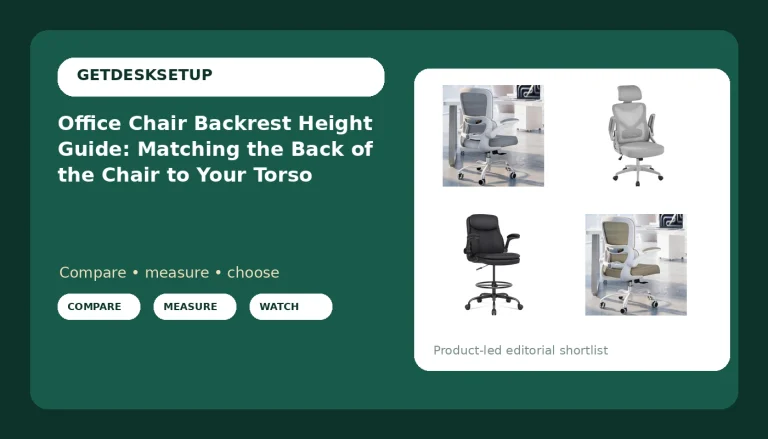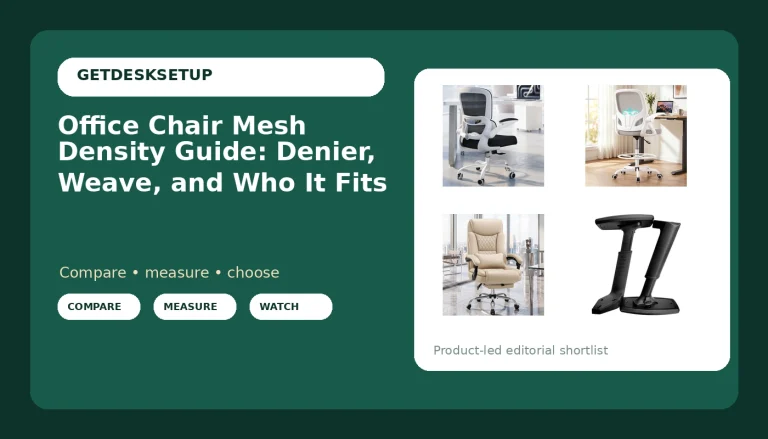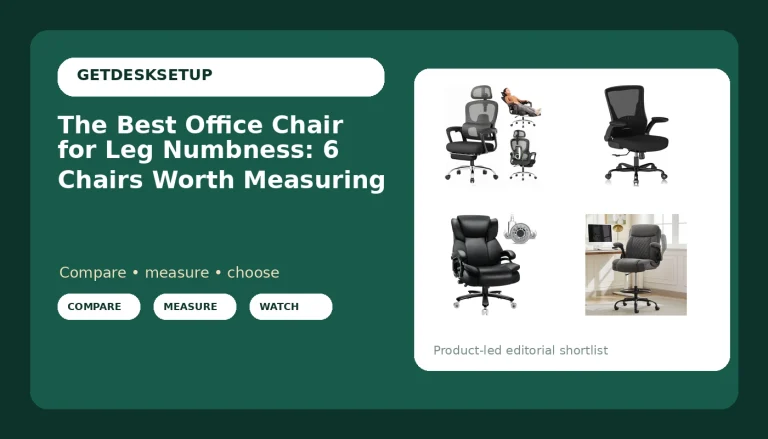
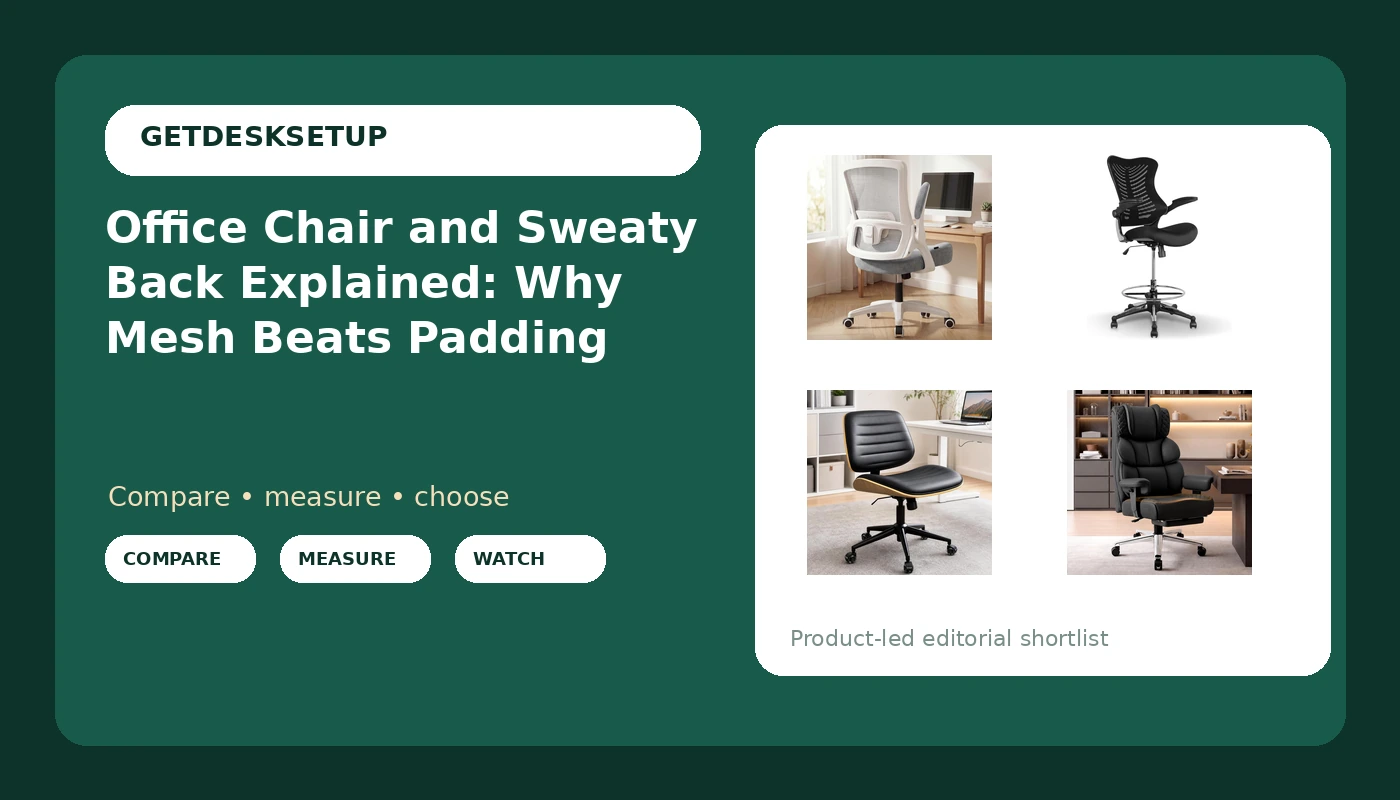
The office chair and sweaty back problem is a physics problem before it is a comfort problem. A back panel and a seat pan that seal against your body stop air from moving, so the moisture your skin produces has nowhere to go. Two chairs with the same lumbar support and the same seat depth can feel completely different after three hours, because one lets air pass and the other stores heat. This is the office chair and sweaty back explained in the terms that matter at buying time: back panel material, seat pan shape, and how often the chair lets you change position. None of it requires a new desk, a bigger budget, or a cushion.
Related: Standing Desk Wobble: Why It Shows Up Only at Standing Height →
Quick answer
Airflow beats padding. A chair with a mesh back and a seat surface that lets air move runs cooler than a thickly padded chair, because heat builds where contact is continuous and the air is still. Mesh back panels, a breathable seat surface, and an unlocked recline that lets you shift posture all break that contact. No chair cools the air in a room, and none of this compensates for a hot office. What a chair can do is stop holding warm air against your back. Treat words like coolest or best as marketing until the listing backs them up with a material, a measurement, or an adjustment.
Four useful options
| Model | Best fit | What stands out |
|---|---|---|
| NEO CHAIR Office Desk Chair High Back Mesh Chair Adjustable Lumbar, Grey | Standard-height desk, everyday mesh seating | High back mesh panel with adjustable lumbar support |
| OfficeFactor 300 Lbs Tall Drafting Chair with Adjustable Foot Ring & Flip-Up Arms, Black | Standing desks and counter-height surfaces | Adjustable foot ring, flip-up armrests, 300 lb rating |
| Sytopia Small Desk Chair for Home Office, Armless, Walnut Wooden, Vintage Black Leather | Tight rooms and small desk footprints | Armless swivel design on a walnut wood base |
| BestGlory Big and Tall Office Chair with Footrest, 400 lbs, Black | Larger users who want a footrest and a recline | 400 lb rating, adjustable armrests, built-in footrest |
Mesh everyday pick: NEO CHAIR Office Desk Chair High Back Mesh Chair Adjustable Lumbar, Grey
Mesh solves the back panel side of the problem and leaves the seat pan side open. The adjustable lumbar support is the feature worth checking first, because a lumbar pad sitting in the wrong place pushes your lower back forward and holds it there, which is the opposite of what you want in a warm room. Set it so it fills the curve of your lower back without pressing. Then check seat depth. If the seat pan is longer than your thigh, you slide forward, lose the lumbar contact, and lean harder into the back panel. Two fingers of clearance behind your knee is the working rule.
Tall desk pick: OfficeFactor 300 Lbs Tall Drafting Chair with Adjustable Foot Ring & Flip-Up Arms
This is the chair for a standing desk or a counter-height surface rather than a standard desk. The adjustable foot ring is the part that matters, because a tall chair with no foot support leaves your legs hanging, and a hanging leg position pushes you toward the front edge of the seat until your back leaves the panel. The flip-up armrests let the chair tuck under a counter when it is not in use. The 300 lb rating gives you a stated weight ceiling, which not every listing in this category provides. It is still a mesh chair, but at a tall seat height your posture is more upright and the back panel carries more of you, so panel airflow matters more here than on a standard-height chair.
Small room pick: Sytopia Small Desk Chair for Home Office, Adjustable Height Swivel Armless Office Chair No Arms, Mid Century Modern Chair with Wheels, Walnut Wooden Sturdy, Vintage Black Leather
Small rooms and small desks change the math. This chair is armless, which removes the armrest contact point where heat collects under your forearms, and it removes the width that armrests add, so it fits a narrow desk footprint. The trade-off is the seat surface. Leather and vinyl hold heat against your legs in a way mesh does not, so this is the option to pick when floor space matters more than airflow. Armless also means there is nothing to rest your shoulders on during a long session, which moves more load onto your lower back. If you sit for six hours straight, weigh that against the smaller footprint before you buy.
Big and tall pick: BestGlory Big and Tall Office Chair with Footrest, 400 lbs
Big and tall chairs are built around weight and width, and this one carries a 400 lb rating with adjustable armrests and a footrest. The footrest is the reason to look at it, and it is also the reason to think about heat. A footrest is used with the chair reclined, and a reclined position spreads your back across the panel, which increases the contact area that holds warmth. Adjustable armrests help, because you can drop them low enough to keep your shoulders relaxed instead of shrugged. The padding that makes a heavy duty chair durable is the same padding that holds heat, so this is the pick for someone who wants support and a footrest first, and airflow second.
Prices and availability may change. Product images, names, and retailer links are matched to verified listings. No current price, rating, stock status, or measured result is stated here without current evidence.
Why an office chair and sweaty back problem starts with contact area
A desk chair and sweaty back complaint almost always traces to one of three mechanisms. The first is sealed contact. Foam, leather, and vinyl press flat against skin and stop air from moving across it, so the moisture you produce has nowhere to evaporate. The second is posture stasis. If you sit in one position for an hour, the same patch of your back stays covered the whole time and the chair never dries out. The third is fit. When seat depth is too long or the lumbar support sits too low, you slide forward and lean back harder, which increases pressure and contact at the same time.
An ergonomic chair and sweaty back issue can absolutely coexist, because lumbar support is about the shape of your spine, not about airflow. A chair can hold your lower back perfectly and still trap heat against it. That is why material matters less than people expect and posture matters more. A mesh back panel only helps while air can pass through it. If a cushion, a hoodie, or a jacket sits between you and the mesh, you have rebuilt the problem you were trying to solve. The same goes for a perforated seat pan covered by a thick pad.
The practical test takes an hour and no tools. Sit as you normally sit, then slide your hand behind your lower back. If your shirt is damp and the panel behind it is warm, the chair is holding air rather than moving it. If the panel is warm but your shirt is dry, the problem is probably the room, not the chair. Those are different problems with different fixes, and buying a new chair only solves one of them.
How to read a chair listing for airflow
Listings rarely mention heat, so you have to read them for the measurements that decide it. Work through these five checks in order before you compare anything else.
- Read the back panel material first. Mesh, a perforated shell, or a suspended back will move air. Foam wrapped in vinyl will not, however the listing describes it.
- Find the seat height range and compare it with your desk. If the seat height cannot put your elbows near desk height, you will perch or slouch, and both change where the back panel touches you.
- Check seat depth against your thigh length rather than against the chair's overall size. Seat depth is the measurement that decides whether your back reaches the lumbar support at all.
- Look for adjustable lumbar support. A fixed pad fits one back shape. An adjustable one can be moved to yours, which cuts the squirming that keeps a hot patch of fabric in place.
- Check the recline and the tilt tension. A chair that rocks and returns with adjustable tension keeps your back moving and lets air reach the panel. A back locked upright is the warmest setting a chair has.
Practical setup changes that cut back heat
A task chair and sweaty back problem is rarely solved by a cushion. A cushion adds a layer between you and the seat, which is the opposite of what you want. Fix the setup instead.
- Set seat height first, then seat depth, then armrest height. Changing them in that order stops you from fixing one measurement by breaking another.
- Leave two fingers of space behind your knee. That keeps the front edge off your thigh and keeps your back against the lumbar support.
- Unlock the recline and dial tilt tension so the chair follows you instead of fighting you. Movement is the cheapest airflow you own.
- If your chair has a headrest, use it during breaks rather than all day. A headrest that holds your head forward pins your upper back against the panel.
- Check your casters against your floor. Casters that roll too freely on a hard floor let the chair drift back from the desk, which pulls you forward into the panel.
Which option should you choose?
Choose the NEO CHAIR Office Desk Chair High Back Mesh Chair Adjustable Lumbar, Grey when you want mesh airflow at a standard desk height and you are willing to set the lumbar support to your own back. Choose the OfficeFactor 300 Lbs Tall Drafting Chair with Adjustable Foot Ring & Flip-Up Arms when your work surface sits at standing or counter height and you need a foot ring and arms that fold away. Choose the Sytopia Small Desk Chair for Home Office, Armless, Walnut Wooden, Vintage Black Leather when the room is tight and you would rather have an armless chair with a narrow footprint than the best airflow in the group. Choose the BestGlory Big and Tall Office Chair with Footrest, 400 lbs when you need a 400 lb rating, adjustable armrests, and a footrest, and you accept that heavy padding holds more heat than mesh.
None of the four listings publishes an airflow measurement, and nothing in this group has been tested in a controlled room here. The guidance above is based on listed materials, listed adjustments, and the measurements you take yourself with a tape.
The bottom line
Back sweat is a fit and airflow problem, and you fix it with three decisions: a back panel that passes air, a seat depth that keeps you against the lumbar support, and a recline you actually use. Mesh handles the first. Your own tape measure handles the second. The third costs nothing. If you work at a standing desk, the tall drafting chair is the only option here built for that height. If you work at a normal desk and heat is the complaint, start with the mesh back. If floor space is the constraint, take the leather seat and the armless design as the trade you are making. The cheapest correct setup beats the most expensive wrong one every time.