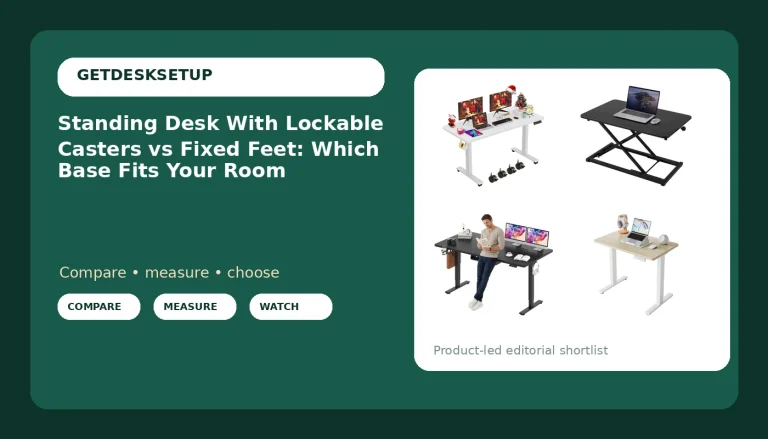
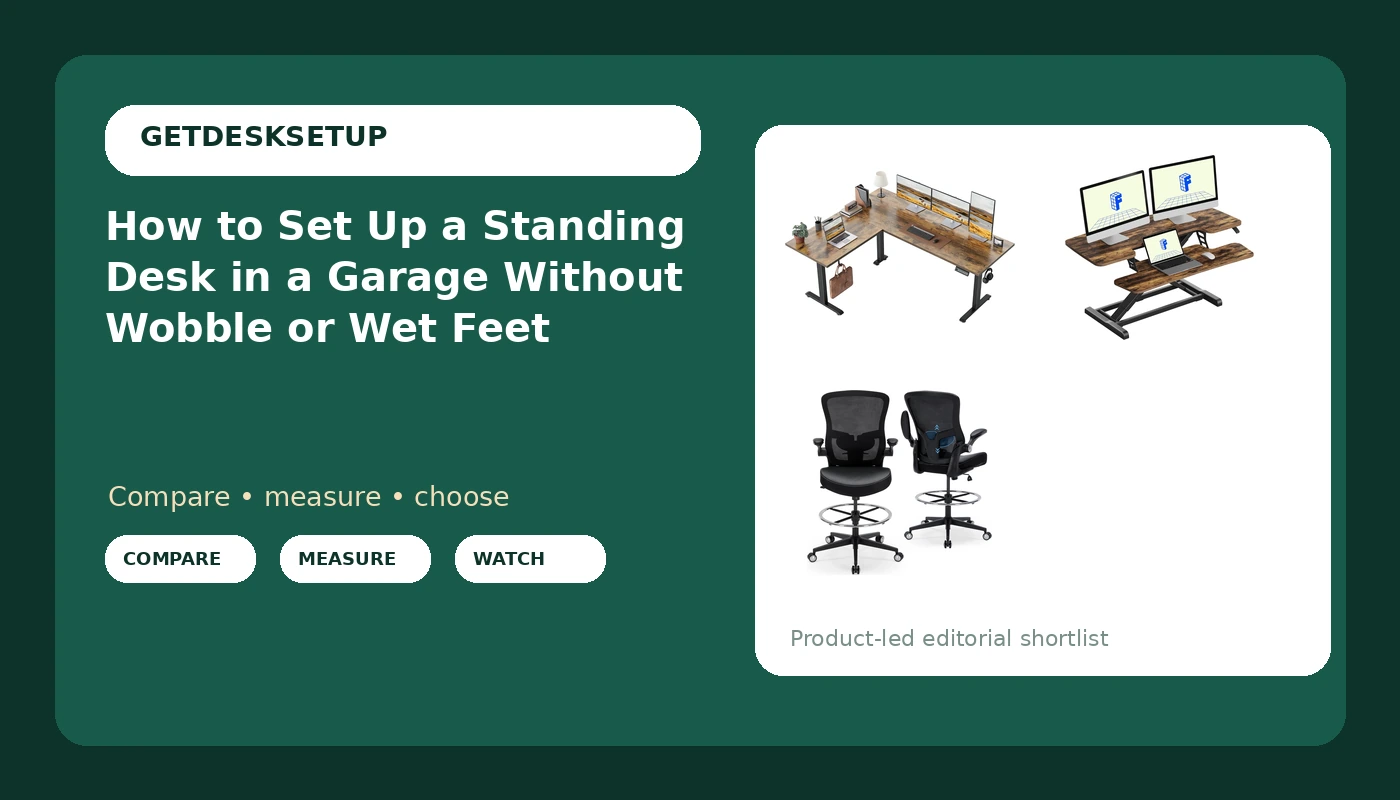
Garages are not rooms. They are concrete slabs with a door on one end, and that changes almost everything about how to set up a standing desk in a garage. The floor falls toward the door so water runs out. The outlets sit on one wall, usually on a circuit shared with the door opener. The overhead door and its track travel through the exact airspace your monitors want to occupy.
I have built out 310 home offices in and around Seattle, and a good number of them were garages, carports, and converted shops. The callbacks are almost never about motors. They are about desks that rock on a sloped slab, desks that stop halfway up because a cable caught on a crossbar, and steel feet that start rusting after one wet winter.
The three pieces below are what I would buy. The eight steps after them are the install order I use on client jobs. The sequence does not change if you want to set up a sit stand desk in a garage on a bench you already own, or if you are starting from bare concrete. The floor is the same floor.
Why you should trust me
Nine years as a facilities manager taught me how to buy desks for 400-person floors. Six years running a two-person desk setup service taught me that a garage is a different job. Between the two, I have built out 310 home offices, and every chair and desk that came through my hands got measured with a tape instead of read off a spec sheet. I keep the numbers in a notebook.
Here is what the notebook says about garages. Slope beats everything. A desk that rocks at the feet feels like a desk that is falling apart at standing height, even when the frame is perfectly fine. Moisture is second, because concrete holds water and anything you leave on the slab will find it. The door is third, and it is the one people forget, because a door that opens over the desk means the desk never really gets to the top of its range.
I do not call a frame stable because the motor is quiet. I load it, raise it to standing height, and push the top sideways, because that is where cheap frames show themselves. In a garage I do the same test with one addition: I check it on the slab it will actually live on, not on a showroom floor.
How I picked and how I tested
The three pieces below solve three different garage problems, and I picked them against the numbers that matter when you set up a standing desk in a garage, not the numbers that look good on a listing.
Desktop depth comes first. An office wall gives you 60 inches or more. A garage wall gives you whatever is left between the door track, the water heater, and the recycling bins. Measure that gap with a tape before you buy anything, because a corner frame is only a good idea if the corner is actually empty. Depth also decides reach. On a deep top, a monitor ends up far enough away that you lean, and leaning is how a standing desk quietly becomes a sitting desk by Thursday.
Lift capacity comes second, and it is not about the desk's own weight. It is about the monitor arm, the two monitors, the laptop dock, the speakers, and the mug you never move. Add those up honestly, then compare against what the listing claims. A frame rated close to your real load will sound strained at the top of its range and will drift down overnight.
Then the controls. A memory preset is not a luxury in a garage. It is the difference between using your standing height and never touching it, because you will not stand there holding a button while the door is open and the cold is coming in.
I also checked how each piece behaves at the top of its range. Every frame is calm at sitting height. The test is what happens at standing height, on a slab that is not perfectly flat, with the door track humming above it.
Finally, I checked fit against the room instead of against a photo. Before I recommend anything for a garage I want four numbers: the fall of the slab across the desk footprint, the height of the lowest point of the door track, the circuit the desk will share, and the distance from the wall to the first obstruction. If the door track owns the wall, the answer is a riser on a bench you already own, not a smaller desk.
What I would put in a garage
Three pieces, one of them optional depending on whether you already own a solid bench.
The desk: Klicelor L Shaped Standing Desk 63 x 48 Inch, Electric Height Adjustable Corner Desk for Home Office Workstation, Ergonomic Sit to Stand Computer Table with Memory Controller, Rustic Brown
The desk
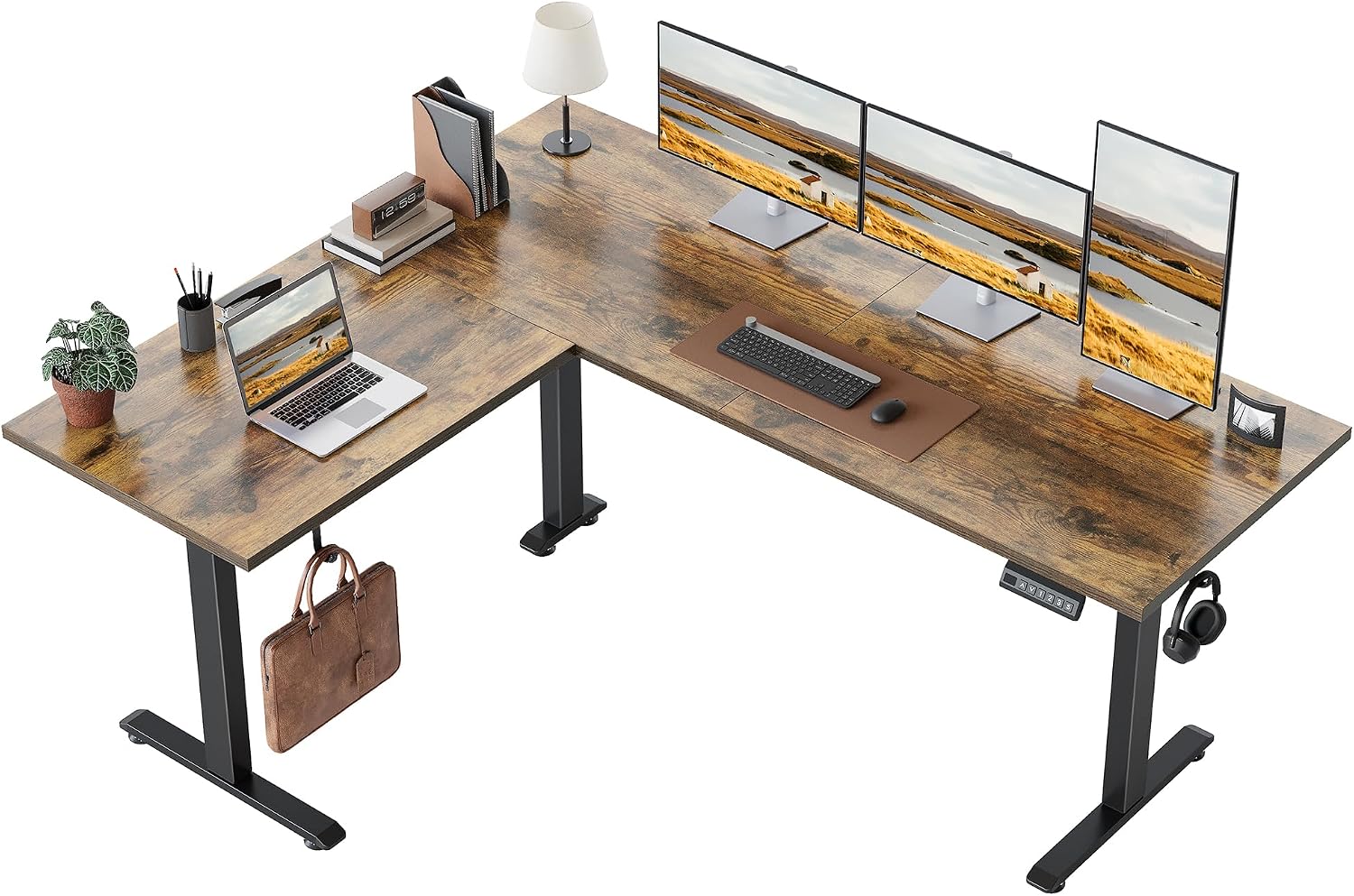
Klicelor L Shaped Standing Desk 63 x 48 Inch, Electric Height Adjustable Corner Desk for Home Office Workstation, Ergonomic Sit to Stand Computer Table with Memory Controller, Rustic Brown
Check current Amazon price
This is the frame I would start with when the garage has a real corner to spare. An L-shaped top at 63 by 48 inches gives you a monitor zone on one leg and a work zone on the other, which is the difference between a garage desk and a garage that has been turned into a pile. The base is electric with a memory controller, so your sit height and your stand height are each one button, and the rustic brown top hides the dust a garage will absolutely deliver.
The catch with any corner frame is the slab. An L-shaped desk rocks diagonally, so a fall that runs across the corner shows up as a wobble you cannot fix by tightening bolts. Shim the feet before you load the top, then re-check after a week, because concrete and steel settle into each other.
Who should skip it: a garage where the door track crosses the corner, or where the open footprint is narrower than the desk's own L. Measure first. If the corner is not there, the riser below is the honest answer.
The riser: FLEXISPOT Standing Desk Converter 40" Wide Desk Riser for Multi-Device, Large Desktop Sit Stand Workstation for Dual Monitors, Ergonomic Height Adjustable Stand Up Desk Riser, Rustic Brown
The riser

FLEXISPOT Standing Desk Converter 40" Wide Desk Riser for Multi-Device, Large Desktop Sit Stand Workstation for Dual Monitors, Ergonomic Height Adjustable Stand Up Desk Riser, Rustic Brown
Check current Amazon price
Not every garage gets a full frame, and the reason is usually the door. If the track and the opener rail cross the only wall wide enough for a desk, you cannot set up a height adjustable desk in a garage without moving the door, and nobody moves the door for a desk.
That is the case for a riser. Forty inches of width takes dual monitors plus a laptop, it sits on the workbench or counter you already own, and it raises and lowers without a single new hole in the slab. It is also the right call for a rental, or for a garage that shares space with a car and has to be clear by evening.
The trade is the trade every converter makes. You keep the bench depth you have, and the bench becomes the desk. If that bench is 24 inches deep, then 24 inches is your desktop depth, and your monitors sit closer than they would on a full frame. That is fine for a laptop and one monitor and tight for two large ones.
Who should skip it: anyone who wants the full sit-to-stand range with nothing underneath. A converter raises your keyboard and screens, not your whole work surface, so your chair height stays where it was.
The chair: Drafting Chair 400lbs Heavy Duty Tall Office Chair Big and Tall Ergonomic Standing Desk Chair with Lumbar Support and Adjustable Footrest Ring, Comfy Mesh Wide Chair with Flip-up Armrests, Black
The chair

Drafting Chair 400lbs Heavy Duty Tall Office Chair Big and Tall Ergonomic Standing Desk Chair with Lumbar Support and Adjustable Footrest Ring, Comfy Mesh Wide Chair with Flip-up Armrests, Black
Check current Amazon price
A garage setup usually ends up higher than an office setup, because benches, counters, and risers all sit above standard desk height. That is where a drafting chair earns its place. This one is built tall, with a footrest ring so your feet have somewhere to go instead of dangling, a mesh back for a room that gets warm in July, flip-up armrests so it slides under a bench, and lumbar support. The listing carries a 400 pound rating, which matters on a slab where you will also be pushing back and rolling.
Who should skip it: if your desk sits at standard sitting height and you are on the shorter side, a drafting chair leaves your feet on the ring all day and your thighs unsupported. A standard task chair is the better fit. The ring is an asset at a tall bench and a liability at a low desk.
In a garage, add a mat. Rolling a heavy chair across bare concrete wears the casters and your knees at the same time.
How to set up a standing desk in a garage, step by step
The order matters more than the tools. Work through it in this sequence and you will not have to undo anything.
Step one: Measure the slab before you unbox anything. Put a level on the floor where the feet will land and find the high corner. Garage slabs fall toward the door on purpose, so slope is a design, not a defect. What matters is whether the slope runs across your desk footprint. If you can see daylight under the level, plan on shims at the low feet. Hard plastic shims, not wood, because wood soaks up moisture out of the concrete and swells.
Step two: Find your real ceiling. Measure from the floor to the lowest point of the door track and to the opener rail, then write down the smaller number. That is your ceiling, not the joists. A desk at standing height, plus a monitor on top of it, plus a monitor arm, is taller than most people expect. If the track crosses your standing eye level, the desk moves to a side wall or becomes a riser on a bench.
Step three: Sort the power before the furniture. Most garages run the whole room on one circuit, and the door opener is on it. A height adjustable frame pulls a spike when it lifts, and the opener pulls one when it starts. Keep the desk on its own outlet if you can, keep a space heater off that circuit entirely, and never daisy chain power strips across the slab. If the only outlet is on the far wall, pay the electrician. It costs less than a fire, and it is the one part of a garage setup you should not improvise.
Step four: Build the frame upside down, on cardboard. Assemble the legs and the crossbar with the frame flipped over, then flip it, then mount the top last. Snug the crossbar bolts after the legs are square, never before. A crossbar tightened early pulls the frame out of square, and an out-of-square frame will not sit flat on anything, let alone on a slab with a fall in it.
Step five: Level it, then decide about anchoring. Adjust the feet until the frame stops rocking, then push the top sideways with your palm. If the desk walks, anchor it. Concrete anchors are fine in a garage, but know where the expansion joints and any radiant heat lines run before you drill. Kids, dogs, and a door that slams are the three reasons I anchor a garage desk.
Step six: Set two heights and save both as presets. Sit with your elbows at ninety degrees and your forearms level with the top. Stand with the top just below your bent elbow. Save each one. Then look at the anti collision setting. A garage slab is not flat, and a frame that trips on a slight slope will stop every time the door rattles. Turn the sensitivity down a notch if yours allows it.
Step seven: Run cables with slack, and give them a tray. Mount a cable tray under the top and leave a service loop long enough to cover the full travel from sit to stand. A cable that is snug at sitting height will pull on your monitor arm at standing height, and within a week your monitor is tilted and you will blame the arm. Route power down one leg, data down the other, and use the grommet for signal cables rather than for a power brick.
Step eight: Deal with the door, the dust, and the damp. If you set up a stand up desk in a garage in a wet climate, the concrete is the enemy. Put a mat under the chair, keep the tower and the power strip off the floor, and cover the top when the desk is not in use. Wipe the frame with a dry cloth rather than a wet one, because garage dust plus condensation turns into a paste on painted steel. And when the door goes up in January, cold air lands directly on your chair, so a small heater on a different circuit or a jacket on the back of the chair is the real fix.
The competition and why it lost
Three setups I considered and left out, plus one accessory family that belongs in a different guide.
The first is a long straight desk, the kind sold as a 70-inch executive top. It is a fine desk. It is the wrong desk for a garage, because the side walls are exactly where the door track, the water heater, and the recycling live. By the time you subtract those, you are back to a footprint that suits an L or a bench.
The second is a cheap single-motor frame with thin legs. At sitting height it feels fine. At standing height, on a slab with any fall in it, it turns every keystroke into a sway. A dual motor frame is not about speed. It is about two lifting columns and a wider leg profile, which is what you are actually paying for.
The third is a wall-mounted folding desk. It is a clever solution for a one-car garage with no floor space, and it fails the point of this article, because you cannot raise it. If you want to set up a standing desk in a garage and actually stand, it is not the tool. If you only ever want a flat surface, buy it.
The accessories are the last group: monitor arms, standing mats, and under-desk bikes. All real, all worth owning, none of them part of the order of operations. If you want the short list, I keep it in my guide to monitor arms for standing desks.
What this all costs
Three pieces, one electrician maybe, and a handful of small parts. Here is how I think about the money.
The desk is the line item that decides whether the setup works. Not because the top is expensive, but because the frame is the thing you are trusting at standing height every day for years. A frame you stop raising has a worse cost per day than a frame you paid more for and actually use. Run that math on anything you are considering: whatever it costs, divided by how many days you will really stand at it.
The riser is the cheaper path, and it is not a compromise if you already own a solid bench. It also gets you standing in a garage where a full frame physically will not fit. The chair is the piece people cheap out on, and it is the one they replace first. A tall bench plus a standard-height chair is a setup you will hate by week two.
Then the small parts nobody budgets for: shims, a cable tray, a chair mat, a cover for the top, and possibly an outlet. Those are the difference between a garage desk that survives a winter and one that rusts at the feet.
Check the three pieces against your own wall before you commit to anything. The measurements are free, and they are the only part of this that cannot be returned.
That is the job. Your garage was built to hold something. Make it hold a desk you actually raise.