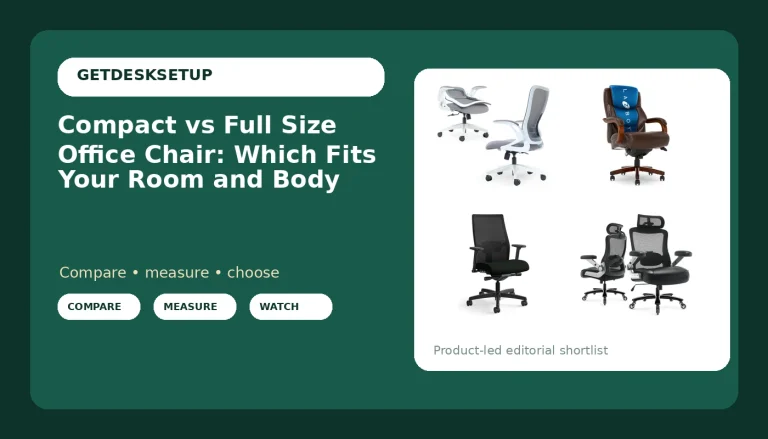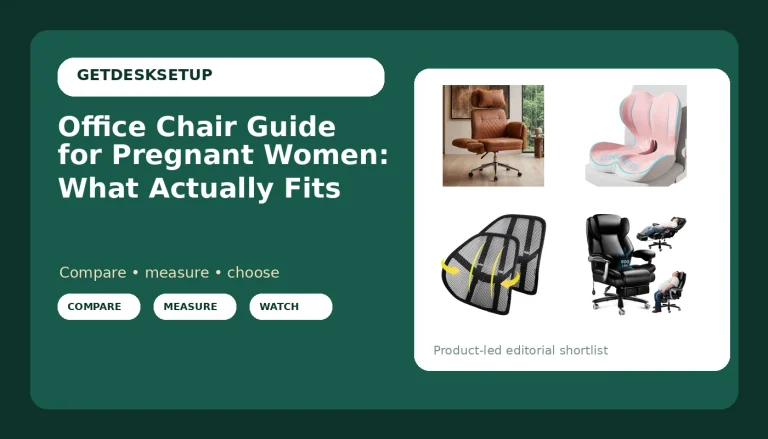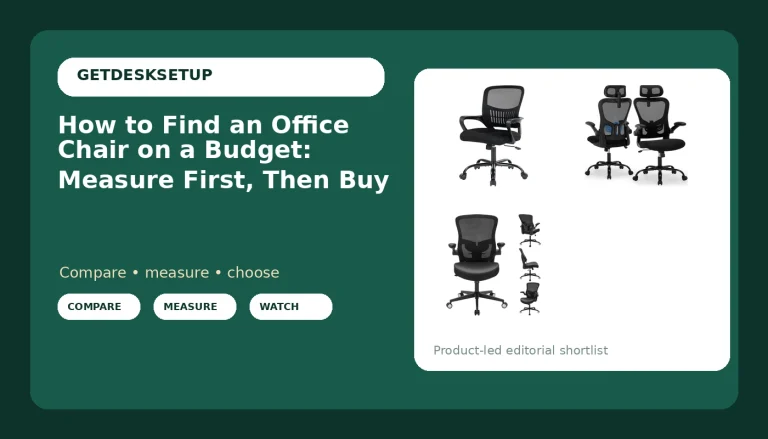
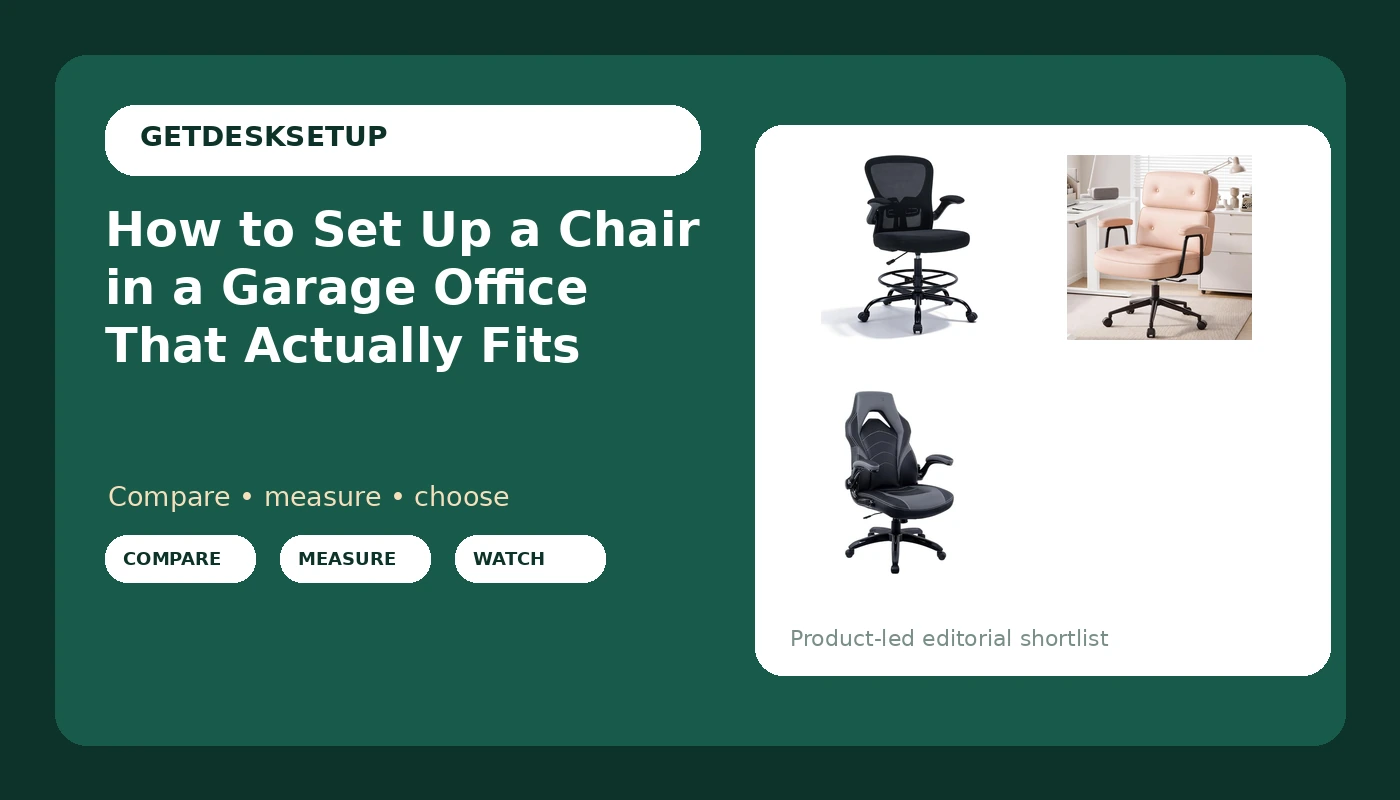
Learning how to set up a chair in a garage office means solving three problems a spare bedroom never hands you: a slab that slopes toward the door, a room that bakes in August and sits near freezing in January, and a car that needs the middle of the floor back every morning.
I have built out 310 home offices, and the garage ones fail in the same three spots every time. The seat height is set on a level assumption the floor does not meet. The casters catch the door track or the lip of a mat. And the lumbar support sits somewhere in the middle of the backrest because nobody measured their own back before they sat down.
The chair matters less than the order of operations. Measure your body, level the spot, then set the chair. Below are three chairs that survive a concrete room, followed by the eight steps that make any of them fit you.
Why you should trust me
I spent nine years as an office facilities manager, buying and assembling chairs and desks for floors of 400 people, and six years after that running a two-person desk setup service that has built out 310 home offices. A good number of those were garages, converted or not.
I keep a notebook with every chair's seat depth and desk height range measured with a tape, not read off a spec sheet. That habit came from the job. When you set up a work chair in a garage office for someone who works there eight hours a day, you cannot guess. You either know the numbers or you buy the chair twice.
A chair either fits your body or it does not. Brand and price are noise until the seat depth and the height range match your measurements.
How I picked and how I tested
To set up an office chair in a garage office properly, you pick the chair for the room, not just for the body. Concrete is harder than carpet, so every caster rolls faster and stops harder. Garages run cold, so gas cylinders and foam behave differently in February than they do in a showroom. And the room usually shares a wall with a workbench, which means armrests have to clear an apron.
The check I run on any chair before it goes into a client's garage is short. Does the seat height range put the client's feet flat on the floor, or onto a footrest ring? Does the seat depth leave a two-finger gap behind the knee? Does the lumbar support move, or is it a pillow sewn into the back? Do the armrests drop low enough to slide under a bench? Does the tilt tension hold a lean without the chair rolling? And are the casters big enough to cross an expansion joint without stalling?
I did not run these three through a lab. What I did is hold them against that list and against the two things a garage punishes, cold and dust. For the wider field, my best office chairs for small home offices roundup covers the chairs that did not make this list.
One rule I hold to: a chair with no adjustable lumbar support does not get called ergonomic in my notes, whatever the listing says.
The three chairs worth putting on a garage slab
None of these three is the perfect chair for every body. Each one solves a different garage problem, and each one has a person who should skip it.
Our pick for a standing desk: Drafting Chair Tall Office Chair, Standing Desk Chair with Flip-Up Armrests, Breathable Mesh High Chair Adjustable Height, Ergonomic Computer Chair with Lumbar Support and Adjustable Footrest Ring
Our pick for a standing desk
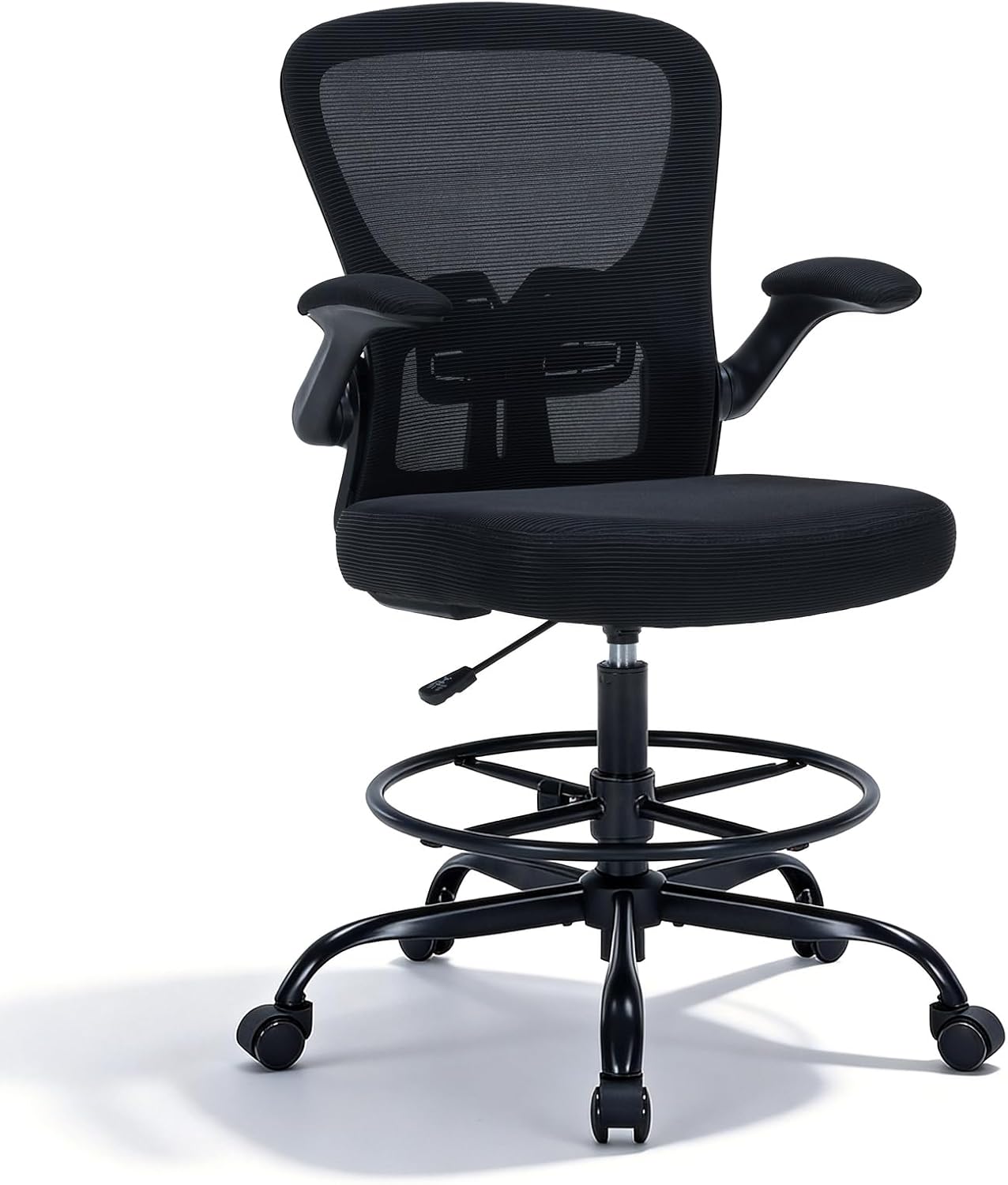
Drafting Chair Tall Office Chair, Standing Desk Chair with Flip-Up Armrests, Breathable Mesh High Chair Adjustable Height, Ergonomic Computer Chair with Lumbar Support and Adjustable Footrest Ring
A tall drafting chair is the right answer when your garage bench is a standing desk, because a normal-height chair at a raised work surface puts your hips below your knees and your lower back pays for it. This one is built for that pairing. The mesh back and seat breathe in a room with no HVAC, the armrests flip up so the chair slides under a workbench apron, the height range reaches standing-desk territory, the lumbar support adjusts, and there is a footrest ring for your feet when the seat is cranked up.
Check current Amazon price.
Mesh earns its keep in a garage. Concrete dust settles into foam and stays there; a mesh seat you can vacuum on a Saturday beats a cushion you cannot. The flip-up armrests are the feature I would pay for, because a fixed armrest that hits the bench apron means you sit a foot away from your work all day.
The footrest ring is also the flaw. On a tall chair your feet land on the ring rather than the floor, and that is a different posture, not a bonus. If you are shorter than about 5'6", a drafting chair pushes your knees up and parks your feet on a bar, so skip it. If your work surface is a standard-height desk rather than a raised one, skip it too, because the seat will not go low enough to put your thighs parallel to the floor.
Flaws but not dealbreakers: The ring is a place bags and cables snag when you stand up, and a tall chair is a long way from the floor, so you lose the habit of planting both feet. Neither one breaks the chair for the person it fits.
Anyone running a standing desk or a tall garage bench, and anyone at least 5'10" with a long lower leg, gets the most out of this one.
The pick for a normal-height bench: OLIXIS Ergonomic Home Office Desk Chair, PU Leather Computer Chair
The pick for a normal-height bench
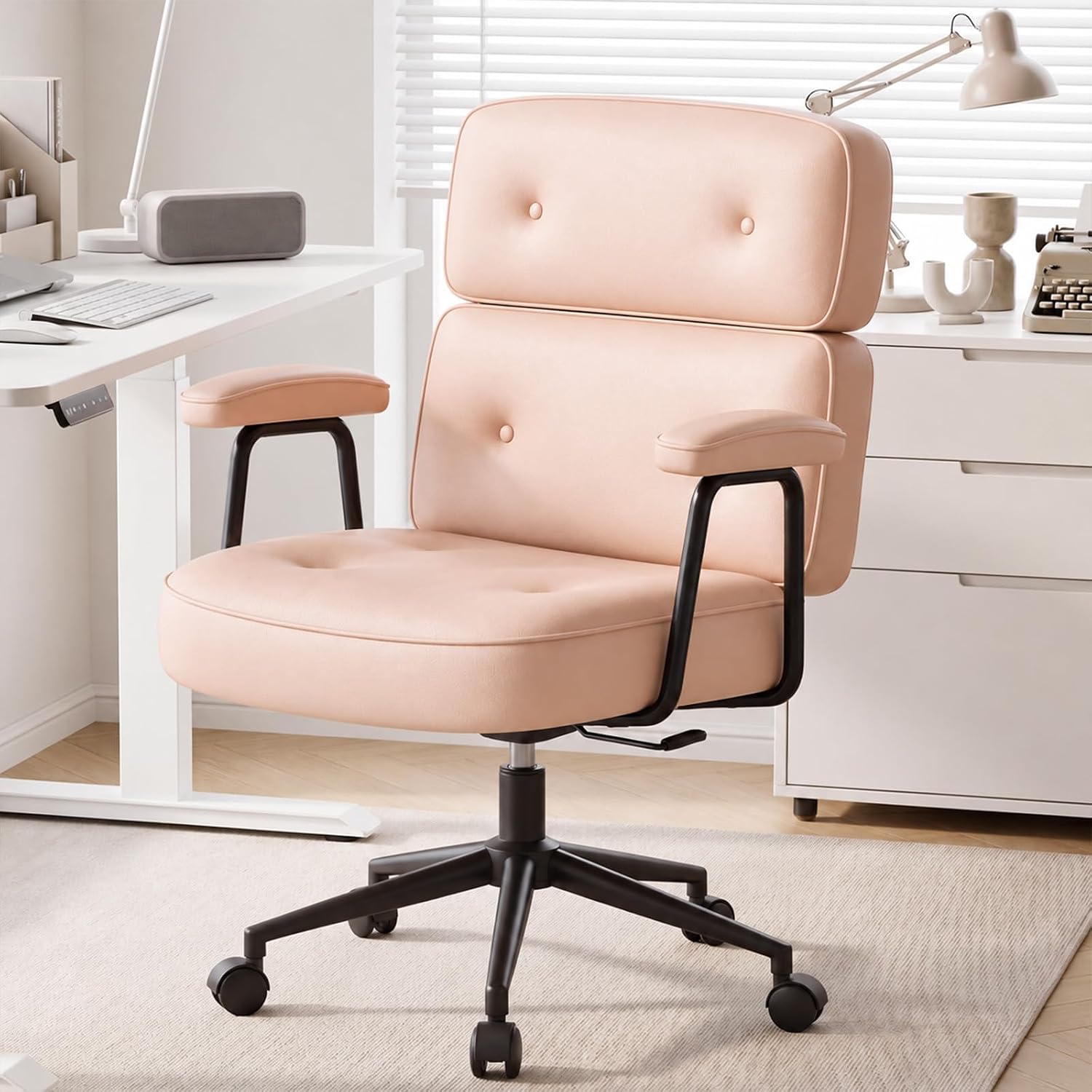
OLIXIS Ergonomic Home Office Desk Chair, PU Leather Computer Chair
The OLIXIS is the standard-height answer, and the PU leather is why it works in a garage. Concrete dust wipes off a vinyl surface with a damp cloth, which is more than you can say for mesh or fabric. If you set up a desk chair in a garage office for two or three hours a day and you want a clean, plain chair at a normal desk height, this is the one to start with.
Check current Amazon price.
The caveat is temperature. PU leather is cold in January and clammy in August, so a garage that freezes or bakes is a bad match for a vinyl seat. The name says ergonomic, and that word means nothing on its own; look at the photos for a lumbar pad you can actually move, because a pad sewn into the backrest is decoration.
Flaws but not dealbreakers: No headrest, and the finish shows scuffs from work boots and toolbox corners. Both are cosmetic on a chair that lives next to a car.
Someone who works at a normal desk height, keeps the garage above freezing, and wants a wipe-clean seat should buy this. Someone who sweats through vinyl by noon, or wants a headrest to lean into, should not.
The pick if you lean back: STAPLES Emerge Vortex Gaming Chair, Adjustable Height, Swivel Black
The pick if you lean back
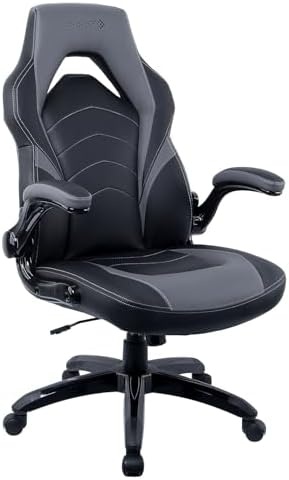
STAPLES Emerge Vortex Gaming Chair, Adjustable Height, Swivel Black
The case for a gaming chair in a garage is recline. The Emerge Vortex reclines farther than either chair above, which is the posture most people fall into when they are thinking rather than typing, and the swivel base means you can pivot from the bench to a shelf without standing up. Black upholstery also hides the dust that a light-colored seat advertises.
Check current Amazon price.
The case against it is the same recline. On a hard slab with free-rolling casters, a deep lean turns into a slow roll backward, so use the recline lock and check the tilt tension before you trust it. The side bolsters are the other problem: they push some shoulders forward and they block your elbows when you work at a bench instead of a keyboard. Bench work wants a flat seat pan, and this is not a flat seat pan.
Flaws but not dealbreakers: The bolsters and the width. If you are broad through the shoulders, sit in one before you commit, because a gaming chair that pinches is worse than a plain task chair that does not.
Anyone who leans back to read, sketch, or take calls, and anyone who wants one chair for desk duty and bench duty, will like this more than the other two. Anyone who wants a flat pan and free elbows should pass.
How to set up a chair in a garage office, step by step
Step one: Measure your body before you touch the chair. Three numbers, taken with a tape, shoes on. Seat height is floor to the crease behind your knee. Seat depth is the back of your seat to the back of your knee, minus two fingers. Elbow height is floor to the underside of your elbow with your upper arm hanging and your forearm at 90 degrees. Write them on a strip of tape and stick it to the bench. Every adjustment below depends on those numbers, and guessing them is how people buy the same wrong chair twice.
Step two: Level the spot, not the chair. Garage slabs slope toward the door on purpose, so the floor where you sit is rarely flat. Put a four-foot level down and find the high and low ends. A chair mat or a half sheet of plywood takes out a mild slope, and you shim the pad, never the chair base, because shimming one leg of a five-star base loads the whole thing onto one point. If the slope is bad, move the desk to the flat end of the garage instead of fighting it.
Step three: Set the seat height first. With shoes on, bring the seat up until your feet rest flat and your thighs run parallel to the floor or slightly downhill toward the knees. If you work at a standing desk, set the desk height first, then raise the chair until your elbows sit just above the desktop. Put the mat down before you set the height, because casters and mat thickness add an inch you will not get back.
Step four: Set the seat depth and the lumbar support. Slide the seat pan, if it slides, until there is a two-finger gap behind each knee. Then move the lumbar support to the small of your back, level with your belt line or a hand's width above it. If the pad is sewn in and lands in the wrong place, no seat height change fixes it, and that is the moment to return the chair rather than live with it.
Step five: Set the armrests, or flip them up. Armrests should meet your forearms so your shoulders stay down and your elbows sit near 90 degrees. Then check the bench. If an armrest hits the apron, you will sit a foot away from your work all day, so flip the armrests up or take them off if the chair allows it. Armrests are the first thing to sacrifice in a garage, because benches are not built to chair height.
Step six: Set the recline and the tilt tension. A garage floor is hard, so use a small recline, five to ten degrees off vertical, enough to take pressure off the lower back without turning the chair into a lounger. Set the tilt tension so you can push the backrest away with two fingers; if you have to shove with your shoulders, it is too tight. On a tall chair with a footrest ring, lock the recline, because a reclined tall chair is a balance act.
Step seven: Fix the casters before the door does. Casters that are fine on carpet flat-spot and drag on concrete, and the lip of a door track will stop a small one dead. If the chair rolls into the door track or a slab joint, either swap to glides for a fixed position or buy a mat with a chamfered edge. Keep the chair out of the car's parking path and out of the door swing, because a chair that lives in the driving lane gets moved, dropped, and eventually bent.
Step eight: Re-check after a week, and again when the season turns. The bolts in a five-star base loosen in the first week, so tighten them once and forget them. Vacuum the caster hoods and the gas cylinder, because concrete dust is a grinding paste. When the temperature drops, gas cylinders stiffen and foam hardens, so re-set the seat height in January instead of trusting your October setting. A garage office is a seasonal room, and the chair has to be re-tuned with it.
The competition and why it lost
Several chairs I like elsewhere in the house lose in a garage. A saddle stool or a kneeling chair gives you no lumbar support, no recline, and no adjustable seat depth; those are twenty-minute chairs, and a garage work session is not twenty minutes. A fixed-height drafting stool without a footrest ring leaves your feet dangling, which puts the weight of your legs on the front edge of the seat.
The most common failure is the padded bar stool at a bench. It has no armrest, no tilt tension, and no seat height fine enough to put your feet flat, and people sit on it for four hours because it was already in the garage. A mat will not fix a stool that was never adjustable.
Cheap marketplace listings that call a chair ergonomic and then sew a pillow into the backrest lose too. No adjustable lumbar support, no recommendation. The same goes for a headrest that pushes your chin forward when you sit normally; a headrest should meet the back of your head at your working angle or it should not be there.
For the bedroom and small-office chairs that did not make this list, the best office chairs for small apartments roundup is where they live. If your garage bench is really a standing desk, pair it with the standing desk setup guide before you buy a tall chair.
What this all costs
Three line items: the chair, the floor fix, and the small parts. The tall mesh drafting chair is the most expensive of the three, the PU leather chair sits in the middle, and the Emerge is the wildcard depending on what the listing is doing that week. Check current Amazon price on each one before you decide, because these three move around more than plain task chairs do.
The floor fix is the cheapest thing you will buy: a chair mat or a half sheet of plywood, plus a level if you do not own one. Glides are a rounding error next to the chair. If you put a mat under a tall drafting chair, buy one rated for the load, because a thin mat curls at the edge and catches a caster at exactly the wrong moment.
Cost per day is the only number that matters. A chair you sit in five days a week for a year comes out to pennies a session, and the gap between the cheapest correct setup and the most expensive wrong one is usually one measurement you skipped. That is the whole job when you set up a chair in a garage office: measure the body, level the floor, then adjust in the order above.
Get the seat height right, get the seat depth right, keep the casters out of the door track, and the garage stops feeling like a compromise. It starts feeling like a room you chose instead of a room you settled for.