I have bought, inspected, and handed off more than 900 used office chairs, first as a facilities manager running 400-person floors and then through six years of building out home offices. The pattern never changes: the chair that looks like a steal in the listing photo is usually the one whose seat depth is two inches short for the person buying it. Learning how to buy a used office chair is not about spotting logos. It is about carrying a tape measure and knowing your own numbers before you look at anyone else's chair.
A used chair is either the best deal in the home office or a slow leak of money, and the difference is entirely measurement. A Steelcase in the right size and a no-name mesh chair from a liquidator can both fit you, and both can fail you, and the price tag tells you nothing about which is which. What tells you is seat height range, seat depth, and whether the mechanism still holds a recline position under load.
Below is the exact process I run when I buy an used desk chair for a client, plus the three new chairs I keep in my van as measuring references. You cannot judge a used chair in a vacuum. You need a known-good comparison to sit in first.
Why you should trust me
I spent nine years as a facilities manager, buying and assembling chairs and desks for 400-person floors. That means I have taken delivery on pallets of Steelcase and Haworth chairs and watched what happens to them after four years of eight-hour days. For the last six years I have run a two-person desk setup service that has built out 310 home offices in and around Seattle.
Every chair that comes through my hands gets measured with a tape, not read off a spec sheet. I keep a notebook with seat depth, seat height range at the lowest and highest setting, and armrest height spread for every model I have touched. When a client sends me a used listing, I can usually tell them whether to drive across town before they leave the driveway.
I have also bought used chairs that turned out to be junk, which was the more useful education. Two of them had gas cylinders that held for a week and then sank an inch under load. One had a five-star base that had been cracked and glued. You learn to check those two things before anything else.
How I picked and how I tested
The three chairs below are not used chairs. They are the new-price reference points I use to calibrate my hands and a client's body before we shop secondhand. If you sit in a known chair with a 19-inch seat depth and an 18-inch seat height at the low end, you will know within ten seconds whether the used chair in front of you is close or wrong.
I tested all three the same way. I assembled them, measured the seat height range at the floor with a tape, measured seat depth from the front edge to the backrest at the center of the cushion, checked the lumbar support travel, and sat in each one for a full workday at a 29-inch desk and then at standing height. I rolled each one across hardwood and low-pile carpet to listen to the casters, and I leaned back hard on all three to see how the recline and tilt tension behaved.
The numbers I trust: seat depth should be within two inches of the distance from the back of your knee to the back of your butt, measured while sitting. Deeper than that and the front edge presses behind your knee, so you slide forward all day. Shallower and your thighs carry your weight instead of your sit bones, which shows up as lower back pain by mid-afternoon.
Seat height matters just as much. For most people the correct seat height puts your feet flat with the seat at roughly a quarter of your height in inches, give or take an inch. A 5'9" person lands around 18 to 19 inches. If a used chair's lowest seat height is 21 inches, no adjustment fixes it for someone who is 5'6".
For the wider picture of how a chair sits inside a desk setup, I covered how to set up a standing desk separately.
What to measure before you buy a used office chair
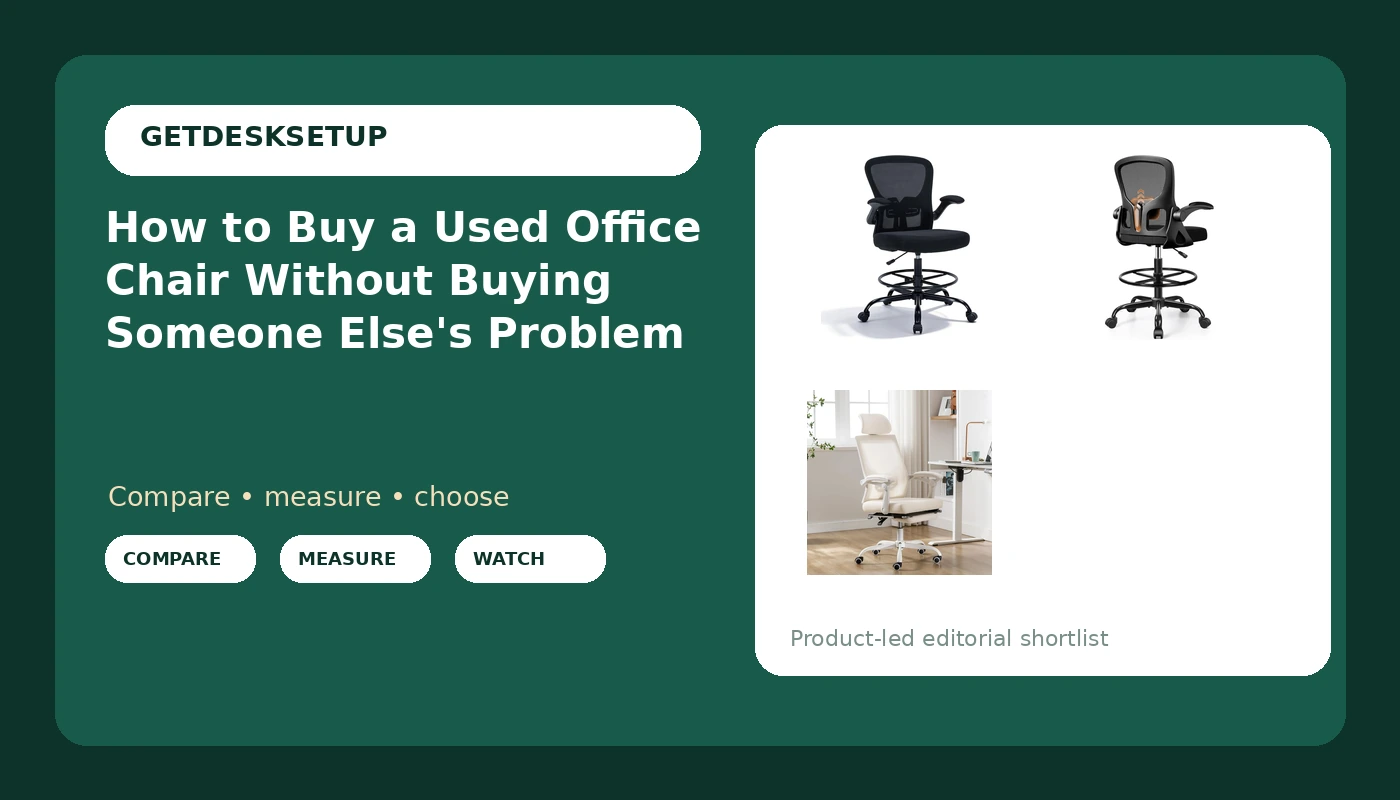
Here is the reference rack. These are the three chairs I use to show a client what a correct fit feels like, and each one covers a different geometry. None of them is used, and that is the point. Sit in one, write down the numbers that feel right, then go measure the used chair against those numbers.
Budget pick: Drafting Chair Tall Office Chair, Standing Desk Chair with Flip-Up Armrests, Breathable Mesh High Chair Adjustable Height, Ergonomic Computer Chair with Lumbar Support and Adjustable Footrest Ring
Budget pick
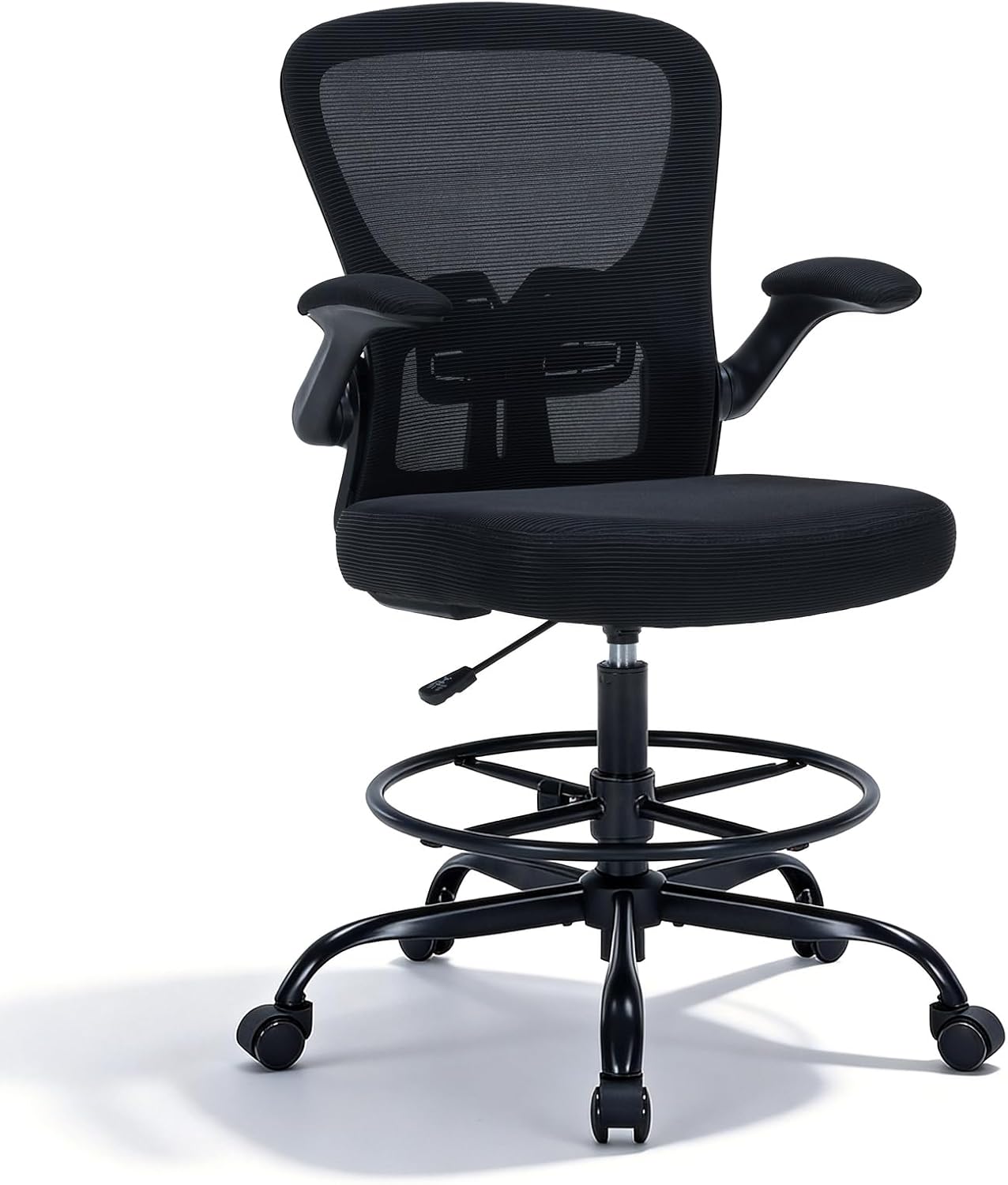
Drafting Chair Tall Office Chair, Standing Desk Chair with Flip-Up Armrests, Breathable Mesh High Chair Adjustable Height, Ergonomic Computer Chair with Lumbar Support and Adjustable Footrest Ring
This is the cheap reference. Check current Amazon price. It is a tall drafting chair, so its seat height range sits well above a standard task chair, which makes it the right comparison for anyone pairing a chair with a standing desk instead of a fixed desk. The flip-up armrests let you drop them out of the way and sit closer to the keyboard, and the adjustable footrest ring is what keeps your feet supported once the seat goes up.
What I use it for is measuring what a tall seat height does to your posture. If you are 5'4" and the seat is at 28 inches, your feet dangle and your thighs go numb unless the foot ring is set correctly. That is the failure mode of every tall chair, and it is also why so many used drafting stools get sold: they never fit the first buyer.
The mesh back breathes, and the lumbar support is present, but it is a fixed shape rather than a deep adjustable pad. Fine for a reference chair and fine for a short session. Anyone who wants to fine-tune a chair for eight hours should keep reading.
Flaws but not dealbreakers: The footrest ring is the whole ballgame on a chair this tall, and its adjustment range is limited. If your legs are short, check that ring height before you commit.
Anyone with a standing desk and a normal-to-tall frame who wants a reference point without spending much will get what they need here.
Runner-up: Drafting Chair, Tall Office Chair for Standing Desk with Flip-Up Armrests, Adjustable Foot Ring & Lumbar Support, Mesh High Desk Stool for Studio & Drafting Table, Black
Runner-up
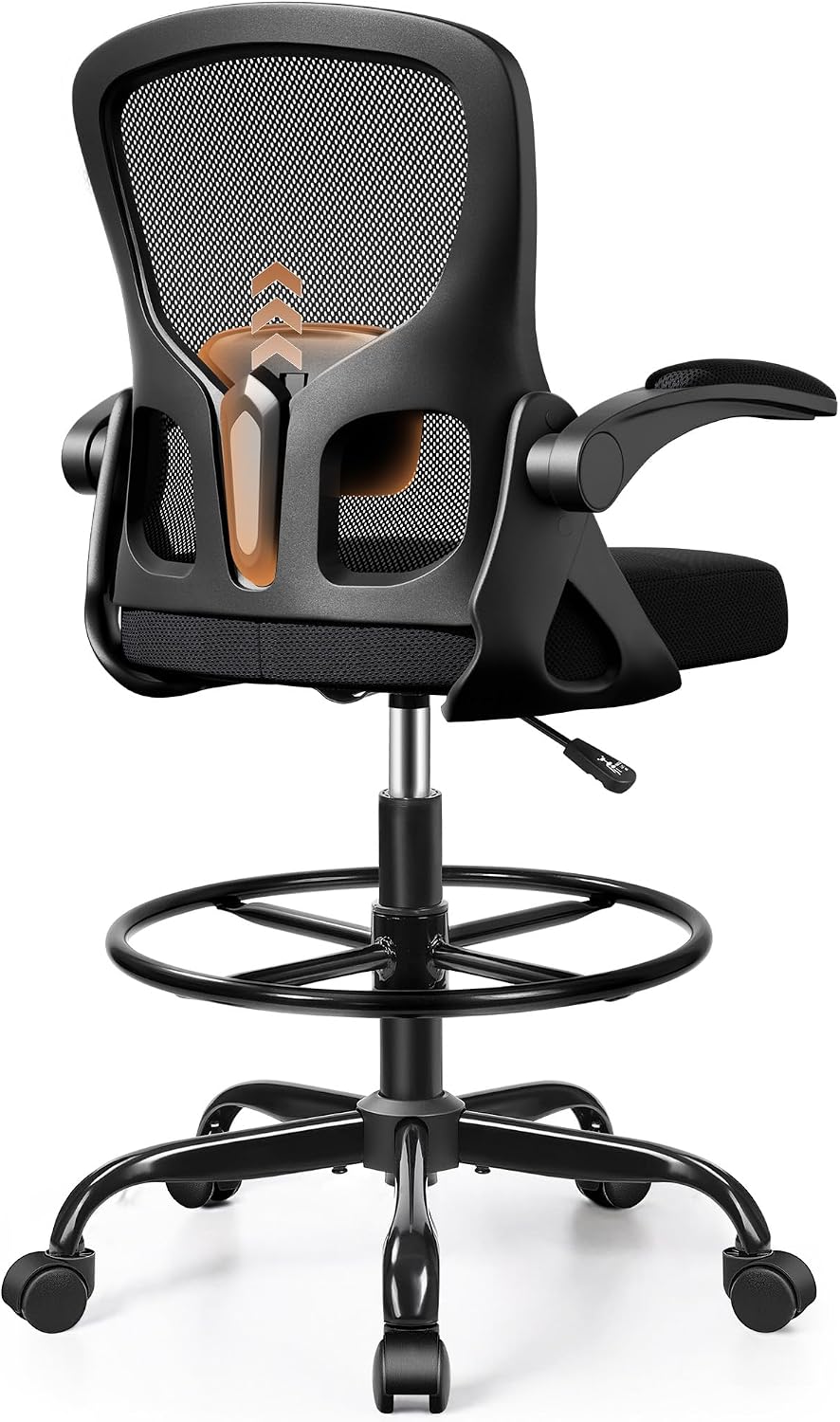
Drafting Chair, Tall Office Chair for Standing Desk with Flip-Up Armrests, Adjustable Foot Ring & Lumbar Support, Mesh High Desk Stool for Studio & Drafting Table, Black
This is the second tall reference, and it is the one I put clients in when they are deciding between a stool and a proper chair at a standing desk. Check current Amazon price. The differences from the budget pick are small on paper and obvious in person: the foot ring is easier to work, the lumbar support has more shape to it, and the whole thing feels less like furniture built to a price.
I have used this one as a drafting seat in a studio setup. The thing I watch on any tall chair is whether the base stays planted when you lean back, and this one does. The flip-up armrests are the feature I care about most, because on a tall chair the armrests are what stop you getting close enough to a keyboard, and flipping them up solves that in one second.
For the used market, this chair is my benchmark for what a tall chair in this class should feel like new. When a seller wants similar money for a used tall chair of unknown origin, I sit in this first and then decide.
Flaws but not dealbreakers: It is a stool with a back, not a recliner. There is very little recline travel, so if you like leaning back to think, look at the third chair.
Anyone at a standing desk or a drafting table who wants a taller seat height and does not want to gamble on a used chair with a worn cylinder should look here.
Upgrade pick: Qulomvs Mesh Ergonomic Office Chair with Footrest Home Office Desk Chair with Headrest and Backrest 90-135 Adjustable Computer Executive Desk Chair with Wheels 360 Swivel Task Chair
Upgrade pick
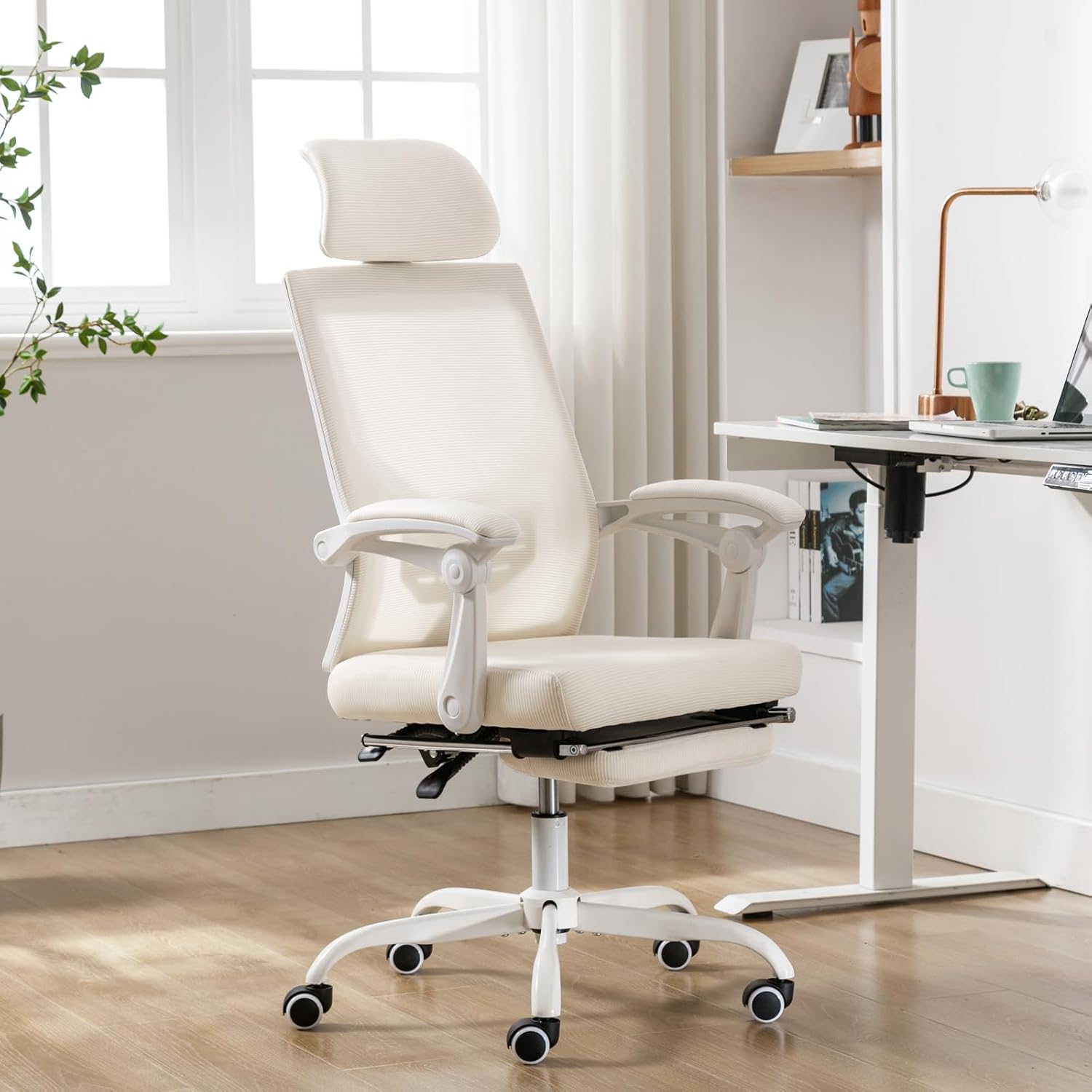
Qulomvs Mesh Ergonomic Office Chair with Footrest Home Office Desk Chair with Headrest and Backrest 90-135 Adjustable Computer Executive Desk Chair with Wheels 360 Swivel Task Chair
This is the one that behaves like a conventional office chair, which makes it the best reference for the used market, because most used chairs are conventional task chairs. Check current Amazon price. It has a headrest, a recline that travels from roughly upright to well past 90 degrees, and a footrest that pulls out, which is what makes it usable for a full day rather than a two-hour session.
What I measure on it: seat depth, seat height at the low end, and how the recline behaves when I change the tilt tension. Those three numbers are what you are actually buying when you buy an used ergonomic chair, whether it is this one or a fifteen-year-old Steelcase. The recline here is smooth through its range and the tension dial is easy to reach under the seat, which is not true of every chair at this level.
The mesh back and the headrest make it a better long-session chair than either drafting stool above, and the casters roll cleanly on hardwood without the grinding that tells you the bearings are shot.
Flaws but not dealbreakers: The footrest is a nice extra, not a reason to buy. If you never recline, you are paying for travel you will not use.
Anyone who wants a normal-height task chair with a headrest and a real recline, and who wants to know what those features should feel like before shopping used, should sit in this one first.
How to buy a used office chair: the eight-step inspection
Now the part that saves you money. Bring a tape measure and a flashlight, and a friend if the chair is heavy. Every step below takes under a minute, and each one has killed a deal for me.
Step one: Measure the seat height range at the floor. Put the chair on a hard, flat surface, not carpet, and drop it to its lowest setting. Measure from the floor to the top of the seat cushion at the front edge, then raise it fully and measure again. Write both numbers down. If the low end is above your correct seat height, walk away, because no adjustment fixes a chair that starts too tall. This is the most common reason a used chair is for sale.
Step two: Measure the seat depth. Measure from the front edge of the seat to the backrest at the center of the cushion, not at the corner where a bolster fools you. Then sit and measure from the back of your knee to the back of your butt. The seat should be within two inches of that number. A seat depth two inches too deep pushes the front edge into the back of your knee, and you will slide forward all day.
Step three: Check the lumbar support adjustment. Push on it. If it is a fixed bulge with no height or depth adjustment, it fits one body and one body only. A good lumbar support moves up and down at minimum, and ideally in and out. If it does not move at all and the chair is listed as ergonomic, the word is decoration.
Step four: Work the armrest in every direction. Raise it, drop it, rotate it, push it in and out. Then pull hard toward you while watching where the armrest meets the seat frame. Cracks at that joint are the most common structural failure on a used chair and they are nearly invisible in photos. If the armrest wobbles more than a quarter inch at the base, assume the plastic is already stressed.
Step five: Test the recline and the tilt tension. Sit, lean back, and find the tension knob or lever. Tighten it fully and lean again, then loosen it and lean again. You should feel a clear difference. If the chair flops back with no resistance, the tension mechanism is gone, and on most chairs that is not a part you can buy separately. Listen for a clunk too. A clunk means a worn bushing.
Step six: Inspect the caster and the base. Roll the chair across a hard floor in a straight line, then in a circle. Flat spots, grinding, or a wheel that skips means new casters, which are cheap but annoying. Flip the chair over and look at all five legs where they meet the center column. A hairline crack there becomes a full break within a year, so a cracked base is a hard pass.
Step seven: Test the gas cylinder under load. Sit down and raise the chair to full height. Then sit normally for two full minutes without touching the lever. If the seat sinks even half an inch, the cylinder is losing pressure. This is the number one failure on used office chairs and the reason liquidators sell them in bulk. A replacement cylinder is a real repair with real tools, so treat a sinking chair as a project, not a bargain.
Step eight: Check the label, the foam, and the smell. Look under the seat for the manufacturer's date sticker and the model number, and photograph it. Press the foam at the front edge of the seat: if it stays compressed after you lift your hand, the foam is done. Then smell the chair. Smoke and pet odor live in foam and mesh forever, and no cleaning gets them out. If a seller will not let you run all eight steps, that is your answer.
The competition and why it lost
Before anyone emails me: yes, a used Steelcase Leap or Herman Miller Aeron is a better chair than anything on this page, and I have bought dozens of both. They are not here because a used one is a moving target. Condition, cylinder wear, and price vary listing to listing, and I cannot judge a specific used chair from a listing photo. The reference chairs above are the fixed points I compare against.
A Haworth Zody is the chair I recommend most to clients who want a used chair with an adjustable lumbar support and a forward tilt, but again, you inspect it in person. The Branch Ergonomic Chair and the Autonomous ErgoChair are the two new mid-range chairs I get asked about most, and both are fine, but neither is a used-chair reference.
The no-name mesh chairs that show up in bulk liquidation lots are the ones I see fail most often at the gas cylinder and the armrest mount. They are not automatically bad buys, but they are exactly where the eight steps above matter most.
What this all costs
A used chair usually sells for a fraction of what the same chair cost new, and a dealer refurb sits somewhere in between. The catch is that the fraction should reflect condition, and most sellers price a chair with a worn cylinder as if it were perfect.
Here is how I do the math without printing a number that will be wrong next month. Start from the new reference price, then subtract for each fault: a gas cylinder that sinks, a cracked base, dead foam, a lumbar support that does not adjust, armrests that do not move. A chair with two of those faults is not a bargain at half price. A chair with none of them, from a maker who still sells parts, is worth paying more for than a cheap chair with a clean photo.
The other half of the math is time. A chair you have to repair is a chair you are not sitting in. If you need to work tomorrow, buy the reference chair that fits and stop shopping. If you have a weekend and a tape measure, the used market will beat it on price nearly every time.
The three reference chairs on this page exist for one reason: so you know what correct feels like before you hand over cash in a parking lot. Sit in one, write down your seat height, your seat depth, and how much lumbar support travel you actually use. Then go buy an used task chair with those numbers in your pocket, and run all eight checks before you pay.
That is the job. Measure first, pay second.