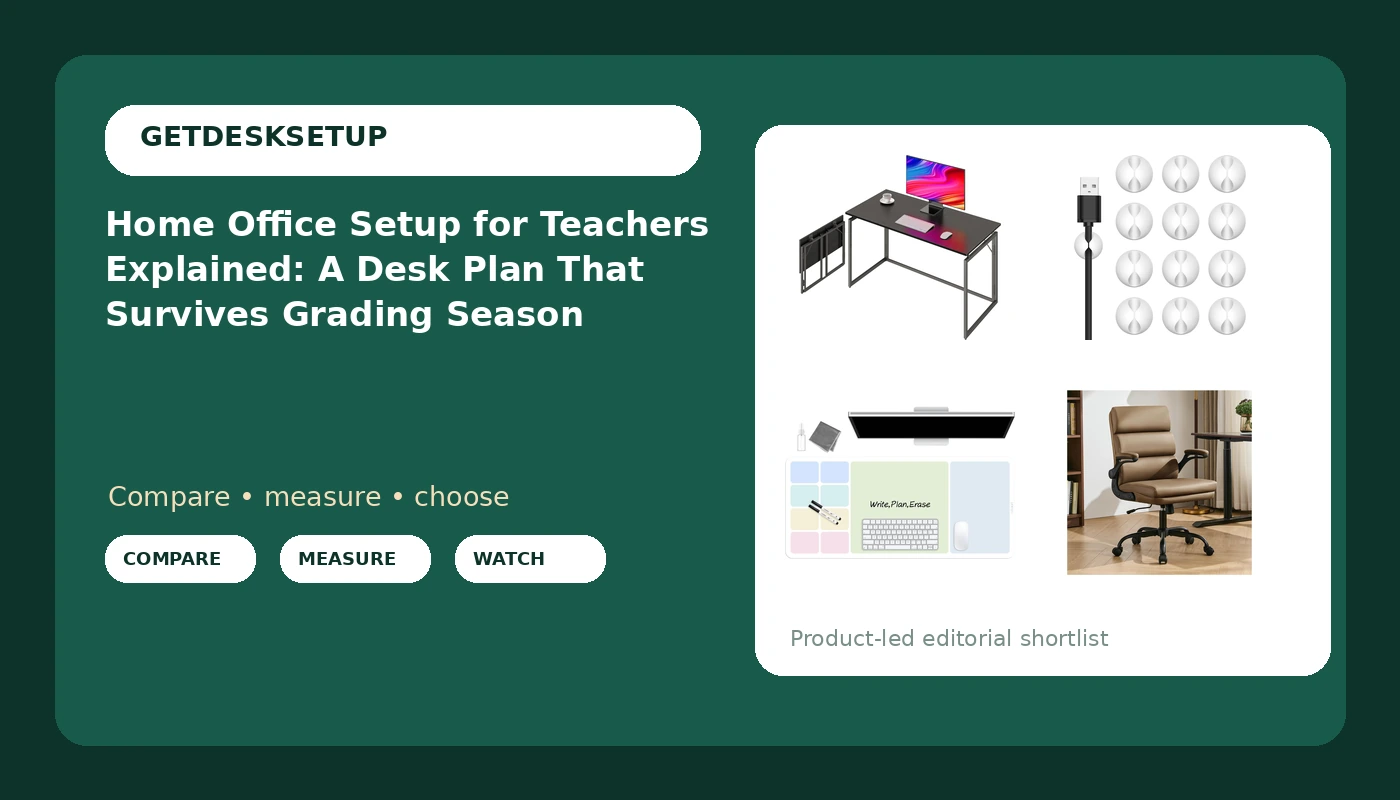
A home office setup for teachers is not a smaller version of a corporate desk. The work arrives in bursts: forty minutes of grading, a call with a parent, then an hour of lesson planning with a gradebook, a rubric, and a browser full of tabs open at the same time. Most of it happens in a corner of a bedroom or at the end of a dining table, which means every item has to earn the space it takes up.
That is the problem this guide solves. The four products below cover the four jobs that decide whether a small teaching workspace functions: a surface that fits the room and can be cleared away, a way to stop cables from migrating, a writing area you can wipe clean, and a chair you can sit in for a full grading session. Everything below is a home office setup for teachers explained in four parts, in the order you should set them up.
Related: Standing Desk Height and Wobble: What to Test Before You Buy →
Quick answer
Buy the desk first and the chair second, because the desk sets the width and the height you have to work with. Measure the wall you plan to use, subtract six inches for walking clearance, and treat the result as your maximum desk width. Then set the chair so your feet are flat and your elbows land near desk height, place the monitor about an arm's length away with the top of the screen at or slightly below eye level, and route cables before you load the desktop. In a small room, a folding desk, a set of adhesive clips, a dry-erase desk mat, and a task chair with flip-up armrests cover the whole job.
Four useful options
| Model | Best fit | What stands out |
|---|---|---|
| alawooder 39.4" Folding Desk: No Assembly, Wood Top for Small Spaces | Rooms where the desk has to fold away between terms | 39.4-inch top, folding frame, no assembly stated |
| Flezoo 12PCS White Adhesive Cable Clips Cord Organizer for Wire Management | Cables running along a wall, baseboard, or desk leg | 12 adhesive clips in white |
| loukin Non-Slip Dry Erase Desk Mat, 32''x14'' Writing Mouse Pad for Office | Grading and mouse work sharing one station | 32 by 14 inch dry erase surface with a non-slip backing |
| amseatec Home Office Desk Chair, Leather Flip-Up Armrests Comfy Task Chair | Teachers who need the chair to slide fully under the desk | Leather upholstery and flip-up armrests |
Desk: alawooder 39.4" Folding Desk: No Assembly, Wood Top for Small Spaces
The 39.4-inch figure is a hard constraint, not a suggestion. Put a tape along the wall first. If the clear wall is 46 inches, you have 40 inches of usable width once you take six inches of walking clearance, and this desk fits with about half an inch to spare. If your wall is 36 inches, it does not fit, and no amount of rearranging will change that.
The trade-off is height. This is a fixed-height folding desk, so the top lands wherever the frame puts it, and you have to check that number against your own seated elbow height before you buy. Skip it if you need a sit-to-stand range, if you run two monitors, or if you want drawers in the desk itself. For a teacher who needs a real surface that can be cleared away in under a minute, the folding frame is the point.
Cable planning: Flezoo 12PCS White Adhesive Cable Clips Cord Organizer for Wire Management
Plan the route on paper before you stick anything down. Start at the power outlet, decide which side of the desk the cable will drop down, and count the clips you need along that path. Adhesive clips are hard to reposition once they have set, and a route that crosses the middle of the desk top will annoy you within a week.
Skip these if you are running a heavy bundle of thick cables that needs a tray, or if you already have an under-desk tray with room to spare. Twelve small clips hold a laptop charger, a monitor cable, and a phone cable. They are not a substitute for a tray on a six-cable run.
Writing surface: loukin Non-Slip Dry Erase Desk Mat, 32''x14'' Writing Mouse Pad for Office
Do the arithmetic against the desk before you order. A 32-inch mat on a 39.4-inch top leaves roughly seven inches of bare wood, which is where the mug, the phone, and the stapler end up. That is workable, but it means you should not expect to also park a full-size keyboard beside the mat on the same surface without crowding.
Skip it if you grade entirely on screen and never write by hand, or if you already use a large desk pad and do not want a second surface on top of it. The mat is for the teacher whose day includes a printed rubric, a class list, or a running to-do list that gets rewritten every period.
Chair: amseatec Home Office Desk Chair, Leather Flip-Up Armrests Comfy Task Chair
Two numbers decide whether any chair fits you, and you should measure both on yourself before you read a single listing. Sit on a hard chair with your feet flat. Measure from the back of your buttocks to the back of your knee: that is your seat depth, and a chair seat should leave a small gap behind the knee rather than press into it. Then measure the floor to the underside of your elbow, because that is roughly where your desk height should land.
Chair pairing is where most small setups go wrong. If the chair's seat height range does not put your feet flat and your thighs roughly level, no amount of armrest adjustment fixes it. Check the seat depth and seat height range on the chair page before you commit, and skip this one if those two numbers are not published or do not match your measurements. Flip-up armrests solve the storage problem; they do not solve a seat that is the wrong depth.
Prices and availability may change. Product images, names, and retailer links are matched to verified listings. No current price, rating, stock status, or measured result is stated here without current evidence.
Sizing a home office setup for teachers: measurements before shopping
Treat the home office workstation for teachers as a measured object rather than a shopping list. Four numbers do almost all of the work, and you can collect all four with a tape measure and a chair in about ten minutes.
Room width. Measure the wall you intend to use, then subtract six inches for walking clearance. That result is your maximum desk width. A 39.4-inch desk needs a clear wall of at least 45.4 inches to leave that gap. If the room is narrower than that, the desk goes on a different wall or you buy a narrower one.
Desk height. Sit on a chair with your feet flat on the floor and your shoulders relaxed. Measure from the floor to the underside of your elbow. That number, minus one or two inches, is the desk height you want. Most fixed desks land somewhere in the high twenties, which is why tall teachers end up raising a desk on blocks and shorter teachers end up with their shoulders creeping up.
Chair pairing. Seat height should let your feet rest flat with your thighs roughly level. Seat depth should leave a small gap behind the knee. Those two numbers have to match your body, not the desk's marketing copy.
Monitor distance. An arm's length, roughly 20 to 30 inches from your eyes, with the top of the screen at or slightly below eye level. If you wear progressives, you may want the screen a little lower.
Room layout, lighting layers, and ventilation
A work from home setup for teachers shares a house with other people, so the room layout has to survive the rest of the household. Put the desk where you can close a door for a call, and avoid sitting with a bright window directly behind you on camera, because backlight turns you into a silhouette. Light in front of you, wall behind you.
Build lighting layers rather than one bright source. A ceiling light covers the room, a task lamp aimed at paper covers the grading surface without shining into your eyes, and a small light behind the monitor softens the background on video calls. Three cheap layers beat one expensive lamp.
Plan the power outlet before the furniture. Count everything that needs to plug in: laptop, monitor, lamp, phone charger, and anything else that lives on the desk. Then check where the nearest outlet actually is, because a desk in front of an outlet you cannot reach means a cable running across the floor. Avoid daisy-chaining power strips, and keep the strip reachable with your foot rather than behind a drawer.
Ventilation is the layer nobody plans for. A small room with the door shut warms up fast during back-to-back calls, and a warm room makes a long grading session feel twice as long. Leave the door cracked, open a window for ten minutes between blocks, or plan a small fan that does not blow papers off the desk.
Here is the order that avoids rework:
- Measure the wall, your seated elbow height, and your seat depth before you buy anything.
- Place the desk against the measured wall, leaving six inches of clearance on the open side.
- Sit in the chair, set the seat height so your feet are flat, then confirm the seat depth leaves a gap behind your knee.
- Route the cables with the clips, starting from the power outlet and ending at the desk edge.
- Set the monitor distance and angle last, then load the desk and work one real session before you adjust anything else.
Practical guidance for a home workspace setup for teachers
- Choose the wall with the outlet you will actually use, not the wall that photographs better. A cable across a doorway is a tripping hazard in a house with kids or pets.
- Leave the desk top's last seven inches empty. On a 39.4-inch top with a 32-inch mat, that is the entire free zone, and it fills up fast with a mug, a phone, and a stack of returned papers.
- Space the clips along the cable run so nothing hangs with slack between two points. Weight on a cable is what moves a monitor arm.
- Flip the armrests up every time you finish a session. In a small room, the chair is the item that makes the space feel crowded, not the desk.
- Test the setup at the end of a grading block, not at the start. Forty minutes of real work tells you more about desk height and monitor distance than any five-minute check.
Which option should you choose?
Choose the alawooder 39.4" Folding Desk: No Assembly, Wood Top for Small Spaces when the room has to serve another purpose and you have at least 45 inches of clear wall. Choose the Flezoo 12PCS White Adhesive Cable Clips Cord Organizer for Wire Management when your cables currently run loose along a wall or desk leg and you want the monitor angle to stay where you set it. Choose the loukin Non-Slip Dry Erase Desk Mat, 32''x14'' Writing Mouse Pad for Office when grading involves paper, rubrics, or lists that get rewritten, and your desk is wide enough to give up 32 inches of the top. Choose the amseatec Home Office Desk Chair, Leather Flip-Up Armrests Comfy Task Chair when the chair needs to disappear under the desk between sessions, and the published seat depth and seat height range match your own measurements.
One caveat worth stating plainly: the numbers quoted here come from the product listings, and none of these items has been measured in a room by this guide. The chair is the item where that matters most, because seat depth and height range are the two figures that decide fit, and they are the two figures most often left off a listing. Verify them before you buy. If they are not published, the honest answer is to keep looking rather than guess.
The bottom line
A home office setup for teachers works when the measurements come first and the shopping list comes second. Measure the wall, decide the maximum desk width, check the chair's seat depth and height range against your own body, then buy. The four items here cover the four jobs a small teaching workspace has to do: a surface that folds away, a cable route that stays put, a writing area that wipes clean, and a chair that tucks in under the desk. Get those four right in a small room and the setup will hold up through a full grading season, which is the only test that matters.