I have built out 310 home offices in and around Seattle, and the ones that fail are almost never the ones with the wrong chair brand. They fail because the room was ignored. A home office in an attic vs a basement is not a style question, it is a measurement question, and the two rooms disagree on nearly every measurement that matters: ceiling slope, floor temperature, how far the nearest power outlet sits, and whether air moves through the space at all. I have installed a standing desk under a ridge beam and I have installed one under a basement duct, and the two builds had almost nothing in common once the tape measure came out.
Related: How to Measure Desk Height Before You Buy a Chair
My verdict after both builds: the long-hours chair and the wide desk belong in the basement, and the tall drafting chair, the tall desk, and a gel mouse wrist rest belong in the attic. The attic gives you height in a narrow strip down the middle and almost nothing at the edges. The basement gives you full floor width and a flat ceiling you can plan around, but it takes daylight away and adds a cold floor. Everything below is about matching the product to the room, not the room to the product.
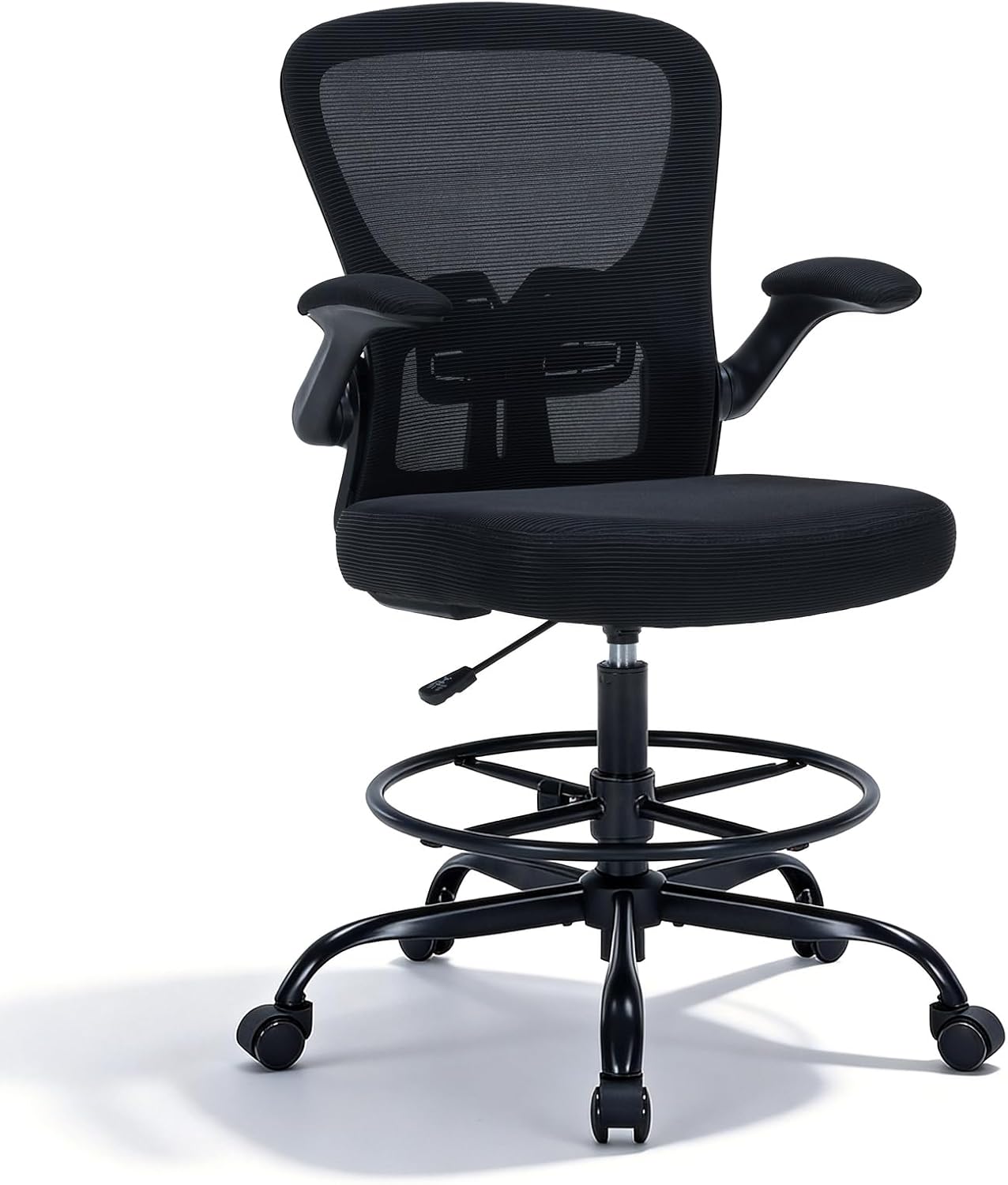
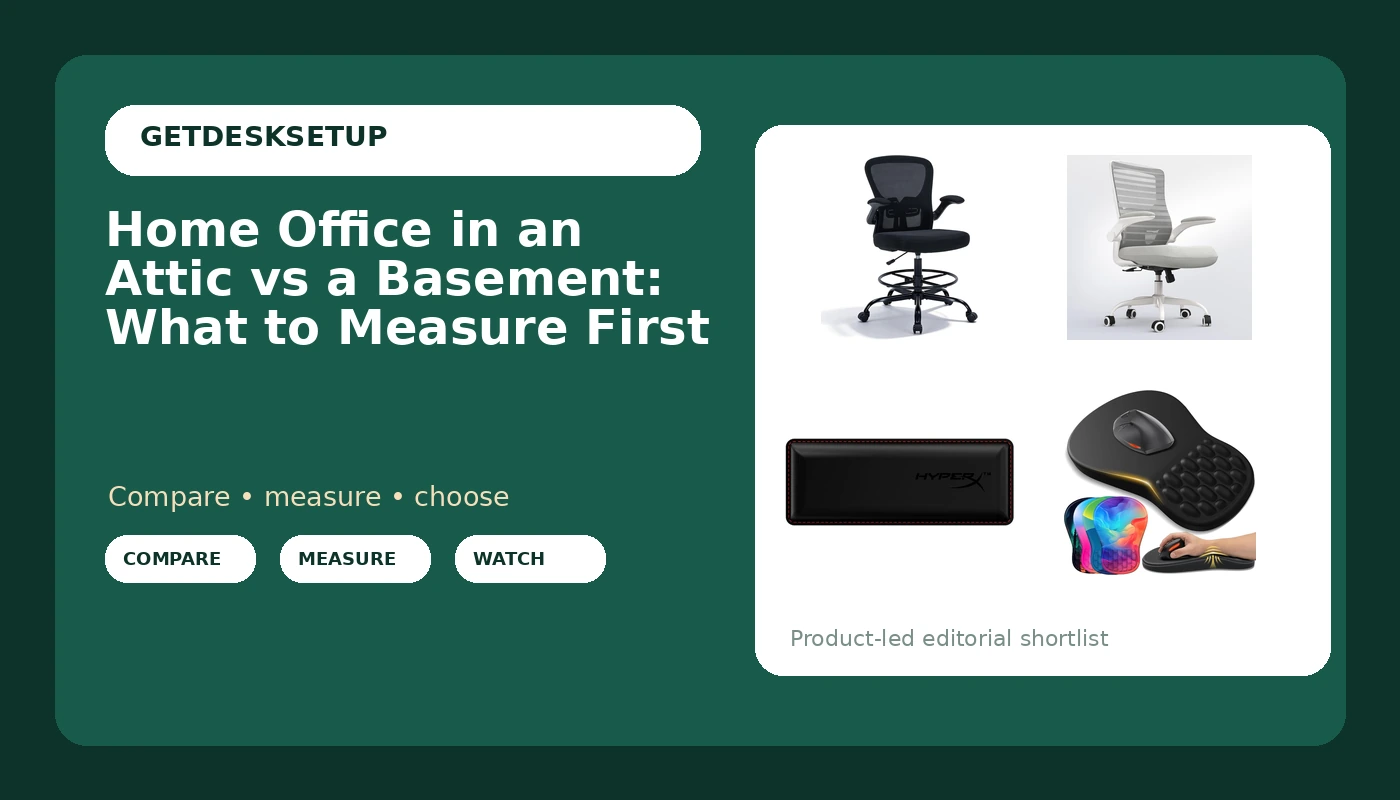
Drafting Chair Tall Office Chair, Standing Desk Chair with Flip-Up Armrests, Breathable Mesh High Chair Adjustable Height, Ergonomic Computer Chair with Lumbar Support and Adjustable Footrest Ring
Tall adjustable range suits a standing desk conversion or a high attic desk, the flip-up armrests clear a knee wall, and the mesh back moves air in a room that heats up all day
It is a perching chair, not an all-day chair. The footrest ring is the only lower-body support, and the name gives you no seat depth to check against your own measurement
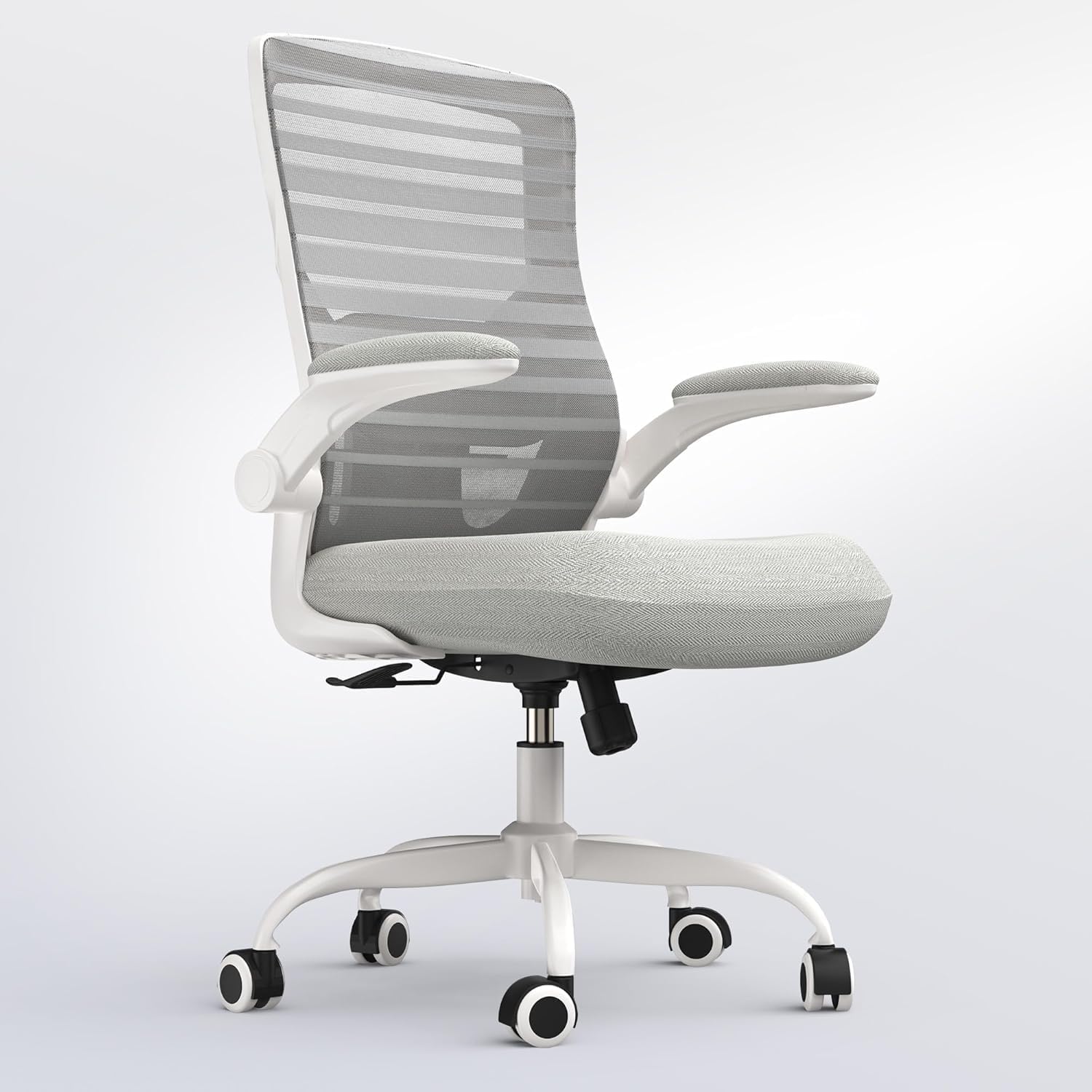
Ergonomic Office Chair for Long Hours, 4" Molded Foam Cushion, 350 LBS
A 4 inch molded foam cushion and a 350 lb rating are aimed at long sits, which is exactly what a basement office without daylight turns into
The name gives you cushion thickness and a weight rating, not a seat depth or an armrest adjustment, so you still have to measure your own body before you commit
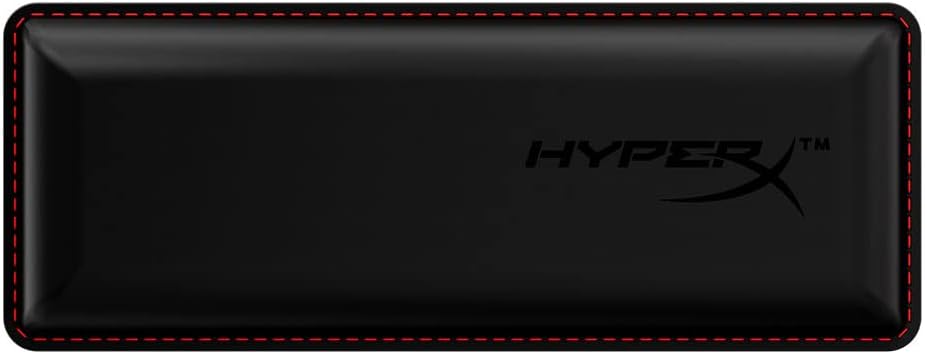
HyperX Wrist Rest, Mouse, Cooling Gel, Memory Foam, Anti-Slip,Black
Cooling gel over memory foam with an anti-slip base, and gel does not go clammy the way fabric does in a warm attic
Mouse only. Your keyboard hand gets nothing, and it is a rest rather than a pad, so the mouse still runs on bare desktop

YIWEI Ergonomic Mouse Pad with Wrist Rest for Carpal Tunnel Pain Relief
Pad and wrist support in one piece, so nothing slides off a short attic desktop and your hand never drops off an edge
The pad footprint eats desk space, which is the one thing an attic strip or a narrow basement desk does not have. Pain relief is a marketing phrase, not a medical claim
Prices and availability may change.
Desk height and chair pairing: home office in an attic vs a basement
Start here, because this decides everything else. Desk height is not a preference. For most adults a fixed desk lands between 28 and 30 inches, and the chair seat has to put your elbows at roughly 90 degrees with your feet flat. In an attic, the ridge beam and the slope set a hard ceiling on where that can happen. If the ceiling is 5 feet at the knee wall and 7 feet 6 inches at the ridge, your usable desk strip is the middle 4 to 6 feet of the room, and the desk has to sit inside it or you will spend every day leaning away from the slope.
That is why chair pairing matters more in an attic than in any other room in the house. A standard task chair with a 17 to 19 inch seat height works under a 29 inch desk, but it also puts your head lower, which is fine under a flat ceiling and awkward when the ceiling is dropping toward you. A tall drafting chair with an adjustable footrest ring lets you raise the seat and keep the desk high, so your shoulders stay in the tall part of the room instead of the low part.
The basement inverts the problem. Ceiling height there is usually flat and often lower than the rest of the house, and a duct or a beam can cut another 8 to 10 inches out of the middle of the room. You are not fighting a slope, you are fighting a straight line. Measure from the finished floor to the lowest obstruction, then subtract your seated height plus a few inches of clearance. If you come out under 6 feet, plan on a standard-height desk and a standard chair, not a standing desk.
Room layout: the usable strip versus the full rectangle
The difference between home office in an attic and a basement shows up in three measurements before it shows up in a single photograph: usable width, usable depth, and the distance from the desk to the nearest outlet. An attic is a triangle. You get a wide strip at the floor and almost nothing at head height, so a 60 inch desk placed against the gable wall may be fine, while the same desk turned sideways is unusable.
A basement is a rectangle with a cold floor. You get the whole footprint, minus the mechanicals, which means you can actually build an L shape if you want one. I will not build a desk narrower than 48 inches in either room. A 27 inch monitor, a keyboard, and a mouse pad with a wrist rest need that much, and the wrist rest is the piece people forget when they measure.
Then there is the door swing. Attic doors often sit at the bottom of a stair with a low header, and basement doors often sit under a duct. Both eat a corner you thought you had.
Lighting layers and ventilation
Attics and basements are the two darkest rooms in a house for the same reason: they are the two rooms with the fewest windows. You need three lighting layers in both, and they are not optional.
Ambient light first, which is a ceiling fixture or two so the room is not a cave. Task light second, which is a lamp aimed at the desk surface and not at your eyes. Bias light third, which is a dim source behind the monitor so the screen is not the brightest thing in your field of view at 9 p.m.
Attics run hot. Heat stacks, and a room under a roof can be 10 degrees warmer than the floor below it by mid-afternoon. That changes your accessory choices: a mesh back breathes, a gel wrist rest stays cooler than fabric, and a fan is part of the build rather than an afterthought.
Basements run damp and cold. Ventilation matters more than temperature, because still air plus a concrete slab is how you get a musty office. A dehumidifier and a small fan that keeps air moving across the desk do more for how the room feels than any paint color. A thick foam cushion also helps, because concrete pulls heat out of your legs through the chair.
Cable planning, power outlet access, and monitor distance
Cable planning in an attic is a slope problem. Outlets usually sit on the knee wall, which means every cable runs uphill to the desk and then hangs in the air behind it. I run a cord cover along the baseboard to the gable end, then a single vertical run up the wall, then a surge strip mounted under the desktop. Nothing loose, nothing pulling on a monitor arm.
Basements have the opposite issue. Outlets sit low on a concrete wall, sometimes on a circuit shared with a sump pump or a freezer. If you are running a desktop, two monitors, and a standing desk motor, check what else is on that breaker before you add a space heater. A power outlet that browns out when the freezer kicks on is worse than no outlet at all.
Monitor distance is the same target in both rooms: roughly an arm's length, with the top of the screen at or slightly below eye level. In an attic that is harder than it sounds, because the slope pushes you to sit further forward than you want. In a basement the flat wall makes it easy, but the low ceiling pushes the monitor down unless you use an arm that clamps to the desk instead of the wall.
The tall chair pick for the attic strip
If the attic strip is where you work, this is the chair I would start with. Drafting Chair Tall Office Chair is built around a tall adjustable column with a footrest ring, flip-up armrests, and a mesh back.
Three things make it fit an attic specifically. The height range lets you pair it with a taller desk surface, which keeps your head in the tall part of the room. The flip-up armrests clear a knee wall when you turn to get up. The mesh back moves air, which matters in a room that gains 10 degrees by mid-afternoon.
Who should skip it: anyone who sits eight hours straight. A drafting chair is a perching chair. The footrest ring supports your feet, but there is no deep cushion and no recline you would want for a long afternoon. If your attic is a two-hour-a-day room, buy it. If it is your whole workday, read the next section and put the chair in the basement instead.
The long-hours pick for a basement desk
Basements are where long sessions happen, partly because there is nothing to look at and partly because the cold floor makes you want to sit still. Ergonomic Office Chair for Long Hours, 4" Molded Foam Cushion, 350 LBS is the one I would pair with a basement desk.
The 4 inch molded foam cushion is the number that matters here, because foam thickness is what keeps a concrete floor from reaching your legs. The 350 lb rating is the other number, and it tells you the frame and the cylinder were built for a wider range of bodies than the average budget chair.
The honest caveat: the name gives you cushion thickness and a weight rating, and nothing about seat depth. Seat depth is the measurement I care about most, because a seat that is too deep puts pressure behind your knees and a seat that is too short leaves your thighs hanging. Measure from the back of your knee to the back of your hip while seated, then compare that number to whatever the current listing says before you buy.
Wrist support: gel in the attic, a full pad in the basement
Both of these cost about the same and both do the same job, so the room decides.
HyperX Wrist Rest, Mouse, Cooling Gel, Memory Foam, Anti-Slip,Black is a mouse-only rest with a gel layer over memory foam and an anti-slip base. Gel is the right call for an attic, because fabric gets warm and stays warm in a room that heats up all day, and the anti-slip base holds on a smooth desktop that has been sitting in the sun.
YIWEI Ergonomic Mouse Pad with Wrist Rest for Carpal Tunnel Pain Relief is a pad and a wrist support in one piece. That combination is better for a basement, where the desk is usually wider and you can afford the footprint. One height across the whole surface means your hand does not drop off an edge between the pad and the rest.
One note on the second one: pain relief is a marketing phrase, not a medical claim. If you have actual carpal tunnel symptoms, a wrist rest is support, not treatment, and the thing that helps most is keeping your wrist flat and your elbow at 90 degrees.
Who should skip which product
Skip the drafting chair if you are building a basement office with a flat 6 foot ceiling. There is no reason to pay for a tall column you will never raise, and a perching chair under a flat ceiling is just an uncomfortable chair.
Skip the 350 lb molded foam chair if your attic strip is narrow. It is a full-size task chair, and a full-size task chair in a 4 foot wide strip is a chair you turn sideways to get out of.
Skip the gel mouse rest if you already run a large desk pad. Two layers of foam under your wrist is worse than one, and the gel rest will not sit flat on top of a cloth pad.
Skip the full mouse pad if your desktop is 40 inches wide. That pad takes the last 8 to 10 inches of a short surface, and you need that space for mouse travel itself.
What I would build in each room
Attic build: a 48 inch desk in the tall strip, a tall drafting chair with the footrest ring, a gel mouse rest, a cord cover down the slope to the knee wall outlet, three lighting layers, and a fan. Check current Amazon price on every piece before you order, because these listings move.
Basement build: a 60 inch desk against the flat wall, the molded foam chair, the full mouse pad with wrist rest, a surge strip on the wall above the slab, a dehumidifier, and a bias light behind the monitor. Same accessories, different chair, and a very different lighting plan because there is even less daylight down there.
Both builds get the same rule: measure first, then buy. Whether you are planning home office in an attic or a basement, the tape measure decides more than the catalog does. If you have been reading up on a basement vs home office in an attic comparison and you still cannot decide, the tiebreaker is simple. Count the hours you will sit. Under four hours a day, take the attic and the tall chair. Over six, take the basement and the foam.
The takeaway
A home office in an attic vs a basement comes down to which measurement you can live with. The attic gives you a view and takes away headroom at the edges, so you buy height where you can get it: a tall chair, a tall desk, and a wrist rest that does not hold heat. The basement gives you floor space and takes away light and warmth, so you buy cushion, air movement, and three layers of lighting.
Neither room is the better office. The chair that fits your seat depth is the better office, and the desk that clears your ceiling at the height you actually work at is the better office. If you cannot say your seat depth in inches, you are guessing, and guessing is how an expensive chair ends up in a corner of the attic while a cheaper one does the real work downstairs.
Before you buy anything, measure the ceiling at its low point and its high point, measure the widest clear strip, measure from the floor to the lowest duct or beam, and measure your own seat depth. Then check the current Amazon price on the pieces that match those numbers, and skip the rest.