Home office acoustic treatment explained in one sentence: you are not fixing your microphone, you are fixing the room the microphone hears. A bare-walled office with a hard floor, a hard desk, and a window behind the monitor gives a voice almost nothing to absorb it, so calls come back hollow and boomy, and no noise-reduction setting fully removes the ring. The catch is that furniture decides how much of the room you can actually treat. Room layout, desk height, and chair pairing set where you sit, where your mouth points, and which wall is close enough to matter. This guide covers the acoustic side and the desk-side decisions that make it work, so a home workspace acoustic treatment plan starts with the right pieces instead of a random box of foam.
Related: Standing Desk Wobble at Full Height: What to Check Before You Buy →
Quick answer
Treatment works when the hard, parallel surfaces closest to your head get covered, because those are the surfaces returning reflections within the first few milliseconds of your voice. In a home office the practical order is: position the desk so you are not speaking straight into a bare wall at close range, add absorption at the first reflection points beside and in front of you, then let rugs, curtains, and bookshelves contribute as partial help rather than a solution. None of the four products below is an acoustic panel. Each one changes room layout, desk height, chair pairing, or monitor distance, and those four things decide where absorption can physically go. Nothing here is called the quietest, fastest, or best, because the evidence for those labels is not available.
Four useful options for a treated home office
| Model | Best fit | What stands out |
|---|---|---|
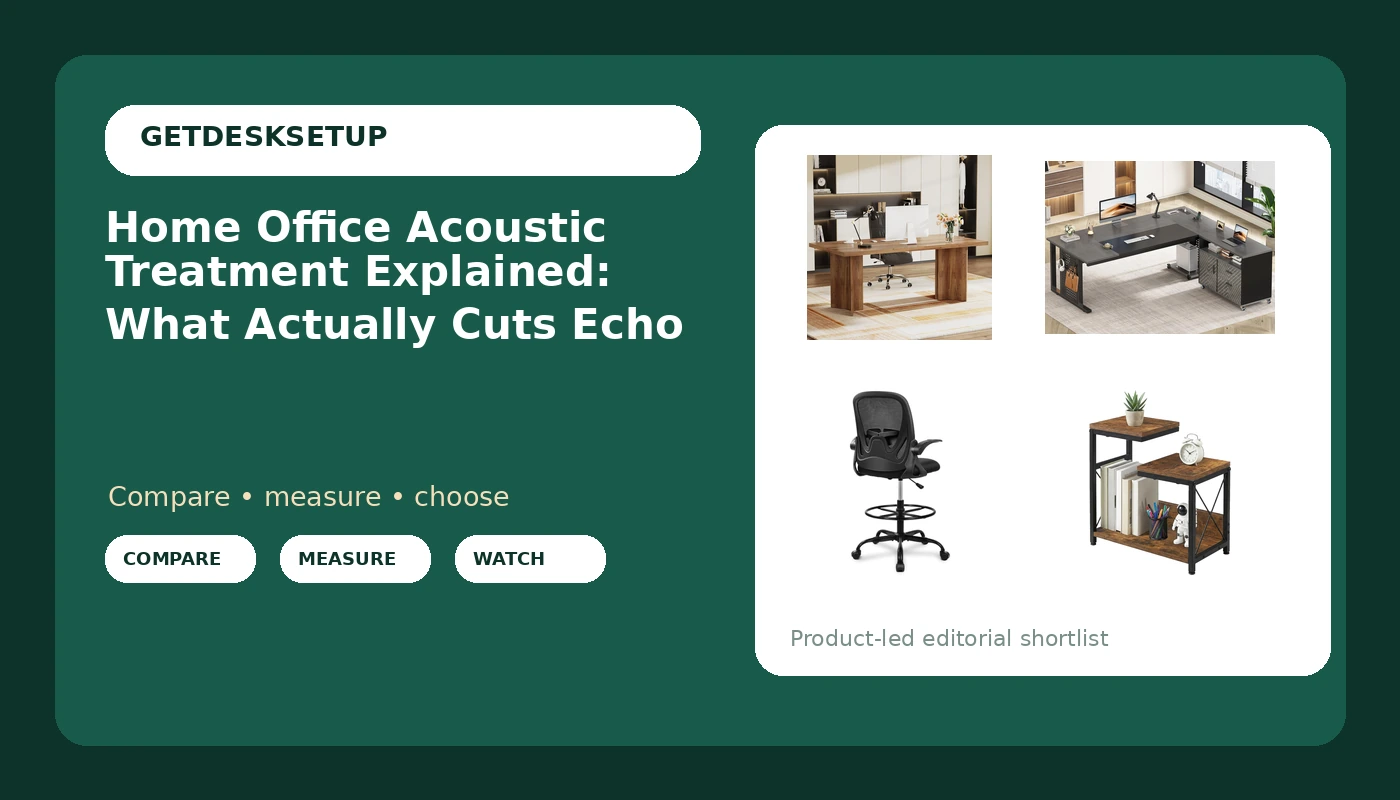
| Tribesigns 63-inch Executive Desk | One measured wall and a fixed seat position | 63-inch tabletop in walnut brown with a farmhouse writing-desk build |
| SEDETA 71" Executive Desk with Rolling File Cabinet | Corner rooms and cable-heavy setups | L-shaped top, built-in power outlets, CPU stand, pegboard, and storage shelves |
| Primy Drafting Chair | Tall desks and users who alternate sitting and standing | Flip-up armrests, lumbar support, and an adjustable footrest ring |
| Desk Shelf Organizer, 3 Tier | Small desks that need vertical storage | Three-tier wooden riser in rustic brown for the desktop |
The measured desk: Tribesigns 63-inch Executive Desk
A desk of this width is the piece that locks in your room layout. Run it against the long wall and your voice fires across the room at a parallel surface; float it in the middle and you lose the wall behind you as a place to hang absorption. Measure before you commit. A 63-inch top needs roughly that much usable wall plus clearance on each side, and in a narrow room it can leave you sitting within arm's reach of a side wall, which is exactly the surface that returns an early reflection. Pair a hard top like this with a rug underneath and treat the wall in front of you first, since that is the reflection arriving soonest.
The corner desk: SEDETA 71" Executive Desk with Rolling File Cabinet
An L shape puts the seat in a corner, and corners are where low-frequency energy collects, so this is a desk that makes boom more likely and treatment more necessary. The built-in power outlets help for a less obvious reason: cable planning. Cables that climb a wall where you want to mount a panel force you to notch the panel or move it, and power at the desktop keeps runs short and low so the upper wall stays clear. The CPU stand does the same job at floor level, lifting a tower that would otherwise be another reflective box sitting on a hard surface.
The tall seat: Primy Drafting Chair Tall Office Chair with Flip-up Armrests
This is a chair pairing problem before it is an acoustics problem. A standing desk at the top of its range sits well above what a standard chair can reach, so people perch, and a perch changes everything downstream: the mouth ends up closer to the desk surface, the shoulder line drops, and monitor distance grows. The flip-up armrests let you roll right up to the desk edge, which tightens monitor distance and lets a desk-mounted microphone sit where it should. The footrest ring exists because a tall seat leaves your feet hanging otherwise. Get desk height and seat height to agree before you hang a single panel, because the seating position is the reference point for every reflection you are trying to manage.
The riser: Desk Shelf Organizer, 3 Tier
Be clear about what this is: wood reflects sound, so a desktop shelf does not absorb anything. Its role in a setup is elevation and order. Lifting a monitor or a small speaker off the desktop raises it toward ear height and holds monitor distance where you set it, and the tiers keep paper, notebooks, and cables from piling up in the working zone. Clutter on a hard desktop does not fix echo, but a tidier desk makes it far easier to see which wall is still bare and still needs a panel.
Prices and availability may change. Product images, names, and retailer links are matched to verified listings. No current price, rating, stock status, or measured result is stated here without current evidence.
What home office acoustic treatment actually changes
Two different problems get called the same thing. Soundproofing stops sound from crossing a boundary. Treatment changes what happens inside the room. If a neighbor, a highway, or a barking dog is the problem, no panel on your wall solves it.
Inside the room, your voice leaves your mouth in every direction. The direct sound reaches the microphone first. Everything after it is the room: the desktop, the wall in front of you, the side walls, the ceiling, the floor, and the glass behind the monitor. Those reflections arrive milliseconds later, and the microphone does not separate them from you. That is the hollow, boxy quality people hear on calls.
Decay time is the number that matters most. A room full of hard, parallel surfaces with nothing soft in it keeps a voice ringing after you stop speaking, and that tail is what makes speech hard to follow.
Absorption is also frequency-dependent. Thin foam and thin fabric panels absorb high frequencies well and low frequencies poorly, so a room treated only with thin panels can end up sounding dull and still boomy. Coverage area and material thickness matter more than panel count, which is why a rug, a couch, and a full bookshelf do more than their price suggests. That is the whole of home office acoustic treatment in a small room: fewer, better-placed absorbers on the surfaces nearest your head.
The desk itself is a large horizontal reflector sitting inches from your mouth. Desk height changes how far that surface sits from your face and how much of your voice bounces straight back at the microphone, which is why a taller desk and a matching seat can change a recording even though neither product is acoustic gear.
Treatment also does not fix noise generated inside the room. Keyboard clatter, a desk fan, and a ventilation register pointed at your desk are direct sources. Move the airflow path before you spend anything on absorption.
How to plan work from home acoustic treatment
Work the plan in this order and you avoid buying panels you cannot hang.
- Measure the room before you buy furniture. Note wall lengths, ceiling height, window positions, and the minimum desk width you can live with, because a 63-inch desk commits you to that much wall.
- Choose the seat position first, since it determines every reflection path. Avoid sitting with your face close to a bare wall, and avoid a position where a side wall is within arm's reach of your head.
- Find the first reflection points from your normal seated position: the wall directly ahead of your mouth, the side walls beside your head, and the ceiling above you. A hand mirror held flat against each surface shows you where your own face is visible.
- Treat in order of arrival time. Wall ahead, side walls at head height, then a ceiling cloud, then corners if low-frequency boom remains.
- Verify by recording. Clap once and listen to the tail, then record a minute of speech and listen on headphones, changing one thing at a time.
Practical rules for a work from home office acoustic treatment plan
- Coverage beats count. A few large absorbers spread across the surfaces nearest your head outperform a scatter of small decorative panels.
- Decide which wall is the acoustic wall before you drill. Lighting layers, shelving, and monitors all compete for the same wall space, and relocating a panel later leaves holes.
- Keep cable planning low. Runs that cross head height limit where absorption can go, so route power and data behind the desk.
- Put a power outlet where the desk sits. Built-in outlets remove the temptation to run an extension cord up a wall you wanted to treat.
- Fix ventilation noise before reflections. A register or fan aimed at your desk is a direct noise source that no amount of absorption removes.
- Cover part of the floor. A rug under the desk breaks up the vertical bounce between a hard floor and a hard ceiling, which is often the cheapest real improvement in a home workspace acoustic treatment pass.
Which option should you choose?
Choose the Tribesigns 63-inch Executive Desk when your room has one clean wall, you want a fixed seat position, and you would rather spend the rest of the budget on absorption than on storage. Choose the SEDETA 71" Executive Desk with Rolling File Cabinet when the desk has to live in a corner, you need power outlets at desktop level, and cable planning is part of the plan. Choose the Primy Drafting Chair when the desk is tall enough that a standard chair leaves you perching, or when you alternate between sitting and standing through the day. Choose the Desk Shelf Organizer, 3 Tier when the desktop itself is the bottleneck and you need vertical storage without adding another piece of floor furniture.
None of these four products absorbs sound. The acoustic result comes from where the desk sits, how much absorbent material you can place on the surfaces nearest your head, and whether the noise you are fighting is generated inside the room. If your problem is a neighbor, traffic, or a ventilation register, no purchase on this page changes it.
The bottom line
Home office acoustic treatment explained honestly comes down to geometry and coverage: keep your mouth away from a bare parallel wall, cover the surfaces that return early reflections, and accept that thin panels mostly tame highs. The furniture comes first because it fixes the geometry. A 63-inch fixed desk gives you one predictable seat position. An L-shaped desk with built-in power and a CPU stand keeps cables and boxes off the surfaces you want to treat. A drafting chair with a footrest ring lets you match a tall desk instead of perching. A three-tier riser clears the desktop so monitor distance stays where you set it. Get desk height and chair pairing right, hang absorption where the mirror test says, and record a test clip before and after. If you are still choosing the desk itself, start with how to measure a desk for your room before you buy anything.