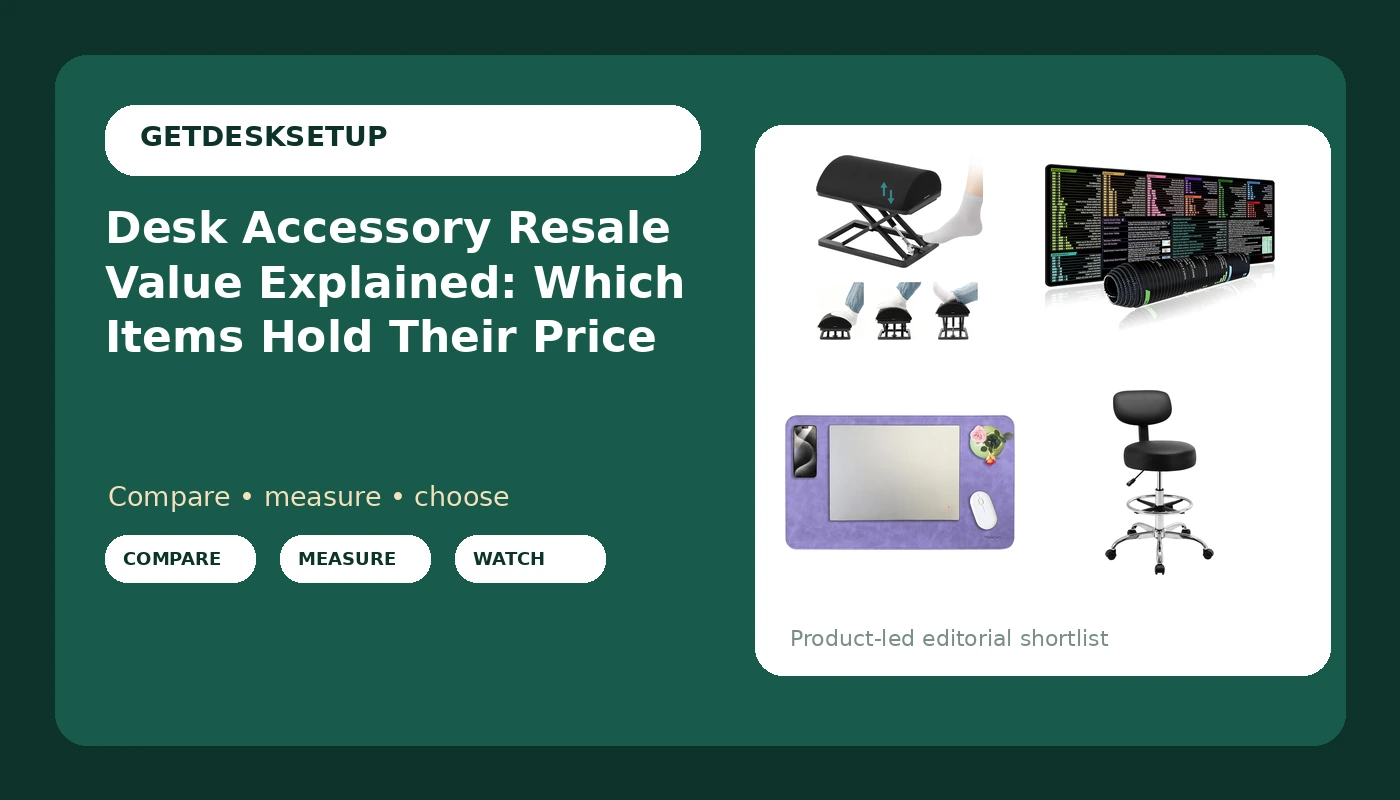
Resale value is an odd thing to weigh when you are buying a footrest or a desk mat, but it is the same question a facilities manager asks when a floor gets rearranged: when this comes off the desk, does it go to another desk or into a dumpster? The desk accessory resale value question is not really about brand names. It comes down to three measurable properties: whether the item is sized to one specific body or one specific desk, how fast its wear surface degrades, and how much it costs to ship once a stranger wants it. Get those three right and a used accessory finds a second owner. Get them wrong and you keep it until it breaks.
Related: Desk Mat Sizes and Materials Compared →
Quick answer
Value in this category tracks specificity, not price. An accessory that fits a wide band of bodies and desks and adjusts by a mechanism keeps a second buyer; a cushion, a novelty print, or a model-specific bracket does not. A mat holds value when its thickness and density keep it flat and its surface can be cleaned. A footrest holds value when height and angle change by a mechanism rather than by foam compressing. A drafting chair holds value when its seat height range and foot rest suit more than one sitter. Commodity parts such as an adhesive clip, a cable sleeve, or a raceway lose value fastest, because shipping and fees eat whatever they were worth. Desk accessory resale value explained in one line: buy the mechanism, not the branding.
Four useful options
| Model | Best fit | What stands out |
|---|---|---|
| Step-to-Adjust Foot Rest – Truly Infinite Height, No Bending Needed | Fixed-height desks and sitters who shift foot position often | Step-on height adjustment with no bending or hand crank |
| Excel Shortcut Keys Mouse Pad, Extended Large Desk Mat (31.5×11.8 Inch) with Non-Slip Base & Washable Surface for Gaming, Computer, Office Desk | Desks wide enough for one surface under keyboard and mouse | Extended 31.5 by 11.8 inch footprint, non-slip base, washable surface |
| Vintage PU Desk Mat, Anti-Curl Waterproof Pad, 23.6"x13.8" Purple | Writing desks and laptop-only setups | Anti-curl build and a waterproof PU surface in a compact size |
| Shintenchi Black Drafting Chair w/Backrest & Adjustable Foot Rest | Tall work surfaces and drafting-height desks | Backrest plus an adjustable foot rest on a drafting-height base |
The adjustable footrest: Step-to-Adjust Foot Rest – Truly Infinite Height, No Bending Needed
The mechanism is what you are buying. A footrest angle you can change without leaving your chair is worth more on the used market than a fixed wedge, because a wedge only fits the person whose legs it happened to fit. That is the whole resale argument: mechanism is universal, cushion is personal.
Who should skip it: if your chair already puts your feet flat on the floor with your knees near a right angle, a footrest adds height you do not need, and it will not resell easily from your desk, because the buyer who wants it is the buyer whose desk is too tall. If you work standing most of the day, the same applies.
For a fixed-height desk and a chair that cannot go lower, this is the accessory that changes the geometry of the whole setup, and that is exactly the kind of item that gets passed on rather than thrown out.
The extended mat: Excel Shortcut Keys Mouse Pad, Extended Large Desk Mat (31.5×11.8 Inch) with Non-Slip Base & Washable Surface for Gaming, Computer, Office Desk
Size is the first filter. An extended mat at 31.5 by 11.8 inches needs a desk wide enough that the mat does not hang off the front edge and deep enough that the keyboard still sits at a sensible distance from the monitor. Measure the desktop first; a mat that overhangs a narrow desk is a mat that curls there. The computer desk accessory resale value question usually resolves to exactly this: size and surface, not artwork.
Mat thickness and mat density decide what the mat looks like after a year. A dense mat that stays flat and cleans up keeps most of its second-hand appeal. A thin mat that has gone shiny and stained at the wrist area has almost none. Washable matters more for resale than for daily use, because the buyer's first question about a used mat is whether the surface can be brought back.
The printed shortcut layout is a niche appeal. If resale is part of the plan, a plain surface in the same size reaches more second buyers.
The compact mat: Vintage PU Desk Mat, Anti-Curl Waterproof Pad, 23.6"x13.8" Purple
On a narrow desk the mat is not decoration; it is the main work surface, and the writing desk accessory resale value argument for this one rests on how it behaves at the edges. Anti-curl construction is the claim that matters, because the failure mode for thin mats is a lifted corner that catches your forearm every time you move.
PU is a wipe-clean surface, which helps resale: a coffee ring comes off, and a mat that can be cleaned is a mat someone else will take. Colour is the trade-off. A purple mat narrows the pool of second buyers compared with a grey or black mat in the same size, so expect the finish to cost you some appeal even if the material holds up.
Compare footprints before you commit. The difference between this size and an extended mat is the difference between a writing desk and a full keyboard setup.
The drafting chair: Shintenchi Black Drafting Chair w/Backrest & Adjustable Foot Rest
Chairs are the accessories with real resale, and they are also the ones where a wrong measurement kills the value. Before buying, confirm the seat height range against your own floor-to-desk measurement, and confirm the foot rest ring sits where your feet actually land. A chair that fits one height is a chair with one buyer.
The backrest matters more than it looks. A drafting stool without one is a perch. With one, it can carry a full workday, and that is what makes it worth passing on to someone else.
The adjustable foot rest is the detail that keeps a tall chair usable. On a tall seat, dangling feet put pressure on the back of the thighs, and the ring is the fix. If your feet already reach the floor at your desk height, a drafting chair is the wrong shape for you and will be hard to resell into a normal-height office.
Prices and availability may change. Product images, names, and retailer links are matched to verified listings. No current price, rating, stock status, or measured result is stated here without current evidence.
What actually drives desk accessory resale value
Four forces decide whether a used accessory is worth anything, and none of them is the logo on the box.
Specificity. A universal item that fits any desk keeps buyers. A model-specific part does not: a bracket for one monitor arm, a tray cut for one desktop, a lamp with a proprietary driver. The narrower the fit, the narrower the second market.
Wear surface. Mats compress. Foam flattens. PU can crack at a fold. The wear surface is what a buyer inspects, so mat thickness and mat density matter more than the print on top. A dense mat that stays flat holds value; a thin mat that has gone shiny at the wrist does not.
Mechanism versus cushion. Mechanical adjustment resells. A footrest angle you change with your foot, a gas lift, a clamp that tightens with a lever: those are the parts still working in year three. Cushions and pads take the shape of the first owner.
Shipping volume. A chair is bulky, a mat rolls or lies flat, and a bag of small parts costs more to ship than it is worth. Anything that cannot be shipped for a sensible fraction of its value is effectively unsellable, whatever its condition.
Two more things quietly erode value. First, obsolescence: desk lamp lumens and connectors that were standard two years ago, cable management built for one desk frame, a raceway sized for a thickness nobody uses now. Second, adhesive. An adhesive clip is the cheapest item on a desk and the first to fail, and when the adhesive lets go the value is zero. Cable management is the fastest-depreciating category on any desk, and it is the one people overspend on trying to fix. The work desk accessory resale value math is different from the home math for the same reason: an office replaces on a schedule and writes the parts off, so nothing there is bought to be sold.
Sizing, wear, and the shipping math
Resale starts at the buying decision, not at the listing. If you want an accessory to be worth something in two years, buy the version that fits the widest band of bodies and desks, keep the wear surface intact, and avoid parts that fit one model only.
The measurement part is not optional. An accessory that is the wrong size does not resell; it gets stored. Write down your floor-to-desk height, your seated knee height, and the usable width and depth of the desktop. Everything else follows from those four numbers. If you are still picking a surface, desk mat sizes and materials compared covers the trade-offs.
Here is the order that works.
- Measure your floor-to-desk height and your seated knee height first. Anything that changes foot position is sized against those two numbers.
- Note the desktop's usable width and depth, then compare with the accessory footprint. A mat that overhangs the front edge will curl there.
- Identify the wear surface and ask what it looks like after a year of wrists, elbows, and coffee. Cleanable beats pretty.
- Check whether the adjustment is mechanical or foam. Mechanical parts keep working; foam takes a set.
- Ask whether you would pay to ship it to a stranger. If the answer is no, it has no resale value regardless of what you paid.
Practical guidance when you buy with resale in mind
- Buy standard footprints. A mat in a common size and a footrest with a real height range reach more second buyers than a custom-cut or fixed item.
- Keep the box, the hardware bag, and the paperwork for anything bulky. A chair without its bolts is a chair nobody wants to collect.
- Avoid licensed prints, unusual colours, and novelty layouts if resale is part of the plan. A purple mat is a fine mat and a narrower market.
- Prefer mechanical adjustment over cushioning in every category. Footrest angle, gas lift, and clamp tension are the parts that survive.
- Treat cable management as consumable. A cable sleeve, an adhesive clip, and a raceway are items you replace rather than resell, so buy them cheap and plan to throw them away.
Which option should you choose?
Choose the Step-to-Adjust Foot Rest – Truly Infinite Height, No Bending Needed when your desk is fixed in height and your chair cannot go lower, because the mechanism is what you pay for and what a second buyer pays for too. Choose the Excel Shortcut Keys Mouse Pad, Extended Large Desk Mat (31.5×11.8 Inch) with Non-Slip Base & Washable Surface for Gaming, Computer, Office Desk when you have the desk width for one surface under keyboard and mouse and you want a mat that can be washed. Choose the Vintage PU Desk Mat, Anti-Curl Waterproof Pad, 23.6"x13.8" Purple when your desk is a writing or laptop desk and a compact, wipe-clean surface suits it. Choose the Shintenchi Black Drafting Chair w/Backrest & Adjustable Foot Rest when your work surface is taller than a standard desk and you need a seat that reaches it with a backrest behind you.
Nothing here is a promise about what any item will fetch later. Resale depends on condition, demand, timing, and where you list it, and none of that is knowable at purchase. What you can control is whether the item fits a wide band of buyers, whether its wear surface survives, and whether it is cheap enough to ship that someone will bother.
The bottom line
Buy the accessory that fits a measurement, not the one with the best story. A mechanical footrest, a mat with real thickness and density, and a drafting chair with a backrest and an adjustable foot rest are the kinds of items that earn a second life, because they are defined by their dimensions and their mechanism rather than by the branding on them. The cheap cable parts are not investments and should not be bought as if they were. The desk accessory resale value question has one honest answer: buy the version that would fit someone else's body and someone else's desk, and it will still be worth something when it stops fitting yours.