Most teachers do not get to design an office. They get a spare bedroom with a guest bed still in it, a corner of the dining room, or half of a shared apartment, plus a district laptop that has to be online by 7:40 a.m. When a client hires me to set up a home office for a teacher, the brief is always the same: the room has to work for grading, video calls, and lesson planning all day, then go back to being a family room at night.
I have built out 310 home offices in and around Seattle, and the teacher builds are the ones I plan most slowly. If you are working out how to set up a home office for a teacher, the order matters far more than the budget. Desk first, because everything else hangs off the desk height. Chair second, because chair pairing with the desk is what keeps a 45-minute grading block from turning into a backache. Light third, because a teacher reads more paper than almost anyone else I build for.
The three products below are what I would spec for that room today. The eight steps after them are the same sequence I run on a paid install, and none of it requires a dedicated room.
Why you should trust me
I spent nine years as a facilities manager, buying and assembling chairs and desks for floors of 400 people, and the last six running a two-person desk setup service. We have built out 310 home offices. I keep a notebook with every chair seat depth and every desk height range in it, measured with a tape, not copied off a spec sheet, because the spec sheet is where most bad advice starts.
Two rules come out of that notebook. A chair either fits your body or it does not, and brand and price are noise until the seat depth and height range match your measurements. Ergonomics is a measurement, not a feeling; if you cannot say your seat depth in inches, you are guessing. I will not publish a fit claim without a height and weight range behind it, and I will always tell you who should skip a product, including the three below. The cheapest correct setup beats the most expensive wrong one every time, and teacher budgets are why I believe that most strongly.
How I picked and how I tested
Every chair and desk that goes into a client's office runs the same checklist. These three are what survived it for a teacher's room.
Room first. I measure the wall before I measure anything else, because room layout decides the desk, not the other way around. A teacher's top has to hold a laptop or monitor, a paper pile, and a mug without a fight, so the minimum desk width I will plan for is 63 inches of clear wall.
Chair second. I check seat depth, lumbar adjustment, and whether the backrest has any real curve to it. Chair pairing with desk height matters more than the chair's own spec sheet: a good chair at the wrong height is worse than an average chair at the right one.
Then the small stuff. Monitor distance gets a tape from the eye to the screen. Cable planning gets a pull test, because a cable that pulls on a monitor changes the monitor angle within a week. Lighting layers get checked at 4 p.m. in winter, when the ceiling light is on and the screen is a mirror.
Where a listing does not publish a height and weight range, I say so instead of guessing, and I tell you who should skip it. That is the honest version of the checks I run before I set up a home office for a teacher, and it is also why the list is short.
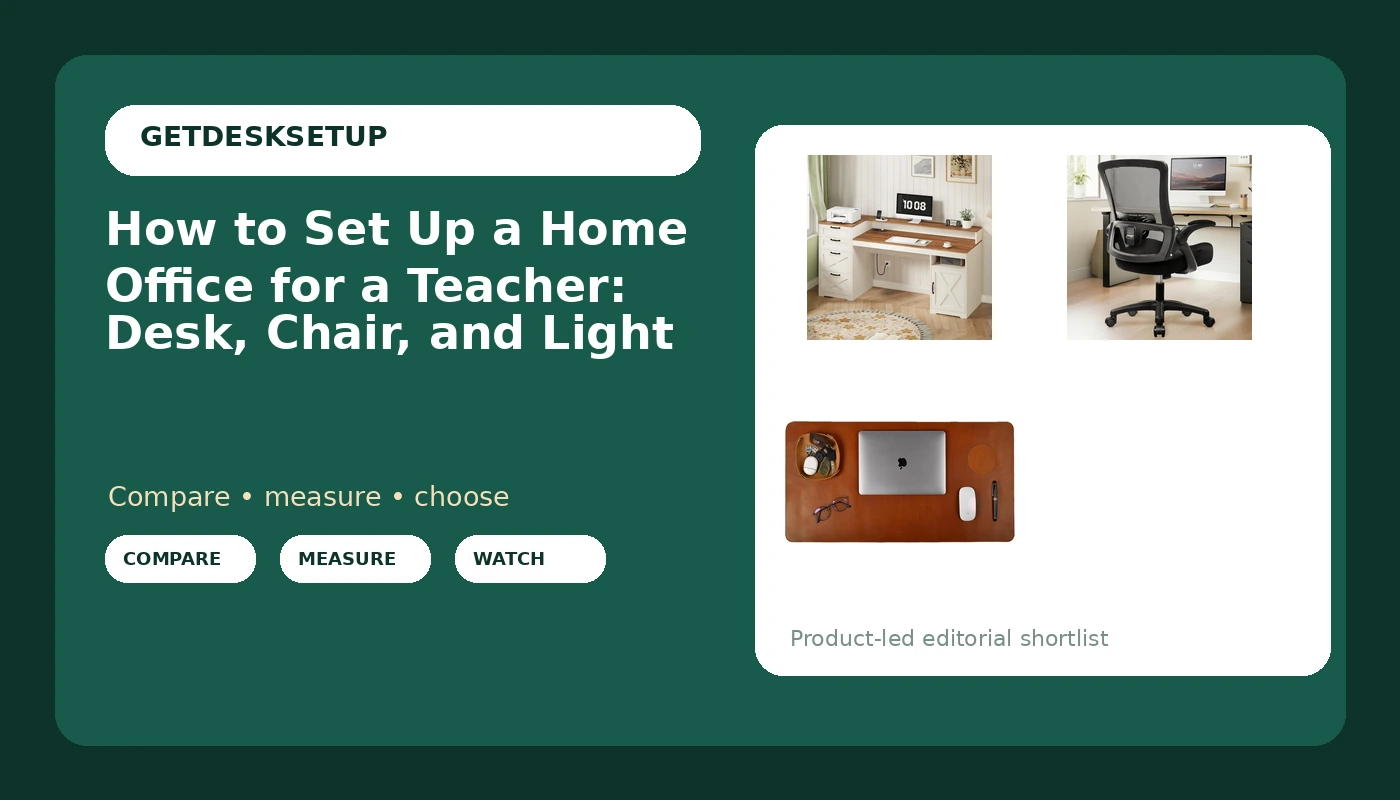
Our pick: 63" Farmhouse Computer Desk with 4 Drawers for Home Office, Bedroom
Our pick
63" Farmhouse Computer Desk with 4 Drawers for Home Office, Bedroom
Check current Amazon price.
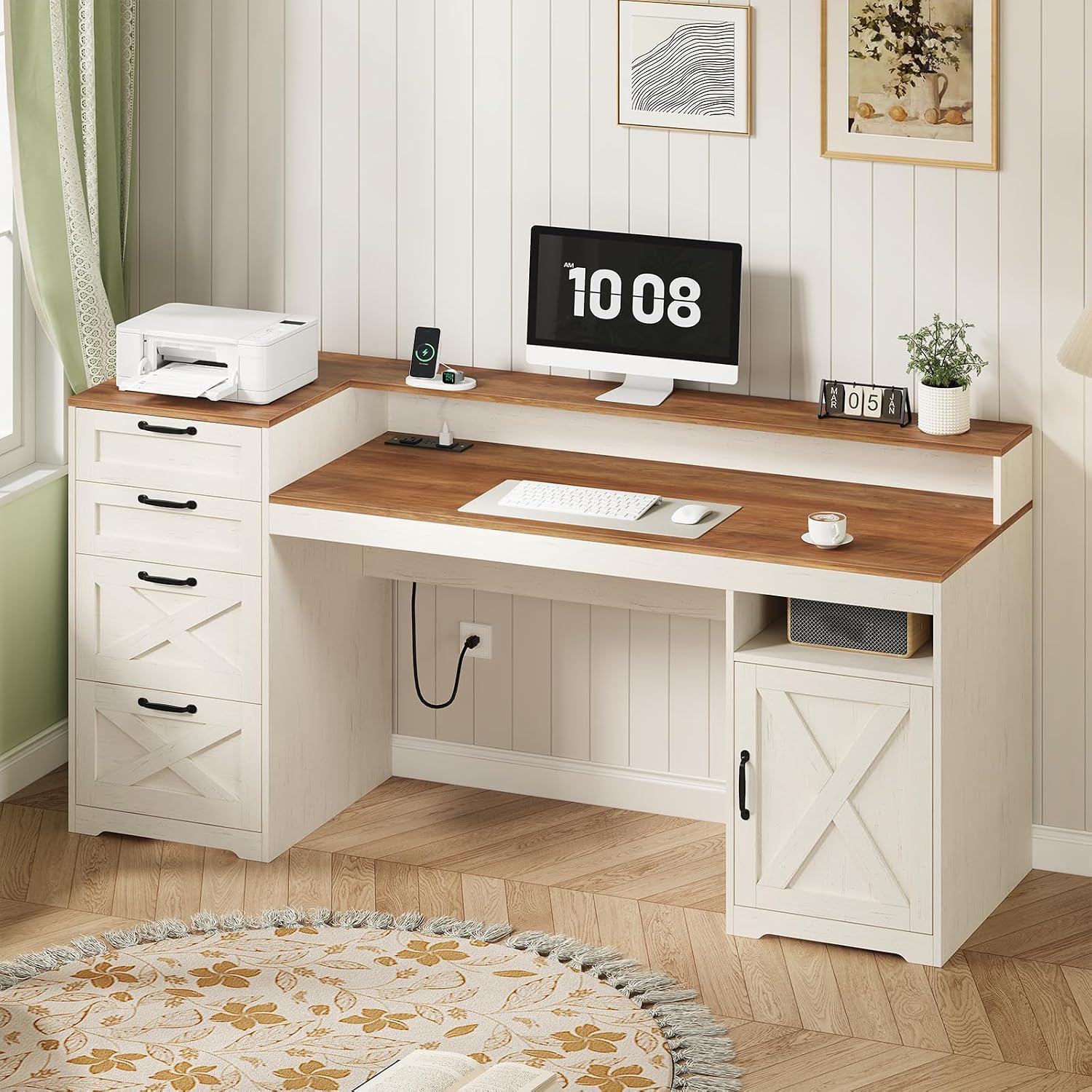
A teacher's desk is a storage unit as much as a work surface, which is why I start here. The top is 63 inches wide, the number that matters most in this article, because it is the minimum width I want on a teacher's wall: a laptop or a monitor in the middle, a stack of papers on one side, and a mug that is not sitting on a rubric. Four drawers take the stapler, the spare chargers, the tape, and the grading pile that should not be living on the desktop overnight. When a client says the papers take over the dining table every evening, this is the fix.
The farmhouse styling is not the reason to buy it, but it helps in a room that has to double as a bedroom. It reads like furniture rather than office equipment, which matters when the desk is the first thing you see from the hall.
Measure the wall before you order. A 63-inch desk needs 63 inches of clear wall plus room behind the chair to stand up and push back, and in a bedroom that is usually the wall opposite the door. If the clear run is shorter, go down a size rather than turning the desk sideways into the walkway.
Flaws but not dealbreakers: The drawers make the footprint deeper than a plain table, and they eat the knee space in the middle. Taller teachers who like to stretch their legs straight out should sit at one before committing. Renters who move every spring should skip it too, because a desk this size is a two-person move.
Anyone setting up a dedicated corner for a teacher and staying in one place for a few years should start here.
Budget pick: NEO CHAIR Office Desk Chair High Back Mesh Chair Adjustable Lumbar, Black
Budget pick
NEO CHAIR Office Desk Chair High Back Mesh Chair Adjustable Lumbar, Black
Check current Amazon price.
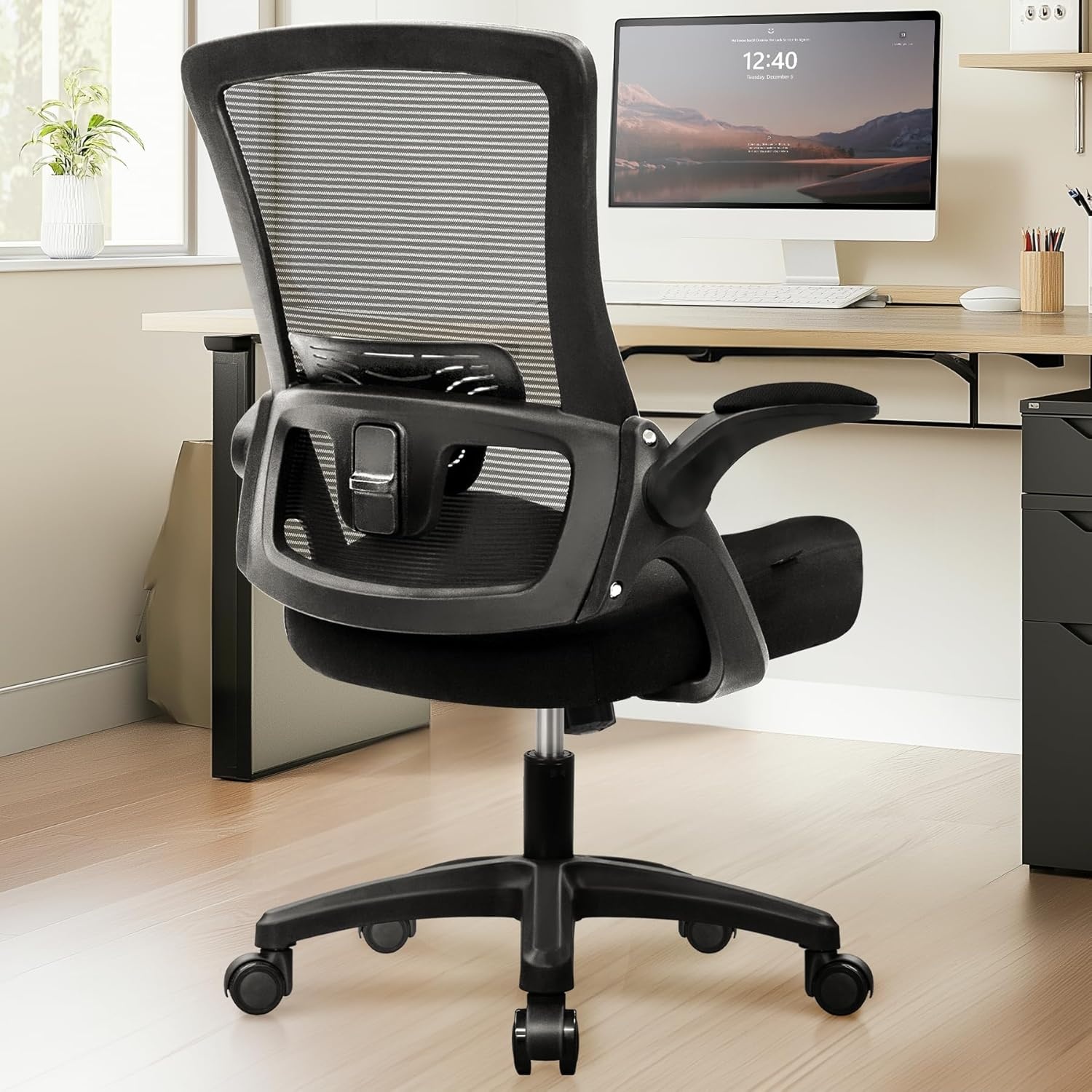
The chair is where teacher setups usually go wrong, because it is the last thing bought and the first thing replaced. This one keeps the budget honest. The listing names an adjustable lumbar support and a high mesh back, and the mesh is the part a teacher will notice: a mesh back moves air, and ventilation behind your shoulders matters when you talk for six hours a day in a closed bedroom.
Here is what I will not do: turn that listing into a fit claim. It does not publish a height and weight range I am willing to vouch for, and I do not guess on sizing. Measure yourself first, from the back of your knee to the back of your hip, and compare that number to the seat depth before you order. If you are long in the thigh, or you want a seat depth slider, a headrest, and arms that adjust in three directions, skip this one and budget up. This is a chair for a teacher who grades in 40-minute blocks, not for someone who sits four hours without standing.
Flaws but not dealbreakers: The armrests are fixed, and the lumbar pad adjusts but the seat depth does not. That is what a chair at this price buys, and for a home office that sees two or three hours of real sitting at a stretch, it is a fair trade.
Anyone who wants the lumbar support off the base model of a mesh chair, on the smallest line item in the setup, should put this one in the cart.
Upgrade pick: LEATHER VILLAGE Real Leather Desk Pad Thick Double Layer Desk Mat Cognac.
Upgrade pick
LEATHER VILLAGE Real Leather Desk Pad Thick Double Layer Desk Mat Cognac.
Check current Amazon price.
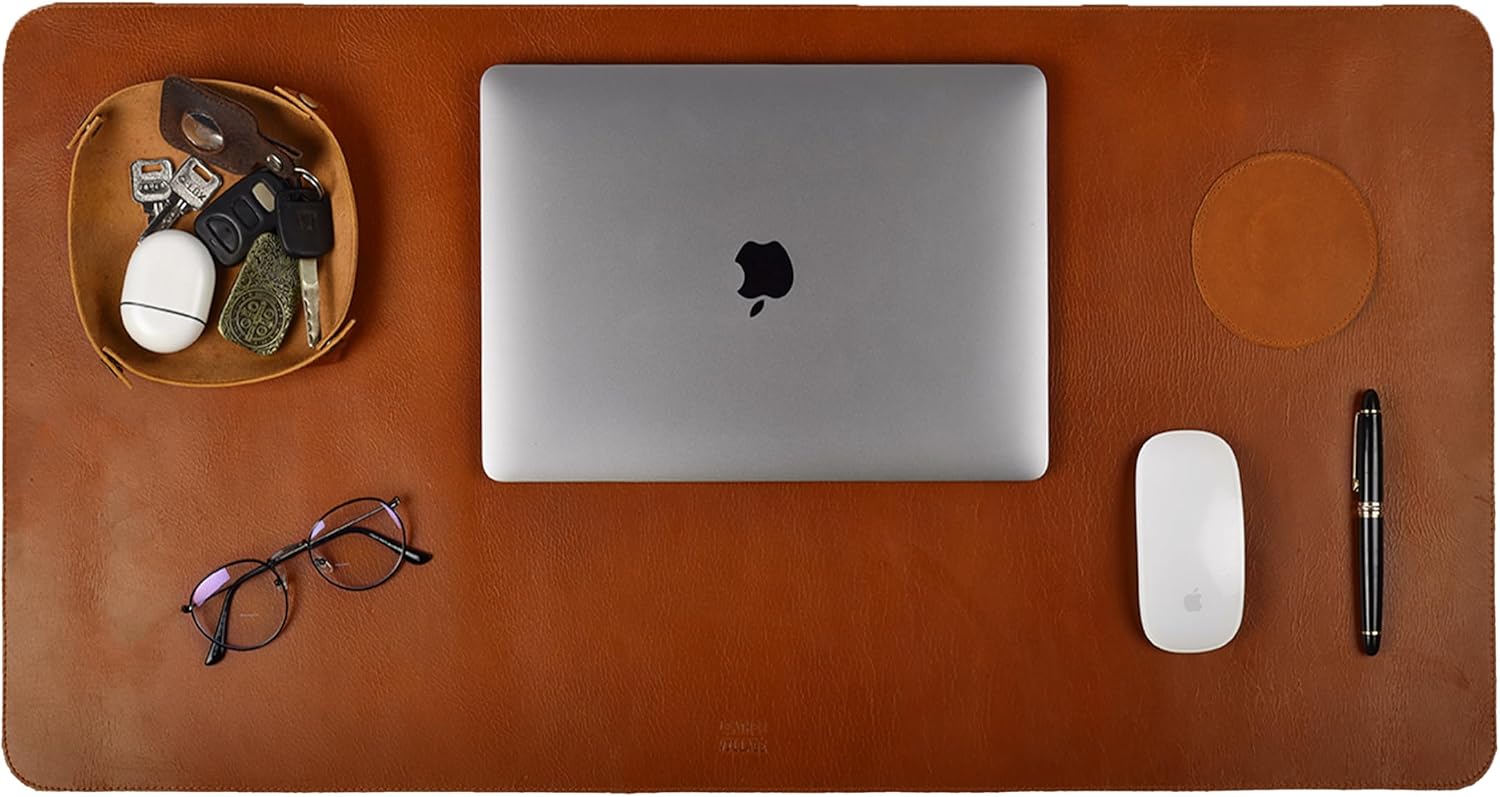
The last item is the one clients thank me for a month later, which is not what I expected the first time it happened. A desk pad does three jobs. It protects the finish on a new desk from laptop feet, mug rings, and pencil pressure. It gives you a writing surface a pen actually likes, which matters when half your afternoon is marking. And it draws a line under the keyboard, so the mouse and the monitor end up in the same place every day. That third job is the one people underestimate. Monitor distance only stays correct if the keyboard stays put.
This one is real leather, double layered, in a cognac finish that hides pencil marks and coffee smudges better than a pale mat. On a 63-inch top it covers the working zone in the middle, not the whole surface.
Flaws but not dealbreakers: It is a writing surface, not a full desk protector. If you want edge-to-edge coverage on a wide top, a larger felt or synthetic mat is the better buy. On a glass desk, leather can creep, and you will be nudging it back every week.
Anyone who writes on paper every day and wants the keyboard to stay where they put it should add this to the order.
How to set up a home office for a teacher: the eight-step build
If your job is to set up a work from home for a teacher before the first inservice day, work top down and follow this order. Districts that set up a work from home office for a teacher usually stop at the laptop and the VPN token, which is why the furniture side falls on you. When you set up a home workspace for a teacher in a shared apartment, the same eight steps hold, with one adjustment: choose a desk that can be pushed flat to the wall at the end of the day.
Step one: Pick the wall before you buy anything. Room layout decides the desk, not the other way around. Measure the clear run of wall, and remember that a 63-inch desk needs 63 inches plus room behind the chair to push back. Keep the door swing, the closet, and the heating vent clear. If you can, sit with your back to the wall rather than to the door, so hallway traffic is not in your eyeline all day.
Step two: Count the power outlet before you place the desk. A teacher runs a laptop, a monitor, a lamp, a phone, and sometimes a printer. One wall outlet will not cover that. Put a surge protector with a flat plug at the desk-side outlet, and never run a cord across a walkway. If the only outlet is on the far wall, run a cord cover along the baseboard before the first week of school, not after.
Step three: Set desk height first, then pair the chair to it. Sit down, feet flat, and adjust until your elbows rest at roughly 90 degrees with your shoulders relaxed. If the desk height is fixed and your elbows sit high, raise the chair and add a footrest so your feet are not dangling. This is the step where chair pairing beats chair shopping. Get the relationship right and an inexpensive chair works.
Step four: Set the chair in this order, seat depth, lumbar, then armrests. Leave a couple of fingers of gap behind your knee, then bring the lumbar pad into the small of your back, then drop the armrests low enough to slide under the desk. Reversing that order is why so many chairs feel wrong: people adjust the arms first and then cannot get close enough to the desk.
Step five: Set monitor distance and height. An arm's length from your eyes to the screen is the starting point, with the top of the screen at or just below eye level. A stack of books under the monitor is fine. If you wear progressive lenses, drop the screen a little lower so you are not tilting your chin up all day.
Step six: Build lighting layers instead of one bright ceiling. Overhead light off during screen work, one task lamp beside your writing hand, and one ambient source behind the monitor. Then check the window. If it is behind you, it will bounce off the screen all afternoon; if it is in front of you, it will be in your eyes by 4 p.m. Move the desk or add a shade.
Step seven: Do cable planning once, properly. Leave slack at both ends of every run, secure the bundle so nothing pulls on the monitor or the laptop lid, and label anything you unplug often. A cable that pulls on a monitor changes the angle within a week, and then you spend a month wondering why your neck hurts.
Step eight: Handle ventilation, then reset the room. A spare bedroom with the door closed goes stale in about an hour, and a warm room makes a long afternoon longer. Open the door or the window for ten minutes at the start and end of the day. Then reset: papers in a drawer, chair pushed in, laptop closed. The room has to go back to being a bedroom at 5 p.m., and a two-minute reset is what makes that possible.
The competition and why it lost
A standing desk is the first thing people ask about, and it is the right answer for some teachers and the wrong answer for most. If you teach from a fixed desk and then grade at the same desk, you are paying for a height range you will use twice a week. If you do want one, read my notes on standing desks that do not wobble at standing height before you buy, because wobble at the top of the range is the failure that actually matters.
A 47-inch writing desk lost on width. It fits the wall and the budget, but a paper pile and a laptop cannot share that top, and you are back at the dining table by October.
Big-box chairs sold as ergonomic with a fixed lumbar pad lost on the one feature that matters. If the lumbar does not adjust, it is a shape, not a support.
A monitor arm lost on timing. It is the right upgrade once the desk and the chair are settled, and a distraction before that. Same for a gaming chair, which is built for a different posture and a different kind of sitting.
None of those are bad products. They are wrong for this brief, and the brief is a room that has to do two jobs.
What this all costs
I do not print prices in this guide, because they move every few weeks and a stale number is worse than no number. Each product block above links to the current listing, where the price lives, and I would rather you see today's number than last month's.
What I can give you is the shape of the budget. The desk is the largest line item, and it should be, because it is the piece you keep when everything else gets replaced. The chair is the smallest line, and it does the most work for your back, which is why I would rather you spend the difference there than on the finish of the desk. The desk pad is the finishing touch, and it is the one clients come back to thank me for.
Spread over the years a teacher tends to stay in one room, the daily cost of a setup that actually fits is small. The cost of the wrong setup is not measured in dollars at all. It is measured in the afternoons you spend at the dining table because the desk you bought does not hold the paper.
So here is the whole answer to how to set up a home office for a teacher: buy the desk for the room, the chair for the body, and the pad for the habit, then run the eight steps in order. Check current Amazon price on each piece before you commit, and measure your wall and your seat depth first. That is the job, and it is a two-weekend job at most.