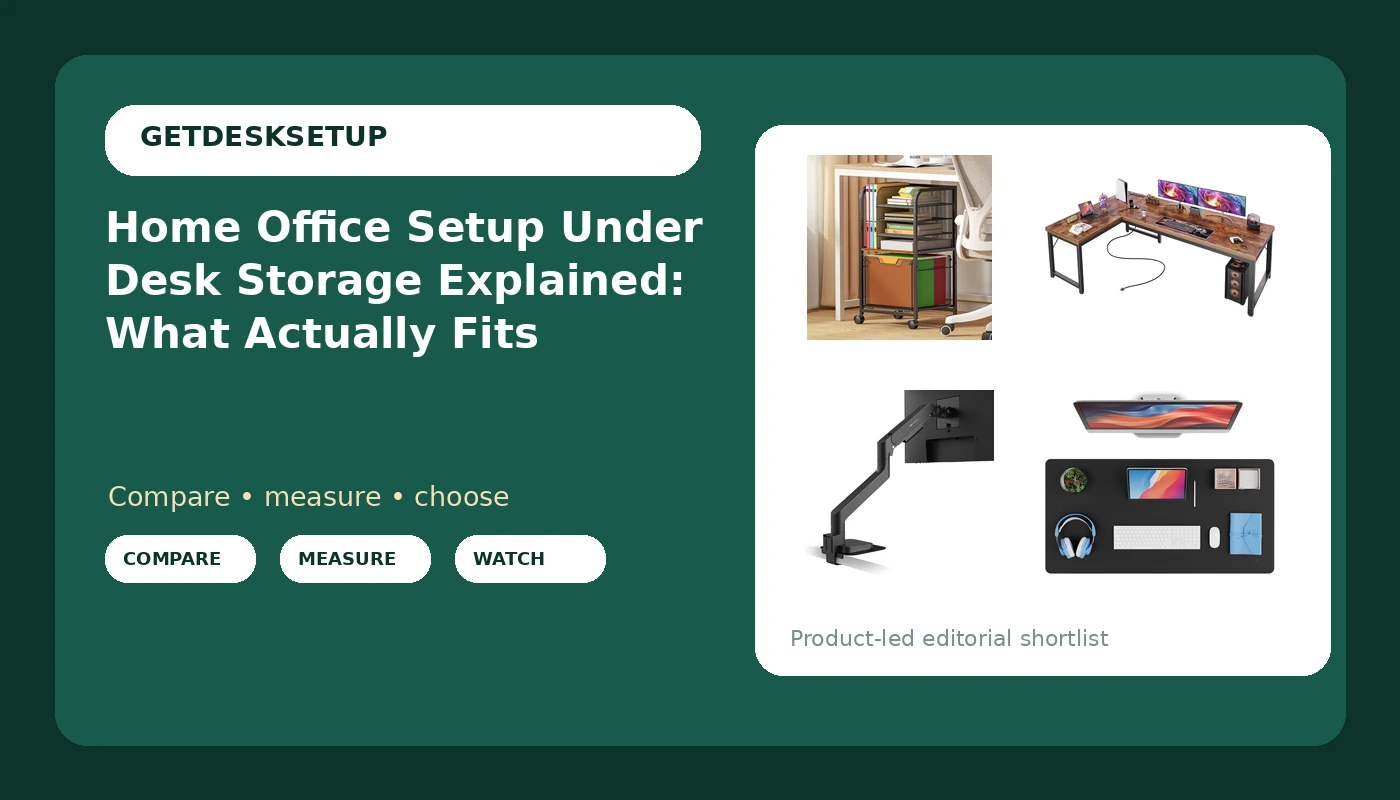
Under-desk storage decides how a home office actually feels to sit in. A cart that rolls out of the way keeps the floor clear, and clear floor is what makes a small room work, but the cart only rolls if the desk has the room for it. I spent nine years buying furniture for open-plan floors and six more building out home offices, and the failure is almost never the storage itself. It is the desk: a crossbar, a drawer unit, or a motor housing sitting exactly where the cart needs to slide. So treat home office setup under desk storage as a measurement problem before it becomes a shopping problem. This article is home office setup under desk storage explained in the numbers that matter, with four products covering four jobs: the cart, the desk it rolls under, the arm that clears the desktop, and the pad that protects it.
Related: Ergonomic Office Chairs for Small Home Offices →
Quick answer
Measure two numbers before you buy anything: the clear height from the floor to the lowest obstruction under the desk, and the clear width between the legs or frame at floor level. Storage has to fit inside both, with an inch or two left over so casters can actually roll. Then keep the desktop for work rather than for storage: move the monitor onto a desk mount, put a pad under the keyboard and mouse, and finish cable planning and the power outlet run before the cart is loaded. The four options below cover that sequence, the Feyejade 5-Tier Rolling File Cart Cabinet, the Huuger 63 Inch L Shaped Desk with Power Outlets, the BenQ ErgoArm BSH01 desk mount, and the K KNODEL Large Desk Protector Mat, and each section below names who should skip it.
4 useful options
| Model | Best fit | What stands out |
|---|---|---|
| Feyejade 5-Tier Rolling File Cart Cabinet Under Desk Storage Organizer | Files and supplies that need to roll out of the footwell | Five tiers on casters, built as an under-desk cart |
| Huuger 63 Inch L Shaped Desk with Power Outlets & 0.95 Inch Thicker Desktop | A corner that needs power built into the desk | 63 inch L shape, integrated outlets, thicker desktop |
| BenQ ErgoArm BSH01 Heavy Duty VESA Desk Mount for Screen up to 45" & 44 lbs | Clearing the desktop above the storage | Heavy duty VESA mount rated for screens up to 45 inches and 44 lbs |
| K KNODEL Large Desk Protector Mat and Pad for Office (Black, 15.7" x 31.5") | Protecting a desktop that is already fine | 15.7 by 31.5 inch pad in black |
The storage anchor: Feyejade 5-Tier Rolling File Cart Cabinet Under Desk Storage Organizer
The cart is the piece most people buy first and measure last, which is backwards. Before ordering, measure the floor-to-underside clearance at the front of the desk and again at the back, because frames taper and a crossbar often sits further in than the front legs. Then measure the width between the legs at floor level. If the listed cart height leaves less than an inch of slack, skip it, because casters need a little room and a rug or thick carpet adds resistance that turns a rolling cart into a dragging one. This is also where chair pairing matters: with your chair pushed in, the footwell has to hold the chair base, your feet, and the cart at the same time. If those three do not fit, under-desk storage is the wrong answer for that room and a closed cabinet beside the desk is the right one.
The foundation: Huuger 63 Inch L Shaped Desk with Power Outlets & 0.95 Inch Thicker Desktop
Room layout decides this desk before price does. An L shape needs the corner plus both legs of the L to be genuinely usable, and 63 inches is the long run, so the room has to give you that run plus chair clearance behind it. If it cannot, a straight desk is the honest choice. Two details matter for a setup built around under-desk storage. First, the built-in power outlet changes cable planning: devices on the desk can plug into the desk itself, so the run to the wall outlet drops to a single cable, and fewer cables means fewer things to snag on a rolling cart. Second, the 0.95 inch desktop is thick enough that clamp mounted accessories, monitor arms and some trays among them, have material to bite into, which is not true of every thin top. Leave ventilation room behind the desk in a corner, and do not push the rear edge flush against a wall if you plan to hang a tray or route cables back there. If your room cannot spare the corner or the long run, skip this one.
The space maker: BenQ ErgoArm BSH01 Heavy Duty VESA Desk Mount for Screen up to 45" & 44 lbs
A monitor on its own stand eats the deepest part of the desktop, and that is usually the strip directly above the under-desk storage. Moving the screen onto an arm returns that area to the room. Two measurements decide whether this one works for you. Monitor distance: your eyes want the screen roughly an arm's length away, and an arm lets you set that distance without moving the desk or the cart. Clamp thickness: check your desktop against the mount's clamp range, because the thicker Huuger top is a friendlier surface for clamps than a thin hollow-core top. Cable planning follows the arm, since the display cable has to travel along it and back down to the desk, and a cable that pulls on the arm changes the monitor angle within a week. If your screen is heavier than the stated capacity or larger than 45 inches, skip this mount and look at a freestanding arm instead.
The surface saver: K KNODEL Large Desk Protector Mat and Pad for Office (Black, 15.7" x 31.5")
The pad is the least glamorous item here and the one that decides how the desk looks in a year. The 15.7 by 31.5 inch footprint is roughly a keyboard and mouse zone with room to spare, so measure where your keyboard actually sits before assuming it covers your wear spots. If you use a clamp mounted arm, check whether the mat should stop short of the clamp base, since a pad pinched under a clamp can wrinkle at the edge. On a desk with built-in power outlets, keep the pad clear of the outlet flap so you can still reach it without peeling the mat back. If you already own a pad you like, skip this one, because there is nothing here a different pad cannot do.
Prices and availability may change. Product images, names, and retailer links are matched to verified listings. No current price, rating, stock status, or measured result is stated here without current evidence.
How home office setup under desk storage changes your clearance math
Clearance is the whole game, and it has three parts. The first is vertical: floor to the lowest obstruction. On a fixed desk that is the underside of the top or a crossbar; on a standing desk it is the motor housing or the frame's lowest point, and that point moves as the desk rises. Measure with the desk at the height you actually work at, not at its lowest setting, because a frame that clears a cart at sitting height can foul it at standing height. The second is horizontal: the width between the legs or the frame at floor level, measured at the front and again at the back. The third is the rolling path, which has to be flat. A rug edge under a caster is enough to stop a loaded cart from coming back out.
Desk height and chair pairing sit on top of all three, because the footwell has to hold your chair base, your feet, and the storage at the same time. If your chair has a wide five-star base and you sit with your feet forward, the cart loses that argument. Monitor distance ties in as well: storage that pushes your chair back also pushes your eyes away from the screen, and you will feel that strain long before you work out that the cart is the reason. Lighting layers do not change any of these numbers, but a dark cart in a shadowed footwell is easy to forget, so keep the tier you use daily where you can see it without kneeling.
Matching storage to desk height, chair pairing, and cable planning
The order below is the order that avoids returns, and it is the same order for any home office setup under desk storage, whatever the desk costs. Do it with a tape measure and a notebook, and write the numbers down, because the second measurement will make you doubt the first.
- Measure floor-to-underside clearance at the front, middle, and back of the desk, with the desk at working height.
- Measure clear width between the legs or frame at floor level, front and back.
- Push your chair in and measure the leftover footwell width after the chair base and your feet.
- Compare those numbers against the listed storage dimensions and keep at least an inch of slack on height and width.
- Finish cable planning and the power outlet run before loading anything, so cables reach without crossing the rolling path.
Practical rules for a work from home setup under desk storage
A work from home setup under desk storage plan is mostly about what you refuse to put under there.
- Buy storage after you measure, not before. Height and width first, product second.
- Keep the top tier at or below desk height so nothing blocks a knee, a drawer, or the desk's own adjustment.
- Keep the rolling path flat, with no rug edge, cable, or chair-base foot in the way.
- Leave the power outlet, the rear vents, and the desk's adjustment controls reachable without moving the cart.
- Load heavy items on the bottom tier and daily items on the top, so you are not pulling the cart out every hour.
A home workspace setup under desk storage that follows those rules stays usable for years, and one that ignores the second rule gets emptied out within a month. If you are still choosing the chair side of the equation, the chair sizing walkthrough covers the measurements that pair with a desk this shallow underneath.
Which option should you choose?
Choose the Feyejade 5-Tier Rolling File Cart Cabinet Under Desk Storage Organizer when you have measured clearance and width and both numbers clear the cart with an inch to spare. Choose the Huuger 63 Inch L Shaped Desk with Power Outlets & 0.95 Inch Thicker Desktop when you are starting from an empty corner and want the work surface, the outlets, and a thicker desktop in one purchase. Choose the BenQ ErgoArm BSH01 Heavy Duty VESA Desk Mount for Screen up to 45" & 44 lbs when the desktop, not the floor, is your bottleneck and you want the screen on an arm. Choose the K KNODEL Large Desk Protector Mat and Pad for Office (Black, 15.7" x 31.5") when the desk you own is already right and you only want to protect the finish.
A home office workstation under desk storage setup that has to hold a printer, a tower, and a chair base in the same footwell is a different problem, and it usually ends with a cabinet beside the desk instead of under it. None of these four products is claimed as the quietest, fastest, safest, or best in its category; each is simply the option that matches one job here, and the fit numbers still have to come from your own room. Prices, ratings, and stock change, and nothing of that kind is asserted on this page.
The bottom line
Under-desk storage is a fit problem with a shopping solution, not the other way around. Measure vertical clearance with the desk at working height, measure the width between the legs at the floor, and leave slack for casters and carpet. If the numbers work, the Feyejade cart takes the files off the desktop, the Huuger desk supplies the surface, the outlets, and a thicker top to clamp to, the BenQ arm clears the strip above the storage, and the K KNODEL pad protects the finish everything else rests on. If the numbers do not work, no product on this page fixes that, and the honest move is a closed cabinet beside the desk. That is the whole test: a cart you can roll out with one hand beats a cart you have to fight, every time.