There is one number that decides whether a footrest helps you or wrecks your knees, and almost nobody knows it. It is the distance from the floor to the crease behind your knee while you sit in the shoes you actually wear at your desk. Get that number and you can measure footrest height for your legs in about ninety seconds with a tape measure and a doorframe.
Most people do it backwards. They buy the rest first, stack books under their feet for a month, and then wonder why their lower back aches by three in the afternoon. I have walked into enough home offices to know that the footrest is the last thing anyone thinks about and the first thing that explains the ache.
This is how to measure footrest height for your legs, in the order I run it in a client's office: body first, chair second, footrest third. The gear list is short and the measuring itself costs nothing.
Why you should trust me
I spent nine years as an office facilities manager, buying and assembling chairs and desks for 400-person floors. Then six years running a two-person desk setup service that has built out 310 home offices. I keep a notebook with every chair seat depth and desk height range I have measured with a tape, not read off a spec sheet. When a client tells me a chair is comfortable, I ask for the seat depth in inches. If they cannot say the number, they are guessing, and so is the chair.
That habit is why this article is about a tape measure and not about a brand. Ergonomics is a measurement, not a feeling. A chair either fits your body or it does not, and the same is true of the thing under your feet. I will not call a product comfortable without telling you who should skip it, and I will not tell you a footrest fits without naming the gap it has to cover. If you cannot state your seat depth and your seat height range, you are shopping blind.
How I picked and how I tested
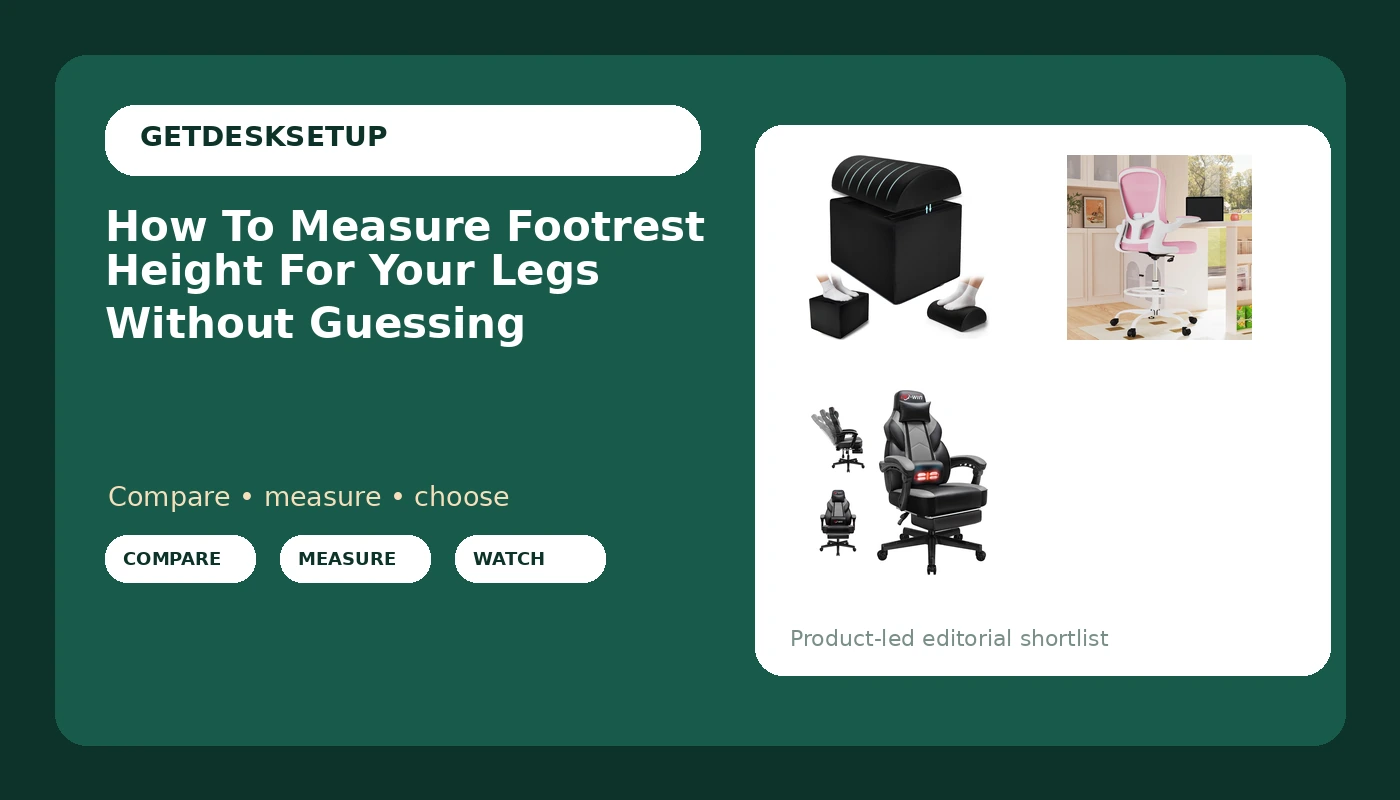
The three products below are not a ranked list of everything on Amazon. They are the three ways people actually solve this problem, and each one needs a different measurement before you buy: a plain adjustable rest, a tall chair with a ring built into the base, and a big-and-tall chair with a panel that slides out of the seat.
My test is the same in every office and it takes about ten minutes. Shoes on, because nobody sits at work in socks. Tape measure against the wall or the side of the desk. I measure the floor to the crease behind the knee, the floor to the underside of the thigh, and the seat height at the lowest setting the chair will hold. The difference between the last two numbers is the gap a footrest has to fill, and if you skip that arithmetic you are buying a guess.
The second thing I check is the floor itself. A footrest lives in the same square foot as everything else you drop down there, so I look at the under-desk raceway running along the back panel, the cable sleeve on the monitor arm, the adhesive clip that lets go after a month and dumps a USB cable into your ankle. All of it competes for the same space, and a rest that lands on a cable is a rest that rocks. I keep a small desk lamp in the van for this, because desk lamp lumens matter more than people think when you are reading a tape measure inside a shadowed knee well.
For the two chairs, the check is different. I sit, set the chair to the height my desk wants, and then measure what the built-in foot support does at that height. A ring on a drafting chair and a slide-out panel on a gaming chair are both fixed relative to the seat, not the floor, which means they either land under your legs or they do not, and no amount of fiddling with a floor rest will fix that. I also run the wobble test I use on every standing desk, because a footrest under a desk that shakes is a problem you feel in your heels before you see it.
Gear that helps you measure footrest height for your legs
Three products, three jobs. None of them replaces the tape measure, and each one answers a different version of the same question.
The baseline: Adjustable Footrest for Under Desk at Work Ergonomic Foot Rest with 3 Adjustable Height Foot Stool for Under Desk Office Footrests with Removable Washable Mesh Cover, Black
The baseline
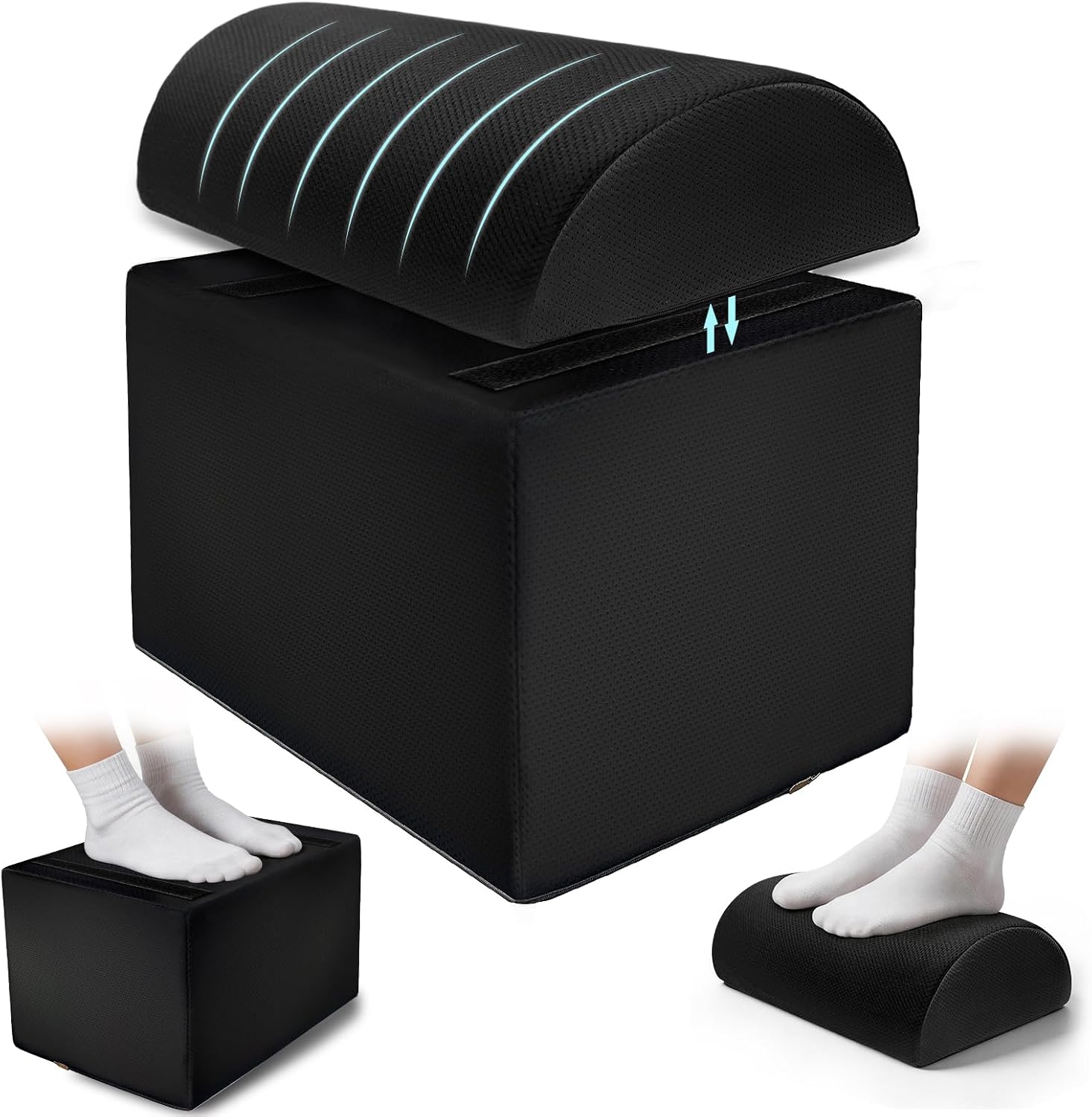
Adjustable Footrest for Under Desk at Work Ergonomic Foot Rest with 3 Adjustable Height Foot Stool for Under Desk Office Footrests with Removable Washable Mesh Cover, Black
This is the piece most people need, and it is what I put under the desk when the measurement says the gap is real. Three height settings mean the platform covers a range instead of one fixed position, which matters because your gap is a number you found with a tape, not a number a factory guessed. The mesh cover comes off and goes in the wash, which is the difference between a footrest you keep and a footrest you throw out after a summer of bare feet. Check current Amazon price.
The measurement you need here is the platform height at each of its settings against the gap you calculated. The platform has to sit inside your gap, not at the edge of it, because you will change shoes in November and lose half an inch.
Who should skip it: if your chair's lowest seat height already puts your feet flat on the floor with your knees at ninety degrees, you do not have a gap and this product has nothing to do. Also skip it if you want a locked tilt rather than a flat platform, because a flat platform is what this one is built to be.
The tall chair with the ring built in: Drafting Chair, Tall Office Chair with Flip-up Armrests Executive Ergonomic Computer Standing Desk Chair, Office Drafting Chair with Lumbar Support and Adjustable Footrest Ring
The tall chair with the ring built in
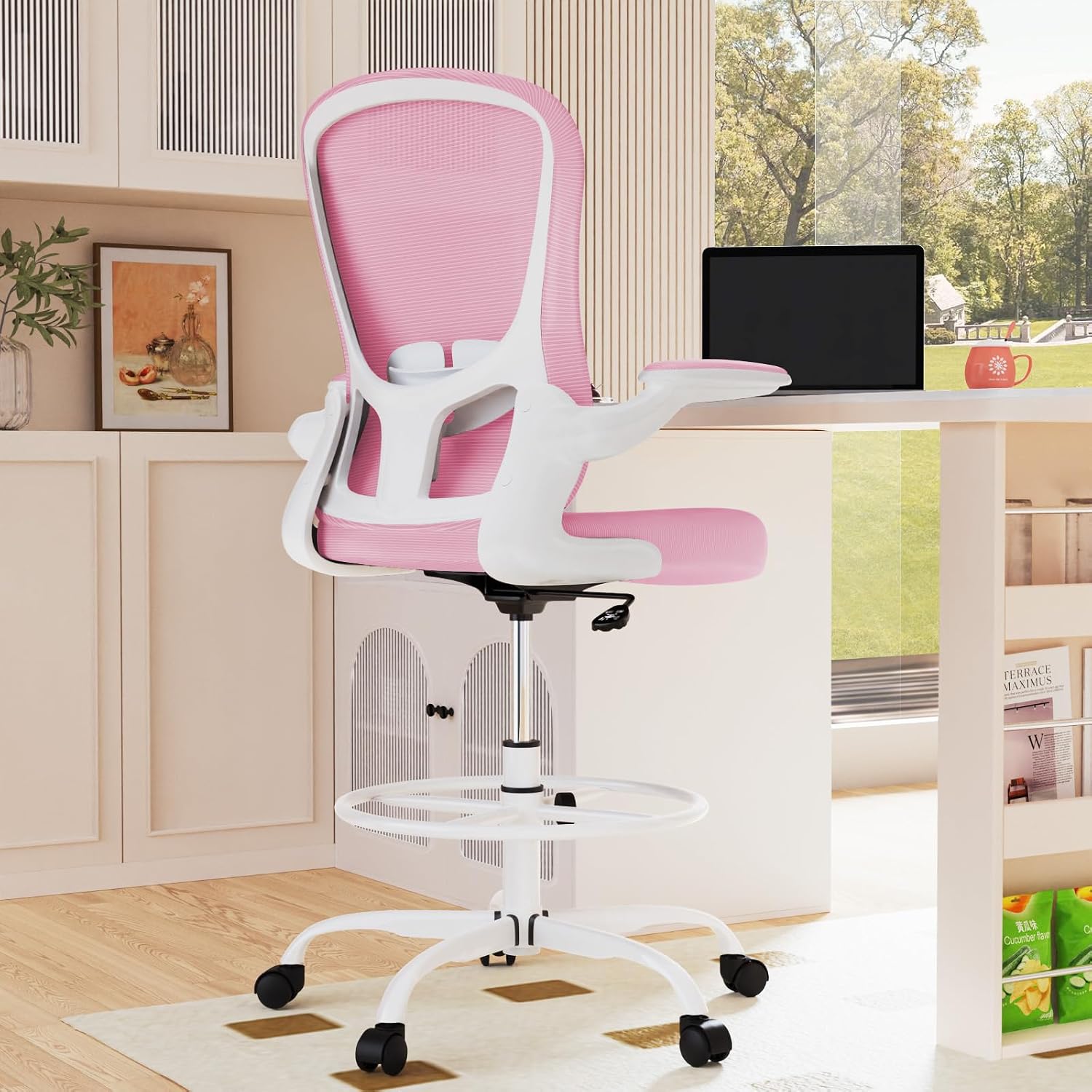
Drafting Chair, Tall Office Chair with Flip-up Armrests Executive Ergonomic Computer Standing Desk Chair, Office Drafting Chair with Lumbar Support and Adjustable Footrest Ring
When the desk is high, a floor footrest stops being the answer. A rest on the floor cannot help you if the seat is so tall that your legs dangle, because the gap is wider than any platform's range and your thighs are still sloping downhill. What you need is support that travels with the seat, and that is what the ring on this drafting chair is. It has flip-up armrests, so it tucks under a desk without a fight, and lumbar support, which is the adjustment I look for before I call any chair ergonomic. Check current Amazon price.
The measurement changes here. You do not measure from the floor, because the ring is not on the floor. You set the chair to the height your desk wants, sit down, and measure the ring against the underside of your legs. The ring has to be adjustable, and you have to be able to say where it lands at your working height. If it only works at the bottom of the chair's travel, it does not work for you.
Who should skip it: if your desk sits at a standard seated height, this chair will hold you too high and the ring will not rescue you. It is for a drafting-height desk or a standing desk you use in the seated position, not for a normal desk doing a normal chair's job.
The big-and-tall option: DL-win Gaming Chairs for Adults, Computer Chair with Footrest and High Back, Big and Tall Gamer Chair's with Massage Lumbar Support, 360° Swivel Height Adjustable Gaming Chair, Grey
The big-and-tall option
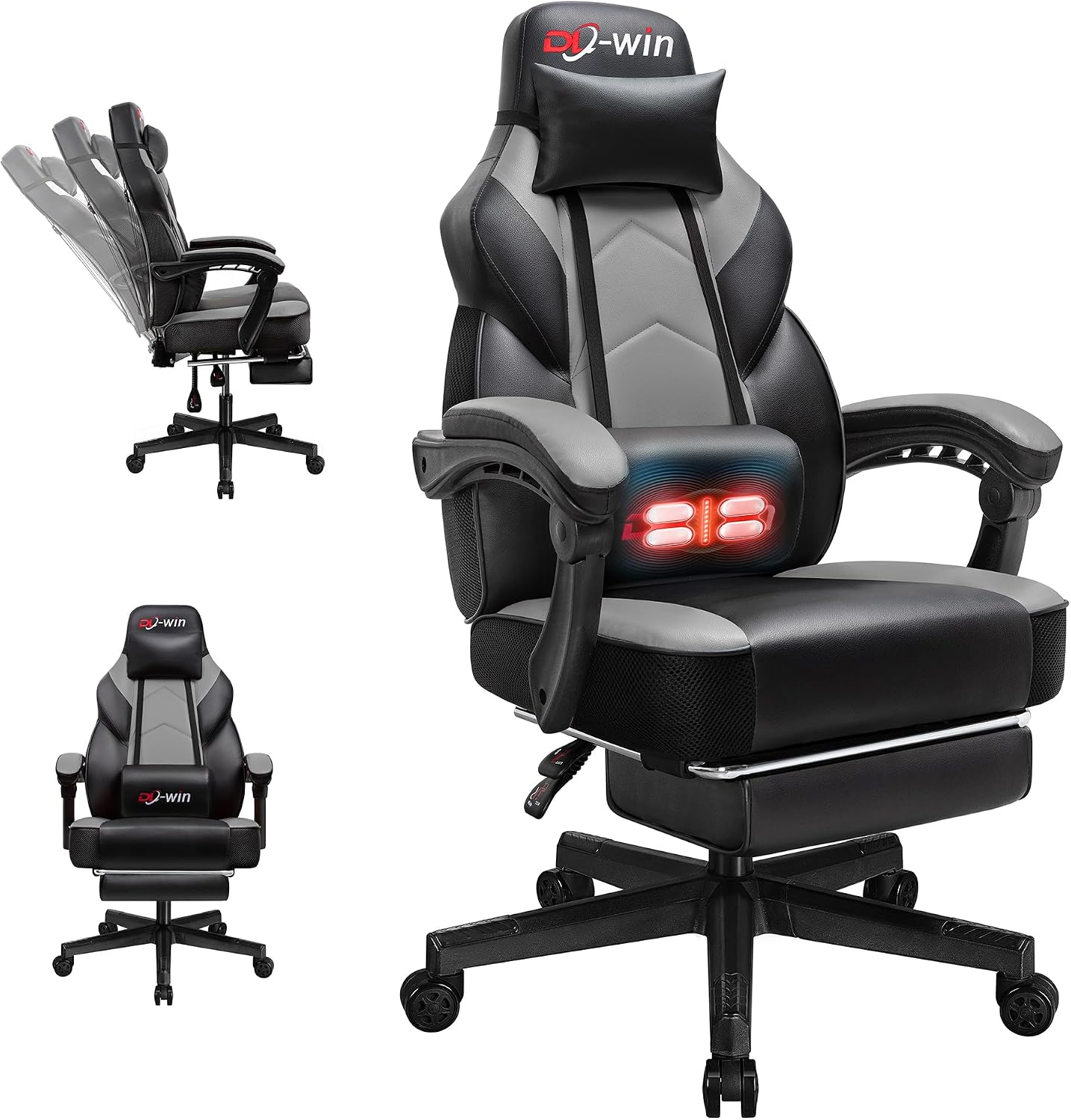
DL-win Gaming Chairs for Adults, Computer Chair with Footrest and High Back, Big and Tall Gamer Chair's with Massage Lumbar Support, 360° Swivel Height Adjustable Gaming Chair, Grey
This is the third way people solve it: a chair that carries its own footrest in the seat, so nothing lives on the floor at all. The panel slides out from under the seat, the back is high, the base swivels, and the chair carries a massage lumbar support. In a small room where the floor under the desk already holds a raceway and a power brick, that is a real advantage, because the foot support disappears when you are not using it. Check current Amazon price.
The measurement is different again. The panel is fixed relative to the seat, so the number that matters is where it lands relative to your calves once the chair is at your working height. Sit, extend it, and check that it supports the lower part of your leg instead of pushing your knees up. If extending it tips your pelvis back or lifts your thighs off the seat, it is too high for your body and no adjustment will save it.
Who should skip it: skip it if you share the desk or move between rooms, because you cannot take the foot support with you. Skip it if your knee well is tight, since this is the biggest footprint of the three, so measure the knee well width against the base before you order. Skip it too if you want the room to read as an office rather than a cockpit. And check the published weight capacity against your own weight before buying, because a big-and-tall label is a category, not a guarantee.
The actual measuring workflow
Eight steps, one tape measure, and a wall. Do them in this order, because the chair decides the number and the footrest only fills it. This is the order that works, and it is the fastest way to measure footrest height for your legs without buying anything first.
Step one: Put on your work shoes and set the chair height. Sit down, plant your feet, and set the seat so your elbows rest at desk height with your shoulders relaxed. Do not touch the footrest yet. If you measure with the chair at the wrong height, every number after this one is wrong.
Step two: Measure your popliteal height. Keep your feet flat on the floor and your knees at ninety degrees. Measure from the floor straight up to the crease behind your knee. That is your popliteal height, and it is the height your seat wants to be. Write it down in inches, not as "about right."
Step three: Find the gap. Take the seat height from step one and subtract the popliteal height from step two. If the answer is zero or negative, your feet reach the floor and you are done, no footrest required. If the answer is positive, that number is the gap you are shopping for, and it is also the height your footrest platform needs to sit at.
Step four: Check the footrest's range against the gap. Read the platform heights the rest offers and compare them to your gap. You want your gap in the middle of that range, not at the top, because the top of the range is where cheap rests get wobbly and where you have no room left when you change shoes. If you want to measure under desk footrest height for your legs in a chair that also reclines, redo steps one and two at the position you actually work in.
Step five: Add the floor you actually stand on. Before you measure desk footrest height for your legs, measure the floor itself. If you keep an anti-fatigue mat under the chair, measure its mat thickness and subtract it from the gap, because the mat raises the floor and shortens the distance your feet have to travel. Mat density matters too: a mat that squashes to nothing under your heels changes the gap by the time you finish your coffee. Measure the mat compressed, not new out of the box.
Step six: Set the footrest angle, then leave it alone. Start flat. A flat platform is the default for a reason, and most people should stop there. If you want a slight tilt, change it a few degrees at a time and check your lower back the next morning, not the next minute. The right footrest angle is the one you forget about. If you are adjusting it every day, the problem is the height, not the angle.
Step seven: Clear the travel path before you commit. Kneel down with a lamp and look at what shares the floor: the raceway along the back panel, the cable sleeve on the monitor arm, the adhesive clip holding the power brick, the heads of the desk's own bolts. The rest has to sit flat with nothing under its feet. This is where cable management stops being about looks. A cable trapped under a footrest gets crushed, and a footrest sitting on a cable rocks every time you press down.
Step eight: Re-measure in a week, then write the number on the desk. Sit down a week later and run steps one through three again. Chairs settle, mats flatten, and you will have changed shoes at least once. When the number holds, write it on a piece of tape under the desktop where nobody sees it, next to your seat depth. That is the whole point of measuring: the next chair you buy gets checked against a number instead of a feeling.
The competition and why it lost
A stack of books lost first. It is free and it works for a week, and then the books slide, the height changes every time you take one off, and you never write the number down.
A fixed wedge under the desk lost next. It only works at one chair position, and the moment you roll back to reach the printer it is in the wrong place. Anything that does not travel with your feet is furniture, not a footrest.
An anti-fatigue mat used as a foot platform lost for a different reason. Mat thickness and mat density are real variables, and a mat is built to compress under a standing body. It is not a platform, and it will not hold a height.
A foot hammock lost because it hangs from the desk. It swings, it pulls on the desktop, and its height depends on where you clamped it, which is the opposite of a measurement you can trust. Whether you write the word as footrest or foot rest, the method to measure foot rest height for your legs does not change, and neither does the reason these alternatives fail.
A balance board or a rocking footrest lost because it moves when you want it still. Fine for circulation, wrong for the ninety minutes you spend trying to hold a knee angle. Save it for the afternoon.
The one category that loses for a structural reason is the chair with a built-in foot support that does not adjust relative to the seat. If it only lands correctly at one seat height, it is a fixed wedge with extra steps. That is the test I apply to every drafting chair and every gaming chair I look at, and it is why the ring on the chair above matters more than the chair's styling.
What this all costs
Nothing here is expensive, and the measuring is free. That is the part to notice.
The tape measure you already own. If you do not, it is the cheapest thing in the entire setup and the only tool that improves every future purchase you make for this desk.
The footrest is the smallest line item of the three products here and the one that solves the most common problem, because most people's gap is small. Check current Amazon price before you decide.
The two chairs are the big line items. Divide the price by 365 and you get a number that makes almost any chair look reasonable, which is exactly why you should not run that math before you measure. Do the measurement first. A chair at the wrong height costs you a footrest, a cushion, and eventually another chair.
If you want to see where this fits against the rest of the desk, how I budget a home office setup covers the whole list.
Whatever you pay, the math is the same. A footrest you measured before you bought is a footrest you keep for five years. A footrest you guessed at is one you return, and the return shipping costs more than the tape measure did.
That is the job. Ten minutes with a tape, one number written under the desk, and your feet stop being an afterthought. Your legs already know the height they want. Go measure it.