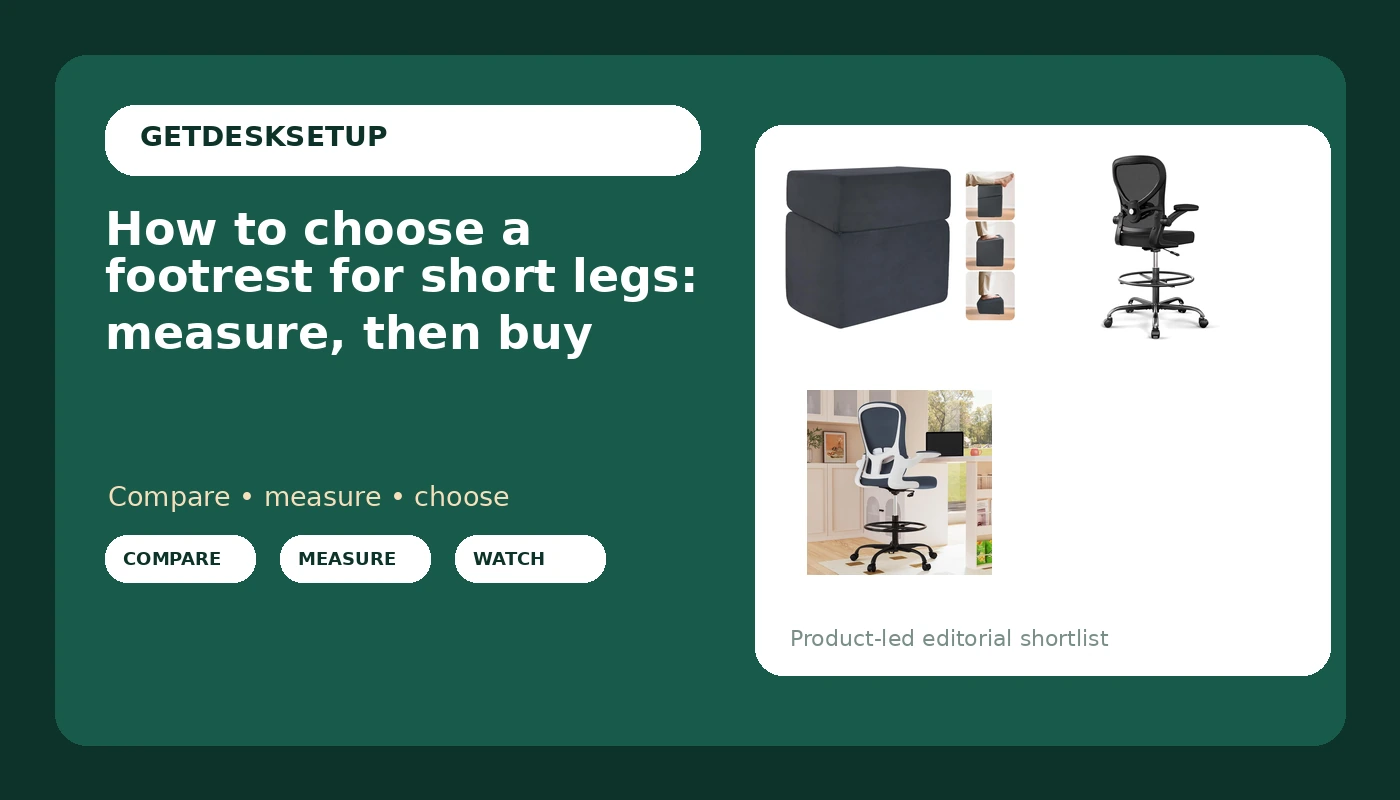
If you are 5'4" or shorter, the standard 29-inch desk was not built for you, and neither was the standard office chair. The seat pan stops somewhere around 16 inches, your feet dangle, and your thighs end up carrying weight your feet should be carrying. That is the whole problem behind how to choose a footrest for short legs: you are not shopping for a cushion, you are shopping for the two to four inches of missing floor between your soles and the ground.
I spent nine years as an office facilities manager, buying and assembling chairs and desks for 400-person floors, and six more years running a two-person desk setup service that has built out 310 home offices. I keep a notebook of every seat depth and desk height range I measure with a tape, not read off a spec sheet. For shorter users the pattern never changes. The chair is usually fine, the desk is usually fine, and the floor is the problem.
The fix is the cheapest thing in the room. Below is how I size a footrest, which three products I put in front of clients, and the exact order I install them in.
Why you should trust me
Ergonomics is a measurement, not a feeling. If you cannot say your seat height in inches, you are guessing, and I do not guess on client installs. I have a notebook with a line for every desk and chair I have set up, and the two numbers on every line are seat height and desk height, both taken with a tape.
That is also why I do not trust the word "ergonomic" on a listing. A chair either fits your body or it does not, and a footrest either fills the gap between your seat and the floor or it does not. Brand and price are noise until those numbers match. When a client asks me to choose a foot rest for short legs, the answer is always arithmetic, never a feeling.
My test for anything I recommend is simple: would I put it in a client's office for a year and still stand behind it? If the answer is no, it does not make the list, no matter how many reviews it has. And when a product only fits some people, I say who should skip it.
How I picked and how I tested
I picked the three products below by their published numbers against my notebook, not by review count. For a footrest, that means one question first: do the stated height settings bracket the gap between your seat and the floor?
You cannot choose an under desk footrest for short legs from a product photo. A standalone footrest has to hit the low end of the range. If your seat sits at 16 inches and the crease behind your knee is at 13, you need roughly 3 inches of lift, and a stool that starts at 6 inches is too tall no matter how good it looks on a showroom floor.
A chair with a built-in footrest ring is a different answer to the same question, and it only makes sense if the seat height itself adjusts down to your body. If you want to choose a desk footrest for short legs and also want a tall desk in the same room, the chair with the ring is the option to look at, not the stool. I include both kinds because half the clients who ask me how to choose a footrest for short legs are really asking whether they should replace the chair instead. See my standing desk setup guide for how the desk side of that decision works.
I checked the same things on all three: the stated height range, whether the platform or ring is fixed or adjustable, and how the thing behaves on carpet, where mat thickness and mat density change your real seat height by half an inch or more. I also checked the under-desk space, because a footrest competes with cable management for the same real estate. A raceway or a cable sleeve that hangs low enough to catch your shin will kill a setup faster than a wrong height will.
How to choose a footrest for short legs: the three I put in front of clients
These are the three products I hand to clients with short legs and a tall desk. One is a stool, two are chairs that solve the same problem from the other end.
Our pick: Adjustable Foot Rest for Under Desk At Work – 3-in-1 Ergonomic Foot Stool with Zipper Connection, 6.3"/11.8"/16" Height Adjustable for Office, Home & Gaming (Black)
Our pick
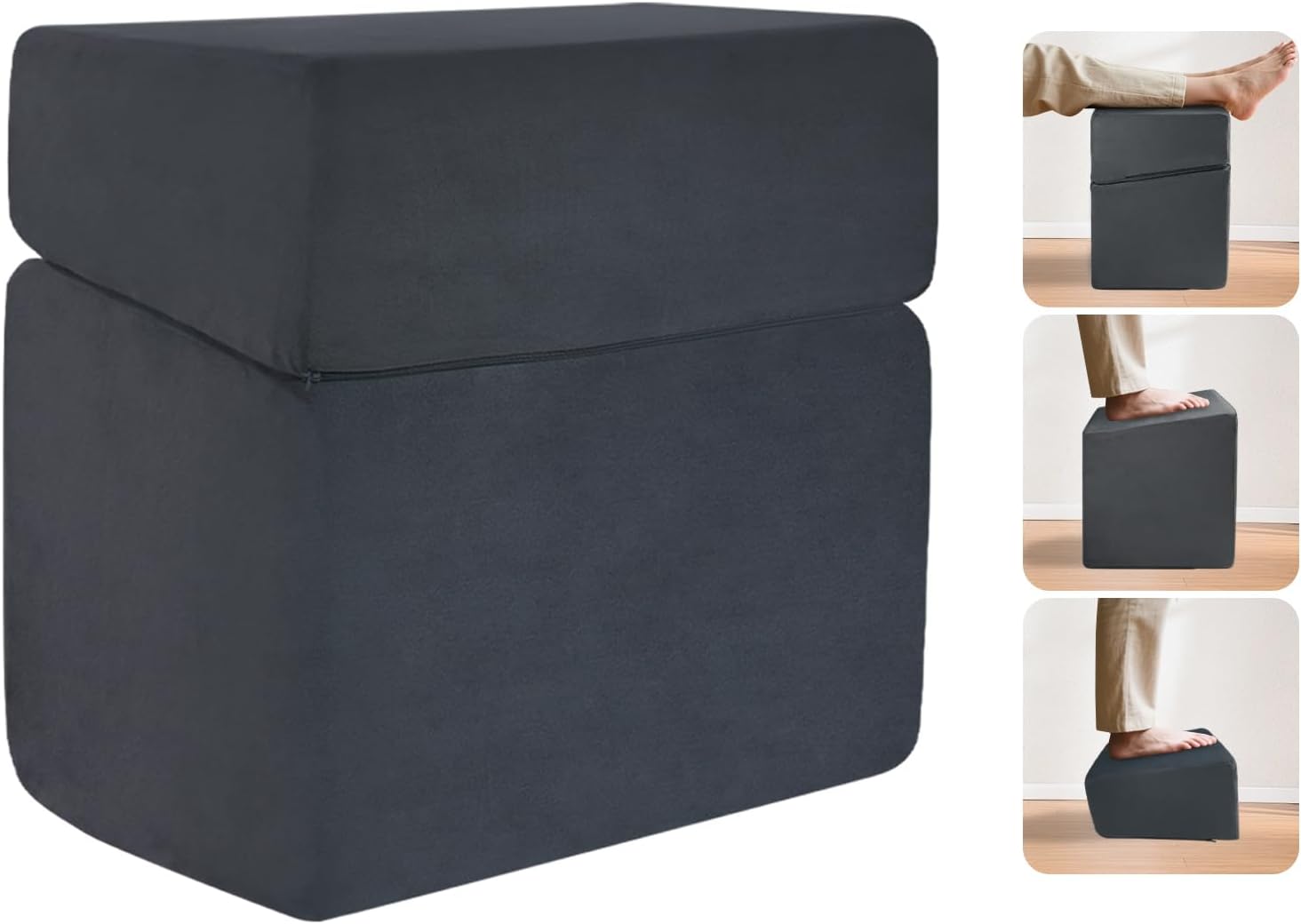
Adjustable Foot Rest for Under Desk At Work – 3-in-1 Ergonomic Foot Stool with Zipper Connection, 6.3"/11.8"/16" Height Adjustable for Office, Home & Gaming (Black)
This is the product the article is actually about. It is a flat platform with three stated heights, 6.3 inches, 11.8 inches, and 16 inches, and a zipper connection that is how it moves between them. For most short-legged desk users the number that matters is the lowest one, because 6.3 inches sits under a standard desk and still lifts your feet off the floor without driving your knees toward the underside of the desktop.
Here is the arithmetic I run in a client's office. If your seat height is 16 inches and the crease behind your knee sits at 13 inches, you need about 3 inches of lift. That lands inside the range this stool covers, and it is why it is my first recommendation for anyone under roughly 5'4".
Check current Amazon price before you order, because the three-in-one build is the reason to pick this over a fixed block of foam.
Flaws but not dealbreakers: It is a flat platform, not a rocker. If you want a footrest angle that changes as you shift in the chair, this is not that product and you should look at a tilting model instead. On a hard floor, anything under the desk can slide, so tuck it against the desk's crossbar or a leg so it stays where you set it.
Who should skip it: anyone whose seat height is already under 15 inches, because you have no gap to fill. Lower the chair instead.
Runner-up: Alolo Drafting Office Chair with Foot Rest,Ergonomic Chair with Footrest for Standing Desk,Adjustable Mesh Lumbar Support Chairs with Flip-up Armrest and Heavy Duty Rolling(Black)
Runner-up
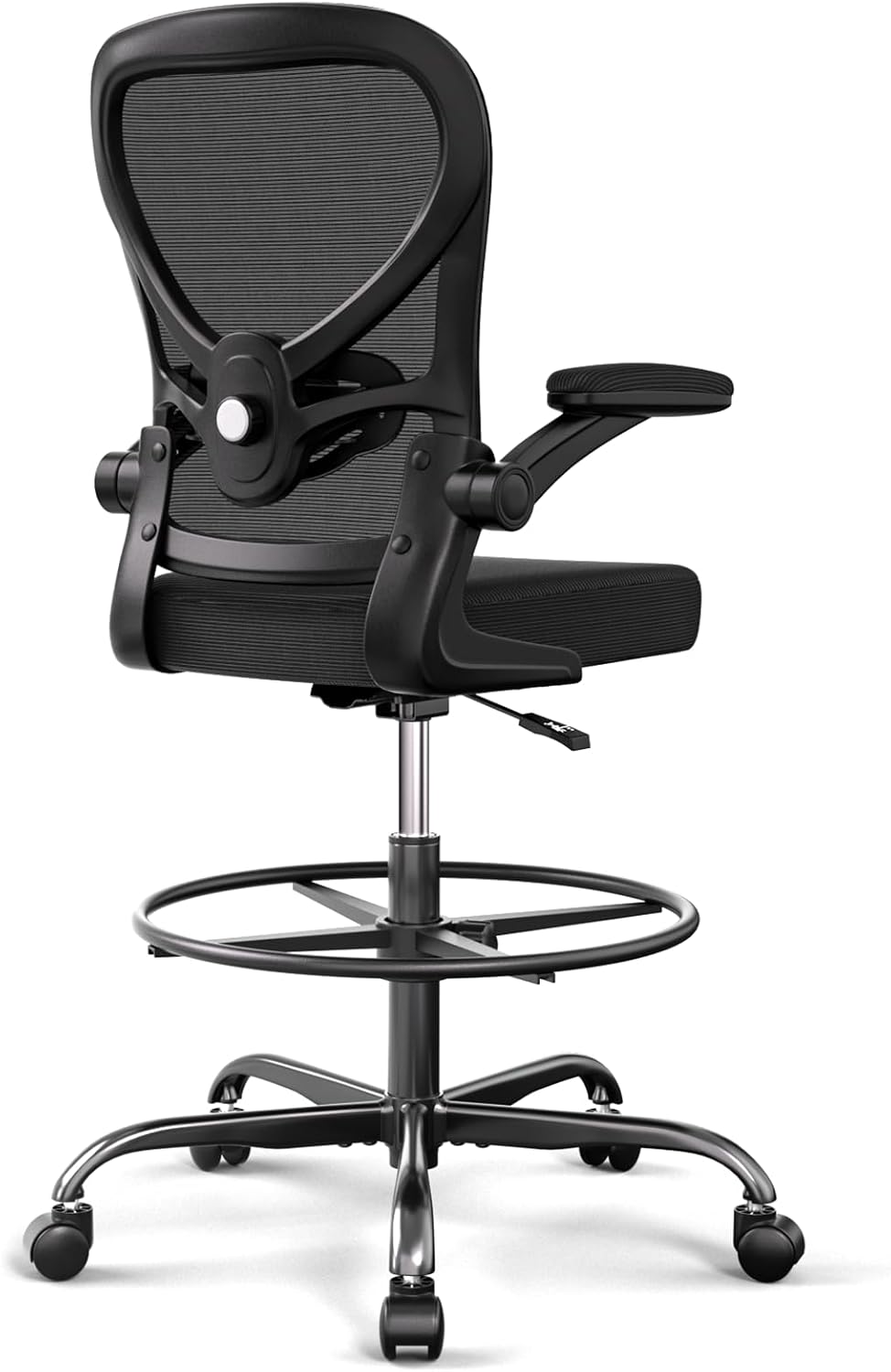
Alolo Drafting Office Chair with Foot Rest,Ergonomic Chair with Footrest for Standing Desk,Adjustable Mesh Lumbar Support Chairs with Flip-up Armrest and Heavy Duty Rolling(Black)
If your current chair cannot go low enough, a footrest is a patch on a bigger problem, and this is the cheaper of the two chairs that solve it properly. It is a drafting chair with an integrated footrest, adjustable mesh lumbar support, flip-up armrests, and a rolling base. The footrest is part of the chair, which means the ring moves with the seat instead of sitting on the floor where your feet have to find it every time you sit down.
Drafting chairs are taller than task chairs by design, which sounds backwards for a short user, and that is exactly why I only recommend this one to a specific person: someone pairing it with a standing desk or a tall bench, where the work surface is already higher than 29 inches. If you sit at a standard 29-inch desk, skip this and buy the stool above.
The flip-up armrests matter more than they sound. They let you push the chair all the way under a desk with drawers, which is the difference between a setup you use and one you fight.
Check current Amazon price, and confirm the seat height range fits your body before you buy.
Flaws but not dealbreakers: Adjustable mesh lumbar support is not the same as a firm lumbar pad that locks in place. If you need fixed, hard support, keep shopping.
Who should skip it: anyone at a standard-height desk. This is a standing desk chair.
Upgrade pick: Drafting Chair, Tall Office Chair with Flip-up Armrests Executive Ergonomic Computer Standing Desk Chair, Office Drafting Chair with Lumbar Support and Adjustable Footrest Ring
Upgrade pick
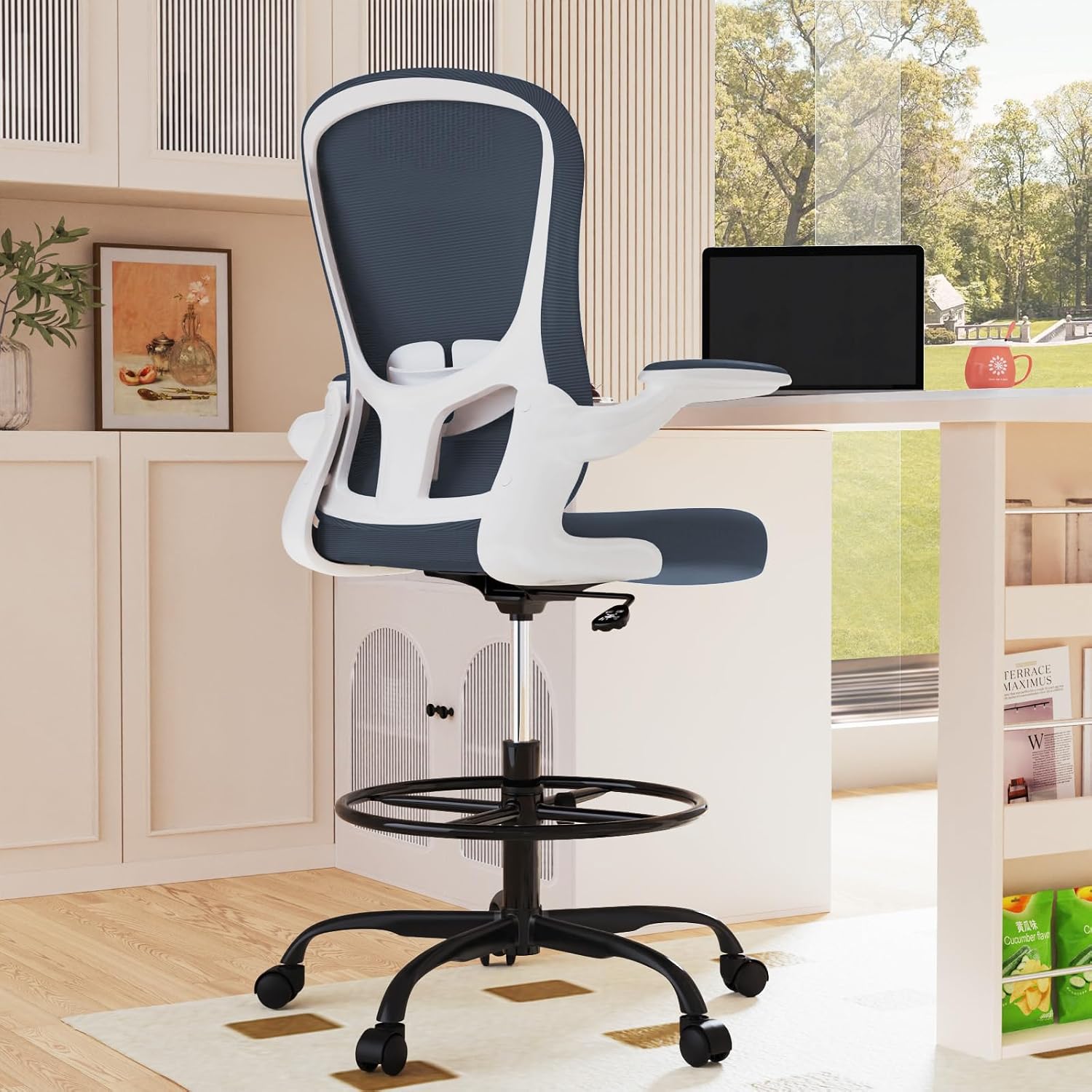
Drafting Chair, Tall Office Chair with Flip-up Armrests Executive Ergonomic Computer Standing Desk Chair, Office Drafting Chair with Lumbar Support and Adjustable Footrest Ring
The last one is the same idea with a better ring. This is a tall drafting chair with flip-up armrests, lumbar support, and an adjustable footrest ring, and the word to notice is adjustable. On cheaper drafting chairs the ring is welded in one spot, which means it fits exactly one leg length. Here you move the ring to meet your feet instead of moving your feet to meet the ring.
That adjustability is what makes it worth the step up for a short user on a tall desk. Set the seat so your knees sit at about 90 degrees, then raise or drop the ring until your thighs are level and your lower back stops rounding. If you cannot get there, the chair is wrong for you and no amount of adjustment will fix it.
Check current Amazon price and compare it against the Alolo before you decide, because the two are close and the difference lives in the ring and the base.
Flaws but not dealbreakers: A drafting chair with a foot ring still needs floor space under the ring. If you also want a mat, budget for mat thickness in your seat height before you set anything.
Who should skip it: anyone under 5'2" who sits at a standard desk. The seat will not go low enough and neither will the ring.
The actual footrest workflow
Now the part you came for. This is the order I work in when a client asks how to choose a footrest for short legs, and it takes about fifteen minutes with a tape measure.
Step one: Measure your seat height. Sit in the chair with your back against the backrest and both feet flat on the floor if they reach. Measure from the floor to the top of the seat cushion at the front edge. Write it down. If your feet do not reach the floor, measure anyway, because that number starts the arithmetic.
Step two: Measure the crease behind your knee. Sit with one foot flat and that knee at 90 degrees, then measure from the floor to the crease at the back of the knee. This is the height your seat should be, and it is the number almost nobody measures. It decides everything that follows.
Step three: Subtract. Seat height minus knee crease height equals the lift you need. Under 2 inches, lower the chair instead of buying anything. Between 2 and 4 inches, a footrest is the right fix. Over 5 inches, the chair is the problem, not the floor.
Step four: Set the footrest angle first. Start flat. A flat platform is the neutral position and where most people should stay. If your lower back rounds after twenty minutes, tilt the platform slightly toward you and check again. Change one variable at a time or you will never know what fixed it.
Step five: Account for the floor. On carpet your chair sinks and your real seat height drops. Measure mat thickness where the casters sit, and remember mat density matters more than thickness: a soft mat compresses under a loaded chair and takes your footrest height down with it. On a hard floor, skip this step.
Step six: Clear the under-desk space. Before anything goes under the desk, deal with the cables. A cable sleeve, a run of adhesive clip, or a screw-in raceway along the back rail keeps cords out of the zone where your feet and the footrest now live. Cable management is not aesthetics here. A cable that pulls on a monitor arm changes the monitor angle within a week.
Step seven: Install low, then raise. Put the footrest at its lowest setting, sit down, and check that your thighs are level. Raise it one setting at a time. Do not start at the top and work down, because you will overshoot and your knees will hit the desktop. Once it feels level, leave it alone for a week.
Step eight: Re-check the desk above it. Raising your feet changes your hip angle, which changes where your eyes sit, which changes your monitor height. Set the monitor so the top of the screen is at eye level, and if you are leaning in to read, fix the light before you move the screen: desk lamp lumens that are too low pull your head forward and undo the posture you just bought. Then set the chair height once more and stop.
The competition and why it lost
Not everything that claims to fix dangling feet actually fixes dangling feet.
Rocking footrests are the most common alternative. A rocker is fine if you want motion under the desk, but motion is not the problem you have. The problem is height, and a rocker that only moves through a few degrees does not add any. Buy one after you have solved the height, not instead of solving it.
Foot hammocks hang from the desk on straps and swing. They set the angle for you, they take almost no weight, and they put a strap across the front of your desk where your knees want to be. Skip them for a work setup.
Anti-fatigue mats are for standing, not sitting. Under a seated desk a mat does nothing except raise your chair, and it changes your mat thickness math in the wrong direction.
Balance boards and under-desk bikes solve a fidget problem, not a reach problem. They also raise your knees, which is the opposite of what a short-legged user needs.
Keyboard trays fix a different failure. If your desk is too high for your shoulders, no footrest will save you, because the two problems live at different heights. Fix the surface height or add a tray, then come back to the floor.
And the four-figure ergonomic chair loses here for a plain reason: if your current chair already goes low enough and the gap is only three inches, you are paying a chair price for a footrest problem.
What this all costs
The honest answer is that the cost here is not the footrest. It is deciding which of three problems you actually have.
Problem one: your chair is right and the floor is too far away. That is the stool above, the cheapest item in this article by a wide margin. Check current Amazon price; it is still the cheapest fix on this list.
Problem two: your chair cannot go low enough even with a footrest under it. That is a chair replacement, and the two drafting chairs above are the options I would put in a client's office for a year. They cost more than the stool, and they are worth it only if you are also running a desk taller than 29 inches. Check current Amazon price on both before you pick one.
Problem three: your desk is too high for your shoulders. That is not a footrest problem, and no amount of money spent below the desk will fix it.
Add the small stuff: a mat if you are on carpet, a cable sleeve or raceway if your cords hang where your feet go, and a tape measure. The tape measure is the one that saves you money, because it tells you which of the three problems you have before you buy anything at all.
That is the job. Measure your seat, measure your knee, subtract, and buy the smallest thing that closes the gap.