I have measured footrests the same way for eleven years: floor to the underside of the knee while seated, floor to the top of the platform, and a note on how many directions the thing moves. The adjustable vs fixed footrest question is not a taste question. It is a geometry question, and for a specific group of people it has one wrong answer that no amount of cushioning will fix.
Related: Desk Height and Chair Height: How to Match Them
The short version: if your desk height is locked, buy an adjustable footrest, because a fixed platform pins your legs to one angle while your chair is the part that moves. If your desk goes up and down, a footrest that travels with the chair, either an adjustable ring on a drafting chair or a pull-out on a gaming chair, is the cleaner answer, because you never have to move a second object when you change posture.
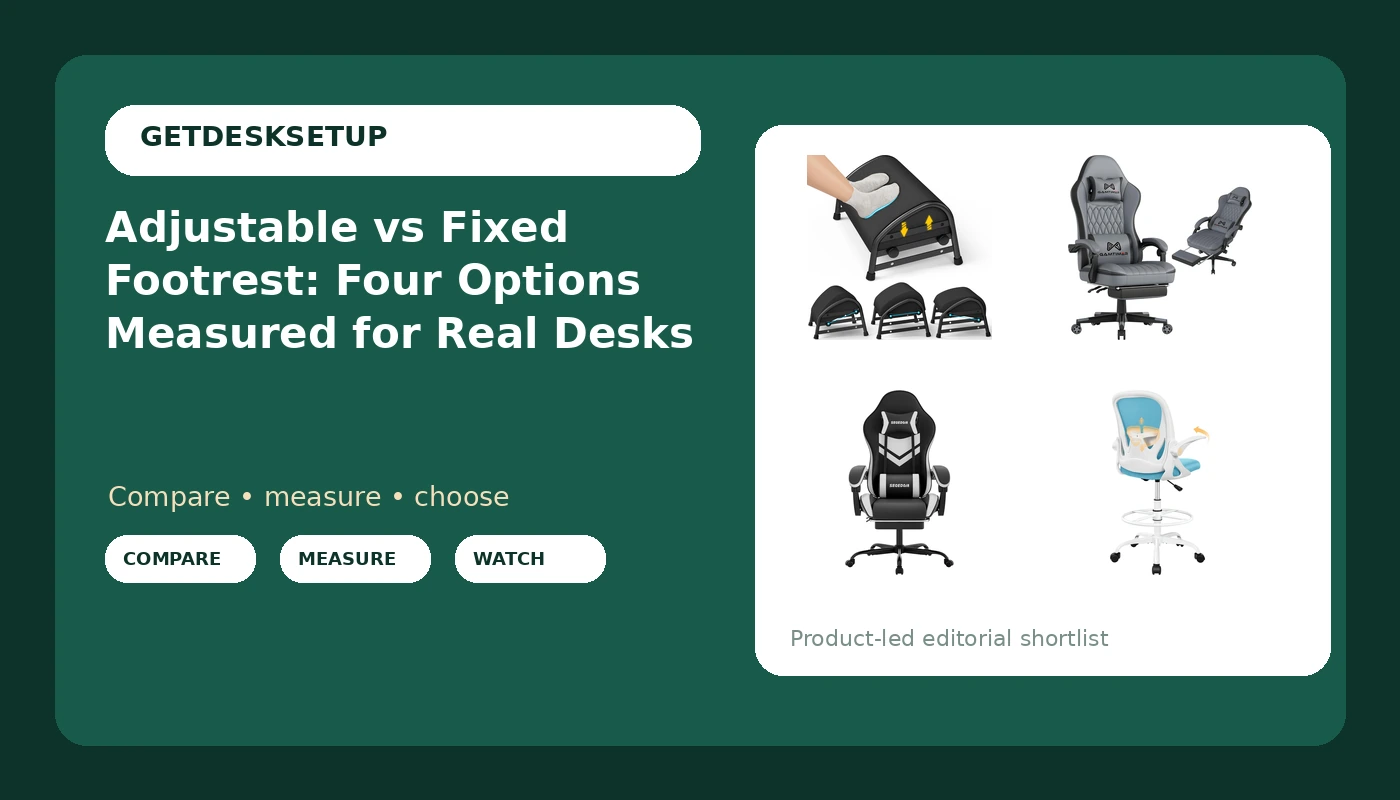
That leaves four products worth comparing: one dedicated under-desk adjustable footrest and three chairs that solve the same problem in different ways. Two are gaming chairs with built-in footrests, one is a tall drafting chair with an adjustable footrest ring. I would not put all four in a client's office, and I will say which ones I would.
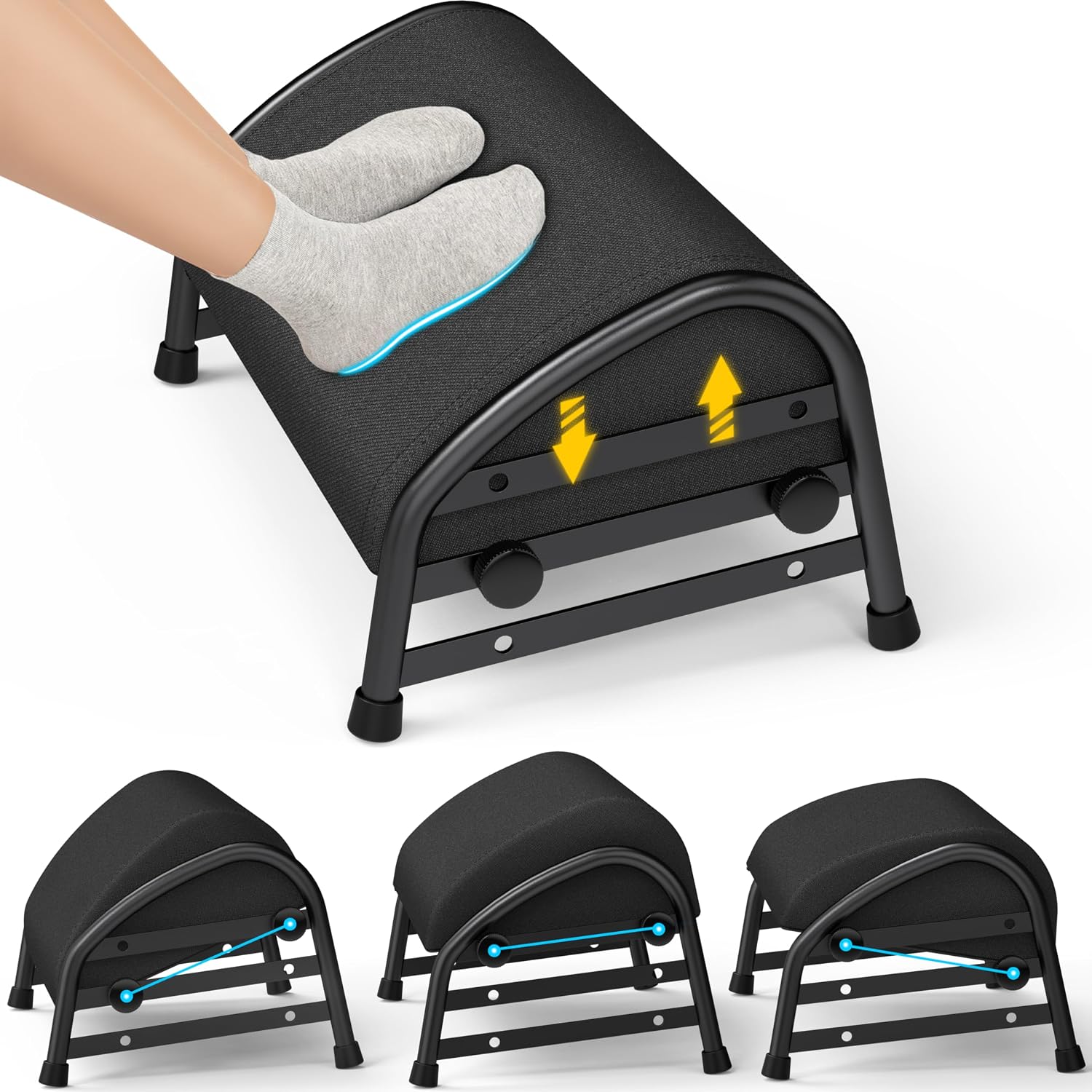
YEASHEIN Adjustable Foot Rest for Under Desk at Work
The footrest is the whole product, so it is the least complicated way to find out whether your feet belong off the floor. It moves independently of your chair, which is exactly what a fixed-height desk needs.
It is a second object on the floor. On deep pile carpet a flat platform rocks, and at standing height it becomes something to trip over.
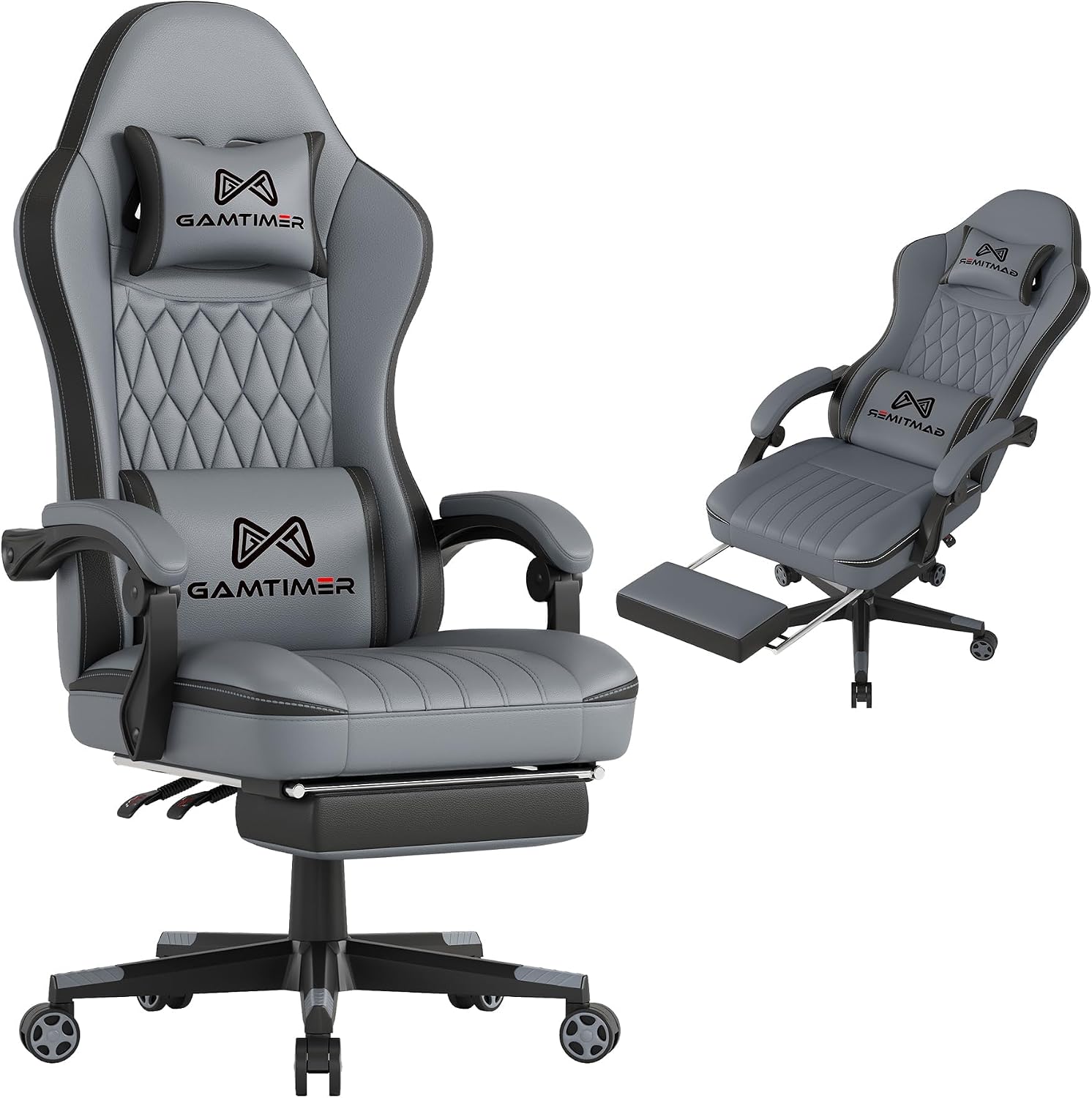
Gamtimer Gaming Chair with Footrest, Grey
Headrest, lumbar support and a footrest arrive in a single purchase, so the footrest never becomes a separate decision or a separate box on the floor.
A chair-mounted footrest is a one-position pull-out built around reclining, not around a supported leg angle while you type.
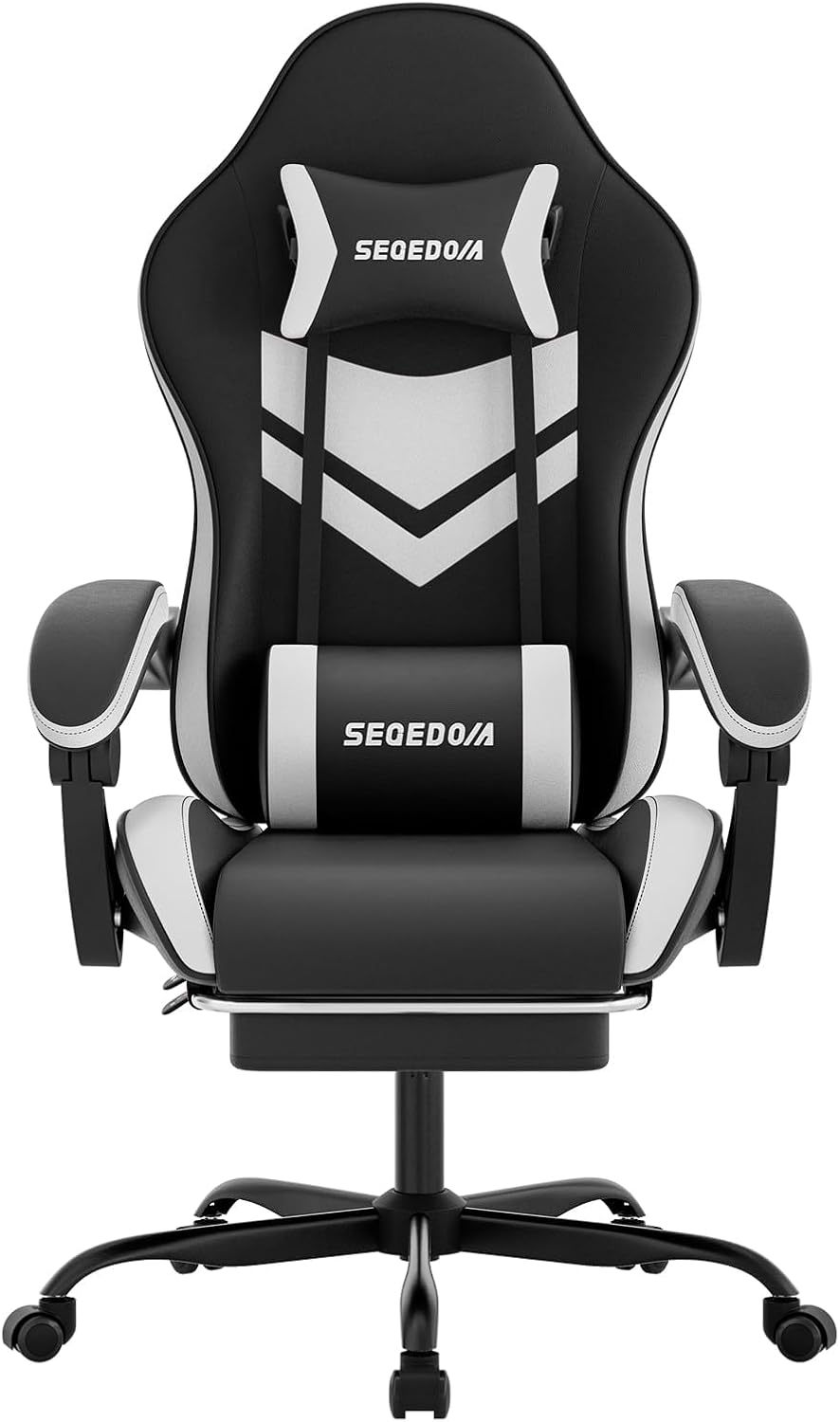
Gaming Chair with Footrest and Massage Lumbar Support, Black White
It states a 300 lb capacity and includes massage lumbar support, so a heavier user gets a number instead of a vague claim about durability.
Same fixed, one-position footrest as any chair-mounted design, and no way to change the footrest angle.
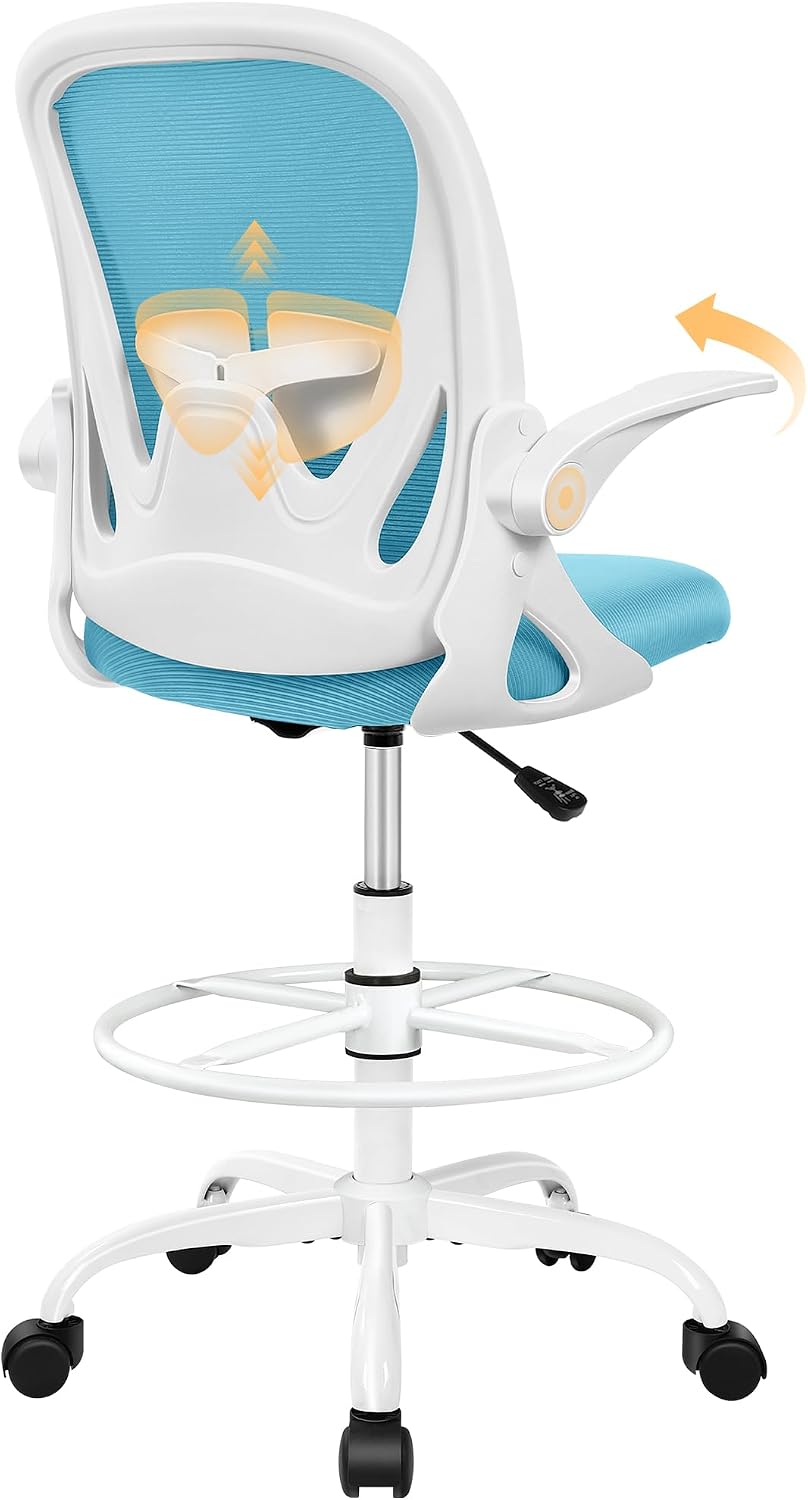
Primy Drafting Chair with Flip-up Armrests, Blue
The adjustable footrest ring clamps to the cylinder and travels with the seat, the only design here that works at both sitting and standing desk heights. Flip-up armrests let it tuck away.
Drafting chairs are built around tall seated positions. If you are short, the ring can sit below your feet, and no adjustment fixes that.
Prices and availability may change.
What adjustable vs fixed footrest means on a real desk
Two words get used loosely, so here is the difference in plain terms. A fixed footrest is a platform whose height and angle are set by the factory, so the only variable left is where your feet land on it. A pull-out footrest on a gaming chair is the classic fixed design: it slides out, it locks, and it holds one position relative to the seat. An adjustable footrest lets you change height, angle, or both, usually with detents or a friction joint, and the adjustable footrest ring on a drafting chair qualifies because it clamps around the gas cylinder and slides up and down.
The distinction matters because what you are actually adjusting for is not comfort. It is the angle of your knee and the height of your feet relative to the seat pan. In my notebook the three numbers are floor to the underside of the knee while seated, floor to the top of the platform, and the gap between them. If that gap is fixed at two inches and you need four, you will spend the afternoon sliding forward in the chair, and the footrest gets blamed for a chair problem.
Fixed footrests are not bad products. They are correct when the desk and the chair are both locked and the geometry already works. They become wrong the moment either number changes, which is why I do not recommend a fixed footrest to anyone who owns a standing desk, or to anyone sharing a chair with a person a foot taller.
The four options in this comparison
YEASHEIN Adjustable Foot Rest for Under Desk at Work
This is the product the keyword is really about. It is a standalone platform that lives on the floor under a fixed desk, and because it is adjustable you can chase the footrest angle and height that matches your knee measurement instead of accepting whatever the factory picked. It does not care which chair you own, which is the entire appeal: a fixed-height desk with a chair that already fits is the situation where a floor platform earns its place.
Who should skip it: anyone with a standing desk who raises and lowers through the day. A floor platform is a second object to move, and at standing height it is an obstacle under the desk rather than an aid. Also think twice if your floor is deep pile carpet, because any flat platform on soft pile is a compromise and you will feel the rocking in your ankles before the week is out.
Gamtimer Gaming Chair with Footrest, Grey
Here the footrest is part of the chair, which is the second way to solve the problem. Headrest, lumbar support and a footrest arrive as one purchase in a PU material. If you were buying a gaming chair anyway, the footrest is not an extra decision and not an extra object on the floor.
Where it fails the measurement test is the mechanism. A chair-mounted footrest is normally a pull-out that gives you one position, and it is designed around a reclined posture rather than around typing upright. If your goal is a supported leg angle while you work, a fixed pull-out is the wrong tool. If your goal is putting your feet up between calls, it is exactly the right one.
Skip it if you need an adjustable footrest angle. Do not buy this chair expecting the footrest to behave like an under-desk platform, because it will not.
Gaming Chair with Footrest and Massage Lumbar Support, Black White
Same idea, different trade. This one states a 300 lb capacity and adds massage lumbar support. The stated capacity is the useful part: it is a number, and numbers are how I decide whether a chair belongs in a client's office for a year. The footrest is chair-mounted again, so it holds one position.
Skip it if you want adjustable. Also check the listed seat height range against your own measurements before you buy, because a high-back chair that only suits one desk height is a chair you will fight every afternoon.
Primy Drafting Chair with Flip-up Armrests, Blue
This is the third approach and the one I recommend most often to standing desk owners. A tall drafting chair with an adjustable footrest ring, flip-up armrests and lumbar support. The ring clamps to the cylinder, so the footrest travels with the seat and adjusts in height with it, and the flip-up armrests mean the chair tucks away when you stand.
The catch is height, and it is a real one. Drafting chairs are built around tall seated positions, so a shorter user can end up with the ring sitting below their feet rather than under them. No amount of adjustment fixes a chair that is too tall for you. Measure your seated knee height first, compare it to the listed seat height range, and if the two do not overlap, skip it.
Fixed footrest vs adjustable: the measurement that decides it
Do this in order and you will not need to guess.
First, sit in your chair at your desk with your shoes on, and measure floor to the underside of your knee. Write it down. That number is your target platform height, plus or minus an inch depending on how much heel lift you like.
Second, measure your desk height and decide whether it ever changes. A fixed desk plus one user is the only situation where a fixed footrest can be the right call. A standing desk, or a desk two people share, means the answer is adjustable, every time.
Third, check what the product actually adjusts. Height and angle are two different adjustments, and plenty of listings only do one. A footrest that raises but does not tilt cannot fix a knee angle, and a footrest that tilts but does not raise cannot fix a dangling foot.
Fourth, decide where the object lives. A chair-mounted footrest never has to be moved, which is worth more than extra range for most people. A floor platform has to be pushed aside to stand, and if you stand up eight times a day, that is eight small annoyances you are signing up for.
The difference between adjustable and fixed footrest in daily use
In daily use, a fixed footrest teaches you one position and you stop noticing it, which is either the point or the problem depending on your body. An adjustable footrest gets moved, usually twice a day: once in the morning when you are fresh and sitting upright, once in the afternoon when you want a different leg angle. That movement is the feature.
There is a catch worth naming. Adjustable does not automatically mean better. A wobbly adjustable platform is worse than a solid fixed one, because every time you press down you get a little give that your ankles correct for without telling you. When I test an adjustable footrest, I check it at the top of its range, not the bottom, because the top is where the mechanism is least supported. Same principle as testing a standing desk at standing height rather than at sitting height.
Also count the moving parts. A fixed pull-out has a slide and a lock. An adjustable platform has detents, a hinge, or a threaded joint. Fewer parts means fewer things to loosen, and a footrest that starts creaking in month three is a footrest you stop using in month four.
Adjustable or fixed footrest: my call by desk type
Fixed desk, one user, chair already fits: the under-desk adjustable platform. It is the least complicated correct answer and it does not require replacing a chair that works.
Fixed desk, gaming chair, reclining between sessions: either chair-mounted footrest is fine. You are not trying to hold a leg angle while typing, so a fixed pull-out does the job.
Standing desk with frequent transitions: the drafting chair with the adjustable footrest ring. The footrest travels with the seat, and you never touch a second object.
Shared desk with two very different users: adjustable, whichever style you prefer, because two people need two positions and a fixed platform can only serve one of them.
The desk around the footrest: mats, cables, and light
The footrest is never the only variable under a desk, and three of the surrounding ones change the answer.
Floor surface first. If you roll a chair on a mat, mat thickness and mat density matter more than most people expect. A thick mat raises the floor, which effectively lowers your footrest, and a low-density mat lets a platform dig in and rock. Measure the mat before you measure the platform, because the mat is part of the floor as far as your feet are concerned.
Cables second. A footrest that slides will drag a cable with it, and a pulled cable changes the angle of whatever it is attached to within a week. Route the runs into a raceway under the desktop, wrap the loose bundle in a cable sleeve down the leg, and use an adhesive clip for the final short run to the power strip. Cable management is not aesthetics here, it is what keeps your footrest from quietly tugging your monitor arm out of alignment.
Light third, and this is the one people skip. If you work after dark, the area under the desk is the darkest part of the room. A desk lamp with enough lumens on the work surface keeps you from leaning forward into the shadow, and leaning forward is the posture the footrest was supposed to fix in the first place. Fix the light and you will use the footrest the way you intended.
Who should skip each one
Skip the under-desk platform if you stand up often or your floor is deep pile carpet. Skip the Gamtimer chair if you want an adjustable footrest angle rather than a recliner aid. Skip the Black White gaming chair for the same reason, and check the seat height range first if you are tall. Skip the drafting chair if your seated knee height falls below its listed seat range, because the ring will dangle under your feet and you will blame the chair for a sizing mistake.
The final call
The adjustable vs fixed footrest decision comes down to one question: does anything about your desk or chair change during the day? If nothing changes and the geometry already works, a fixed footrest is cheaper, simpler and has fewer parts to loosen. If anything changes, and for most home offices something does, adjustable is the only answer that survives contact with a real workweek. Measure your knee height, decide whether your desk moves, then pick the product that matches the number. That is the whole test, and it has never once failed me in a client's office.