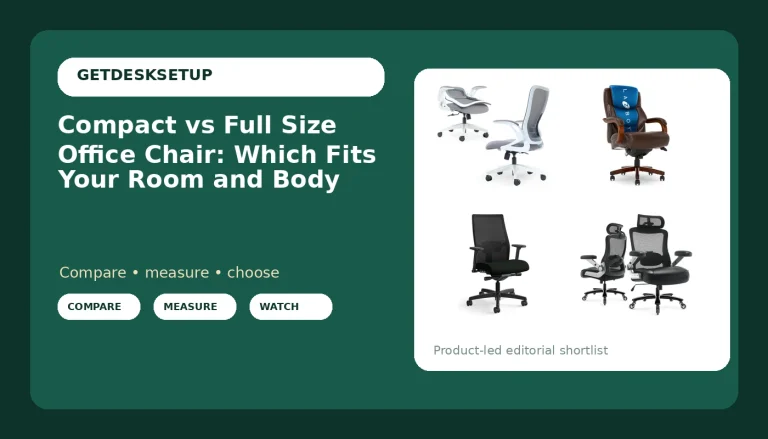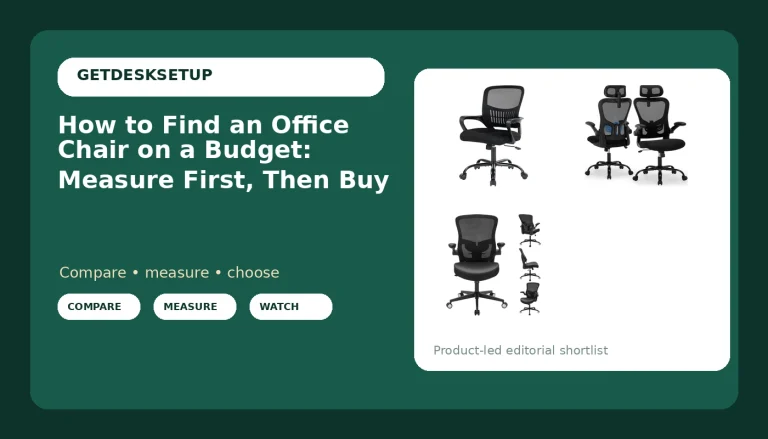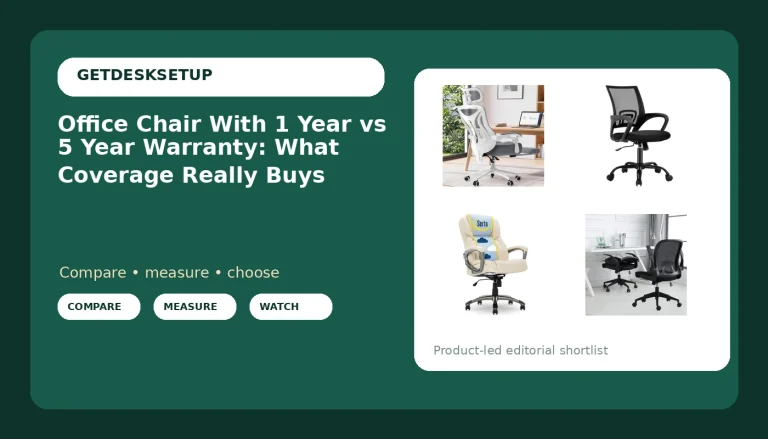
Carpet is the quiet killer of office chairs. The pile compresses under the base, the casters dig in, and within a month you have four divots, a chair that will not roll straight, and a floor you cannot un-crush. Learning to protect an office chair on carpet comes down to matching three things: your carpet's pile, your chair's base, and the load sitting on top of it.
I have built out 310 home offices in and around Seattle, and most of them were rentals with wall-to-wall carpet the tenant could not replace. The damage pattern never changes. The chair goes down first, the divots show up second, and the panic shows up third, usually the week before a move-out inspection. This guide is how to protect an office chair on carpet without ripping out flooring or buying a different chair. It covers the two chairs that do the most damage, the one piece of gear that makes the job visible, and an eight-step workflow you can run in an afternoon.
The order matters, and most people run it backwards. They buy a mat first, drop it under the chair, and never reset the seat height. Two weeks later their knees sit higher than their hips and they blame the chair. Get the sequence right and you can protect a desk chair on carpet with one hardware swap and one afternoon of adjustment.
Why you should trust me
I spent nine years as an office facilities manager, buying and assembling chairs and desks for 400-person floors, then six years running a two-person desk setup service that has built out 310 home offices. Carpet is the variable that eats the most service calls. Every chair I install gets its seat depth and its desk height range measured with a tape, not read off a spec sheet, because the two numbers that decide whether a chair works on your floor are the ones you take in your own room.
I keep a notebook of those numbers. I know which casters crack a thin mat, which bases spread load, and which chairs are simply too tall to sit on a thick pile without a hard surface underneath. The rules for how to protect an office chair on carpeted floors in a rental are stricter than in a house you own, because you are protecting the carpet itself, not just the pad under it. If a chair cannot work on your carpet, I will say so rather than sell you a mat that hides the problem for six months.
How I picked and how I tested
The three products below are not a best-office-chair list. They are the three things that show up in this specific job: a tall chair that behaves worst on carpet, a heavy chair whose casters point-load the pile, and a light you need at floor level to see what the carpet is actually doing. I worked from the listings and from the physical criteria that decide whether a chair and a carpet get along: base spread, caster wheel diameter, caster stem size, stated weight capacity, and how much of the chair's height range is left after a mat adds thickness.
I did not run a lab. I ran a tape measure and a notebook, and I checked the same four things on every chair that came through a client's door. First, does the base spread wide enough that five casters share the load instead of two? Second, how big is the wheel, because a small hard wheel plows through pile and a large soft one rolls over it? Third, what stem size does the socket take, because a caster upgrade you cannot install is money burned? Fourth, what happens to the chair at the top of its height range, since tall chairs are the ones that lean on carpet.
The honest caveat is that the only numbers that matter are the ones you take in your own room. Pile height, base spread, and stem diameter vary enough that a recommendation without those three measurements is a guess. If you have not sized a chair to your own body yet, start with how to measure an office chair for your body and come back to this page with your seat depth in hand.
Chairs that put the most stress on carpet
Two chair types cause almost all the carpet damage I see: chairs that sit high, and chairs that carry a lot of weight. The first tips, the second punches. Both can be protected, but they need different fixes.
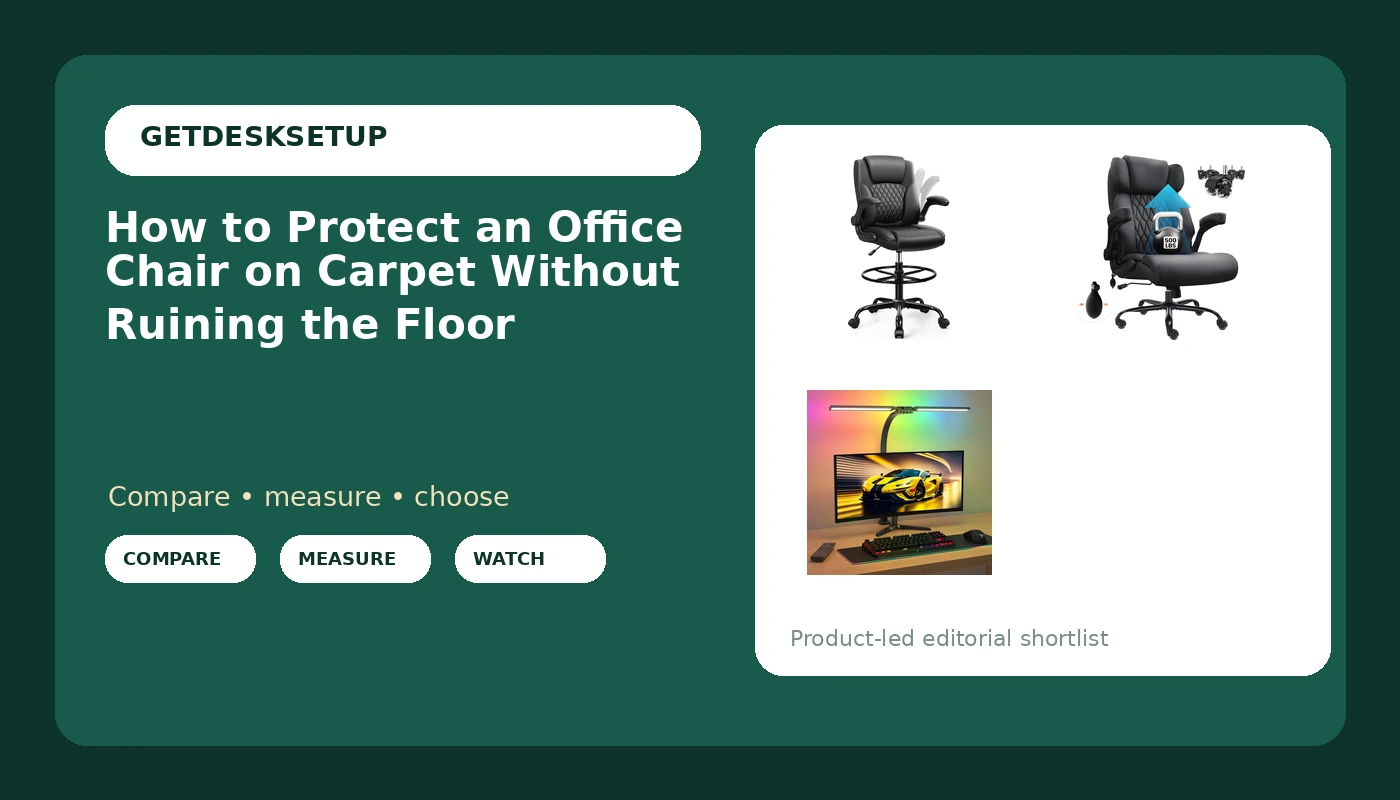
The highest-risk chair: Drafting Chair, Tall Office Chair for Standing Desk, High Executive Leather Ergonomic Computer Chair with Adjustable Height and Flip-Up Armrest for Counter Height Desk, Black, Pack of 1
The highest-risk chair
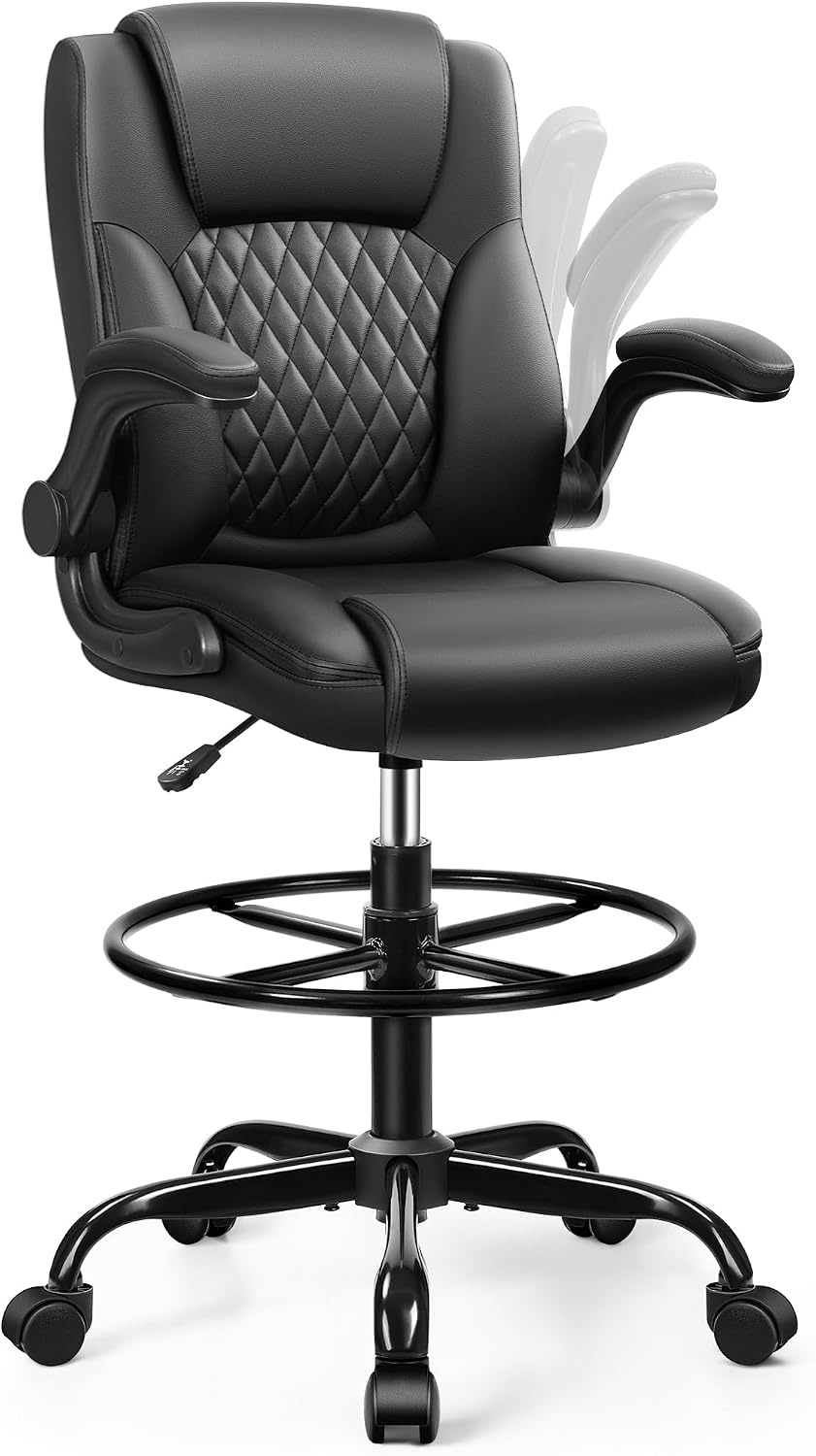
Drafting Chair, Tall Office Chair for Standing Desk, High Executive Leather Ergonomic Computer Chair with Adjustable Height and Flip-Up Armrest for Counter Height Desk, Black, Pack of 1
A drafting chair is the worst case on carpet, and it is not the chair's fault. It is the height. This one is built for a counter-height desk or a standing desk, so the seat sits well above a standard task chair, which raises the center of gravity and gives every lean more leverage through the base. On a soft pile the base sinks, the chair tilts, and the front casters crush a track you can see from across the room.
The flip-up armrest matters here for a reason that has nothing to do with your elbows. With the arms flipped up you can push the chair fully under a counter-height desk, which keeps the base off the walkway where the pile is thinnest and the damage is most visible. That single habit buys you months.
If you are going to spend money on this chair for carpet, spend it on the casters, not on a mat. Pull one caster out and measure the stem before you order anything, because the two common stem sizes are close enough that guessing gets you a set of wheels you cannot install. Then check the seat height range against your desk. Check current Amazon price.
The heaviest load: 500lbs Big and Tall Office Chair Adjustable Lumbar Support for Back Pain, Extra Wide Seat Executive Office Chair Thick Armrest Pad, Heavy Duty Base&Upgraded Wheels, Ergonomic Desk Chair
The heaviest load
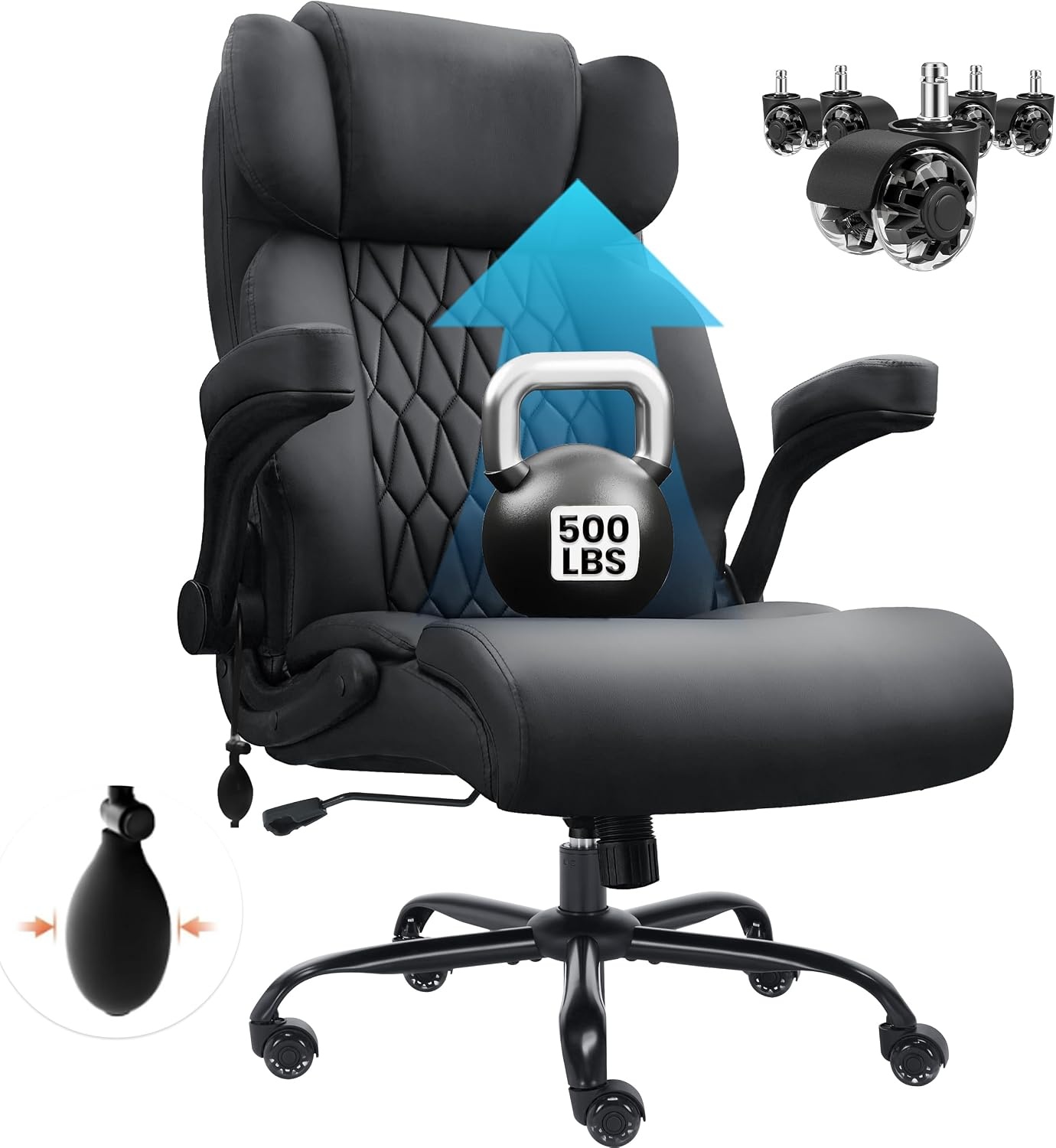
500lbs Big and Tall Office Chair Adjustable Lumbar Support for Back Pain, Extra Wide Seat Executive Office Chair Thick Armrest Pad, Heavy Duty Base&Upgraded Wheels, Ergonomic Desk Chair
Weight is the whole story with this one. A chair rated to 500 pounds pushes more load through each caster than a standard task chair pushes through two, and on carpet that turns every wheel into a punch. The heavy duty base and the upgraded wheels both help, because a wider base spread and a larger wheel diameter reduce the pressure at each contact point. That is the physics of it: same weight, more contact area, less crush.
The extra wide seat changes the math in a different way. A chair this size does not thread between furniture, so it tends to live in one spot, and one spot is exactly how you get four permanent divots instead of a worn path. If this is your chair, plan on a rigid surface under it rather than a thin mat, and plan on shifting the whole thing a few inches every couple of weeks so the pile has a chance to recover.
The adjustable lumbar support and the thick armrest pad become more important once you add that surface, because raising the chair raises your whole posture. Set the lumbar to fill the curve of your lower back at the new seat height, not at the old one. Check current Amazon price.
The gear that helps you protect an office chair on carpet
One more thing belongs in this guide, and it is not a mat. Carpet damage happens at floor level, in shadow, where you never look until the divots are permanent.
The work light: SIBRILLE Upgraded LED Desk Lamp for Home Office with RGB, Rotatable Computer Desk Light with Remote, Tall Table Lamp with Clamp for Working, Dimmable Dual Head Task Lighting for Monitor PC, 22W
The work light
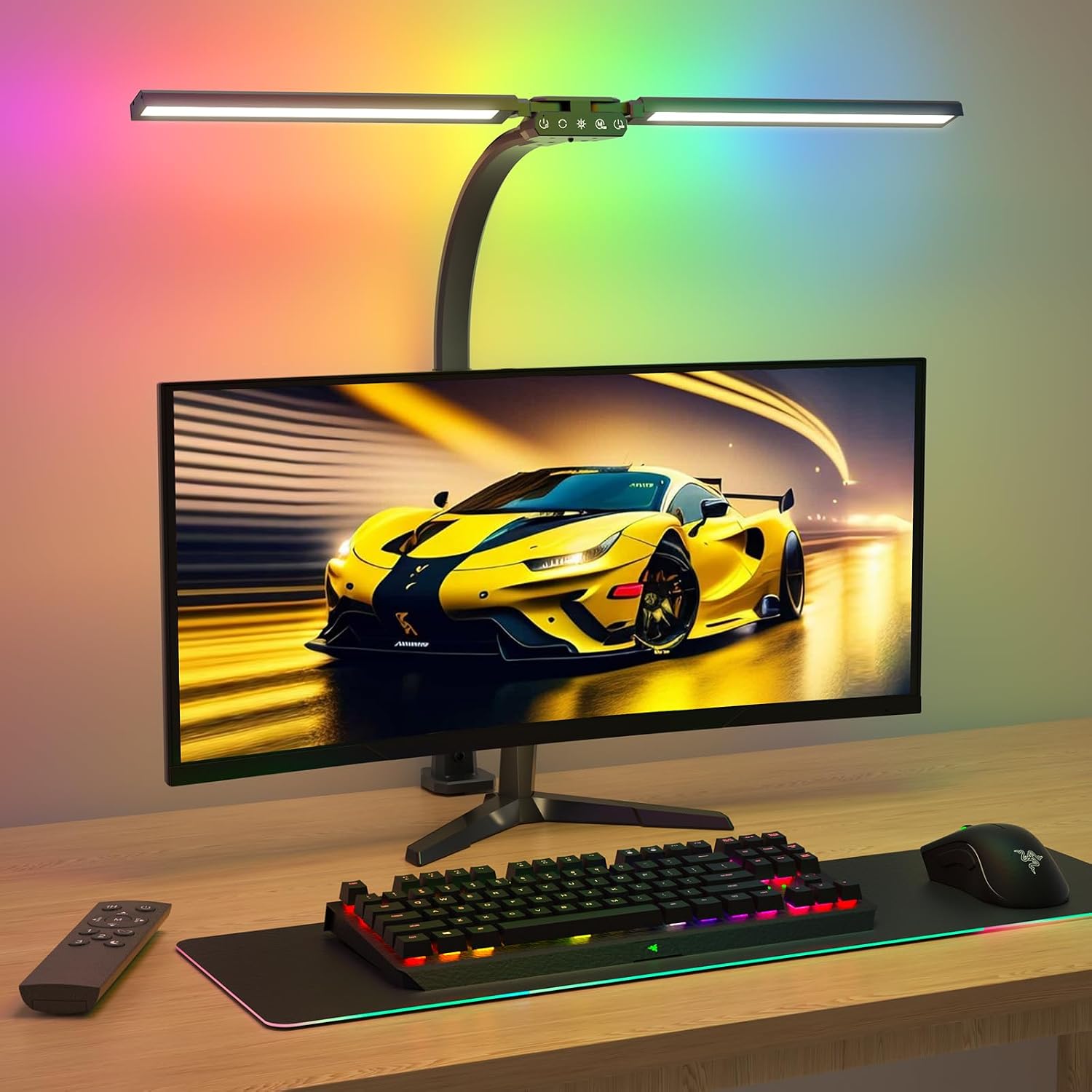
SIBRILLE Upgraded LED Desk Lamp for Home Office with RGB, Rotatable Computer Desk Light with Remote, Tall Table Lamp with Clamp for Working, Dimmable Dual Head Task Lighting for Monitor PC, 22W
You cannot fix what you cannot see, and the underside of a chair on carpet is a place light never reaches. This is a clamp lamp, so it takes no desk surface, and the dual head is the part that matters for this job. One panel aims at your monitor for normal work. The second rotates down and throws a low, raking light across the pile, which is the only way to see caster tracks, hair wrapped around an axle, or the first hairline crack in a mat before it becomes a broken mat.
The RGB lighting is a desk aesthetic feature you do not need for carpet work. The dimming and the remote are the useful parts, because you want a dim, angled beam that creates shadows rather than a bright overhead wash that flattens them out. If you are running the eight steps below, do step eight with this lamp pointed at the floor. Check current Amazon price.
The actual protection workflow
This works on any carpet and any chair with a five-star base. Run the steps in order. The cheapest way to protect an office chair on carpet is step four, and it is the step most people skip because they already bought a mat.
Step one: Measure the pile. Press a ruler straight down into the carpet next to the chair and read how deep the fibers go before you hit backing. Then sit in the chair for a minute and look at how far the base sinks. Low pile under a quarter inch behaves like a hard floor with grit on it. Thick plush over three quarters of an inch will swallow a caster whole. Write both numbers down, because everything after this depends on them.
Step two: Measure the chair's footprint. Measure from the center of the base out to the end of one caster arm, then double it. That is your base spread. Then measure the wheel diameter. A wide base shares load across five points. Small, hard wheels concentrate it. If the spread is narrow and the pile is thick, you need load spreading under this chair no matter what else you do.
Step three: Decide what you are actually protecting. In a rental, you are protecting the carpet from an inspection. In a house you own, you are protecting the pad and the subfloor from compaction and moisture. Those are different jobs with different budgets. Be honest about which one you are doing, because it changes whether a thin mat is enough or whether you need a rigid panel.
Step four: Swap the casters before you buy a mat. This is the highest-return change in the whole list. A larger, softer wheel rolls over pile instead of plowing through it, and a dual-wheel caster spreads load across two contact points instead of one. Pull one caster out of its socket and measure the stem diameter and stem length. The common diameters are close enough that you must measure rather than guess, and you also need to know whether the socket takes a grip-ring stem or a threaded one.
Step five: Add a hard surface if the pile is thick. This is where you have to protect an office chair on thick carpet rather than just manage it. Polycarbonate works on low and medium pile. Thick plush needs either a stiffer mat or a rigid panel under an area rug. Size it wider than the chair base at full recline, and anchor the lip under the desk so the chair is not constantly rolling off an edge.
Step six: Reset seat height and seat depth after the mat goes down. Any surface you add raises the chair, and a raised chair changes your posture. Set the seat height so your feet sit flat and your knees land level with your hips. Then set the seat depth so there is a two or three finger gap behind your knee. Then move the lumbar support up to meet your lower back at the new height. If you are on a standing desk, recheck the top of the range, because the height that worked before the mat is not the height that works after it.
Step seven: Set the armrest, recline, tilt tension, and headrest for the new floor. A chair on carpet rocks. A chair on a mat rolls freely. Set the armrest height so your shoulders drop when your forearms rest on them. Set the recline stop where your back still feels supported. Tighten the tilt tension until the chair does not drift backward on its own when you sit down. If the chair has a headrest, set it to touch the base of your skull, not the back of your head.
Step eight: Load test, rotate, and maintain. Two weeks in, pull the chair aside and look at the pile with a low light. Four distinct dents mean the load is still too concentrated, so add a rigid panel. Rotate the mat a quarter turn every few months so no single edge takes all the traffic. Vacuum the carpet with the chair moved off it. Cut hair and carpet fiber out of the casters, because a wrapped axle drags and drags dig. Then check the armrest and headrest fasteners, which loosen faster on a chair that rocks.
The competition and why it lost
The standard PVC chair mat is the first thing everyone buys and the first thing that fails on plush carpet. The spikes do not reach the backing, the edges curl up, and the chair rolls off the lip within a week. It is a low-pile product sold to thick-carpet buyers.
The polycarbonate mat is the right answer for low and medium pile. It is stiffer, it stays flat, and it does not yellow the way cheap vinyl does. It loses on thick plush, where the pile lifts the sheet off the backing and the whole thing slides.
The tempered glass mat is the best-looking option and it works fine on medium pile, but it is heavy, it is a poor match for a heavy chair on a floor that is not level, and it shows every scratch from tracked grit. If the point is protecting carpet, glass is paying for looks.
The rollerblade caster set is the best cheap fix and it is still not universal. Stem sizes vary, and on very thick plush even a big soft wheel will press a track into the pile.
The plywood-and-rug trick is what a lot of offices actually do, and it works, but the panel edges telegraph through the rug and the sheet walks over time unless you anchor it to something.
The carpet-to-hard-floor transition panel is a good answer for a chair-mat-sized area under a rolling chair. It is not a substitute for a proper base if the chair is heavy, and it is not a fix for a chair that is too tall for the pile.
What this all costs
The cheap version of this job is a caster swap plus an afternoon of adjustment, and it is the version I would run first on any carpet that is not plush. The middle version adds a mat, which is where most people start and where most people stop. The expensive version is a rigid panel under an area rug plus new casters, and that is the version that holds up under a big and tall chair rated to 500 pounds.
Cost is not the hard part. The order is. Buying a mat before you swap the casters means you pay to treat a symptom, and skipping the seat height reset means you pay and still end up uncomfortable, which is how people end up convinced that carpet is the problem when the setup is. Check current Amazon price on each of the three items above and you will see that the whole job is one afternoon and one or two purchases, not a flooring project.
That is the job, and it is the whole point of learning to protect an office chair on carpet. Carpet loses to concentrated load every single time. Spread the load, reset the chair, check the pile once a season, and the floor outlasts the chair.