Restless legs at a desk get blamed on coffee, on the chair, and on the time of day. The first thing I check is duller than that: whether your feet can reach the floor at all. Footrest and restless legs turn up in the same search because the two problems overlap in one measurable place, the gap between your chair seat and the ground.
I spent nine years as an office facilities manager buying chairs and desks for 400-person floors, then six years running a two-person desk setup service that has built out 310 home offices. My notebook is full of seat depths and desk height ranges measured with a tape, not copied off a spec sheet. That is why this page is organized around adjustment ranges and around who should skip each product, not around which one feels nicest in the first five minutes.
One boundary up front: this is an explainer, not a treatment plan. Restless legs syndrome is a medical condition, and no footrest cures it. What a footrest can do is remove one mechanical trigger that makes sitting still harder than it needs to be, and give your feet a surface to push against so your legs stop bracing against nothing.
Related: How to set desk and chair height to your own measurements →
Quick answer
A footrest helps when your chair is set high enough that your feet dangle, or when your feet reach the floor but your knees sit above your hips for hours. The goal is a surface that puts your knees level with or slightly below your hips, and lets you change position during the day. Restless legs syndrome itself is not something a footrest treats. If symptoms interrupt your sleep or your day, that belongs with a clinician, not in a shopping cart. None of the four options below can be called the best in any general sense. What separates them is adjustment range, surface, and whether you want a separate footrest or a chair that includes one.
Four options for footrest and restless legs
| Model | Best fit | What stands out |
|---|---|---|
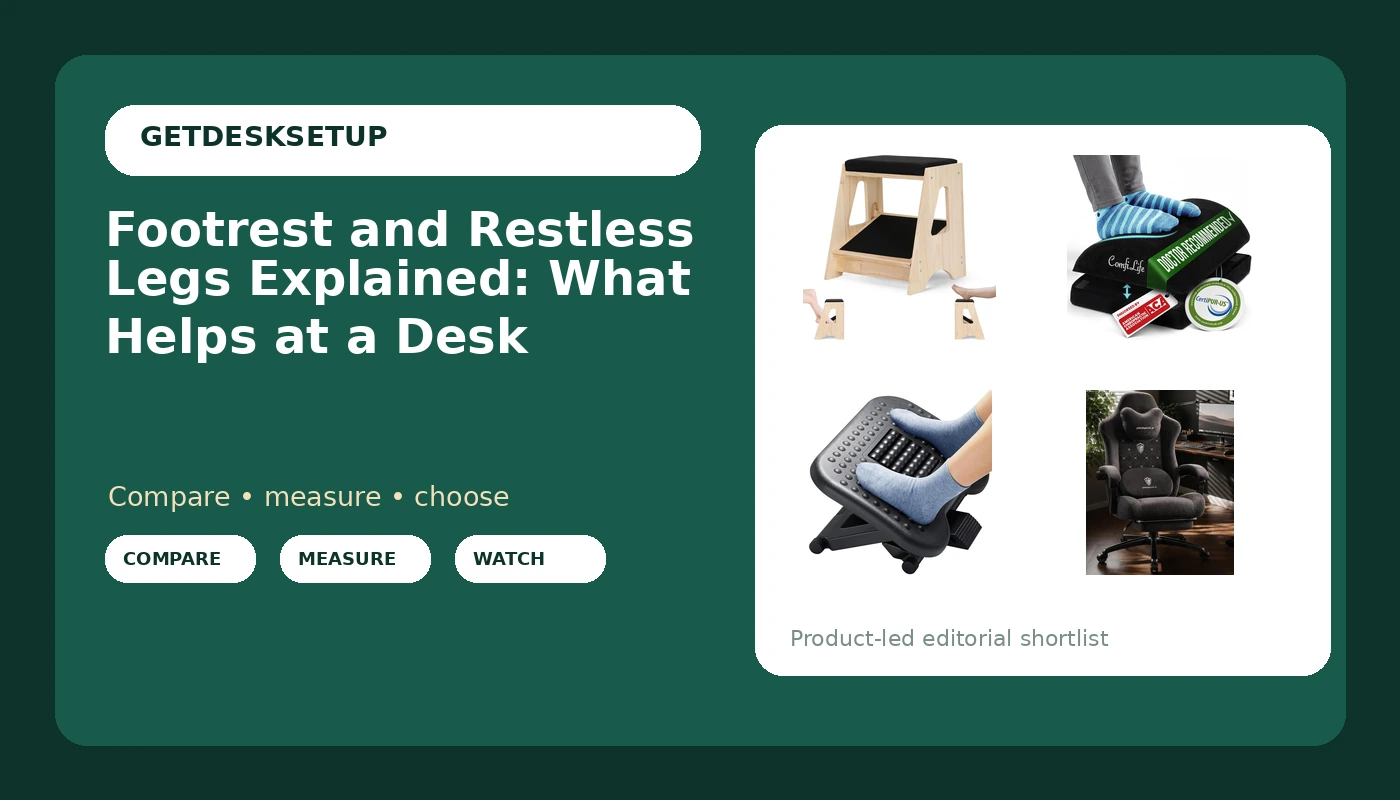
| Double Step Footrest Under Desk,4 Adjustable Heights with Adjustment Stem | Desks where one fixed height never lands right | Four adjustable heights set with a stem, plus a two-level step surface |
| ComfiLife Foot Rest for Under Desk at Work, Adjustable Height Memory Foam Foot Stool for Under Desk, Office Chair & Gaming Chair, Ergonomic Footrest for Back & Hip Pain Relief (Black) | Bare feet and socks on a soft surface | Memory foam top on an adjustable-height base |
| HUANUO Foot Rest for Under Desk at Work, Adjustable Footrest with Massage Texture and Roller, Ergonomic Foot Stool with 3 Height Position, 30 Degree Tilt Angle Adjustment for Home, Office | Desks where you want to change ankle angle through the day | Three height positions, a 30 degree tilt range, a massage texture and a roller |
| Dowinx Gaming Chair with Heated Massage Lumbar Support,Big and Tall Fabric Gaming Chairs for Adults with Footrest, Ergonomic Computer Game Chair with Poket Spring Cushions, 350lbs, Black | Buyers replacing chair and footrest together | A built-in footrest, heated massage lumbar support, pocket spring cushions, and a stated 350 lb capacity |
The four-height pick: Double Step Footrest Under Desk
Height range is the whole point here. A single-height footrest fits a narrow band of lower leg lengths, and most people find out after the fact that their chair has several useful heights while the footrest has one. Four positions mean the same unit can follow you down when you drop the desk after a standing call and back up when you raise it again.
The stepped surface is a second kind of adjustment. You can rest both feet on the upper level, both on the lower, or split them one on each. That matters more than it sounds if your legs want to move, because a footrest that supports one position invites the same static posture that made your legs loud in the first place.
Skip it if you work barefoot and want foam under your arches, or if you want one wide uninterrupted platform. This is a hard, two-level design, and that is the trade.
The memory foam pick: ComfiLife Foot Rest
Foam changes how you use a footrest, not just how it feels. On a hard platform your feet tend to stay put, because there is no payoff for moving them. On foam, small pressure shifts are pleasant, and small shifts are close to what fidgety legs are asking for.
The height adjusts, so the surface can sit where your knees want it rather than where the box decided. The listing places it under a desk, an office chair, or a gaming chair, and because it is a separate unit it can follow you to a new chair without a new desk.
Skip it if you want a tilt range or a textured massage surface, because there is neither here. Skip it as well if you push your feet into the platform to brace, since foam returns less energy than a rigid top does.
The tilt and texture pick: HUANUO Foot Rest
Three heights and a 30 degree tilt make this the most adjustable of the standalone footrests here. The tilt is the part worth understanding. Rocking your ankle through a range moves the calf through a longer arc than a flat platform allows, and if your legs get loud after two hours in one position, a surface that invites that motion does more than a surface that only holds your feet up.
The top carries a massage texture and a roller, which gives your feet something to do during a long call without standing up. Neither feature is a treatment for anything. They are ways to keep your feet moving on purpose instead of by accident.
Skip it if you want foam underfoot, since this is a textured hard surface. Skip it too if three discrete heights and a tilt is less range than your own desk height changes demand.
The all-in-one pick: Dowinx Gaming Chair with Footrest
This option only makes sense if you are replacing the chair anyway, and it changes the math when you are. Instead of hunting for a footrest that matches your chair height, the footrest arrives with the chair. You give up tuning the two independently, and you gain one purchase instead of two.
The listing describes heated massage lumbar support, pocket spring cushions, a built-in footrest, and a 350 lb capacity in a big and tall fabric build. The heated massage function is a comfort feature and I would treat it as one. It has nothing to do with restless legs.
Skip it if you already have a chair that fits you. Swapping a chair you have measured and dialed in, just to gain a footrest, is a bad trade. A stated 350 lb capacity tells you what the frame is rated for, not whether the seat depth matches your body. Measure the chair you own first, then decide.
Prices and availability may change. Product images, names, and retailer links are matched to verified listings. No current price, rating, stock status, or measured result is stated here without current evidence.
Why footrest and restless legs show up in the same search
Sitting is not a passive act. Your legs are always doing something, even when you are not aware of it, and what they do depends on the angles your joints are holding.
Start with the chair. When a seat is set higher than your lower leg length, your feet stop reaching the floor. The body does not leave them dangling. It recruits the front of the shin and the top of the thigh to hold the feet up, and it keeps recruiting them for the whole session. That low-level bracing is what people describe as legs that will not settle down by four in the afternoon.
Then there is the hip angle. If your feet are planted but your knees sit well above your hips, the same long-hold tension shows up behind the thigh and through the calf. A footrest fixes this by raising the floor to meet your feet, which drops your knees toward hip level and gives your legs a surface to rest on instead of a distance to cover.
What a footrest does not do is address restless legs syndrome itself, which has a neurological basis and is diagnosed by a clinician. Footrest angle can change how much your ankle moves through the day, and that movement can make long sitting easier for many people, but easier is not the same as treated. Keep those two claims apart and the rest of this page stays honest. That is the short version of footrest and restless legs explained: a measurement problem on one side, a clinical condition on the other. The phrasing varies, from foot rest and restless legs to the closed-up version, but the question underneath is the same one.
How to size a footrest in five steps
An under desk footrest and restless legs routine starts with two numbers I take in every client office, and neither one comes from a product page.
- Sit in your chair at the height you actually use, in the shoes you actually wear, and measure from the floor to the crease behind your knee.
- Measure the height of the chair seat from the floor at that same setting, and write both numbers down.
- Subtract your lower leg measurement from the seat height. That difference is how much lift a footrest needs to supply. If the difference is zero or negative, your chair is the problem, not your feet.
- Pick a footrest whose adjustment range covers that number with room on either side, because a standing desk changes the gap twice a day.
- Choose the surface last. A hard platform, a tilted platform, and a foam top all solve the height problem and differ in what they let your feet do once the height is right.
If the numbers in steps one and two surprise you, the chair is usually where the fix starts, and the same measurement logic runs through the rest of the setup.
One note on the floor under all this. If you add an anti-fatigue mat for standing hours, mat thickness and mat density change the effective floor height by half an inch or more, which can undo a footrest setting you just dialed in. Measure with the mat in place, not without it.
Practical setup notes for a desk footrest
A desk footrest and restless legs plan lives or dies on the under-desk zone, so deal with that zone before the footrest arrives.
- Clear the under-desk zone first. Cable management gets harder once there is a platform in the way, and a cable that ends up beneath a footrest gets flexed every time you shift.
- Run power and display cables along the back edge in a raceway rather than across the middle, then bundle the loose runs in a cable sleeve so nothing droops into the foot zone.
- Fix the last stretch with an adhesive clip on the underside of the desktop. It is the cheapest part of the job and the one that stops a cable from migrating onto the footrest.
- Treat footrest angle as a setting you revisit, not one you set once. A flat position for focused work and a tilted position for calls is a reasonable daily pattern.
- If you work after dark, compare desk lamp lumens ratings instead of brightness adjectives. Lighting is the other thing people blame at nine at night when they cannot settle.
Which option should you choose?
Choose the Double Step Footrest Under Desk,4 Adjustable Heights with Adjustment Stem when your desk moves between sitting and standing heights and the footrest has to keep up. Choose the ComfiLife Foot Rest for Under Desk at Work, Adjustable Height Memory Foam Foot Stool for Under Desk, Office Chair & Gaming Chair, Ergonomic Footrest for Back & Hip Pain Relief (Black) when you work in socks or bare feet and want a soft surface at an adjustable height. Choose the HUANUO Foot Rest for Under Desk at Work, Adjustable Footrest with Massage Texture and Roller, Ergonomic Foot Stool with 3 Height Position, 30 Degree Tilt Angle Adjustment for Home, Office when you want tilt and texture so your ankles keep moving through the day. Choose the Dowinx Gaming Chair with Heated Massage Lumbar Support,Big and Tall Fabric Gaming Chairs for Adults with Footrest, Ergonomic Computer Game Chair with Poket Spring Cushions, 350lbs, Black when you are replacing the chair and the footrest in one purchase and the chair's stated capacity and dimensions fit you.
The caveat applies to all four: a footrest is a mechanical fix for a mechanical problem. If your legs bother you at night, if the urge to move comes with crawling or creeping sensations, or if symptoms are getting worse rather than better, that is a medical question and no desk accessory answers it. What the desk can do is stop adding a trigger on top of whatever else is going on.
The bottom line
Footrest and restless legs is a fair pairing to research, as long as you keep the two halves apart. A footrest solves a measurement problem, seat height versus lower leg length, and that is a number you can find with a tape in two minutes. Restless legs syndrome is a clinical condition that a footrest does not treat and should not be expected to. Get the height right, pick a surface that lets your feet move, clear the cables out of the way, and if your legs still will not settle, take that question to someone who can actually answer it.