A desk lamp is a geometry problem before it is a lighting problem. The head only lights what the arm can hold it over, and the arm only reaches as far as its mounting point allows. That is why two lamps with the same bulb and the same color temperature can feel completely different at nine at night: one drops light on the keyboard and the page, the other throws it behind your shoulder or straight into your eyes. This article treats desk lamp arm length as the measurement it is, and it stays on the parts you can check before you buy: where the lamp mounts, how many joints sit between the mount and the head, and how far the head travels from the base.
Related: Monitor Arm Cable Management: Keeping the Desk Clean →
Quick answer
Here is desk lamp arm length explained in one line: reach is the horizontal distance from the mounting point to the spot where light actually lands, and it has to cover the gap between the back edge of the desk and the middle of your work. A clamp at the rear edge needs more reach than a weighted base set beside the keyboard. Count the joints, because every joint adds a segment and a failure point. Then look at the head: a head that tilts but does not rotate forces the whole arm to move whenever you change the aim. Measure your desk depth first, then shop.
4 useful options
| Model | Best fit | What stands out |
|---|---|---|
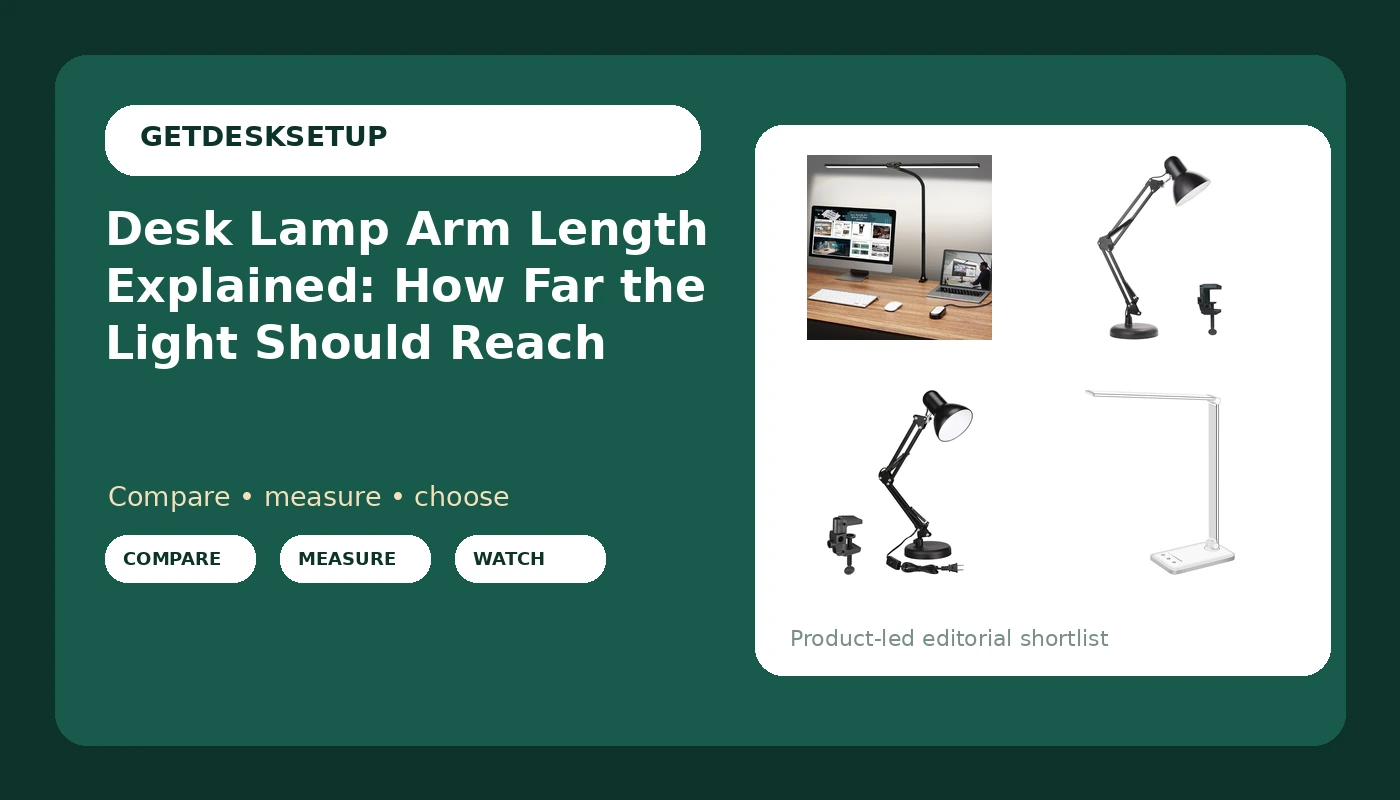
| ShineTech LED Desk Lamp for Home Office | Dual-monitor desks where the clamp sits far back | Flexible gooseneck with a clamp mount and 25 lighting modes |
| Newhouse Lighting NHDK-WR-BK Wright Architect Desk Lamp | Desks that may need a clamp or a freestanding base | 2-in-1 weighted base and clamp mount, swing arm, 5-watt LED bulb included |
| TORCHSTAR Metal Desk Lamp | Buyers who want to choose their own E26 bulb | Adjustable swing arm with a replaceable E26 socket |
| White crown LED Desk Lamp | Narrow desks where the lamp sits beside the keyboard | Dimmable, 5 lighting modes, USB charging port, 30/60 minute timer |
The clamp gooseneck: ShineTech LED Desk Lamp for Home Office
A gooseneck solves a different problem than a jointed arm. It bends continuously, so the head can be brought close to the work and then pushed back without you re-aiming from scratch. That flexibility is also its limit: a gooseneck holds the shape you bend it into, and it will not lock the way a friction joint does. On a dual-monitor desk, plan the clamp first. If the clamp sits on the rear edge, the neck has to cross the space the monitors already occupy, and the light ends up above the screens instead of on the desk. Route the lamp cable along the same path as the monitor cables and bundle both in one cable sleeve, so the arm does not get pulled sideways every time you move the screens.
The two-mount swing arm: Newhouse Lighting NHDK-WR-BK Wright Architect Desk Lamp
A swing arm trades smooth adjustment for repeatable positions. The segments fold against each other when the lamp is parked and open up when you pull the head forward, so the reach you get depends on how far you unfold it. That is also why the mount matters: the same arm covers a shorter horizontal distance from a weighted base sitting on the desktop than from a clamp on the rear edge, simply because the base starts farther forward. If you move a lamp between two desks, the two-mount design is the reason to pick this one. Check your desk edge thickness and the clearance underneath before you commit to the clamp.
The swing arm with a replaceable bulb: TORCHSTAR Metal Desk Lamp
With an E26 socket, the brightness question and the reach question separate cleanly. Desk lamp lumens come from the bulb you install, not from the arm, so you can change the output later without changing the geometry. The arm sets where that light lands, and the bulb sets how much of it there is. That split is useful if you already own bulbs you like, and it is a limitation if you would rather buy a sealed LED fixture with nothing to replace. Either way, judge the lamp by the swing arm and the head first, and treat the bulb as a separate purchase you can adjust later.
The lamp with no reach to plan: White crown LED Desk Lamp
A lamp with a fixed body does not have a reach problem, because you place the whole fixture where the light needs to be. That works on a narrow desk where a clamp will not fit and a swing arm would crowd the monitor. It also means the light source sits close to your hands and near the keyboard, so the head angle and the dimming range do more of the work than any arm does. Keep the base near the desk edge behind the keyboard, and use the USB port for the device you charge most often instead of running a second cable across the desk. A short adhesive clip on the back edge keeps that cable out of the way.
Prices and availability may change. Product images, names, and retailer links are matched to verified listings. No current price, rating, stock status, or measured result is stated here without current evidence.
How desk lamp arm length changes what you see
Reach is a horizontal number, not a diagonal one. A head sitting high above the desk on a long diagonal arm can look generous in a photo, but what matters is how far forward of the mount the head can be positioned while the light still points down at the work. Two measurements decide that: the distance from the mounting point to the first joint, and the length of each segment after it.
Joints are where reach is won and lost. A single-joint lamp sweeps an arc, so pushing the head forward also pulls it sideways unless the base moves. A two-joint arm can fold and unfold, letting the head travel forward while the base stays put. A gooseneck does the same thing continuously rather than in steps. More joints mean more positions and more places for a friction joint to loosen, which is why a lamp that sags after a month is usually a joint problem rather than an arm-length problem.
Arm length also changes the angle the light hits the desk. A head mounted close to the work throws light almost straight down and leaves a hard edge under your hand. A head on a longer arm sits farther away and higher, so the same output spreads over a wider area with softer shadows. Distance has a cost: the farther the head sits from the page, the more output you need to keep the surface bright, which is where desk lamp lumens and arm length stop being separate questions. A task lamp arm length that stops at the keyboard edge will leave the page dark no matter how bright the bulb is.
Measuring reach before you buy
Measure your desk before you read another product page. Three numbers cover most of it: desk depth from the front edge to the wall, the horizontal space your monitors occupy, and where your hands actually work. Reach is the number a desk light arm length figure is trying to describe, and you can produce it yourself in a minute with a tape.
The goal is to know whether the lamp mounts behind the work and reaches over it, or sits beside the work and lights it from the side. Clamp mounts need a rear edge with enough thickness and clearance underneath. Weighted bases need open desktop. Then decide how much adjustment you want, because a lamp with more joints asks for more careful placement and returns more usable positions.
- Measure desk depth in inches from the front edge to the wall or the back edge of the desk.
- Mark where your hands sit when you type, and where a page or notebook sits.
- Measure the horizontal distance from the planned mount point to that mark. That number is your required reach.
- Check the mounting surface: edge thickness for a clamp, clear desktop for a weighted base.
- Count the joints and note whether the head rotates as well as tilts, since a fixed head turns arm length into arm movement.
Placement rules that survive a real workday
- Put the head above and slightly in front of the work, not above and behind it, so your hand does not cast a shadow onto the page.
- Keep the light source out of the screen's reflection path. If you can see the lamp in the monitor when the screen is dark, the arm needs to move or the head needs to turn.
- Run the lamp cable along the arm and down the same route as the monitor cables, and hold both in one cable sleeve or an adhesive clip near the rear edge, or in a short raceway under the desk.
- Tighten the clamp before you load the arm. Clamping after the lamp is extended puts a twisting load on the desk edge.
- Treat the rest of the desk the way you treated the lamp. Measure the footrest angle you actually use, and check mat thickness and mat density before buying a chair mat, because those numbers decide whether the chair rolls freely and whether your feet rest flat. The work lamp arm length you need is a measurement too, and it comes off the same tape.
Which option should you choose?
Choose the ShineTech LED Desk Lamp for Home Office when the lamp has to mount at the rear edge of a deep desk and reach over a dual-monitor setup. Choose the Newhouse Lighting NHDK-WR-BK Wright Architect Desk Lamp when you want one arm that can run either from a clamp or from a weighted base, and you are willing to check your desk edge thickness. Choose the TORCHSTAR Metal Desk Lamp when you already own E26 bulbs and want the arm to be the only thing you are buying. Choose the White crown LED Desk Lamp when your desk is narrow, a clamp will not fit, and you would rather place a whole dimmable fixture beside the keyboard.
One caveat on evidence: the reach figures that matter are the ones you measure on your own desk. Published arm lengths are useful for comparison, but clamp clearance, desk thickness, and monitor depth vary enough that no single number settles the question for every setup.
The bottom line
Desk lamp arm length is the part of the setup you cannot fix later. Brightness you can change with a dimmer or a different bulb, and color temperature you can adjust on most LED fixtures, but a head that cannot reach the middle of your work will keep missing it. Measure the distance from your planned mount point to where your hands work, then pick the lamp whose mount and joints cover that distance with the head angled down. The clamp gooseneck covers rear-edge mounting on a deep desk, the two-mount swing arm covers a desk you rearrange, the E26 swing arm separates the bulb from the geometry, and the fixed LED lamp covers the narrow desk where nothing else fits.