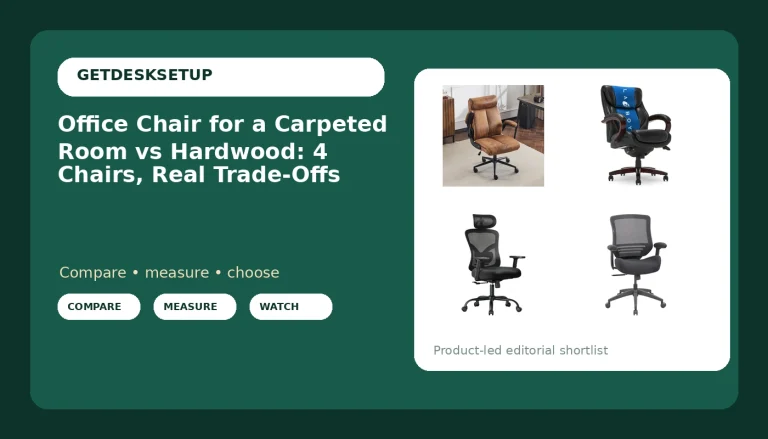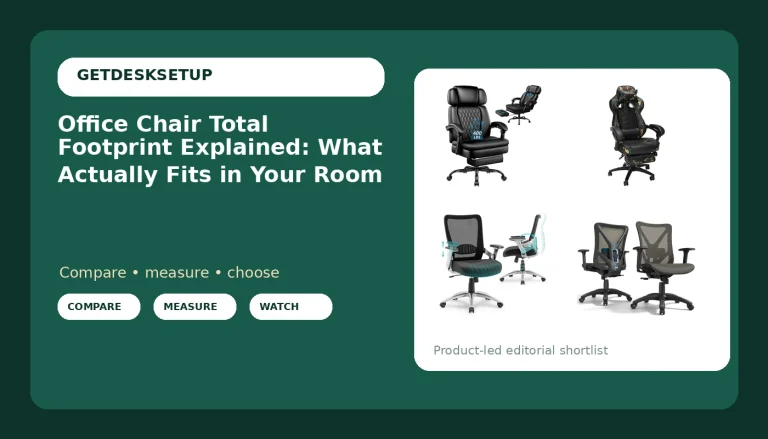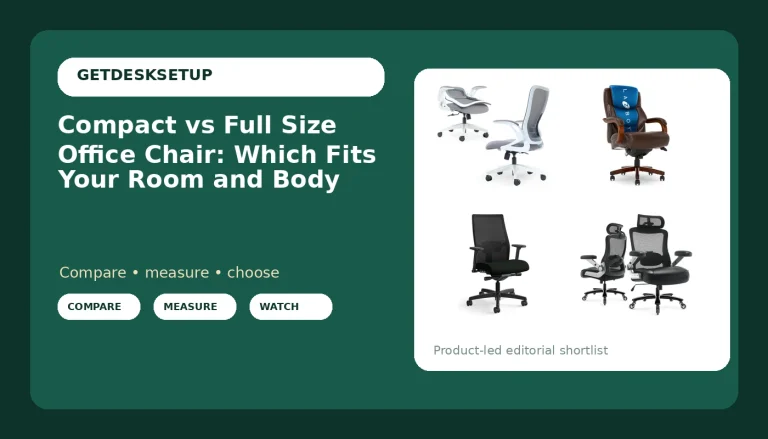
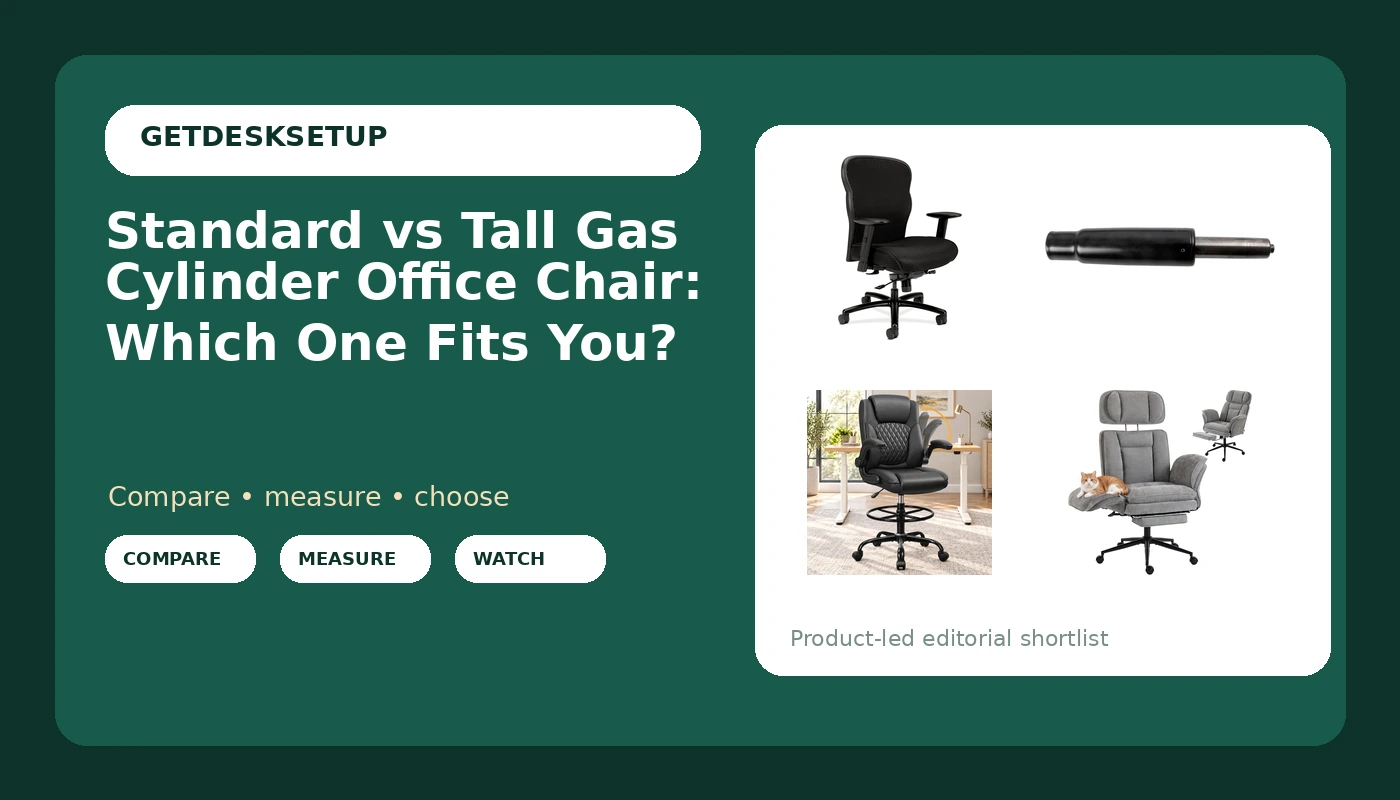
I have replaced more gas cylinders than I have replaced chairs. Nine years buying seating for 400-person floors, then six years fitting home offices two at a time, and the cylinder is still the part that decides whether a chair works at your desk. It is also the part almost nobody reads before buying. So here is the standard vs tall gas cylinder office chair question in plain numbers: what the lift actually changes, what it leaves alone, and which of the four chairs below I would hand to a client.
For anyone at a standard 28 to 30 inch desk, a standard-height cylinder is the right buy, and the HOMCOM Criss Cross is the chair I would start with. That flips the moment your desk sits above 30 inches, or the moment you are past roughly 6'1" and want your feet flat on the floor. At that point you are shopping a tall cylinder, and most chairs on a normal-height base become the wrong shape for you.
Related: Standing Desk Height for Tall Users
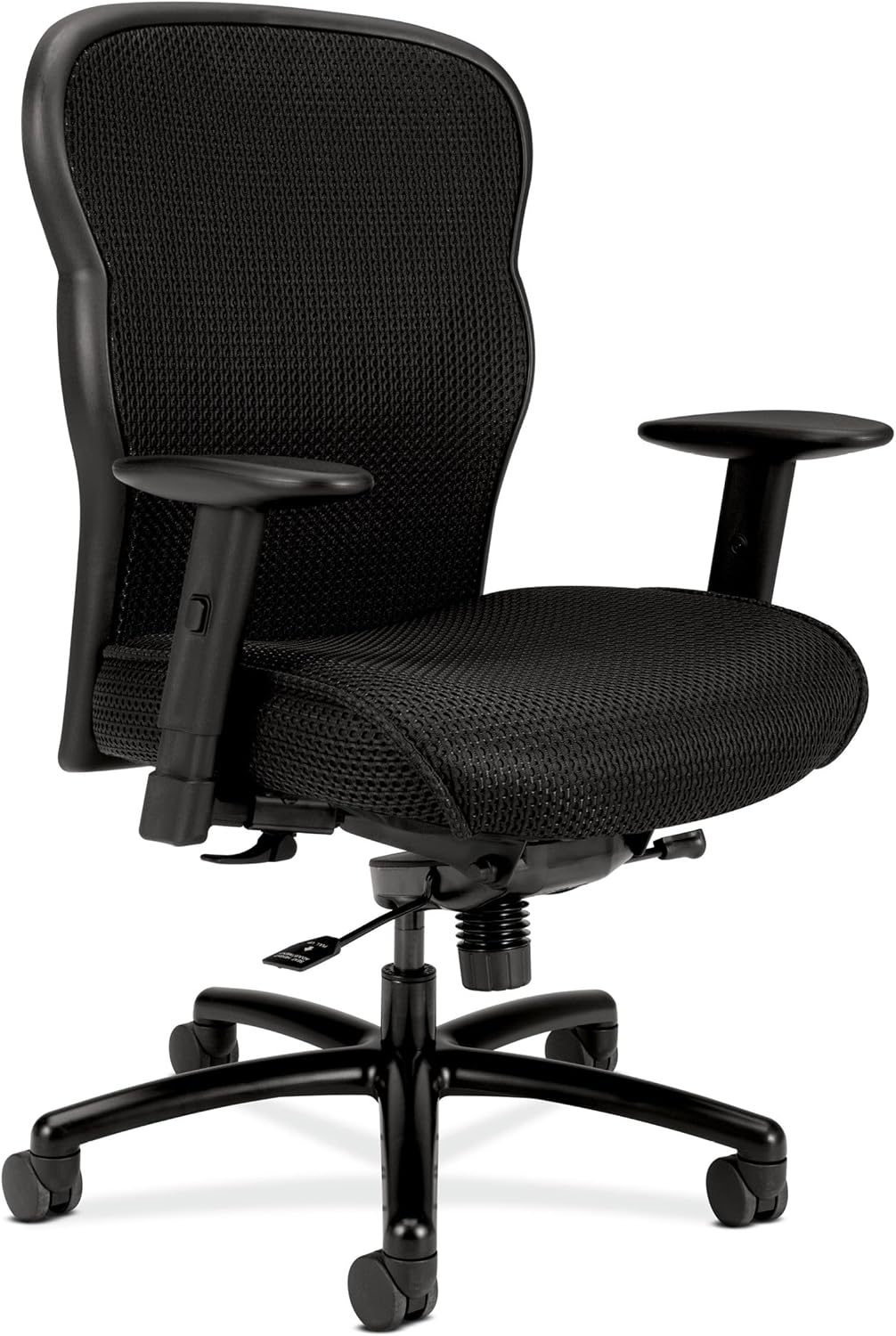
HON Wave Big and Tall Ergonomic Office Chair, Black
The heavy-duty frame I would spec for a large client who refuses to change desks. Big and tall is a frame rating, and this one does not flex when you lean back
The most expensive chair here, and the biggest footprint in the group

AVIMYA Heavy Duty Gas Cylinder Lift Office Home Computer Chair, Standard Head, Black
The reference chair for the standard side of this comparison. Heavy-duty lift, plain geometry, no surprises
Standard head means standard height range. Above a 30 inch desk it is simply the wrong chair
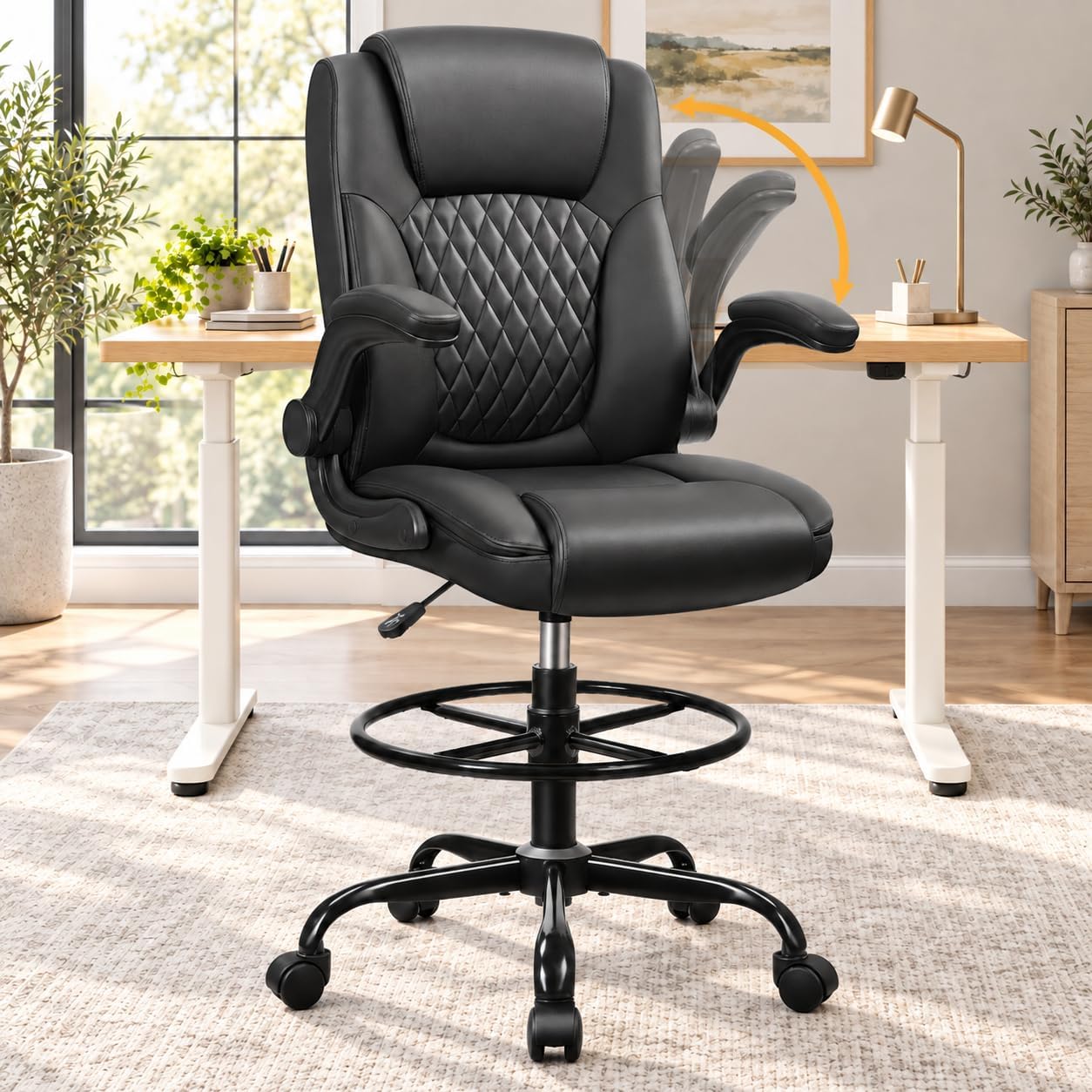
Drafting Chair, Tall Office Chair for Standing Desk Counter Height, Black
Built around a tall cylinder from the start, for counter-height surfaces and standing desks
At a 29 inch desk your feet dangle and your thighs take the pressure
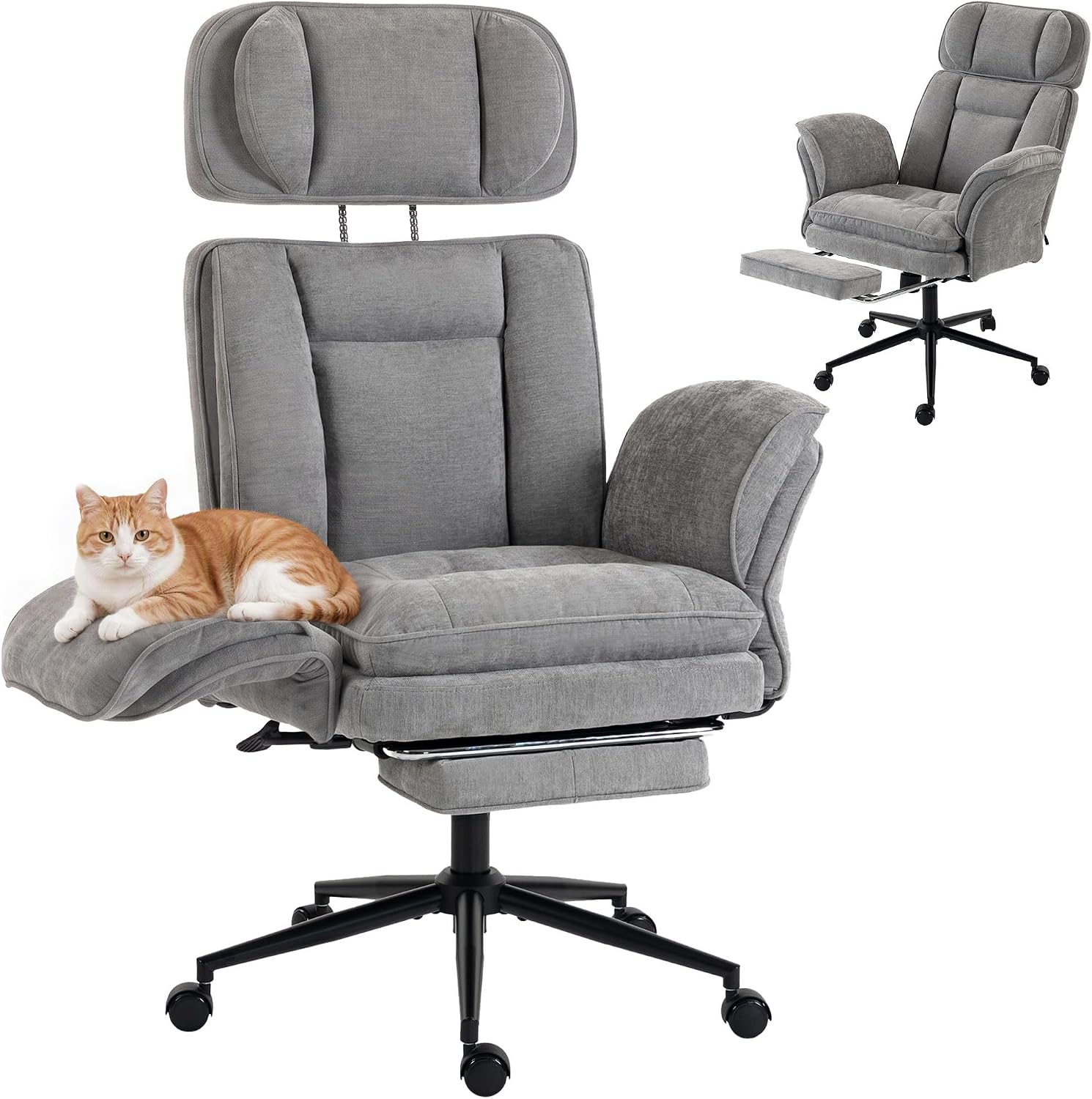
HOMCOM Criss Cross Office Chair, Flip Armrests, Adjustable Headrest, Gray
The most tunable chair in the group. Flip armrests clear a keyboard tray, and the adjustable headrest is the only feature here that scales with torso length
The criss cross footprint is a different animal from a five-star caster base, so check floor clearance
Prices and availability may change.
What the standard vs tall gas cylinder office chair difference actually measures
A gas cylinder is a pneumatic spring with a piston inside a tube. A standard cylinder moves the seat through roughly 16 to 21 inches of height. A tall cylinder moves a similar seat through roughly 24 to 32 inches, and it does that with a longer outer tube and a longer piston, not with spacers stacked under the seat plate. The difference between standard and tall gas cylinder office chair is therefore a shift of the whole chair upward, plus about six inches of extra travel.
That is the entire mechanical story, and it is why I get annoyed at listings that describe a tall cylinder as "more ergonomic." A taller lift is not more ergonomic. It is ergonomic for a taller person or a taller desk, and it is worse for everyone else. Put a 5'6" user on a tall cylinder at a 29 inch desk and their feet leave the floor, their thighs take the front edge of the seat, and their lower back rounds inside twenty minutes.
What the cylinder does not change: seat depth, seat width, the shape of the lumbar support, armrest spacing, recline range, and tilt tension. Those are frame and mechanism decisions. If you search tall gas cylinder office chair vs standard, most results will tell you a tall cylinder raises you higher. They rarely tell you it raises you higher without touching a single number that decides whether your back hurts at hour six.
So the cylinder answers one question only: at what height does your seat sit? Everything else in this article is about the other parts.
Seat height math before you buy
Three measurements, in this order.
Desk height first. Measure from the floor to the top of your desk surface, not to the underside of the frame. A standard fixed desk lands at 28 to 30 inches. Most standing desks travel from about 24 to 50 inches, which means a standing desk can be a standard-height desk whenever you want it to be.
Second, floor to the crease behind your knee, in the shoes you actually wear at the desk. That number plus about an inch is your target seat height. Most adults between 5'4" and 6'0" land somewhere between 16 and 20 inches.
Third, subtract your target seat height from your desk height. If that gap is between 8 and 11 inches, you have room for a keyboard and your forearms sit roughly level. If the gap is under 7 inches, your knees will find the underside of the desk no matter what the cylinder does.
Run the math once and the standard vs tall gas cylinder office chair decision answers itself. If your target seat height is 21 inches or less, buy standard. If it is 24 inches or more, buy tall. Between 21 and 24 you are in the gap, and that is where an adjustable-height desk beats a taller cylinder every time, because you can bring the work surface down instead of pushing the chair up.
The four chairs, and the desk each one belongs under
Here is how each of these lands on the fit question, in the order I would hand them out.
HON Wave Big and Tall Ergonomic Office Chair
The HON Wave is the chair I spec when a client is past 6'2" and past 250 lb and will not change their desk. Big and tall seating is a frame rating, not a cylinder rating, so this is the one here built for a heavier body on a standard-height base. The trade is footprint and money. It is the largest chair in this group and the most expensive, and if you are 5'8" and 150 lb you are paying for capacity you will never use.
AVIMYA Heavy Duty Gas Cylinder Lift Office Home Computer Chair
The name tells the whole story: heavy-duty cylinder, standard head. Heavy duty in a lift means a thicker piston and a higher class rating, which is about how much weight the cylinder holds at height before it sags, not about how high it goes. Standard head means standard geometry, so this belongs under a 28 to 30 inch desk with a user under about 6'1". Above a 30 inch desk, skip it, and stop reading "heavy duty" as a substitute for "tall." Those are two different ratings and listings blur them constantly.
Drafting Chair, Tall Office Chair for Standing Desk Counter Height
A drafting chair is a tall cylinder with a job. This one is aimed at counter-height surfaces and standing desks, which means the seat starts roughly where a standard chair tops out. If you stand for half your day and perch for the other half, this is the correct shape and nothing else here comes close. If you sit for eight hours at a 29 inch desk, this is a footrest problem rather than a chair, and a tall cylinder will not fix it.
HOMCOM Criss Cross Office Chair, Flip Armrests, Adjustable Headrest
The most adjustable chair in the group, and the one I would put at a shared desk. Flip armrests mean the chair slides under a surface that a fixed-armrest chair cannot reach, and an adjustable headrest is the only feature here that changes with torso length instead of leg length. Gray is the only non-black option in this group, which matters if your desk is light oak and you care about that sort of thing. The criss cross frame is a different footprint from a five-star caster base, so measure your floor clearance before you commit.
Seat depth, lumbar support, and the parts a cylinder cannot fix
Seat depth is the number most people never take. Sit all the way back against the backrest, then look at the gap between the back of your knee and the front edge of the seat. You want two to three fingers of space. If the seat edge presses into the back of your knee, the pan is too deep, and no cylinder setting fixes it. If there is a whole hand of gap, the pan is too shallow and your thighs are carrying load the seat should carry.
Lumbar support should land in the small of your back, not at your belt line. On a tall cylinder chair the lumbar pad rides higher relative to the floor, which is exactly why a tall chair with a fixed lumbar curve can be worse for a shorter user than a standard chair with an adjustable one. Adjustable is the word that matters. "Ergonomic" on its own means nothing without a lumbar adjustment you can move.
Frame flex is where big and tall frames earn their money. At the top of its travel, any cylinder puts more leverage on the seat plate, and a standard frame will show that as a slow creak and a little give. If you are heavy, the frame rating matters more than the cylinder class.
Armrest, recline, and tilt tension after the cylinder
Armrests need to be height-adjustable or flip-up. Fixed armrests that sit too high push your shoulders into a permanent shrug, and fixed armrests that sit too low do nothing. Flip armrests solve the keyboard tray case, which is why the HOMCOM gets the nod for shared and small desks.
Recline should move the back independently of the seat, and it should lock. A chair that only tilts as one unit slides your hips forward as you lean, which is how you end up sitting on your tailbone by 4 p.m.
Tilt tension is the knob under the seat. Heavier users need more tension, lighter users need less, and if the adjustment range does not cover your weight the chair either slams back or refuses to move at all. Test it in the first week while the return window is open.
One tall-chair note: at tall seat heights, recline geometry changes because your feet may not be planted. A foot ring or a footrest turns a tall chair from a perch into something you can actually lean back in for an hour.
Headrest and caster details that change with height
A headrest is only useful if it adjusts. A fixed headrest on a tall chair tends to land behind your neck or above your skull, which is worse than no headrest. This is the quiet argument for the HOMCOM over the rest of the group if you recline often.
Casters matter more the higher you sit. Two-inch casters are fine on carpet. On hardwood you want soft polyurethane wheels or a chair mat, because a tall chair on hard small wheels skates when you push back. And because a tall cylinder raises your center of gravity, a wider base is worth having. If you are swapping a cylinder yourself, remember that a tall cylinder often wants a foot ring and sometimes a different base, so buy the pair together.
Who should skip which chair
Skip the HON Wave if you are under 5'10" and under 200 lb. You are buying frame capacity you will not use, and the footprint will crowd a small room.
Skip the AVIMYA if your desk top is above 30 inches. A standard head on a heavy-duty cylinder is still a standard head. Heavy duty is a weight rating, not a height rating.
Skip the Drafting Chair if you sit for full days at a normal desk. It is the right chair for counter height and the wrong chair for a 29 inch surface, and no amount of leaning will change that.
Skip the HOMCOM if you need a five-star rolling base for a large home office, or if you want black to match a dark setup. It is the most adjustable chair here, not the most mobile.
Assembly notes from real installs
Order matters. Casters into the base first, base flat on the floor, cylinder dropped into the base, then the seat lowered onto the cylinder, then sit on it so your body weight seats the taper. Never hammer the cylinder into the seat plate. The taper seats with weight, and a hammer is how you crack a seat plate on a the quoted price chair.
If you are replacing a standard cylinder with a tall one, measure the old tube length before you order. The taper diameter is broadly standard, but tube length is not, and a tall tube will not fit a shallow base collar.
On a tall cylinder, tighten the seat plate bolts in a cross pattern and check them again after a week. A taller lift puts more leverage on those four bolts, and a chair that felt solid on day one can develop a rock by day ten.
Standard or tall gas cylinder office chair: the short answer
Choosing standard or tall gas cylinder office chair comes down to two numbers: your desk top height and the floor-to-knee-crease measurement. Desk at 28 to 30 inches and you under about 6'1": buy standard. Desk above 30 inches, or you past 6'1" with long lower legs: buy tall. Sitting in the middle between 21 and 24 inches of target seat height: buy an adjustable desk before you buy a taller chair, because the desk is the cheaper fix.
The four chairs here cover the range. The AVIMYA is the standard-cylinder reference. The HON Wave is the big and tall frame on a standard base. The Drafting Chair is the tall cylinder. The HOMCOM is the adjustable, shared-desk option with the headrest that moves.
Related: Office Chair Gas Cylinder Replacement Guide
A chair either fits your body or it does not, and the cylinder is only half of that sentence. Measure the desk, measure the crease behind your knee, then buy the lift that puts the seat where the math says it goes.