I have measured seat depths and desk heights in 310 home offices around Seattle, and the wrist rest question comes up in almost every build. The mesh vs foam wrist rest debate sounds like an argument about materials. It is not. It is a height argument with a surface finish on top, and once you separate those two things the choice gets simple. Get the height right and the material disappears under your hands. Get it wrong and you will feel it in your forearm by Thursday, no matter what the product page promises.
Related: How to measure wrist rest height against your keyboard
The short answer: for a standard keyboard on a standard desk, a foam or gel-foam rest is the safer pick, and all four sets below are variations on that idea. A mesh cover is worth paying for only if your hands run hot and you accept a firmer, less forgiving surface.
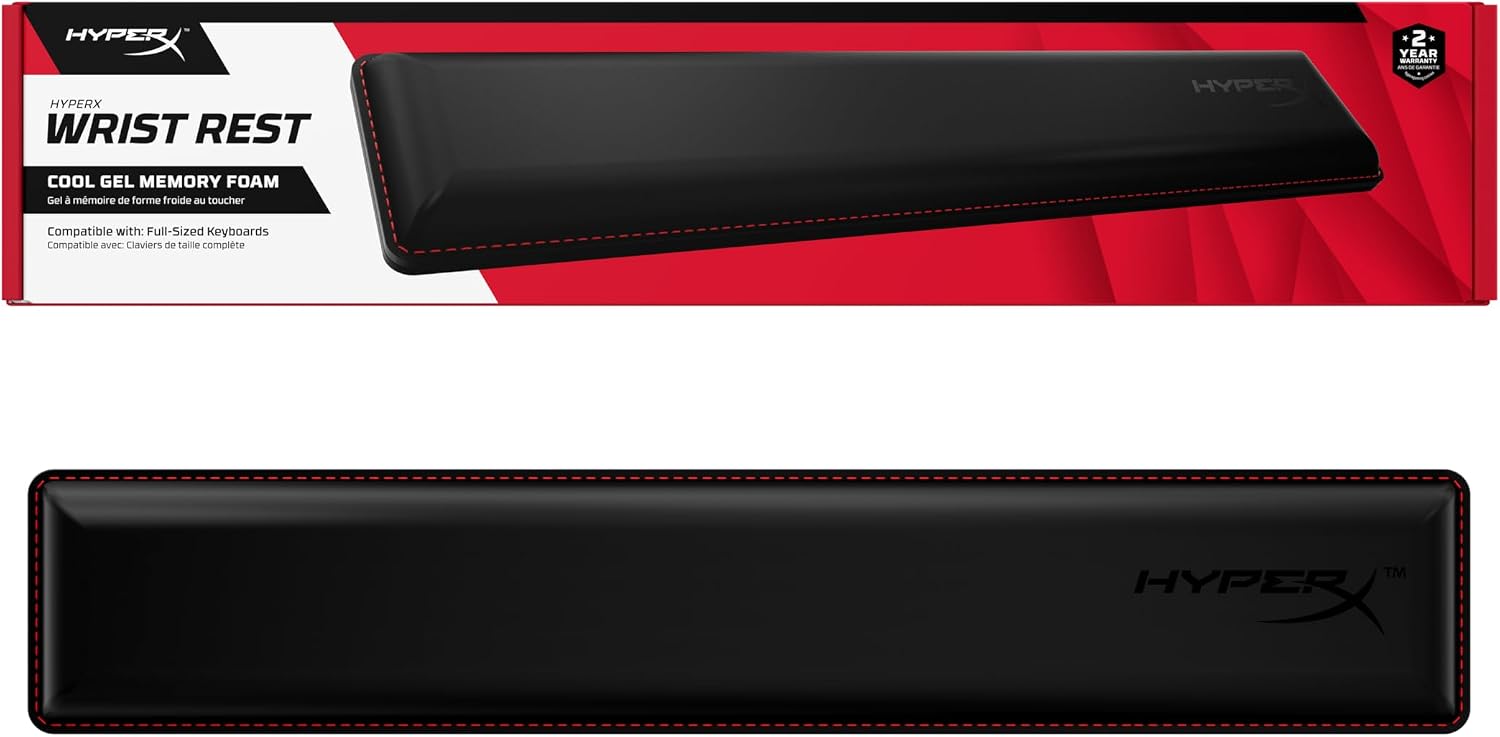
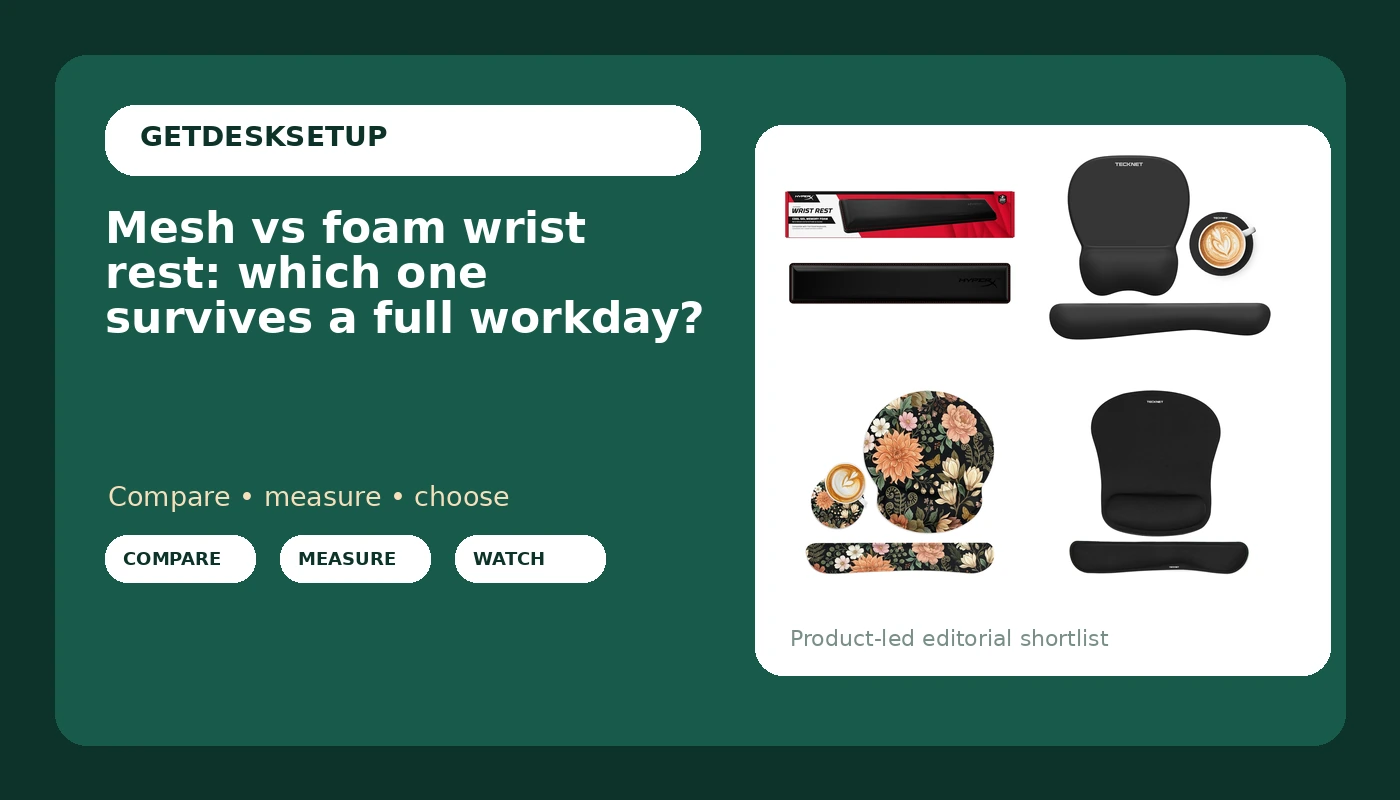
HyperX Wrist Rest, full sized
Full width coverage for a keyboard with a number pad, gel layer over memory foam, anti-slip base
Cut for full-size boards, so it overhangs a TKL or 60 percent keyboard
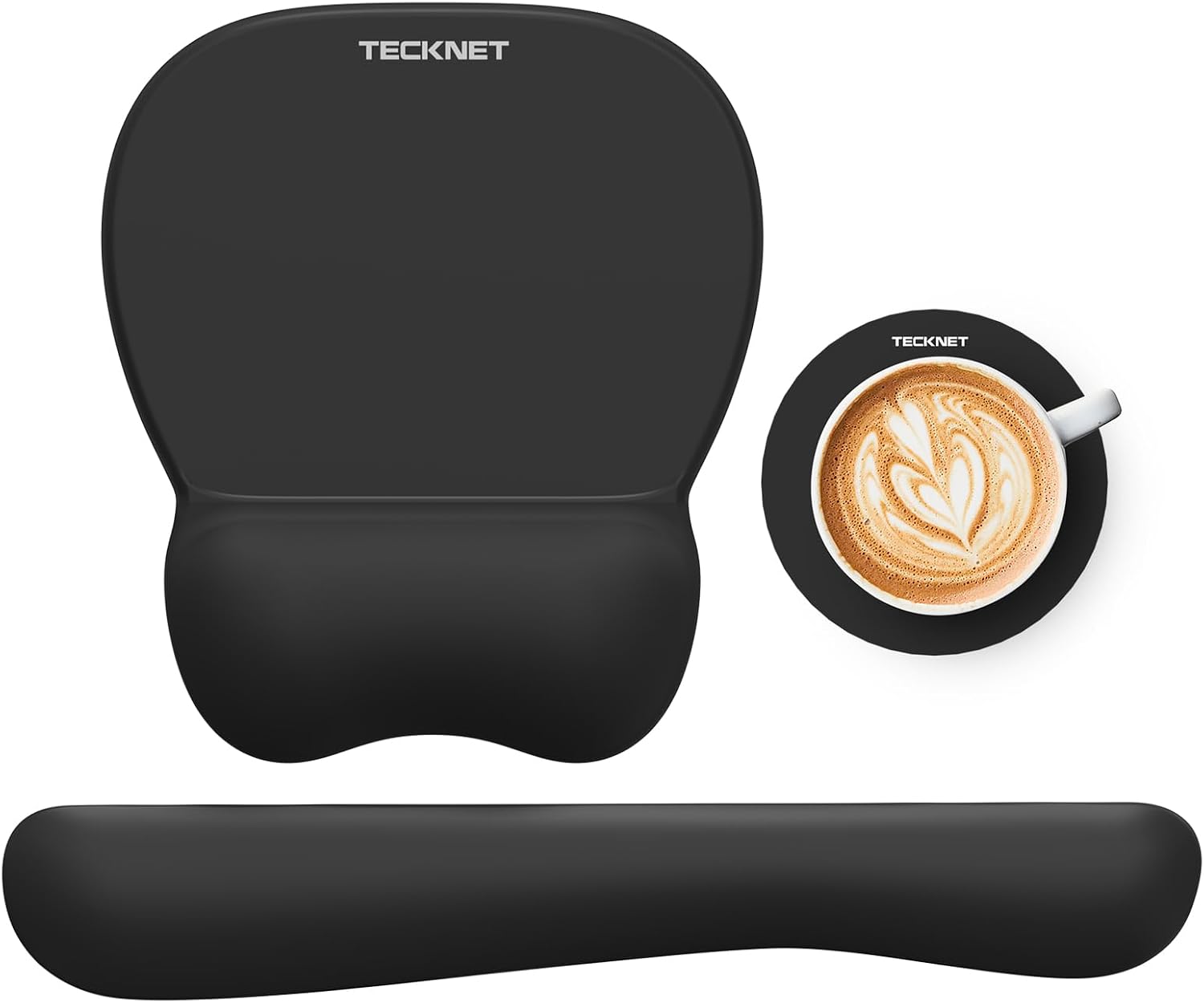
TECKNET Gel Ergonomic Mouse Pad & Keyboard Wrist Rest & Coaster
Gel support under both hands plus a coaster, three pieces in one box
Three separate items to keep aligned, and the mouse pad is a wrist-rest shape rather than a wide surface

Britimes Ergonomic Mouse Pad Set with Wrist Rest, Floral Flower
Mouse side support with a printed cover that gives the desk some color
No keyboard rest in the box, and the floral print is not a neutral look
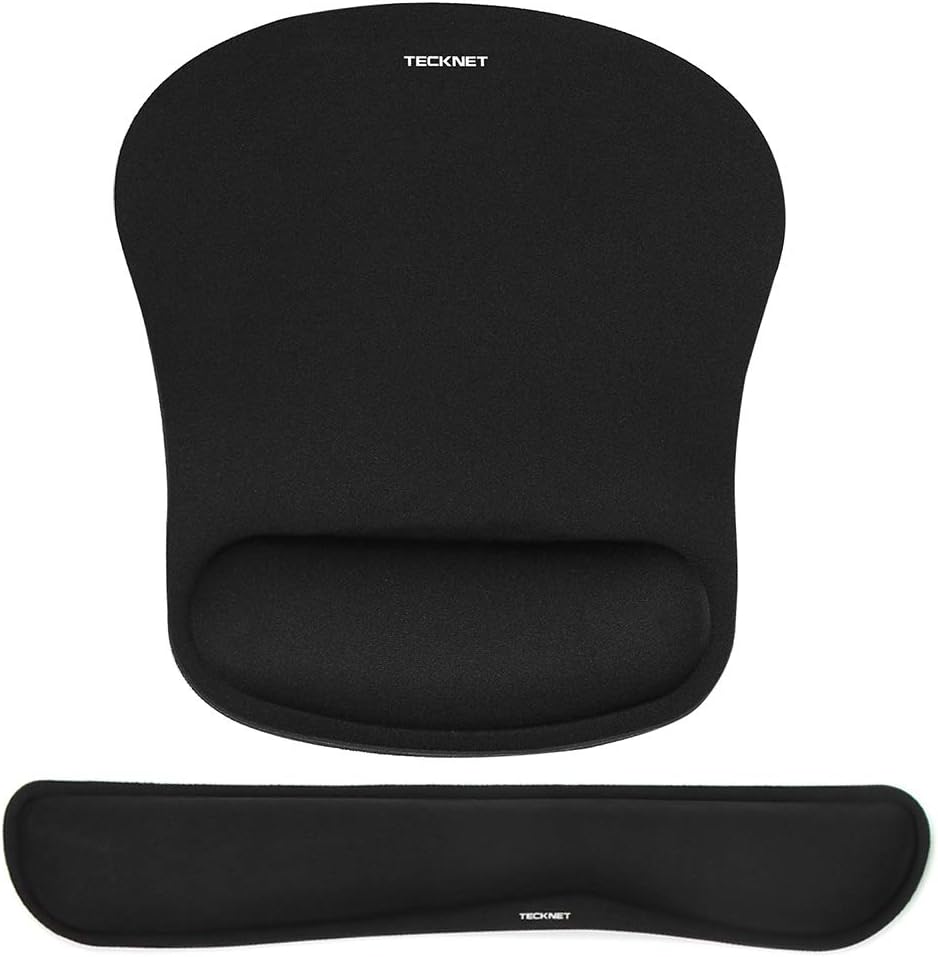
TECKNET Keyboard Wrist Rest and Mouse Pad Set with Wrist Support
Keyboard rest and mouse pad with support in one purchase, both hands at matching height
One purchase covers both hands, so a compact keyboard leaves the keyboard rest too long
Prices and availability may change.
What mesh vs foam wrist rest actually changes
Mesh and foam are not two materials competing for the same layer. Almost every product sold as a mesh wrist rest is a foam or gel core with a woven cover bonded over it. The core does the supporting. The cover does the breathing. When people argue about mesh vs foam wrist rest, they are usually arguing about the cover and calling it the core.
Here is what actually changes when you swap a solid surface for a woven one:
Heat. A woven cover lets air move across the contact patch and carries some moisture away. A solid foam or gel surface traps heat between your wrist and the pad. In a Seattle winter that is a feature. In a warm room in August with no AC, it is the reason people go looking for mesh in the first place.
Break-in. Foam compresses and stays compressed where your wrist sits. Mesh over foam does the same thing, but the fabric hides the divot, so you notice it later rather than not at all. Neither material recovers fully.
Drag. Skin on mesh has more drag than skin on smooth gel or coated foam. If you slide your wrist along the rest as you reach for the mouse, drag is annoying. If you plant your wrist and pivot, drag is harmless.
Cleaning. Foam and gel wipe clean with a damp cloth. Mesh holds oils, dead skin, and coffee at the weave level, where a wipe does not reach.
Seams. A woven cover has a bonded edge, and that edge is where the cover fails first. A solid foam slab has no cover to delaminate.
The difference between mesh and foam wrist rest products is mostly the surface layer, not the support layer. So the decision you should actually be making is about the core: how thick it is, how dense it is, and how high the top surface sits relative to the front row of your keys.
That last number is the only one that changes your posture. A rest that is too tall lifts your wrist above the key plane, so you type with your hand bent back. A rest that is too low does nothing except collect dust. The rule I use on client desks: the top of the rest should sit level with the top of the front row of keycaps, within a few millimeters either way. I cannot give you one number for that, because it depends on your keyboard case height, whether the board sits on a tray, and how tall the keycaps are. Measure the front edge of your keyboard, then compare that to any rest before you buy.
A foam wrist rest vs mesh cover is a fair fight only when the two rests are the same height and the same density. Otherwise you are comparing a height difference and blaming the fabric.
What I check before a rest goes on a client desk
Six things, in this order.
Height relative to the keyboard. Covered above, and it is first for a reason. Everything else is secondary.
Footprint. A full-width rest matches a full-size keyboard with a number pad. A TKL or 60 percent board needs a shorter rest, or you get overhang on both sides, and overhang is where the cover peels. Mouse-side support is a separate purchase in most of the sets below.
Core thickness and density. Mat thickness tells you how far your wrist travels before it finds support. Mat density tells you whether the rest still looks like a rest after a year. A thick low-density slab pancakes into a permanent dip in a month. It is the same check I run on a chair cushion before I look at the fabric.
Base grip. An anti-slip base is not a marketing line. A rest that creeps forward three millimeters a day ends up under the monitor by Friday, and you shove it back without looking, which is a motion you repeat a thousand times a year.
Coverage. Keyboard only, mouse only, or a set. Buy one piece at a time and you end up with two surfaces at two heights, and the mouse side will be the wrong one.
Who it excludes. Every rest on this list is wrong for somebody. If your keyboard sits on a tray below elbow height, or on a standing desk pushed to full height, the fix is the keyboard position, not the rest.
That last point is where the mesh vs foam wrist rest question keeps returning. People buy a rest to correct a wrist angle that the keyboard height created. A wrist rest supports the heel of your hand between keystrokes. It does not lower the keyboard.
The four rests
HyperX Wrist Rest, full sized
The listing describes a cooling gel layer over memory foam, a full-size footprint, and an anti-slip base, in black. Take those three claims one at a time. Full size means it is cut for a keyboard with a number pad, so if you type on a TKL or a 60 percent board, skip it, because the rest will be wider than the board and the ends will rest on the desk at a different height than the middle. The cooling gel is a surface feel, not a cooling system: gel moves heat away from the contact patch a little faster than plain foam for the first stretch of a session, then it equalizes with the room like everything else. The anti-slip base is the claim I care most about, because a full-width rest has more leverage to walk than a small one.
Who should skip it: anyone on a compact keyboard, and anyone who wants keyboard and mouse support from a single purchase, because this covers the keyboard only. Visit on Amazon
TECKNET Keyboard Wrist Rest and Mouse Pad Set with Wrist Support
This is the one-box answer for a full-size keyboard and a mouse sharing a surface. The set pairs a keyboard wrist rest with a mouse pad that has its own wrist support, which means both hands land at the same height instead of one hand resting on a bare desk. That matching height is the whole argument for buying a set rather than two unrelated pieces.
The trade-off is length. A keyboard rest sized for a full-size board is too long for a TKL or compact keyboard, so if you downsized the board and not the accessories, skip this one. The mouse pad in a set like this is built around a wrist bulge, so if you play at low sensitivity and need a wide, flat surface, this is the wrong shape. Visit on Amazon
TECKNET Gel Ergonomic Mouse Pad & Keyboard Wrist Rest & Coaster
Three pieces: a gel mouse pad, a keyboard wrist rest, and a coaster. The coaster is a small thing, but it is the kind of small thing that keeps a drink off the desk surface where your keyboard cable runs, and I will take it. The gel surface is the same idea as the gel layer on the HyperX rest, applied to both hands.
Three pieces is also the downside. Three loose items move independently, and the coaster will migrate to wherever you set your mug. If you want one object to keep aligned, skip this. If you want both hands supported and you do not mind straightening up once a week, it covers more of the desk than the mouse-only set below. And if you use a large cloth pad for low-DPI work, this is not that: a gel pad with a wrist bulge is a different product class. Visit on Amazon
Britimes Ergonomic Mouse Pad Set with Wrist Rest, Floral Flower
Mouse side only, with a printed floral cover. On a desk that is otherwise black plastic and grey laminate, a print is a legitimate reason to buy a pad, and I have stopped pretending otherwise with clients. The wrist rest is built into the mouse pad, so your mouse hand gets support and your keyboard hand gets nothing.
Skip it if you want keyboard support from the same purchase, because there is none in the box, or if you need a neutral look for a shared or client-facing room. Skip it too if you want a wide low-sensitivity mouse surface, for the same shape reason as the gel pad above. Visit on Amazon
Trade-offs I would tell a client about
All four of these are foam or gel products, so the mesh vs foam wrist rest question is mostly academic at this category and this size. If you specifically want a woven cover, you are shopping a different set of products, and you should expect to pay for the cover and give up some give in return.
Ranked by how much desk they cover: the HyperX rest spans the keyboard on a full-size board. The TECKNET set covers both hands. The TECKNET gel trio covers both hands plus a coaster, in three pieces. The Britimes set covers the mouse hand only.
Ranked by how likely they are to still look right in a year: solid foam and gel surfaces first, mesh covers last, and the bonded edge on a cover is the failure point either way.
Ranked by risk of buying the wrong size: the two full-width keyboard rests, because both assume a number pad.
The rest of the desk: cable management, footrest angle, and light
A wrist rest is one part of a system, and the other parts change how well it works.
Cable management first, because a keyboard cable that tugs on the board drags the rest out of position all day. Route the keyboard and mouse cables through a raceway under the desk lip, or bundle the run to the wall in a cable sleeve, and put an adhesive clip on the back edge of the desk so the slack has somewhere to sit. If the cable pulls, the rest moves, and you will not notice until your wrist angle has already changed. More on that in under-desk cable management for standing desks.
Footrest angle next. If your feet are not planted, your pelvis rotates, your shoulders follow, and your forearms land on the rest at an angle instead of flat. A footrest set at a shallow angle is a cheaper fix for that chain than a new chair.
Light last. If you cannot read the legends on your keys without leaning in, you are changing your wrist angle just to see, and no rest fixes that. The desk lamp lumens figure matters more than the shape of the lamp: for a dark room I look for something rated around 400 to 500 lumens at the work surface, then I turn it down in the morning. That is the same logic as the rest itself. Fix the measurement that changes posture, ignore the finish until the measurement is right.
The rule I use for mesh or foam wrist rest
Here is the decision in four lines.
If your hands run hot, or you work in a room that gets above 80 degrees without AC, buy a mesh cover and accept the firmer feel. If you want the longest-lived and easiest-to-clean surface, buy solid foam or gel. If you have no strong preference, buy foam, because foam gives you more height options and height is the thing that changes your posture. And if your keyboard is not already at the right height, fix that before you spend anything on a rest, because no surface material compensates for a keyboard sitting four inches too high.
One check before you buy: measure the front edge of your keyboard, measure the rest you are considering, and pick the one that puts the top of the rest level with the front row of keys. That single measurement beats every material argument in this article.
The honest closing
Would I put these on a client desk for a year? The full-size gel rest for a full-size keyboard, yes. The keyboard and mouse set, yes, if the board has a number pad. The gel trio, yes, for someone who wants both hands supported and does not mind three pieces. The floral mouse pad, yes, on a desk that wants a print. What I would not do is buy any of them to fix a keyboard that sits too high, and I would not buy a mesh cover expecting it to feel like foam, because it will not.