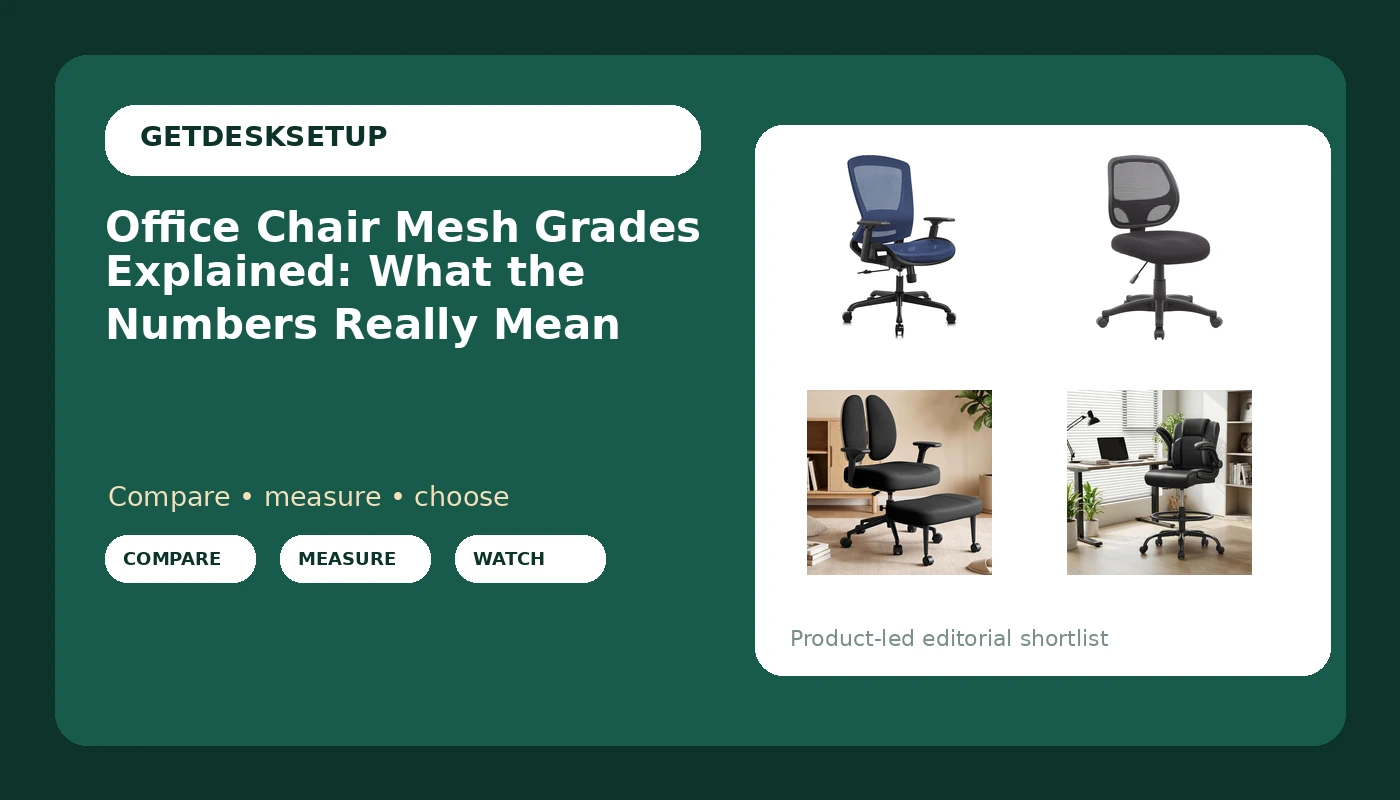
Mesh is the one chair material sold on a number almost nobody publishes. A listing will say "grade A mesh" or "commercial grade mesh" and never explain what the weave, the frame, or the tension does to your back at hour six. Office chair mesh grades, in practice, describe three separate things: how the mesh is woven, how tightly it is tensioned across the back frame, and how that frame is built. This page separates those three, then applies them to four chairs at different price points, so you can choose on seat height, seat depth, and lumbar support instead of on a label.
Related: How to measure seat depth for a home office chair →
Quick answer
There is no shared industry scale behind the words "grade A mesh" or "commercial grade mesh." Those phrases describe one brand's weave and thickness, not a universal rank, so they cannot be compared across listings. What does compare across listings is structure: a certified frame, an adjustable lumbar support, and an armrest you can set to your own elbow height. The mesh itself mostly decides breathability and how the back edge feels against your shoulder blades. No chair here is called the best, the most durable, or the safest, because the available evidence in these listings does not support that distinction.
Four useful options
| Model | Best fit | What stands out |
|---|---|---|
| ELABEST Ergonomic Mesh Office Chair,Comfy Computer Desk Chair – BIFMA 5.1 Certified Commercial Swivel Task Chair for Home Office – Adjustable Lumbar Support & Armrests,Tilt Function,Wide Seat | Full workdays at a fixed desk | BIFMA 5.1 certified build with adjustable lumbar support and armrests, plus a tilt function |
| Boss Office Products Commercial Grade Mesh Task Chair with Lumbar Support in Black | First mesh chair on a tight budget | Commercial grade mesh back with lumbar support in a plain task chair shape |
| Criss Cross Office Chair – Ergonomic Cross Legged Office Chair with 3D Armrest &Dual Back Support – Wide Desk Chair with Stretchable Rotating Footrest for Yoga Kneeling Meditation Home Office | Changing posture through the day | 3D armrests, dual back support, and a stretchable rotating footrest |
| Drafting Chair, Tall Office Chair for Standing Desk, 500Lbs PU Leather Ergonomic Chair with 90 °Flip-up Armrests, Adjustable Foot Ring & Height, for Home, Drawing, or Counter Use(Matte Black) | Standing desks, counters, and drafting tables | Tall frame with an adjustable foot ring, 90 degree flip-up armrests, and a 500 lb rating |
The certified mesh task chair: ELABEST Ergonomic Mesh Office Chair,Comfy Computer Desk Chair – BIFMA 5.1 Certified Commercial Swivel Task Chair for Home Office – Adjustable Lumbar Support & Armrests,Tilt Function,Wide Seat
Certification is the part of this listing worth reading twice. BIFMA 5.1 covers structural testing of the chair, not the feel of the mesh, so it tells you the frame and base were tested to a commercial standard. What it does not tell you is whether the seat depth matches your thigh length. Set the lumbar support first, then the armrest height, then the seat height, and leave tilt tension for last. A wide seat is pleasant for long sittings and awkward in a small room, so measure your floor space before you commit. If you are still sorting out how the seat should fit, how to measure seat depth for a home office chair covers the tape measure version of this decision.
The budget mesh task chair: Boss Office Products Commercial Grade Mesh Task Chair with Lumbar Support in Black
At the entry end, the mesh back is doing most of the work. With a fixed lumbar curve, the shape of the back has to land in the right place on your spine without help, which is why the tape measure matters more here than on any other chair on this page. This is also the class where the caster and base show the savings first, because that is where the cost came out. Check the base and the casters at assembly, before you sit down, and confirm the seat height range against your own desk rather than against the average. If your measurement puts you at either end of the usual range, spend the difference on the certified chair instead.
The cross-legged option: Criss Cross Office Chair – Ergonomic Cross Legged Office Chair with 3D Armrest &Dual Back Support – Wide Desk Chair with Stretchable Rotating Footrest for Yoga Kneeling Meditation Home Office
Cross-legged chairs solve a real problem, which is that a standard task chair offers one posture and most bodies want five. The trade-off is footprint and structure. A wide seat with a rotating footrest takes more floor space than a task chair, the footrest is one more mechanism to check at assembly, and this shape is not sold around a commercial certification the way a task chair is. If you spend nine hours a day in one posture and share the office with someone else, a conventional mesh task chair is the safer shape. If you genuinely change position all day and have the room, this is the one that lets you do it.
The tall option: Drafting Chair, Tall Office Chair for Standing Desk, 500Lbs PU Leather Ergonomic Chair with 90 °Flip-up Armrests, Adjustable Foot Ring & Height, for Home, Drawing, or Counter Use(Matte Black)
A tall chair is the right answer at a standing desk when you want to sit at standing height instead of dropping the desk. The foot ring matters more than the seat in that setup, because at drafting height your feet will not reach the floor and a ring gives them somewhere to land, which is what keeps your knees near a right angle. The flip-up armrests let the chair tuck under a counter when you are not using it. Two limits worth stating: PU leather does not breathe the way an open mesh weave does over a long afternoon, and a tall chair is the wrong pick for a shared desk where the second user is much shorter. If wobble at standing height is your other concern, the same test applies to the desk as to the chair.
Prices and availability may change. Product images, names, and retailer links are matched to verified listings. No current price, rating, stock status, or measured result is stated here without current evidence.
What office chair mesh grades actually describe
Office chair mesh grades come down to three properties, and only one of them is the mesh itself. The first is the weave: an open weave passes more air and feels softer at the edge, while a tighter weave holds its shape longer and feels firmer against your back. The second is tension, which is how tightly the panel is stretched across the back frame. A well tensioned panel flexes under load and returns; a loose one bottoms out against the frame behind it, which is the sensation people describe as a back that has gone flat. The third is the frame: the curve of the back, the material it is molded from, and how the mesh is attached to it. That attachment point is where sag usually starts.
This is also why desk chair mesh grades cannot be compared between brands. There is no body publishing a scale, so "grade A" from one seller and "grade A" from another can describe entirely different weaves. Task chair mesh grades rarely appear on a spec sheet at all, which is why the useful comparisons sit elsewhere: adjustable lumbar support, tilt tension, seat height range, seat depth, armrest adjustment, whether there is a headrest, and what kind of caster the base uses. Ergonomic chair mesh grades matter less than the lumbar mechanism behind the mesh, because a mediocre weave on a well shaped back beats a premium weave on a flat one.
How to choose mesh that fits your measurements
Measure first, then shop. The order below is the order I use on every chair that comes through a build, and it takes about ten minutes with a tape measure and a wall.
- Measure your seat height. Sit with your feet flat and your knees near a right angle, then measure from the floor to the crease behind your knee. That number, not your height, is the seat height the chair has to reach.
- Measure your seat depth. Take the distance from the back of your knee to the back of your hip, then subtract an inch or two so the seat edge does not press behind your knee.
- Check that the lumbar support adjusts rather than merely exists. A fixed curve only fits one spine length, and if it is not yours, nothing else on the chair will fix it.
- Set the armrest so your elbows rest at roughly 90 degrees without lifting your shoulders, and confirm the armrest actually moves to that position.
- Adjust recline and tilt tension last, then check the caster and base with the chair unloaded before you sit down.
Practical guidance for a home office
- Match the chair to the desk, not the reverse. Confirm the seat height range clears your desktop height before you buy either piece.
- Give a wide or cross-legged chair extra floor space. A rotating footrest needs room to swing, and a wide seat needs clearance from a wall or a drawer unit.
- At a standing desk, budget for a foot ring rather than a footrest. Feet that reach nothing are what makes tall sitting fail.
- If a mesh back looks tired but the base and casters are sound, replace the casters before you replace the chair.
- Dust lives in the weave. A vacuum brush once a month keeps an open mesh panel from looking grey at the edges.
Which option should you choose?
Choose the ELABEST Ergonomic Mesh Office Chair,Comfy Computer Desk Chair – BIFMA 5.1 Certified Commercial Swivel Task Chair for Home Office – Adjustable Lumbar Support & Armrests,Tilt Function,Wide Seat when you want a certified mesh task chair with adjustable lumbar support and armrests for full workdays. Choose the Boss Office Products Commercial Grade Mesh Task Chair with Lumbar Support in Black when the budget is the hard constraint and you have already confirmed your seat height and seat depth. Choose the Criss Cross Office Chair – Ergonomic Cross Legged Office Chair with 3D Armrest &Dual Back Support – Wide Desk Chair with Stretchable Rotating Footrest for Yoga Kneeling Meditation Home Office when you want to change posture through the day and have the floor space for a wide seat. Choose the Drafting Chair, Tall Office Chair for Standing Desk, 500Lbs PU Leather Ergonomic Chair with 90 °Flip-up Armrests, Adjustable Foot Ring & Height, for Home, Drawing, or Counter Use(Matte Black) when you sit at standing height and need a foot ring rather than a mesh back.
None of these listings publishes a mesh grading scale, a seat depth in inches, or a measured height range in the product name, so the final check is your own tape measure against the full specification table on the listing page.
The bottom line
Office chair mesh grades explained in one sentence: the grade language is marketing, and the adjustability is the specification. A weave decides breathability and how the back feels, but it does not decide whether the chair fits you. Seat height, seat depth, and an adjustable lumbar support do that, and a certified frame is what keeps them working past the first year. Measure yourself, pick the shape that matches how you actually sit, and treat every mesh label as a description rather than a ranking.